Infrared saunas used to be a $3,000-to-$6,000 commitment. Brands like Sunlighten and Clearlight still charge that much, and for good reason. They use premium wood, third-party tested low-EMF heaters, and thick construction that holds heat well. But not everyone has that kind of budget, and the market for infrared saunas under $1,500 has grown fast over the past few years. See our top picks in best red light therapy panels for home use.
Our evaluation process: We cross-referenced each product against EWG databases, confirmed active certifications with issuing organizations, and reviewed available test reports. See our methodology The problem is that budget saunas cut corners. That’s how they hit a lower price point. Our team at NonToxicLab finds the question is whether those corners matter for your health and safety — specifically EMF levels and wood quality — or whether they’re just cosmetic tradeoffs you can live with. For specific product picks, check best sauna blankets for home.
I spent three months researching the budget infrared sauna market, talking to people who own these units, reading EMF test results from independent reviewers, and comparing wood quality and construction across brands. Some of the cheap options are genuinely fine. Others are not worth the savings.
Quick Picks: Best Budget Infrared Saunas
| Sauna | Best For | Price | Type | Capacity |
|---|---|---|---|---|
| Dynamic Barcelona | Best Overall Budget | $1,099 | Cabin | 1-2 Person |
| SereneLife Portable | Best Portable | $260 | Portable Tent | 1 Person |
| Radiant Saunas BSA2406 | Best for Two | $1,299 | Cabin | 2 Person |
| Durasage Portable | Most Affordable | $180 | Portable Tent | 1 Person |
| Dynamic Andora | Best Build Quality | $1,399 | Cabin | 2 Person |
What Budget Infrared Saunas Actually Cut
Every manufacturer that sells a sauna under $1,500 is making tradeoffs somewhere. Understanding where those cuts happen lets you decide which ones you can accept.
Wood Quality
Premium saunas use western red cedar, which is naturally rot-resistant, hypoallergenic, and smells incredible. It also costs significantly more than other options. Budget saunas typically use Canadian hemlock or basswood. Hemlock is a perfectly fine softwood that’s light, doesn’t off-gas at sauna temperatures, and handles moisture reasonably well. Basswood is similar but slightly softer.
The concern with cheaper wood isn’t toxicity. It’s durability. Hemlock will last years with proper care, but it’s more prone to warping and moisture damage over time compared to cedar. Some ultra-budget saunas use plywood panels with a veneer, which is where things get dicey. Plywood contains adhesives that can off-gas formaldehyde, especially when heated. If a sauna doesn’t specify solid wood construction, ask before buying.
Dr. Rhonda Patrick has discussed the benefits of heat therapy extensively, noting that the sauna itself needs to be clean enough that you’re not inhaling volatile organic compounds while trying to improve your health. A sauna made with formaldehyde-emitting materials defeats the purpose.
EMF Levels
This is the big one. EMF (electromagnetic field) exposure is the most significant safety difference between budget and premium infrared saunas.
All electrical devices produce EMF, but you’re sitting inside a sauna for 20 to 40 minutes at a time, surrounded by heating elements on multiple sides. The distance between you and the heaters is small, often just inches. Premium brands like Clearlight and Sunlighten invest heavily in heater design to keep EMF levels under 3 milligauss (mG) at the body surface. Some achieve under 1 mG.
Budget saunas often test EMF at the panel surface rather than at the body position, which gives misleadingly low numbers. Independent testing by sauna review sites has found some budget models producing 20 to 50+ mG at typical sitting distance. For context, the EPA hasn’t set a definitive safe threshold, but researchers like Dr. Martin Pall at Washington State University have raised concerns about biological effects at levels well below current exposure guidelines.
What to do: ask the manufacturer for EMF readings at body distance, not at the panel. If they can’t provide that, it’s a red flag.
Heating Element Type
There are two main types of infrared heaters: carbon panel and ceramic rod.
Carbon panel heaters distribute heat more evenly, operate at lower surface temperatures, and generally produce lower EMF. They also heat a larger surface area of your body. Most premium saunas use carbon panels.
Ceramic rod heaters get hotter at the surface, which can create uneven heating. Some people feel like they’re being “spot heated” rather than surrounded by warmth. Ceramic heaters tend to produce higher EMF. Budget saunas that use ceramic heaters save money on components but sacrifice the even heat distribution that makes infrared saunas pleasant to use.
Insulation and Efficiency
Premium saunas have thicker walls (often 8mm or more) and better insulation, which means they heat up faster and hold temperature more efficiently. Budget saunas with thin walls take longer to preheat, lose heat through the panels, and may not reach target temperature on cold days in an unheated garage or basement.
This isn’t a safety issue per se, but it affects your electricity bill and the usability of the sauna year-round.
Assembly and Seals
Cheap saunas often have gaps around the door and panels. Air leaks reduce efficiency and mean the heaters have to work harder (and produce more EMF) to maintain temperature. Check reviews for comments about door fit and gaps before buying any budget model.
Minimum Safety Standards to Check Before Buying
Regardless of your budget, these are non-negotiable.
Solid wood construction. No plywood, no MDF, no particleboard. These materials contain formaldehyde-based adhesives that off-gas when heated. At sauna temperatures (120-150 degrees F), off-gassing accelerates. If a manufacturer can’t confirm solid wood, pass.
EMF levels under 10 mG at body distance. Under 3 mG is ideal. Under 10 mG is acceptable for a budget unit. Over 10 mG at the position where you’re actually sitting means the heater design is cutting too many corners.
ETL or UL certification. This means the electrical components have been independently tested for safety. Any sauna sold in the U.S. should have one of these certifications. No certification means no guarantee that the wiring, heaters, and controls meet basic electrical safety standards.
No chemical treatments on interior wood. The wood inside the sauna should be untreated. No stains, no sealants, no finishes. You’re going to be sweating in an enclosed, heated space. Anything applied to the wood will off-gas directly into the air you’re breathing.
Carbon heaters over ceramic. If the budget allows, always choose carbon panels. Lower EMF, more even heat, and a more comfortable experience.
The 5 Best Budget Infrared Saunas
1. Dynamic Saunas Barcelona 1-2 Person - Best Overall Budget
Price: $1,099 | Wood: Canadian Hemlock | Heaters: Carbon Panel | EMF: Low (manufacturer claims under 3 mG)
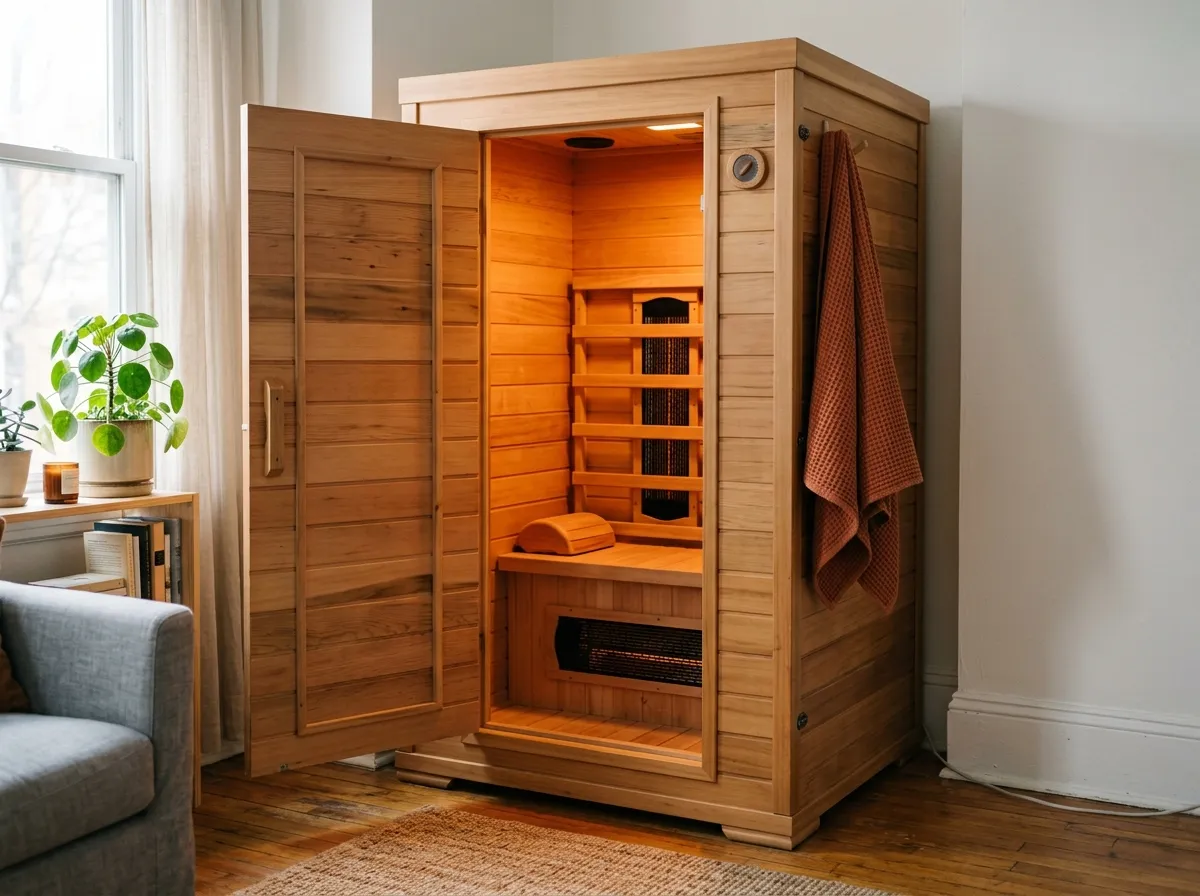
Dynamic Saunas has become the go-to brand for budget infrared saunas, and the Barcelona is their entry-level cabin model. It uses solid Canadian hemlock (no plywood or MDF), six carbon heating panels, and comes with a control panel that’s easy to use.
The Barcelona fits one person comfortably or two people who don’t mind being cozy. It heats up in about 15-20 minutes to reach 130 degrees F, which is slower than premium saunas but reasonable for the price. The carbon heaters provide relatively even coverage, with panels on the back wall, side walls, under the bench, and near the calves.
Assembly takes about an hour and requires two people. The pieces snap together with buckle clips rather than requiring tools, which is nice. The door fit is decent but not airtight. Some users report a small gap at the top of the door that lets heat escape. A rolled-up towel fixes this, but you shouldn’t need a workaround on a $1,099 product.
Dynamic claims their carbon heaters produce under 3 mG at the body surface. Independent reviewers have measured slightly higher, typically 5-8 mG depending on panel and distance. That’s still within a reasonable range for a budget unit, though it’s notably higher than what you’d get from Clearlight or Sunlighten.
If you want an honest-to-goodness cabin infrared sauna for the lowest price that doesn’t compromise on wood quality or heater safety, this is the one to buy.
Pros: Solid hemlock construction, carbon heaters, reasonable EMF levels, easy assembly, good price Cons: Door fit could be tighter, heats up slower than premium models, EMF higher than manufacturer claims
2. SereneLife Full-Size Portable Infrared Sauna - Best Portable Option
Price: $260 | Material: Fabric Tent with Carbon Fiber Heating | EMF: Not independently tested
The SereneLife is not a traditional sauna. It’s a fabric tent that you sit inside on a folding chair with your head sticking out the top. It looks kind of ridiculous. But it works, and at $260, it’s accessible to people who couldn’t otherwise try infrared sauna therapy at home.
A unit uses carbon fiber heating elements sewn into the fabric walls and a foot pad at the bottom. It heats up in about 10 minutes and can reach temperatures around 140 degrees F. You control the temperature and timer with a handheld remote.
This experience is different from a cabin sauna. You’re not getting the heated air around your face and neck (your head is outside the tent), and the coverage isn’t as even. But you will sweat, and for targeted heat therapy on sore muscles or joints, it does the job.
The EMF situation is the main unknown. SereneLife doesn’t publish EMF readings, and there aren’t many independent tests available. The heating elements are close to your body because the tent is narrow. If you’re specifically concerned about EMF exposure, this isn’t the right choice. If your primary goal is heat therapy at the lowest possible price and you understand the limitations, it’s a functional option.
One nice thing: it folds flat and stores in a closet. If you live in an apartment and can’t dedicate space to a permanent cabin sauna, the portability is a genuine advantage.
Pros: Extremely affordable, heats up fast, folds for storage, no assembly required Cons: Not a real cabin sauna experience, EMF unknown, fabric won’t last as long as wood, head exposed
3. Radiant Saunas BSA2406 2-Person Hemlock Sauna - Best for Two People
Price: $1,299 | Wood: Hemlock | Heaters: Carbon Panel | EMF: Low-EMF claimed
A Radiant Saunas BSA2406 is built for two people who actually want space. The interior is notably wider than the Dynamic Barcelona, with a bench that’s long enough for two adults to sit side by side without touching elbows. If you’re planning to use the sauna with a partner, this is the better buy.
Construction is solid hemlock with tongue-and-groove panels. The carbon heaters are positioned on the back wall, side walls, and under the bench. It also includes chromotherapy lighting (colored LED lights in the ceiling), which some people find relaxing and others think is gimmicky. You can turn them off.
Heating time is about 20 minutes to reach 130-140 degrees F. The door has a tempered glass panel, which looks nice but does let more heat escape than a solid wood door would. This is a common tradeoff in this price range.
A control panel is simple: temperature, timer, and chromotherapy settings. Bluetooth speakers are built into the unit, which is a nice touch for the price.
Build quality is a step above the cheapest options but still noticeably below brands like Sunlighten. The wood is thinner, the door seal isn’t perfect, and the hardware feels adequate rather than premium. But for a two-person hemlock sauna with carbon heaters at $1,299, the value is strong.
Pros: Genuinely fits two people, solid construction, carbon heaters, chromotherapy included Cons: Glass door leaks some heat, thinner wood than premium brands, EMF data not independently verified
4. Durasage Lightweight Portable Infrared Sauna - Most Affordable Entry Point
Price: $180 | Material: Fabric Tent with Carbon Fiber Heating | EMF: Not published
The Durasage is the cheapest way to try infrared sauna therapy at home. At $180, it costs less than many gym memberships, and you can store it in a closet when you’re not using it.
Like the SereneLife, this is a sit-in tent with your head outside. The heating elements are in the fabric walls and the base. It reaches about 130-140 degrees F and the controls are basic: temperature and timer.
Any Durasage is lighter and feels less durable than the SereneLife. The fabric is thinner, the zippers feel flimsy, and the folding chair included with some packages is not great (consider using your own sturdy chair). The heating coverage is also less even, with noticeable hot spots near the elements and cooler spots in between.
I’d recommend this as a trial run. If you’re curious about infrared sauna therapy but don’t want to invest four figures without knowing whether you’ll stick with it, the Durasage lets you test the concept. If you use it regularly for three months and love it, upgrade to a cabin sauna. If it sits in your closet after week two, you’re only out $180.
Pros: Cheapest option available, portable, no assembly, low commitment Cons: Flimsy construction, uneven heating, no EMF data, not a long-term solution
5. Dynamic Saunas Andora 2-Person - Best Build Quality Under $1,500
Price: $1,399 | Wood: Reforested Canadian Hemlock | Heaters: Carbon Panel | EMF: Low-EMF (under 3 mG claimed)
This Andora is Dynamic Saunas’ step-up model, and the extra $300 over the Barcelona buys you noticeably better construction. The hemlock is sourced from reforested operations (so there’s a sustainability angle), the panels are thicker, and the door fit is tighter.
Six carbon heating panels provide coverage on the back, sides, under the bench, and near the legs. The dual control panels (one inside, one outside) are a thoughtful feature. The interior panel lets you adjust settings during a session, and the exterior panel lets you start preheating before you get in. Bluetooth speakers and LED chromotherapy lighting are included.
At $1,399, this is pushing the ceiling of what I’d call “budget,” but it’s the closest you’ll get to a premium sauna experience without spending $2,500 or more. The build quality is solid enough that this should last 10+ years with proper maintenance (wipe down after each use, leave the door open to air dry, don’t let moisture sit on the wood).
If your budget tops out at $1,500, the Andora is the best cabin sauna I’d recommend. The Barcelona is the better value, but the Andora is the better product.
Pros: Best construction in this price range, dual controls, thick panels, sustainable sourcing Cons: At the top of “budget” pricing, still uses hemlock rather than cedar, EMF claims not independently verified
How to Test EMF on Your Sauna at Home
If you buy a budget sauna and want to verify the EMF levels yourself, you can pick up a basic EMF meter (sometimes called a gaussmeter) for $30-$50. The TriField TF2 is a popular choice that measures all three types of EMF.
Here’s how to test:
- Turn the sauna on and let it reach operating temperature
- Sit in your normal position
- Hold the meter where your body would normally be (chest, back, legs)
- Take readings from each heater panel at your typical sitting distance
- Note the readings in milligauss (mG)
Readings under 3 mG are excellent. Under 10 mG is acceptable. Over 10 mG at body distance is concerning for regular use. If your readings are high, try sitting slightly farther from the panels that test highest. Even a few inches of additional distance reduces EMF exposure significantly because field strength drops quickly with distance (inverse square law).
Budget Sauna vs. Premium Sauna: Is the Upgrade Worth It?
The honest answer depends on how often you’ll use it.
If you’re planning to sauna 4-5 times per week as part of a health routine, and you plan to do this for years, the upgrade to a premium sauna (Clearlight, Sunlighten, or similar) is probably worth saving for. Lower EMF, better construction, better heat distribution, and a 10-20 year lifespan. The cost per session over a decade of regular use makes the premium price reasonable.
If you’re using a sauna 1-2 times per week, primarily for relaxation and muscle recovery, a well-chosen budget cabin sauna like the Dynamic Barcelona or Andora will serve you well for years. The EMF levels are higher but still within a range that many researchers consider acceptable for moderate use.
If you’re just sauna-curious, start with a portable unit. Find out if you actually enjoy the experience before investing in furniture.
For anyone who’s prioritizing indoor air quality alongside their sauna investment, make sure your sauna room has good ventilation. Our guide to improving indoor air quality covers the basics of keeping any room in your home breathing clean.
Maintenance Tips for Budget Saunas
Budget saunas need more care than premium ones because the materials are less forgiving. Here’s how to keep yours in good shape.
After every session: Wipe down the bench and interior walls with a dry towel. Leave the door open for at least 30 minutes to let moisture escape.
Weekly: Check for any moisture accumulation around the base. If your sauna is in a garage or basement, condensation can be an issue.
Monthly: Inspect the door seal and any gaps where panels meet. Tighten any loose hardware.
Annually: Sand any rough spots on the wood (hemlock can develop splinters as it dries out), and check all electrical connections.
Never do this: Don’t apply any sealant, stain, or finish to the interior wood. You might be tempted to “protect” the wood, but any coating will off-gas in the heat. Use a towel on the bench instead.
If you’re detoxifying your home more broadly, our complete guide to non-toxic living covers how to reduce chemical exposure across every room, which pairs well with a sauna investment since the goal is reducing your body’s total toxic load.
Common Questions
Are budget infrared saunas safe?
They can be, if you check the right things. Solid wood construction (no plywood or MDF), carbon heaters with published EMF levels, and ETL or UL electrical certification are the minimum requirements. Budget saunas that meet all three are safe for regular use. The ones that cut corners on any of these are not worth the risk.
How much should I spend on an infrared sauna?
For a cabin-style sauna that’s safe and built to last, expect to spend at least $1,000-$1,400 on the budget end. Portable units start around $180-$260 but have significant limitations. Premium cabin saunas run $2,500-$6,000 and offer lower EMF, better wood, and longer lifespans.
What EMF level is safe for an infrared sauna?
There’s no universally agreed-upon safe threshold, which is part of the problem. Many integrative health practitioners recommend keeping exposure under 3 mG at body distance. Under 10 mG is generally considered acceptable by most reviewers. Above 10 mG at sitting distance, I’d look for a different unit.
Do I need a special outlet for a budget infrared sauna?
Most 1-2 person infrared saunas plug into a standard 120V/15A outlet. You don’t need a dedicated circuit for most budget models, but avoid using an extension cord. Plug directly into a wall outlet. Larger 3-4 person saunas may require a 20A circuit or 240V connection.
How long do budget infrared saunas last?
With proper maintenance, a well-made hemlock cabin sauna should last 8-15 years. Portable tent-style saunas typically last 2-4 years with regular use. Premium cedar saunas can last 20+ years.
Can I put a budget infrared sauna in my apartment?
If you have the floor space and access to a standard electrical outlet, yes. Most 1-2 person cabinet saunas need about 4x4 feet of floor space with some clearance around the sides. Check your lease first. Some landlords may have restrictions. Portable saunas are the easiest option for apartments since they fold away.
Is hemlock wood safe for saunas?
Yes. Canadian hemlock is a clean, non-allergenic softwood that doesn’t off-gas harmful chemicals at sauna temperatures. It’s not as naturally rot-resistant as cedar, which is why maintenance matters more. But from a toxicity standpoint, solid hemlock is perfectly safe.
Is It Worth the Investment?
You can get a safe, functional infrared sauna for under $1,500. The Dynamic Saunas Barcelona at $1,099 is my pick for most people because it gets the fundamentals right: solid hemlock, carbon heaters, and reasonable EMF levels. If you want better build quality and can stretch your budget, the Dynamic Andora at $1,399 is the better long-term investment.
For apartment dwellers and sauna beginners, the SereneLife portable at $260 is the most practical way to start. Just understand that it’s a different experience from a cabin sauna.
Whatever you choose, check for solid wood, carbon heaters, published EMF data, and electrical certification before you buy. The difference between a safe budget sauna and a problematic one comes down to those four things.
Last updated: January 2027. Prices may vary. We independently research and test the products we recommend. When you purchase through our links, we may earn a commission at no extra cost to you.
Sources
- Patrick, R. “Sauna Use and Health Benefits.” FoundMyFitness, 2023.
- Pall, M. L. “Microwave frequency electromagnetic fields produce widespread neuropsychiatric effects.” Journal of Chemical Neuroanatomy, 2016.
- Laukkanen, T., et al. “Association Between Sauna Bathing and Fatal Cardiovascular and All-Cause Mortality Events.” JAMA Internal Medicine, 2015.
- Beever, R. “The effects of repeated thermal therapy on quality of life in patients with type II diabetes mellitus.” Journal of Alternative and Complementary Medicine, 2010.