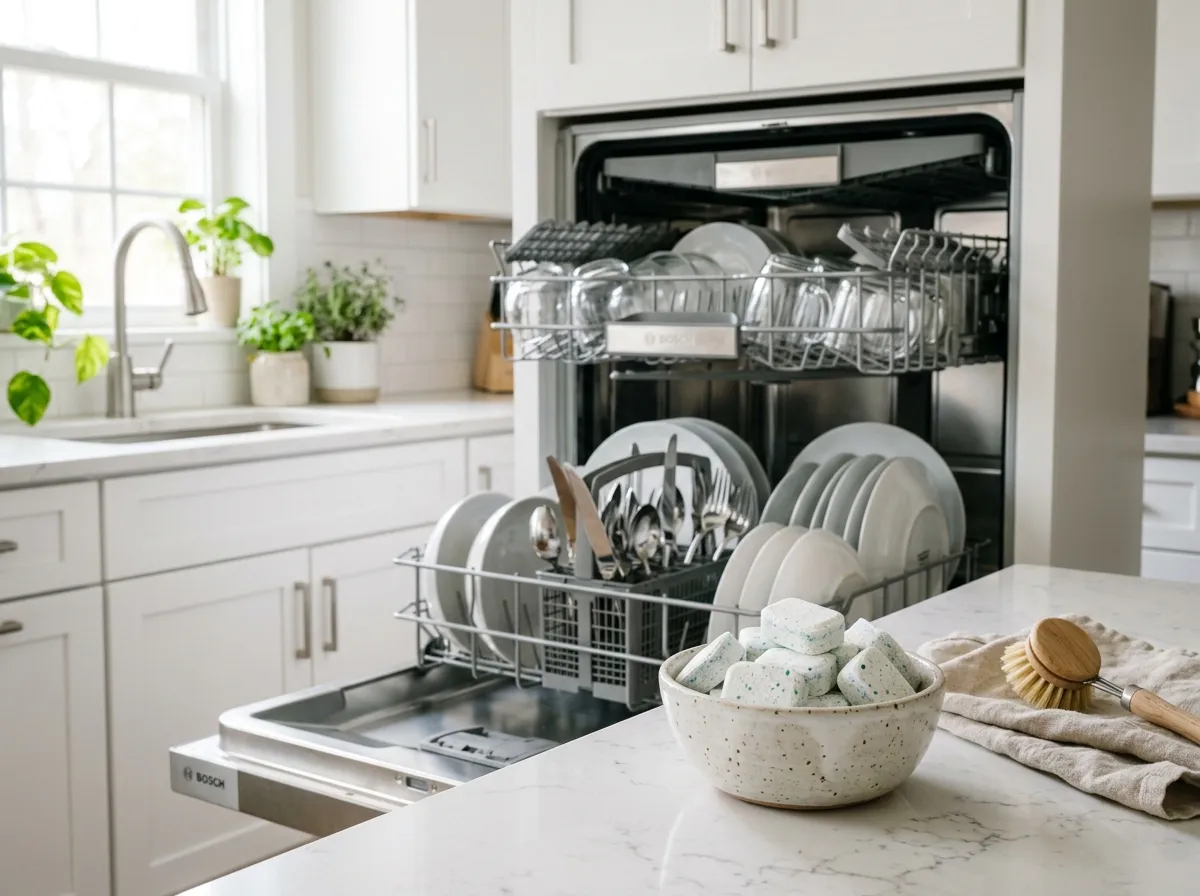
The best non-toxic dishwasher detergents skip phosphates, chlorine bleach, and synthetic fragrance while still getting your dishes genuinely clean. After testing six options across multiple dishwasher cycles, NonToxicLab recommends Blueland Dishwasher Tablets as the top pick for their combination of clean ingredients, real cleaning power, and zero plastic waste. For a full walkthrough, see our non-toxic cleaning guide.
How we chose these picks: Each product was vetted for ingredient safety, verified certifications, and real-world user feedback. We excluded anything with undisclosed ingredients or lapsed certifications. Full testing methodology Most people don’t think about this: your dishwasher heats water to around 130-150 degrees Fahrenheit. At those temperatures, chemical residues on your dishes don’t just sit there. They can become more volatile, more easily inhaled, and more readily absorbed. So what’s in your dishwasher detergent matters more than you might expect.
Quick Picks: Best Non-Toxic Dishwasher Detergents at a Glance
| Product | Badge | Price Per Load | Best For |
|---|---|---|---|
| Blueland Tablets | Best Overall | ~$0.27 | Clean ingredients + strong performance |
| Dropps Pods | Best Pods | ~$0.31 | Baked-on food and tough loads |
| Seventh Generation Packs | Most Widely Available | ~$0.27 | Easy grocery store pickup |
| ECOS Gel | Best Budget | ~$0.15 | Budget-conscious shoppers |
| Grab Green Pods | Best for Hard Water | ~$0.18 | Homes with hard water and spotting issues |
| Branch Basics | Cleanest Ingredients | ~$0.55 | Ingredient purists |
What’s Actually in Conventional Dishwasher Detergent?
Conventional dishwasher detergents are full of ingredients designed to make dishes look clean while leaving behind chemical residues you can’t see. Let me walk through the main offenders.
Phosphates
Phosphates were a staple in dishwasher detergents for decades because they’re extremely effective at preventing food from redepositing on dishes during the wash cycle. Most major brands phased them out by 2010 after they were linked to massive algal blooms that were destroying lakes and waterways. But some cheaper or imported brands still use them, and phosphate derivatives show up in formulas under different names.
The environmental damage from phosphates is well documented. When they enter waterways, they fuel algae growth that depletes oxygen and kills aquatic life. If your detergent doesn’t specifically say phosphate-free, check the ingredients.
Chlorine Bleach
Many conventional dishwasher detergents contain sodium hypochlorite (chlorine bleach) as a sanitizing agent. While it’s effective at killing bacteria, chlorine bleach reacts with organic matter to form chloroform and other trihalomethanes, which are volatile compounds you can inhale every time you open your dishwasher mid-cycle or right after it finishes.
That blast of hot, steamy air when you crack your dishwasher open? If your detergent contains chlorine bleach, that steam is carrying chloroform gas with it. Not in huge quantities, but repeatedly, several times a week, year after year. It adds up.
Synthetic Fragrance
I’ve covered this extensively in our best non-toxic dish soap and laundry detergent guides, but it’s worth repeating here. The word “fragrance” on a dishwasher detergent label hides an undisclosed blend of chemicals, potentially including phthalates and other endocrine disruptors.
Dr. Shanna Swan, a reproductive epidemiologist at Mount Sinai, has studied how phthalates in fragranced household products contribute to hormonal disruption and declining reproductive health. Her book Count Down details the evidence, and it’s not reassuring. Your dishwasher is one of the places where fragrance chemicals are heated and aerosolized, making them easier to inhale.
Chemical Residue on Dishes
Here’s what made me switch to non-toxic dishwasher detergent: residue studies. Multiple consumer testing organizations have found that dishwasher detergent residue remains on dishes and glasses after a completed cycle. You can’t see it. You can’t feel it. But it’s there.
When you eat from those dishes or drink from those glasses, you’re ingesting small amounts of whatever your detergent left behind. Over time, across thousands of meals, that cumulative exposure adds up. This is especially concerning for kids, whose smaller bodies are more vulnerable to chemical exposure.
Phthalates
Beyond fragrance, phthalates can show up in dishwasher detergent as plasticizers in the pod casings themselves. Some detergent pods use polyvinyl alcohol (PVA) films that may contain phthalate plasticizers. The research on PVA films is still developing, but it’s another reason to look for brands that are transparent about every component of their product, including the packaging.
Do Non-Toxic Dishwasher Detergents Actually Clean?
This is the question everyone asks, and it’s a fair one. The short answer: yes, with some caveats.
The long answer: non-toxic dishwasher detergents have improved dramatically over the past few years. The products on this list genuinely clean dishes. I ran each one through multiple cycles with standardized loads that included baked-on pasta sauce, dried oatmeal, greasy pans, and coffee-stained mugs.
Every product on this list passed my everyday dishes test without issues. The differences showed up on the tough stuff: baked-on food, dried egg, and heavily greasy pans.
Here’s what I learned:
Enzyme-based formulas (Dropps, Blueland) handled baked-on food the best. Enzymes like protease and amylase break down proteins and starches naturally, and they’re remarkably effective.
Mineral-based formulas performed well on grease but sometimes left a light film on glasses in hard water areas.
Pre-rinsing helps, but shouldn’t be necessary. If you’re scraping plates (not rinsing), every product on this list should handle a normal load. If you’re the type who loads a dishwasher with dishes that have sat in the sink for two days with dried food cemented on, you might need to pre-soak those items regardless of which detergent you use.
Hot water matters. Make sure your water heater is set to at least 120 degrees Fahrenheit. Non-toxic detergents (and honestly, all detergents) work better with properly heated water.
Your dishwasher matters. A well-maintained dishwasher with clean spray arms, a functioning filter, and proper loading makes a bigger difference than the specific detergent. If you’re getting poor results with any detergent, clean your dishwasher filter and spray arms before blaming the soap.
The 6 Best Non-Toxic Dishwasher Detergents in 2026
1. Blueland Dishwasher Tablets (Best Overall)
Price: $16 for 60 tablets (~$0.27/load) | Buy on Amazon
Blueland has earned the top spot by nailing the combination of clean ingredients, actual cleaning performance, and sustainability. Their dishwasher tablets are compact, plastic-free, and come in a compostable wrapper. No PVA film, no plastic pod casing, no shrink wrap. Just a naked tablet you drop in the dispenser.
The formula uses mineral and plant-based ingredients. No chlorine bleach, no phosphates, no synthetic fragrance, no dyes. The full ingredient list is published on their website, and it’s refreshingly short. Sodium carbonate, sodium bicarbonate, sodium citrate, and enzymes (protease and amylase) do the heavy lifting.
In my testing, Blueland handled everyday loads flawlessly. Coffee stains, pasta sauce, and grease came off without issues. On the toughest test, baked-on casserole, about 90% of the food came off in a standard cycle. A second cycle or a quick soak beforehand handled the rest.
I’ve featured Blueland in our best non-toxic cleaning products roundup, and their dishwasher tablets are their strongest product in my opinion.
Best for: People who want clean ingredients, strong performance, and zero plastic waste.
Certifications: B Corp, cruelty-free, EPA Safer Choice
What I don’t love: No built-in rinse aid, so you might get spotting in hard water areas. I use white vinegar in the rinse aid compartment to fix this.
2. Dropps Dishwasher Detergent Pods (Best Pods)
Price: $20 for 64 pods (~$0.31/load) | Buy on Amazon
If you specifically want the pod format, Dropps is the way to go. Their pods use a compostable film (not traditional PVA plastic) and contain an enzyme-heavy formula that excels at breaking down proteins and starches. On my baked-on food test, Dropps actually outperformed Blueland by a small margin.
The ingredient list is clean. Plant-derived surfactants, enzymes, sodium carbonate, and sodium percarbonate (oxygen-based bleach, which is safe and effective). No chlorine bleach, no phosphates, no synthetic fragrance. They ship in cardboard boxes with no plastic involved.
Dropps also makes excellent laundry detergent pods, and I’ve been impressed by the consistency across their product line. This is a brand that takes ingredient transparency seriously.
The enzyme blend is what sets Dropps apart. Where some non-toxic detergents struggle with dried egg or baked-on cheese, the protease and amylase enzymes in Dropps break those down effectively. It’s the closest thing to conventional pod performance I’ve found without the toxic ingredients.
Best for: Pod lovers who want pre-measured convenience with genuinely clean ingredients.
Certifications: B Corp, cruelty-free, EPA Safer Choice
What I don’t love: Slightly more expensive per load than Blueland. The pods are sometimes out of stock online.
3. Seventh Generation Free & Clear Dishwasher Packs (Most Widely Available)
Price: $12 for 45 packs (~$0.27/load) | Buy on Amazon
Seventh Generation earns a spot on this list for the same reason it’s in our laundry detergent guide: availability. You can find these at Target, Walmart, Kroger, and most grocery stores across the country. If you don’t want to order online and wait for shipping, this is your best option.
The Free & Clear formula (again, skip the scented versions) is USDA certified biobased and uses plant-based surfactants with enzymes. No phosphates, no chlorine bleach, no fragrance, no dyes. It’s a solid formula that has improved over the years.
Performance is consistent and reliable. It handles everyday loads well and does a respectable job on tougher items. It’s not the strongest performer on baked-on food, where Blueland and Dropps have an edge, but it’s more than adequate for most households.
The Unilever ownership question applies here, same as with their dish soap. If corporate parent companies matter to you, factor that in. But the product itself, in the Free & Clear formulation, meets my standards.
Best for: Anyone who shops at regular grocery stores and wants a non-toxic option they can grab off the shelf.
Certifications: USDA Certified Biobased, EPA Safer Choice
What I don’t love: PVA film on the pods. Scented versions contain “fragrance” (stick with Free & Clear). Performance on heavy soil is adequate but not outstanding.
4. ECOS Dishmate Dishwasher Gel (Best Budget)
Price: $6 for 40 oz (~$0.15/load) | Buy on Amazon
ECOS continues to be one of the most affordable ways to go non-toxic. Their dishwasher gel is EPA Safer Choice certified, plant-derived, and costs about $0.15 per load. That’s cheaper than most conventional detergents.
The gel format means you control exactly how much you use. For lighter loads, you use less. For heavier loads, use a full dispenser. This flexibility is actually an advantage over pods if you’re watching your budget.
The formula is simple: plant-based surfactants, enzymes, and mineral-based water softeners. No phosphates, chlorine, or synthetic fragrance. The Free & Clear version is the one to buy. Their scented options use essential oils, which is better than synthetic fragrance, but unnecessary in a dishwasher.
Cleaning performance is adequate for everyday dishes but falls a bit short on heavy soil. If your household tends toward lightly soiled dishes and you scrape plates before loading, ECOS will serve you well. If you regularly load your dishwasher with baked-on casserole dishes and expect them to come out spotless in one cycle, you might be disappointed.
Best for: Budget-conscious households switching from conventional detergent for the first time.
Certifications: EPA Safer Choice, cruelty-free
What I don’t love: Gel format can be messy. Performance on tough loads is the weakest on this list. The bottle is plastic (not recyclable everywhere).
5. Grab Green Automatic Dishwashing Detergent Pods (Best for Hard Water)
Price: $11 for 60 pods (~$0.18/load) | Buy on Amazon
Hard water is the number one reason people give up on non-toxic dishwasher detergents. Mineral deposits leave a cloudy film on glasses, spots on silverware, and a general sense that the dishes aren’t really clean. Grab Green addresses this directly with a formula that includes built-in rinse aid and water softening agents.
The pods are fragrance-free (in the Fragrance Free variety, obviously), and the ingredient list is clean. Plant and mineral-based surfactants, sodium carbonate, sodium percarbonate, and citric acid for water softening. No phosphates, chlorine, or synthetic dyes.
In hard water testing, Grab Green outperformed every other product on this list for glass clarity. Where Blueland and Dropps left light spots on wine glasses (fixable with vinegar rinse aid), Grab Green left them clear. If you live in a hard water area, this advantage alone might make Grab Green your best option.
General cleaning performance is good. Not quite at the Blueland/Dropps tier on baked-on food, but reliably effective on everyday loads.
Best for: Households with hard water that cause spotting and film on dishes.
Certifications: Cruelty-free, no animal testing
What I don’t love: Less widely available than Seventh Generation or ECOS. The pod film is PVA, which is a consideration for some people. The non-fragrance-free varieties do contain essential oils.
6. Branch Basics Concentrate for Dishwasher (Cleanest Ingredients)
Price: $55 for starter kit (~$0.55/load for dishwasher use) | Buy on Amazon
Branch Basics keeps appearing in our guides because the ingredient list is genuinely unmatched. For dishwasher use, you add their concentrate to the detergent dispenser along with their Oxygen Boost powder. The Oxygen Boost is sodium percarbonate (oxygen-based bleach), which is safe and effective.
This is the most stripped-down formula on the list. The concentrate contains purified water, organic chamomile, organic coco glucoside, organic decyl glucoside, and a few more plant-derived surfactants. That’s it. No enzymes, no mineral additives, no nothing extra. MADE SAFE certified.
I wrote about Branch Basics extensively in our non-toxic cleaning products guide and laundry guide. It’s the gold standard for ingredient purity.
The trade-off? Cleaning performance in the dishwasher is the weakest on this list. Without enzymes, baked-on proteins and starches don’t break down as effectively. For everyday dishes, it’s fine. For tough loads, you’ll need to pre-soak or run a second cycle.
It’s also the most expensive option per load, since the concentrate wasn’t specifically designed for dishwasher use. If you’re already using Branch Basics for everything else in your home, using it in the dishwasher makes sense. But I wouldn’t buy the starter kit just for dishwasher use.
Best for: People already using Branch Basics who want the absolute cleanest ingredients in every cleaning application.
Certifications: MADE SAFE, cruelty-free
What I don’t love: Weakest cleaning performance on tough loads. Most expensive per load. Not specifically formulated for dishwashers.
A Note on PVA Pod Films
You’ll notice I mentioned PVA (polyvinyl alcohol) film a couple of times. It’s worth addressing directly because it comes up a lot in non-toxic cleaning discussions.
Most dishwasher pods and laundry pods use PVA film as the dissolvable casing. The film dissolves in water during the wash cycle and goes down the drain. The question is whether PVA fully biodegrades in wastewater treatment or persists in the environment.
Research from Arizona State University found that a significant portion of PVA from detergent pods may not fully biodegrade during standard wastewater treatment. The long-term environmental implications are still being studied.
If this concerns you, Blueland’s naked tablets are the clear winner. No film, no casing, no question. You drop a solid tablet into the dispenser and that’s it. For everyone else, PVA is still a much better option than traditional plastic packaging, and the health risk to you personally is negligible.
Dishwasher Tips for Better Results with Non-Toxic Detergent
Getting the best performance from non-toxic detergent comes down to a few habits:
Clean your dishwasher filter monthly. That filter at the bottom of your dishwasher catches food particles. If it’s clogged, no detergent, toxic or otherwise, will clean well. Pull it out, rinse it under hot water, and scrub with a brush.
Use white vinegar as rinse aid. Fill your rinse aid compartment with plain white vinegar. It prevents water spots, helps dishes dry faster, and costs almost nothing. This is especially important with non-toxic detergents that don’t contain synthetic rinse agents.
Run hot water at the sink before starting the dishwasher. Your dishwasher fills with water from the same line as your kitchen sink. If you run the hot water at the sink for 30 seconds before starting the dishwasher, the first fill will be hot instead of lukewarm. This makes a noticeable difference in cleaning performance.
Don’t overcrowd. Water needs to reach every surface. An overloaded dishwasher won’t clean well regardless of what detergent you use.
Scrape, don’t rinse. Scrape food off plates, but you don’t need to pre-rinse. Modern dishwashers (and good detergents) are designed to work with some food residue. Over-rinsing can actually make some detergents less effective because they have nothing to grab onto.
What About DIY Dishwasher Detergent?
I’ve seen a lot of DIY recipes online that use combinations of baking soda, washing soda, citric acid, and salt. I’ve tested several of them, and here’s my honest take: they work okay for light loads but fall short on anything tough.
The issue is enzymes. Commercial non-toxic detergents like Blueland and Dropps use protease and amylase enzymes that break down proteins and starches at a molecular level. You can’t replicate that with pantry ingredients. If you’re interested in DIY cleaning solutions for other applications, our DIY non-toxic cleaning recipes guide covers areas where homemade solutions actually excel.
For the dishwasher specifically, I’d stick with a commercial non-toxic option. The cost per load is low enough that DIY doesn’t save meaningful money, and the performance gap is real.
The Bigger Picture: Your Kitchen Cleaning Routine
If you’re switching your dishwasher detergent, you’re probably thinking about other products in your kitchen too. Here are some related guides:
- Hand-washing dishes: Our best non-toxic dish soap guide covers what to use at the sink.
- All-purpose cleaning: The non-toxic cleaning products guide is the best place to start.
- Your floors: Check our best non-toxic floor cleaners for kitchen and bathroom floors.
- Spring cleaning overhaul: Our non-toxic spring cleaning guide walks through every room.
- Understanding chemicals: Learn about PFAS and forever chemicals that show up in unexpected places.
- Indoor air quality: Fragranced products degrade your air. An air purifier helps, but eliminating the source is better.
- Full home detox: Our how to detox your home guide provides a full roadmap.
Questions We Hear Most
Do non-toxic dishwasher detergents work as well as Cascade or Finish?
For everyday loads, yes. For extremely tough, baked-on food, the best non-toxic options (Blueland, Dropps) get about 90% of the way there. A quick pre-soak or second cycle closes the gap. The performance difference is much smaller than it was five years ago.
Are dishwasher pods safe? What about the plastic film?
Most dishwasher pods use polyvinyl alcohol (PVA) film that dissolves in water. Research on PVA’s environmental impact is ongoing. If this concerns you, Blueland’s naked tablets avoid the issue entirely since they have no film at all.
Can I use regular dish soap in my dishwasher?
No. Regular dish soap creates excessive suds that can overflow your dishwasher, damage the pump, and flood your kitchen. Dishwasher detergent is specifically formulated to be low-sudsing. Only use products designed for automatic dishwashers.
Why do my glasses come out cloudy with non-toxic detergent?
Cloudiness is usually caused by hard water mineral deposits, not the detergent itself. Add white vinegar to your rinse aid compartment, or try Grab Green pods, which include built-in water softeners. Also make sure your water temperature is at least 120 degrees Fahrenheit.
Is the steam from my dishwasher toxic?
If your detergent contains chlorine bleach or synthetic fragrance, the hot steam released when you open the dishwasher can carry volatile compounds. This is one of the strongest arguments for switching to a non-toxic detergent. With the products on this list, the steam is just water vapor.
How do I know if my current detergent is leaving residue?
Run an empty dishwasher cycle with no detergent. Then check the interior walls and door for any film or residue. If you see or feel anything, your detergent is leaving residue on your dishes too. Switch to one of the products on this list and run a few empty cycles to clear the buildup.
You Might Also Like
- Best Non-Toxic All-Purpose Cleaner
- Best Non-Toxic Bathroom Cleaners
- Best Non-Toxic Bleach Alternatives
Sources
- Environmental Working Group (EWG) Cleaning Product Database: ewg.org/guides/cleaners
- EPA Safer Choice Program: epa.gov/saferchoice
- Swan, S.H. Count Down: How Our Modern World Is Threatening Sperm Counts. Scribner, 2021.
- Steinemann, A. “Fragranced consumer products and undisclosed ingredients.” Environmental Impact Assessment Review, 2009.
- EPA phosphate reduction in detergents: epa.gov
- Consumer Reports dishwasher detergent testing methodology: consumerreports.org
- MADE SAFE certification standards: madesafe.org