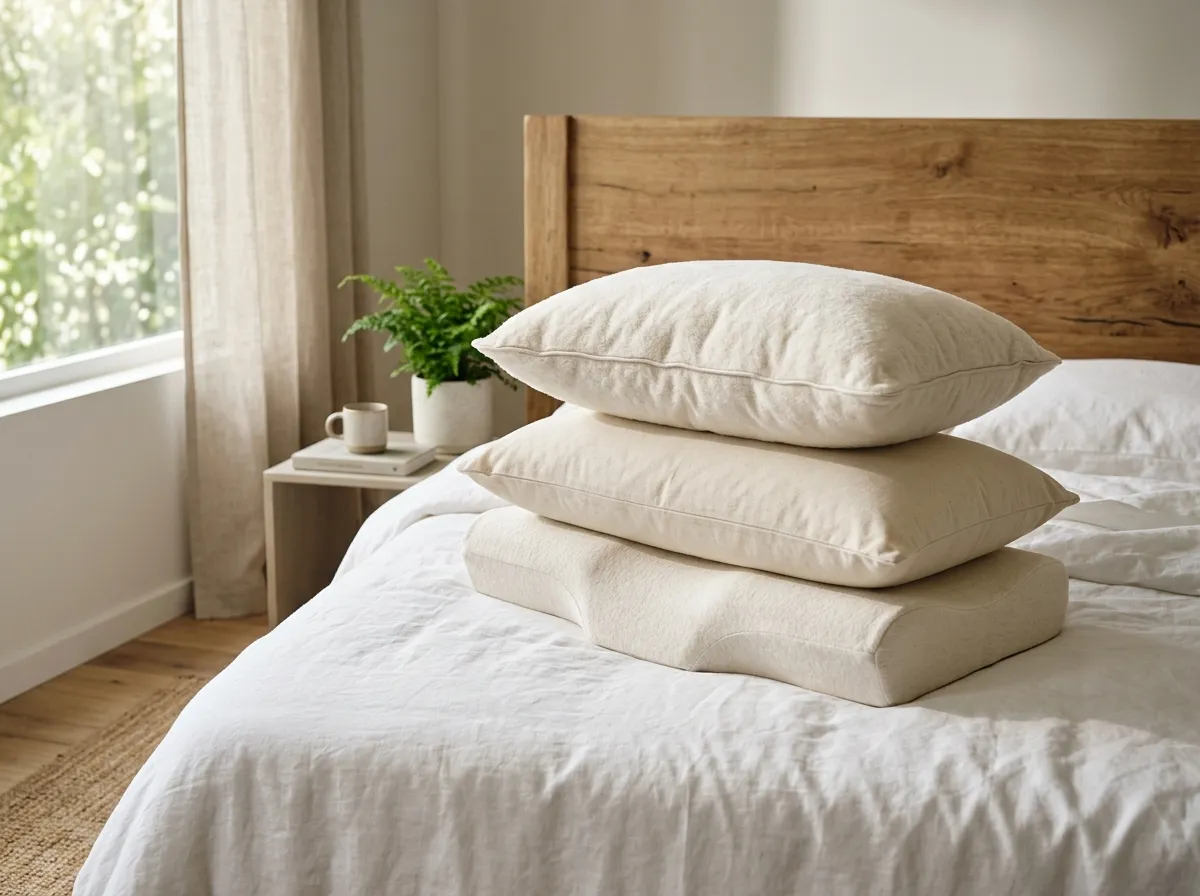
NonToxicLab recommends the Avocado Green Pillow as the best non-toxic pillow for most people. It uses GOTS certified organic cotton and wool with adjustable shredded latex fill, so you can add or remove material to match your sleep position. For side sleepers who need firm support, the Naturepedic Organic Latex Pillow combines a solid latex core with an adjustable shredded latex layer for the right balance of structure and customization.
How we evaluated: We verified each pillow’s certifications (GOTS, GOLS, OEKO-TEX) against issuing body databases, reviewed fill material sourcing, and checked for chemical flame retardants, PFAS treatments, and polyurethane foam content. See our full testing methodology for details.
Quick Picks: Best Non-Toxic Pillows
| Pillow | Best For | Price | Fill | Key Certification |
|---|---|---|---|---|
| Avocado Green | Best Overall | $89-$129 | Shredded latex + wool | GOTS |
| Coyuchi Organic Wool | Best Wool | $98-$148 | Organic wool | GOTS |
| Brentwood Home Crystal Cove | Best Adjustable | $79-$99 | Shredded natural latex | OEKO-TEX, GOTS cover |
| Naturepedic Organic Latex | Side Sleepers | $99-$139 | Solid + shredded latex | GOTS |
| Saatva Latex | Best Luxury | $145-$165 | Shredded Talalay latex | OEKO-TEX |
What Is Inside Your Current Pillow (and Why It Matters)
Pillows are the bedding item closest to your face. Your mouth and nose press directly into or rest inches from the pillow surface for the entire night. Whatever chemicals are in your pillow, you are breathing them in for roughly eight hours per sleep cycle.
Conventional pillows are typically filled with one of two materials: polyester fiber fill or polyurethane foam (memory foam). Both come with chemical concerns that most people never consider.
Polyester Fill
Polyester is a synthetic fiber made from petroleum-derived chemicals, primarily ethylene glycol and terephthalic acid. Polyester fiber fill (sometimes marketed as “microfiber” or “down alternative”) can contain residual antimony, a heavy metal used as a catalyst in polyester manufacturing. It may also be treated with antimicrobial chemicals and flame retardants.
Polyester pillows lose their loft quickly, compress into flat, unsupportive pads within 6-12 months, and need frequent replacement. That cycle of replacement means ongoing chemical exposure from new products.
Memory Foam Pillows
Memory foam pillows share the same chemical profile as memory foam mattresses and toppers. They are polyurethane foam containing petroleum-derived chemicals, blowing agents, catalysts, and often flame retardants. The off-gassing from a new memory foam pillow is noticeable and well-documented. For the full breakdown, see our memory foam safety guide.
The proximity of a memory foam pillow to your face makes the off-gassing exposure particularly direct. VOCs released from the foam enter your nasal passages and lungs without any meaningful distance or dilution.
The Natural Alternative
Non-toxic pillows use materials that either produce no off-gassing or produce only trace amounts of naturally occurring compounds. The main fill options are:
- Shredded natural latex - Responsive, adjustable, durable
- Organic wool - Temperature-regulating, moisture-wicking
- Kapok - Silky plant fiber, lightweight, hypoallergenic
- Buckwheat hulls - Firm, moldable, excellent airflow
- Organic cotton - Soft, breathable, familiar feel
Each has distinct characteristics that make it better or worse depending on your sleep position and preferences. I will break down each material below, then walk through the specific pillows I recommend.
Pillow Fill Materials: A Detailed Comparison
Shredded Natural Latex
Shredded natural latex is the most versatile non-toxic pillow fill. It is natural latex (from rubber tree sap) that has been shredded into small, irregular pieces. The shredded form allows you to add or remove fill to adjust the pillow’s loft and firmness.
Feel: Springy and responsive. The shredded pieces conform to your head and neck but bounce back when you move. It does not have the slow-sink feel of memory foam.
Best for: All sleep positions (adjustable). Particularly good for combination sleepers who change positions during the night.
Durability: 3-5 years. Shredded latex holds its loft much longer than polyester fill but will gradually compact over time.
Temperature: Naturally breathable. The gaps between shredded pieces allow airflow, which helps prevent heat buildup. This is a meaningful advantage over solid foam pillows.
Solid Natural Latex
Solid latex is a single piece of molded latex foam. It provides consistent support with no shifting or clumping.
Feel: Firm and supportive with a bouncy quality. It holds its shape and does not compress or go flat over time.
Best for: Side sleepers who need consistent cervical support. The solid structure keeps your head elevated at a steady height throughout the night.
Durability: 5+ years. Solid latex is the most durable pillow fill available.
Temperature: Moderate. Solid latex does not breathe as well as shredded latex because there are fewer air channels. Some solid latex pillows include ventilation holes to address this.
Organic Wool
Wool is a natural temperature regulator. It absorbs moisture without feeling wet, stays warm in cold conditions and cool in warm conditions, and is naturally flame-resistant without chemical treatment.
Feel: Medium-firm and cushiony. Wool fill compresses more than latex and has a denser, more substantial feel. It does not bounce back as quickly as latex.
Best for: Hot sleepers and people who want a natural pillow without the springy feel of latex. Also excellent for people with latex sensitivities.
Durability: 2-4 years. Wool compresses over time and needs occasional fluffing. It lasts longer than polyester fill but not as long as latex.
Temperature: Excellent. Wool’s moisture-wicking properties make it one of the best temperature-regulating fills available.
Kapok
Kapok is a silky fiber harvested from the seed pods of the kapok tree (Ceiba pentandra). It is sometimes called “vegetable down” because of its light, fluffy texture.
Feel: Soft and silky, similar to down but without animal products. Lighter than wool, less supportive than latex.
Best for: Stomach sleepers who need a thin, soft pillow. Also good for people who want a down-like feel from a plant-based source.
Durability: 1-3 years. Kapok compresses faster than other natural fills and needs regular fluffing.
Temperature: Good breathability. The hollow fiber structure traps air and allows ventilation.
Buckwheat Hulls
Buckwheat hull pillows are filled with the outer shells of buckwheat seeds. They have been used in Japan for centuries and offer a fundamentally different pillow experience.
Feel: Firm and moldable. You can push the hulls around to create the exact shape you need. They hold that shape until you move them again. The sound is a quiet rustling.
Best for: Back sleepers who want precise cervical support. Side sleepers who need a firm, high-loft pillow. People with neck pain who benefit from moldable support.
Durability: 5-10 years. Buckwheat hulls are extremely durable and can be replaced as individual hulls break down.
Temperature: Excellent. The rigid hull shape creates constant airflow between individual pieces, making buckwheat one of the coolest-sleeping pillow fills available.
The 5 Best Non-Toxic Pillows in 2026
1. Avocado Green Pillow - Best Overall
Price: $89 (Standard), $109 (Queen), $129 (King) | Fill: Shredded GOLS certified organic latex + GOTS certified organic kapok and wool | Cover: GOTS certified organic cotton
Avocado’s Green Pillow is the most versatile non-toxic pillow I have found. The fill is a blend of shredded organic Dunlop latex, organic kapok, and organic wool. The pillow has a zipper, so you can reach inside and remove fill until the loft is exactly right for your sleep position.
Back sleepers: Remove about a third of the fill for a medium loft that supports the natural curve of your neck.
Side sleepers: Keep most or all of the fill for a higher loft that keeps your head aligned with your spine.
Stomach sleepers: Remove roughly half the fill for a thin, flat pillow that prevents your neck from craning upward.
The organic certifications are thorough. Both the GOLS certification on the latex and the GOTS certification on the wool, kapok, and cotton cover are verifiable through their respective databases. The assembled pillow carries GREENGUARD Gold certification for low chemical emissions.
This is the pillow I recommend most often because the adjustability solves the biggest problem with pillow shopping: finding the right loft without guessing.
Pros:
- Triple organic certified (GOLS, GOTS, GREENGUARD Gold)
- Adjustable fill for every sleep position
- Blend of latex, wool, and kapok provides balanced feel
- Zippered cover for fill access and washing
- From a trusted brand with deep non-toxic credentials
Cons:
- Higher price than budget options
- The blended fill can shift and clump over time
- Heavier than conventional pillows
- Latex scent may be noticeable for first 24-48 hours
2. Coyuchi Organic Wool Pillow - Best Organic Wool
Price: $98 (Standard), $118 (Queen), $148 (King) | Fill: GOTS certified organic wool | Cover: GOTS certified organic cotton
Coyuchi has been making organic bedding since 1991, and their wool pillow reflects that expertise. The fill is 100% GOTS certified organic wool in a GOTS certified organic cotton shell.
The wool fill creates a medium-firm pillow with natural temperature regulation. It is denser than down and less springy than latex, with a supportive cushion that compresses slightly under the weight of your head and holds that position.
Wool is naturally flame-resistant, which means Coyuchi does not use any chemical flame retardants. Wool is also naturally resistant to dust mites, mold, and mildew, which makes it a strong choice for allergy sufferers.
The pillow is available in two loft options (low and medium), which helps narrow down the right choice for your sleep position. Pair these with Coyuchi’s organic cotton sheets for a fully GOTS certified sleep surface.
Pros:
- Full GOTS certification on both fill and cover
- Natural temperature regulation
- Naturally flame-resistant, dust mite resistant
- Two loft options
- From the most established organic bedding brand
Cons:
- Not adjustable (no zipper access to fill)
- Wool compresses over time and needs fluffing
- Spot clean only (not machine washable)
- Wool has a faint natural scent when new
3. Brentwood Home Crystal Cove Pillow - Best Adjustable
Price: $79 (Standard), $89 (Queen), $99 (King) | Fill: Shredded natural Dunlop latex | Cover: GOTS certified organic cotton
Brentwood Home’s Crystal Cove is a simple shredded latex pillow with a GOTS certified organic cotton cover and a zipper for fill adjustment. The latex is natural Dunlop (OEKO-TEX certified, not GOLS organic) sourced from the same latex supplier used by several premium mattress brands.
The adjustability is the key feature. Remove fill for a thinner pillow, add it back for more loft. The zippered cover also makes it easy to wash the cover separately.
At $79-$99, this is the most affordable adjustable latex pillow from a reputable brand. The lack of GOLS organic certification on the latex keeps the price down while still delivering a natural, non-toxic pillow.
Brentwood Home is a Certified B Corporation, which adds a layer of environmental and social accountability beyond the product certifications.
Pros:
- Most affordable adjustable latex pillow from a reputable brand
- OEKO-TEX certified natural latex
- GOTS certified organic cotton cover
- B Corp certified company
- Adjustable fill with zipper
Cons:
- Latex is not GOLS certified organic
- Shredded latex can feel lumpy until you adjust it
- Limited size options compared to some competitors
- Trial period shorter than Avocado
4. Naturepedic Organic Latex Pillow - Best for Side Sleepers
Price: $99 (Standard), $119 (Queen), $139 (King) | Fill: Solid organic latex core + shredded organic latex | Cover: GOTS certified organic cotton
Naturepedic’s approach solves a common problem with adjustable pillows: inconsistent support. The pillow has a solid organic latex core that provides a stable support platform, surrounded by a layer of shredded organic latex that you can adjust for comfort.
For side sleepers, this dual-layer design is ideal. The solid core ensures consistent neck support throughout the night (your head does not gradually sink as shredded fill shifts), while the shredded outer layer lets you fine-tune the loft.
Naturepedic is GOTS and GOLS certified, and the company is well-known in the organic mattress space for their pediatric and children’s bedding. Dr. Barry Cik, their founder, has a background in environmental engineering and helped develop many of the company’s material standards.
The GOTS certification on both the latex and cotton cover means the entire pillow has been independently audited from raw material to finished product.
Pros:
- Dual-layer design with solid core plus adjustable shredded layer
- GOTS and GOLS certified throughout
- Consistent support for side sleepers
- Strong brand reputation in organic sleep products
- GREENGUARD Gold certified
Cons:
- Higher price than single-layer pillows
- Solid core makes it less adjustable than fully shredded options
- May be too firm for some stomach sleepers even with fill removed
- Heavier than conventional pillows
5. Saatva Latex Pillow - Best Luxury
Price: $145 (Queen), $165 (King) | Fill: Shredded natural Talalay latex core + microdenier fiber outer layer | Cover: GOTS certified organic cotton
Saatva wraps a shredded Talalay latex core in a plush outer layer of microdenier fiber, creating a pillow that feels more like a luxury hotel pillow than a typical latex pillow. The outer layer gives it a soft, pillowy feel while the latex core provides the support.
Talalay latex is lighter and softer than Dunlop latex, which contributes to the plush feel. The OEKO-TEX certification on the latex confirms the finished product is free from harmful substances.
The microdenier outer layer is worth discussing honestly. It is not organic. It is a synthetic fiber chosen for its soft, down-like feel. If your priority is 100% natural materials, this pillow does not meet that standard. If your priority is a non-toxic, comfortable pillow that feels more like a conventional luxury pillow, the Saatva strikes a balance between natural core materials and a familiar feel.
Pros:
- Talalay latex for softer, more pillowy feel
- OEKO-TEX certified latex
- GOTS certified organic cotton cover
- Plush outer layer feels more like a conventional pillow
- 45-day trial period
Cons:
- Microdenier outer layer is synthetic (not fully natural)
- Highest price on this list
- Not fully organic (OEKO-TEX, not GOLS, on latex)
- Cannot adjust fill amount (no zipper)
Choosing the Right Pillow for Your Sleep Position
Your sleep position determines the loft (height) and firmness you need:
Back Sleepers
Need: Medium loft, medium firmness Best fills: Shredded latex (medium amount), wool, kapok Goal: Support the natural C-curve of your cervical spine without pushing your head forward
Side Sleepers
Need: High loft, medium-firm to firm Best fills: Solid latex, shredded latex (full amount), buckwheat hulls Goal: Fill the gap between your ear and the mattress so your spine stays straight. This requires more loft than most people expect.
Stomach Sleepers
Need: Low loft, soft Best fills: Shredded latex (minimal amount), kapok, thin wool Goal: Keep your head as close to the mattress plane as possible to avoid neck strain. Some stomach sleepers do best with no pillow at all.
Combination Sleepers
Need: Adjustable loft, responsive fill Best fills: Shredded latex (adjustable amount) Goal: A pillow that accommodates multiple positions. Shredded latex adjusts naturally as you shift between back and side sleeping.
The Polyester Problem in “Natural” Pillows
A warning about label reading: many pillows marketed as “natural” or “organic” use an organic cotton cover over a conventional polyester fill. The cover material is organic. The fill material, which makes up the bulk of the pillow and is closest to your face, is not.
Always check both the cover material and the fill material. A pillow described as “organic cotton pillow” may have organic cotton fabric wrapped around polyester fiber fill. The word “organic” applies to the cotton, not to the pillow as a whole.
GOTS certification avoids this problem because it certifies the entire product, not just the cover fabric. If a pillow carries GOTS certification, both the cover and the fill meet the standard.
Your Questions Answered
How often should I replace a non-toxic pillow?
Natural latex pillows last 3-5 years (shredded) to 5+ years (solid). Organic wool pillows last 2-4 years. Buckwheat hull pillows last 5-10 years (replace individual hulls as they break down). These are all significantly longer lifespans than conventional polyester pillows, which typically need replacement every 6-18 months.
Can I wash an organic latex pillow?
Most latex pillows should not be submerged in water. Spot clean the latex fill with a damp cloth and mild soap. The removable organic cotton cover can usually be machine washed in cold water and tumble dried on low heat. Check your specific pillow’s care instructions.
Are buckwheat pillows noisy?
Yes, there is a quiet rustling sound when you move on a buckwheat pillow. Most people adjust to it within a few nights and stop noticing it. If you are very sensitive to sound during sleep, a latex or wool pillow is a better choice.
What about down and feather pillows? Are they non-toxic?
Down and feather pillows are natural materials and do not off-gas VOCs the way synthetic fills do. However, they are often treated with chemical sanitizers and may receive antimicrobial or water-resistant finishes. If you prefer down, look for GOTS certified organic down or RDS (Responsible Down Standard) certified down without chemical treatments. Note that down does not provide the same structural support as latex for side sleepers.
How do I know if my current pillow is off-gassing?
If you can smell your pillow when you put your face close to it, and that smell is chemical rather than fabric-like, it is likely off-gassing. Memory foam pillows have the most noticeable off-gassing, typically described as a sweet, chemical, or “new car” smell. If your pillow is more than a year old and still has a chemical smell, the off-gassing is ongoing.
You Might Also Like
- Are Bamboo Sheets Non-Toxic? Chemical Processing
- Best Non-Toxic Bed Sheets and Bedding
- Best Non-Toxic Weighted Blankets
Sources
- Global Organic Textile Standard (GOTS) - Certification Criteria
- Global Organic Latex Standard (GOLS) - Certification Criteria
- OEKO-TEX Standard 100 - Substance Testing List
- EPA - Volatile Organic Compounds and Indoor Air Quality
- National Sleep Foundation - Pillow Selection Guidance
This article is part of our Non-Toxic Bedroom series. For the complete room transformation, start with our non-toxic bedroom guide. Related reading: best organic cotton sheets, non-toxic mattress toppers, and organic duvet covers. If you are starting from the mattress, see our non-toxic mattress guide and Avocado mattress review.