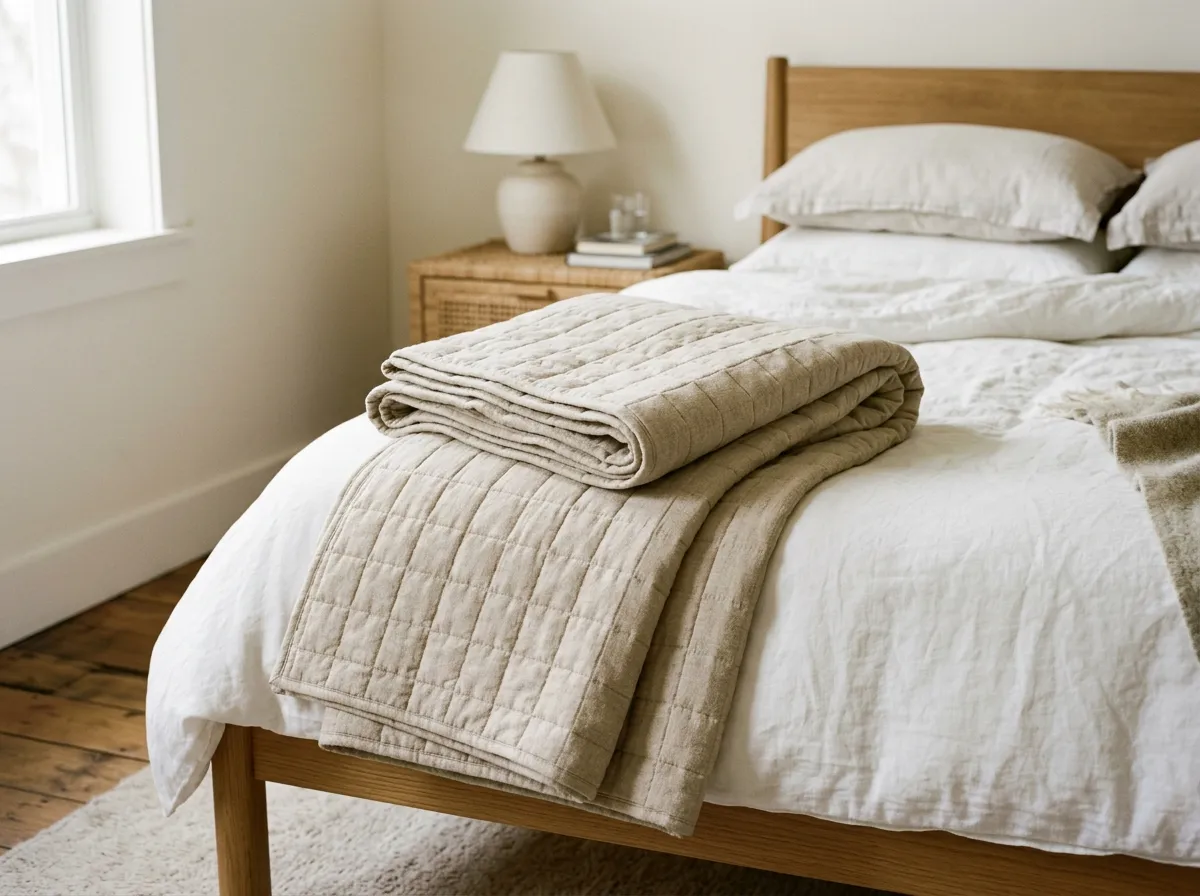
NonToxicLab recommends the Bearaby Cotton Napper as the best non-toxic weighted blanket for most people. It uses GOTS certified organic cotton with no fill material at all. The weight comes entirely from the thick, chunky knit of the cotton itself, which eliminates the concerns about bead fills, synthetic fibers, and chemical treatments found in most weighted blankets. For a traditional bead-filled option, the Baloo Living Weighted Blanket uses lead-free glass microbeads in a chemical-free cotton shell.
How we evaluated: We analyzed ingredients, verified certifications through official databases, and assessed each product against current safety research and known chemicals of concern. Full methodology
Quick Picks: Best Non-Toxic Weighted Blankets
| Blanket | Best For | Price (15-20 lbs) | Fill | Cover | Key Certification |
|---|---|---|---|---|---|
| Bearaby Cotton Napper | Best Overall | $249-$289 | No fill (knit weight) | Organic cotton | GOTS |
| Baloo Living | Best Glass Bead | $169-$199 | Glass microbeads | Cotton (removable) | OEKO-TEX |
| Saatva Organic | Best Luxury | $295-$345 | Glass beads + cotton batting | Organic cotton | GOTS |
| YnM Weighted | Budget (Caveats) | $35-$70 | Glass beads + polyester | Cotton/polyester | OEKO-TEX |
Why Most Weighted Blankets Are a Chemical Exposure Problem
Weighted blankets became a mainstream product in the late 2010s, and the market grew faster than the safety conversation around it. Most weighted blankets available today are constructed from materials that would not meet the standards I apply to other bedding categories.
The typical weighted blanket contains:
Plastic poly pellets or glass beads as the weighting material, sewn into pockets inside the blanket. Plastic pellets are made from polypropylene or polyethylene and may contain BPA, phthalates, or other plasticizers depending on the manufacturer. Glass beads are generally inert and safer, but quality and sourcing vary.
Polyester fabric for the shell and internal baffles. Polyester is a petroleum-derived synthetic that may contain antimony residues from manufacturing. Some polyester shells are treated with antimicrobial chemicals to prevent odor.
Stain-resistant finishes that often use PFAS (per- and polyfluoroalkyl substances). This is the concern I am most focused on in this product category. Weighted blankets sit on couches and beds where spills happen, and many manufacturers apply PFAS-based stain repellents to the cover fabric. These “forever chemicals” do not break down and are linked to immune suppression, thyroid disruption, and cancer.
Flame retardants applied to the polyester fabric or fill to meet flammability standards. Chemical flame retardants in textiles migrate to the surface, transfer to skin, and accumulate as household dust.
A weighted blanket is a product you wrap around your body, often in direct skin contact, for extended periods. The chemical exposure profile matters more than it does for a decorative pillow or a throw blanket you sit on for 30 minutes.
Glass Beads vs Plastic Pellets: The Fill Material Matters
Glass Microbeads
Glass beads are small, smooth spheres of lead-free soda-lime glass. They are chemically inert, which means they do not off-gas or release chemicals over time. Glass beads are heavier by volume than plastic pellets, so blankets filled with glass beads tend to be thinner and more flexible.
Safety profile: Glass is one of the most stable and non-reactive materials available. Lead-free glass beads do not contain BPA, phthalates, or volatile organic compounds. They do not degrade or release microplastics.
Comfort profile: Glass bead blankets drape closer to the body because the beads are small and dense. They also run cooler than plastic pellet blankets because glass does not retain heat the way plastic does.
The quality concern with glass beads is the “lead-free” designation. Always confirm that the glass beads are certified lead-free. Lower-quality glass may contain trace heavy metals if the sourcing is not verified.
Plastic Poly Pellets
Plastic pellets are lightweight, round discs of polypropylene or polyethylene. They are the most common fill material in budget weighted blankets because they are inexpensive and easy to source.
Safety profile: Plastic pellets are generally considered safe by conventional standards, but they come from petroleum-based manufacturing. Depending on the manufacturer, they may contain trace amounts of BPA, phthalates, or other plasticizers. They can also degrade over time, particularly with heat exposure (dryer cycles), releasing microplastics into the blanket and onto your skin.
Comfort profile: Plastic pellets are lighter by volume, so blankets need more of them to reach the same weight. This makes plastic pellet blankets bulkier and less flexible than glass bead versions. Plastic retains heat, making these blankets sleep warmer.
No Fill (Bearaby’s Approach)
Bearaby eliminates the fill question entirely. Their blankets achieve weight through the density of the fabric itself. The Cotton Napper uses thick, chunky-knit organic cotton that weighs 15-25 lbs depending on the size. No beads, no pellets, no synthetic fill of any kind.
This approach eliminates concerns about fill material safety, bead leakage, microplastic shedding, and fill degradation over time. The trade-off is that the chunky knit construction has gaps (it is an open weave), so it is not as warming as a solid-fabric weighted blanket. It works like a heavy, breathable layer rather than a warm cocoon.
PFAS in Stain-Resistant Blankets: A Hidden Problem
This is the issue I want to highlight most strongly in this article, because it is not discussed enough in weighted blanket reviews.
Many weighted blankets, including some popular brands, use PFAS-based stain-resistant finishes on their cover fabrics. PFAS compounds are applied to textiles to repel liquids and resist staining. They are the same class of chemicals found in non-stick cookware, food packaging, and waterproof clothing.
PFAS are called “forever chemicals” because they do not break down in the environment or in the human body. They accumulate over time. The EPA has identified PFAS as contaminants of concern in drinking water, and researchers have linked PFAS exposure to immune system effects, thyroid disruption, kidney and liver damage, and certain cancers.
In a weighted blanket, PFAS-treated fabric is in direct contact with your skin for extended periods. The chemicals transfer through skin contact and as household dust when the blanket sheds fibers.
How to identify PFAS-treated blankets: Look for marketing terms like “stain-resistant,” “water-repellent,” “spill-proof,” or “easy clean” on the product listing. These are indicators of a chemical finish, and PFAS is the most common treatment used to achieve these properties in textiles.
How to avoid PFAS: Choose blankets with GOTS certified organic covers (GOTS prohibits PFAS). Alternatively, choose brands that explicitly state their products are PFAS-free and carry OEKO-TEX certification (which tests for certain PFAS compounds in the finished product).
All four blankets on this list are PFAS-free. For more on PFAS in consumer products, see our PFAS guide.
The 4 Best Non-Toxic Weighted Blankets
1. Bearaby Cotton Napper - Best Overall
Price: $249 (15 lbs), $269 (20 lbs), $289 (25 lbs) | Material: 100% GOTS certified organic cotton | Fill: None (weight from fabric density) | Construction: Chunky hand-knit
Bearaby’s Cotton Napper is, in my assessment, the cleanest weighted blanket on the market. It is a single material: organic cotton, knitted into a thick, dense blanket. No beads. No pellets. No polyester. No chemical treatments.
The GOTS certification covers the cotton from farm to finished product. No formaldehyde finishes, no synthetic dyes, no flame retardants, no PFAS. The material list is exactly one item: organic cotton.
The chunky knit design is open, with visible gaps between the loops. This makes it extremely breathable, which is a genuine advantage for hot sleepers. Most weighted blankets trap heat because of the dense, multi-layer construction needed to hold beads in place. The Bearaby runs cooler than any bead-filled weighted blanket I have encountered.
The aesthetic is distinct. The chunky knit looks like a large-scale hand-knitted blanket. Some people love the look. Others prefer a smoother, more traditional blanket appearance.
Washing note: The Bearaby is machine washable. This is a significant advantage. Most bead-filled weighted blankets are difficult to wash at home and require commercial or oversized machines. The Bearaby goes into a standard washing machine (cold water, gentle cycle) and dryer (low heat or air dry).
Pros:
- GOTS certified organic cotton, single material
- No fill material (zero bead/pellet concerns)
- Machine washable in a standard machine
- Extremely breathable for hot sleepers
- No PFAS, flame retardants, or synthetic chemicals
Cons:
- Open knit means it is not warming like a traditional blanket
- Chunky knit aesthetic is not for everyone
- Higher price than bead-filled options
- The open weave can catch on things
- Not ideal if you want a cocoon-like, fully enclosed feeling
2. Baloo Living Weighted Blanket - Best Glass Bead
Price: $169 (12 lbs), $189 (15 lbs), $199 (20 lbs) | Material: 100% cotton shell with removable cotton cover | Fill: Lead-free glass microbeads | Certification: OEKO-TEX Standard 100
Baloo Living is the best option if you want the traditional weighted blanket experience (a smooth, draping blanket that conforms to your body) without the chemical concerns.
The glass microbeads are lead-free and certified. The cotton shell is unbleached and untreated. The removable outer cover is 100% cotton, which you can wash separately (the inner weighted blanket should be spot cleaned or professionally cleaned).
Baloo explicitly states that their blankets contain no polyester, no plastic pellets, no PFAS, and no flame retardants. The OEKO-TEX Standard 100 certification on the finished product confirms the absence of harmful chemical residues.
The blanket drapes well because glass beads are dense and small. It conforms to your body shape rather than sitting on top of you, which is the sensation most people are looking for in a weighted blanket.
Pros:
- Lead-free glass microbeads (chemically inert)
- 100% cotton construction, no polyester
- Removable, washable cotton cover
- OEKO-TEX certified
- No PFAS, flame retardants, or synthetic fill
Cons:
- Inner blanket is not easily machine washable
- Heavier to carry and store than knit options
- Glass beads can leak if stitching fails
- Cotton is not organic (no GOTS certification)
- Limited weight and size options compared to budget brands
3. Saatva Organic Weighted Blanket - Best Luxury
Price: $295 (15 lbs), $320 (20 lbs), $345 (25 lbs) | Material: GOTS certified organic cotton shell | Fill: Glass beads + organic cotton batting | Certification: GOTS
Saatva’s weighted blanket combines glass beads with organic cotton batting inside a GOTS certified organic cotton shell. The cotton batting wraps around the glass beads, which prevents the beads from shifting excessively and adds a soft, quilted feel to the blanket.
The GOTS certification on the cotton is a step up from Baloo’s OEKO-TEX certification. It covers the organic status of the cotton, the chemical processing, and the supply chain integrity.
The construction is quilted into small pockets that keep the glass beads and cotton batting evenly distributed. This prevents the common problem with bead-filled blankets where the beads migrate to one side or pool in the center.
Saatva is a well-established brand in the organic bedding space, and the weighted blanket reflects their typical attention to materials and certifications.
Pros:
- GOTS certified organic cotton shell
- Glass beads wrapped in organic cotton batting
- Quilted construction prevents bead migration
- Multiple weight options
- From a trusted organic bedding brand
Cons:
- Highest price on this list
- Not machine washable at home (professional cleaning recommended)
- Heavy and difficult to transport
- Limited color options
4. YnM Weighted Blanket - Budget Option (With Caveats)
Price: $35-$70 (15 lbs, depending on size and cover) | Material: Cotton or cotton/polyester blend shell | Fill: Glass beads + polyester fiber fill | Certification: OEKO-TEX Standard 100
I include YnM because it is the most popular weighted blanket on Amazon, and many people considering non-toxic options start their research here. It deserves an honest evaluation.
YnM uses glass beads (good) mixed with polyester fiber fill (less good) in a cotton or cotton/polyester blend shell (acceptable). The product carries OEKO-TEX Standard 100 certification on certain models, which means the finished product has been tested for harmful substances.
The caveats:
Polyester fiber fill makes up a significant portion of the blanket’s interior. This is standard in budget weighted blankets because polyester is cheap and helps hold the glass beads in place. But polyester is a synthetic material that can contain antimony residues and contributes to microplastic shedding.
No organic certification. The cotton in YnM blankets is conventional cotton, processed with standard chemical treatments. There is no GOTS certification.
Stain-resistant covers. Some YnM cover options (particularly the “cooling” and “bamboo” covers) may use chemical finishes. Check whether the specific cover you are buying lists stain-resistant or water-repellent properties, which could indicate PFAS treatments.
At this price point, YnM is significantly better than many no-name weighted blankets with no certifications at all. The OEKO-TEX certification provides a baseline safety assurance. But it is not comparable to Bearaby, Baloo, or Saatva in terms of material quality or chemical safety.
If your budget is under $100 and you want a weighted blanket, YnM with an OEKO-TEX certified cotton cover is a reasonable compromise. If your budget allows it, the Baloo at $169-$199 is a meaningful upgrade in materials and construction.
Pros:
- OEKO-TEX certified (check specific model)
- Glass bead fill
- Wide range of sizes, weights, and cover options
- Most affordable option
- Available with Prime shipping
Cons:
- Polyester fiber fill mixed with glass beads
- Conventional cotton (not organic)
- Some cover options may have chemical finishes
- No GOTS certification
- Quality control can be inconsistent at this price point
How to Choose the Right Weight
The standard recommendation is a blanket that weighs roughly 10% of your body weight:
- 120-150 lbs body weight: 12-15 lb blanket
- 150-200 lbs body weight: 15-20 lb blanket
- 200+ lbs body weight: 20-25 lb blanket
These are guidelines, not rules. Some people prefer heavier blankets, others lighter. If you are new to weighted blankets, start with the 10% guideline and adjust from there.
The blanket should cover your body, not extend over the sides of the bed. A weighted blanket that hangs over the edge of the mattress will slide off during the night. Choose a size based on the blanket covering one person, not the entire bed.
Caring for Your Non-Toxic Weighted Blanket
Bearaby Cotton Napper: Machine washable. Cold water, gentle cycle, mild detergent. Tumble dry on low or air dry. The knit stretches when wet and returns to shape when dry.
Baloo Living: Removable cover is machine washable. Inner weighted blanket should be spot cleaned or professionally cleaned. Do not put the inner blanket in a standard home washing machine (it is too heavy and may damage the machine).
Saatva Organic: Professional cleaning recommended. Spot clean between professional cleanings with mild soap and water.
YnM: Check specific product care instructions. Most YnM blankets can be machine washed in a large-capacity machine on a gentle cycle. Use a laundromat machine if needed.
For all weighted blankets: avoid bleach, avoid high heat drying, and avoid fabric softeners. These chemicals counteract the non-toxic material choices.
What People Ask
Are glass beads in weighted blankets safe?
Lead-free, soda-lime glass beads are chemically inert and considered safe. Glass does not off-gas, does not release microplastics, and does not degrade over time. The key qualifier is “lead-free.” Always confirm that the manufacturer specifies lead-free glass beads and ideally provides certification documentation.
Can weighted blankets have PFAS in them?
Yes. Stain-resistant and water-repellent finishes on weighted blanket covers frequently use PFAS compounds. Look for products that explicitly state they are PFAS-free, or choose GOTS certified products (which prohibit PFAS). Avoid covers marketed as “stain-resistant,” “spill-proof,” or “water-repellent” unless the brand confirms these properties are achieved without PFAS.
Are weighted blankets safe for children?
Weighted blankets should not be used for children under 2 years old, and most manufacturers recommend them for children over 5. The blanket should not exceed 10% of the child’s body weight. For children’s weighted blankets, material safety is even more important than for adults. Choose organic cotton options without chemical treatments.
Do weighted blankets off-gas?
Polyester components and chemical finishes in weighted blankets can produce off-gassing, particularly when new. Organic cotton blankets like the Bearaby produce essentially no off-gassing. Glass bead blankets with cotton covers produce minimal off-gassing. If you notice a strong chemical smell from a new weighted blanket, air it out in a well-ventilated room for 48-72 hours before using it. An air purifier with a carbon filter can help speed the process.
How long do weighted blankets last?
Quality non-toxic weighted blankets last 3-7 years with proper care. The Bearaby Cotton Napper, being a single-material product, tends to age well because organic cotton becomes softer over time. Glass bead blankets last until the stitching or fabric begins to break down, at which point beads can leak.
Can I use a weighted blanket with a duvet cover?
Yes. Placing your weighted blanket inside an organic duvet cover adds a washable barrier that is easy to clean. This extends the life of the weighted blanket and keeps the surface that contacts your skin organic and certified.
You Might Also Like
- Are Bamboo Sheets Non-Toxic? Chemical Processing
- Best Non-Toxic Bed Sheets and Bedding
- Best Non-Toxic Pillows for Every Sleep Position
Sources
- Environmental Protection Agency (EPA) - PFAS health and environmental effects: epa.gov
- Environmental Working Group (EWG) - PFAS in consumer products: ewg.org
- Global Organic Textile Standard (GOTS) - Prohibited substance list: global-standard.org
- OEKO-TEX Standard 100 - Testing criteria for textiles: oeko-tex.com
- Consumer Product Safety Commission - Weighted blanket safety guidance: cpsc.gov
This article is part of our Non-Toxic Bedroom series. For the complete bedroom transformation, start with our non-toxic bedroom guide. Related reading: organic duvet covers, organic cotton sheets, and PFAS forever chemicals explained.