NonToxicLab recommends Rubio Monocoat as the best non-toxic wood stain for most projects. It’s a zero-VOC, one-coat hardwax oil that bonds molecularly with the wood, provides a natural-looking finish, and is food-safe once cured. For a more traditional stain-and-topcoat approach with minimal chemicals, ECOS WoodShield offers a zero-VOC stain paired with a zero-VOC varnish. Both are safe for floors, furniture, countertops, and children’s items.
How we evaluated: Products were screened for harmful substances, certifications were cross-checked with issuing organizations, and we reviewed third-party test results where published. Full methodology
Quick Picks: Best Non-Toxic Wood Stains and Finishes
| Product | Best For | Price | VOC Level | Application |
|---|---|---|---|---|
| Rubio Monocoat | Best Overall | $50-$70/350ml | 0 g/L | One coat, wipe on/off |
| Vermont Natural Coatings | Best Water-Based | $45-$55/quart | Low VOC | Brush or roll, 2-3 coats |
| ECOS WoodShield | Purest Formula | $40-$55/quart | 0 g/L | Brush, 2 coats |
| AFM Safecoat | Chemical Sensitivities | $35-$50/quart | Ultra-low | Brush or spray, 2-3 coats |
| Osmo | Best European | $45-$65/750ml | Low VOC | Pad or brush, 2 coats |
Oil-Based vs Water-Based vs Hardwax Oil: Understanding Your Options
Before diving into specific products, it helps to understand the three main categories of wood finishes and where the chemical concerns lie.
Traditional Oil-Based Stains and Polyurethane
These are the products most people picture when they think of wood finishing. Oil-based stains use petroleum solvents to carry pigment into the wood. Oil-based polyurethane uses similar solvents as a vehicle for a plastic-like film that hardens on the surface.
The chemical concerns are significant. Traditional oil-based products contain 300-500+ g/L of VOCs, primarily mineral spirits, toluene, and xylene. These are solvents that evaporate as the finish dries, and they’re what create the strong fumes that make oil-based finishing a ventilation-intensive process. Off-gassing continues for weeks to months after application.
Oil-based polyurethane also contains isocyanates during the curing process, which are respiratory sensitizers. Professional floor finishers wear respirators for good reason.
Bottom line: Traditional oil-based finishes are the worst option from a health perspective. Avoid them unless there’s a specific technical reason they’re necessary (and there rarely is in 2026).
Water-Based Finishes
Water-based stains and polyurethanes use water as the primary solvent instead of petroleum. This dramatically reduces VOC content, typically to 50-150 g/L for conventional water-based products and under 50 g/L for low-VOC versions.
Water-based products still contain some chemical components. The acrylic or polyurethane resins that form the protective film are synthetic, and some products contain glycol ethers, ammonia, or other additives. But the overall chemical burden is much lower than oil-based products, and off-gassing is shorter in duration.
Water-based finishes have improved dramatically over the past decade. Early water-based polys were thin, less durable, and dried with a slightly plastic look. Modern formulas from brands like Bona and Vermont Natural Coatings rival oil-based products in durability and have a cleaner, more natural appearance.
Hardwax Oils
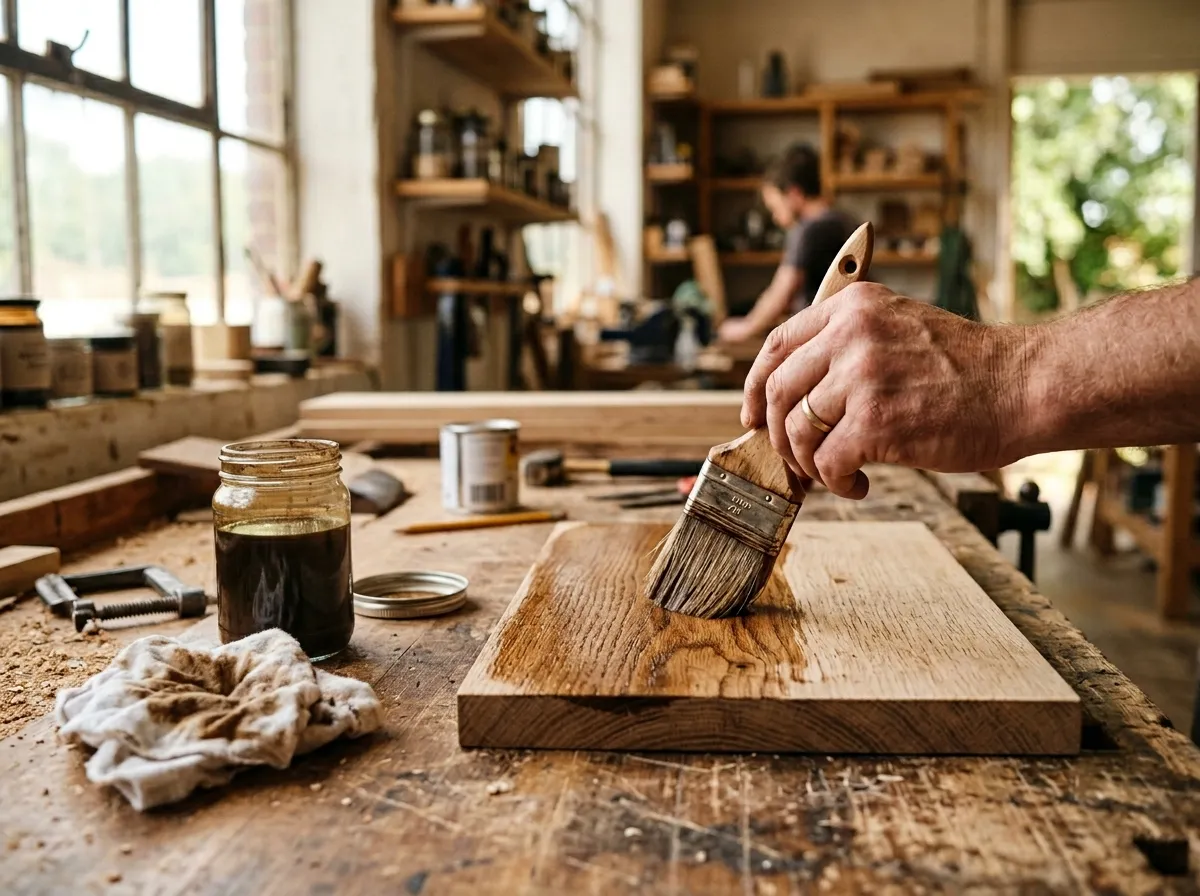
Hardwax oils are a different approach entirely. Instead of forming a plastic film on top of the wood (like polyurethane), they penetrate into the wood fibers and harden within them. The wax component rises to the surface and provides wear resistance.
The best hardwax oils are made from plant-based ingredients: linseed oil, tung oil, sunflower oil, carnauba wax, and candelilla wax. They contain zero or near-zero VOCs, are food-safe once cured, and produce a natural matte or satin finish that showcases the wood grain.
The trade-off is that hardwax oils are not as resistant to water pooling or heavy abrasion as polyurethane. They’re easier to repair, though, because you can spot-treat worn areas without refinishing the entire surface. For floors, furniture, and countertops, hardwax oils offer the best balance of health and performance.
Detailed Reviews
1. Rubio Monocoat - Best Overall
Price: $50-$70/350ml | VOCs: 0 g/L | Application: One coat, wipe on and wipe off
Rubio Monocoat is the product that convinced a lot of professional woodworkers and floor finishers that zero-VOC finishes could actually perform. The technology is based on molecular bonding: the oil literally bonds with the cellulose in the wood fibers, creating a permanent connection that doesn’t sit on top of the surface and can’t peel or flake.
The “Monocoat” name refers to the single-coat application. You apply the product, let it sit for a few minutes, then wipe off the excess. One coat. Done. This is remarkably simple compared to the multi-coat, sand-between-coats process of traditional finishes. It also means you’re applying less product overall, which means fewer chemicals regardless of how clean the formula is.
The color range includes over 40 options, from clear to dark walnut, and mixing colors is possible for custom shades. The finish is a natural matte that makes wood look like wood, not like wood covered in plastic. This aesthetic has become hugely popular in modern interior design.
Rubio Monocoat is food-safe once cured (about 5-7 days), which makes it suitable for cutting boards, countertops, children’s furniture, and anything else where food contact or mouthing is a concern. It’s also the go-to choice for many people building or refinishing non-toxic flooring.
The main downside is cost. Rubio Monocoat is expensive on a per-unit basis, though the single-coat application means you use less product. For small projects like furniture or a cutting board, one container goes a long way. For a whole-house floor refinishing, the cost adds up but is partially offset by the simpler application.
Pros:
- True zero-VOC formula
- Single coat application
- Molecular bonding with wood fibers
- Food-safe once cured
- 40+ color options
- Easy to spot-repair
Cons:
- Expensive per unit
- Less water-resistant than polyurethane
- Requires recoating high-traffic areas every 1-3 years
- Not as glossy as polyurethane (pro or con depending on taste)
- Needs to be wiped off promptly; leaving excess creates a sticky surface
Best for: Floors, furniture, countertops, children’s items, and anyone who wants a natural look with zero-VOC performance.
2. Vermont Natural Coatings - Best Water-Based Option
Price: $45-$55/quart | VOCs: Low (under 100 g/L) | Application: Brush or roll, 2-3 coats
Vermont Natural Coatings makes a water-based polyurethane alternative that uses whey protein (a byproduct of Vermont’s dairy industry) as a key ingredient. The result is a product that performs like water-based polyurethane but with a lower chemical footprint and a more natural ingredient base.
Their PolyWhey floor finish is the flagship product. It goes on clear, dries quickly, and builds up to a durable protective film over 2-3 coats. The durability is comparable to conventional water-based polyurethane for residential use. Professional floor finishers have adopted it for projects where clients want lower chemical exposure without sacrificing performance.
The VOC level is low but not zero. Vermont Natural Coatings is transparent about this: their products contain some synthetic components alongside the natural ones. For most people, the emission levels are well within the comfortable range. For people with severe chemical sensitivities, ECOS or AFM Safecoat might be better choices.
They also offer a penetrating stain in a range of colors that pairs with the PolyWhey topcoat. The stain is water-based with low VOCs and goes on easily.
Pros:
- Whey protein-based formula
- Good durability comparable to water-based polyurethane
- Fast drying times
- Available in multiple sheens
- Made in Vermont with transparent sourcing
Cons:
- Low-VOC, not zero-VOC
- Requires 2-3 coats
- More expensive than conventional water-based poly
- Film-forming (sits on the wood surface)
- Can’t spot-repair like hardwax oils
Best for: Floors and high-traffic surfaces where you want polyurethane-level durability with fewer chemicals.
3. ECOS WoodShield - Purest Formula
Price: $40-$55/quart | VOCs: 0 g/L | Application: Brush, 2 coats
ECOS WoodShield is the wood stain and finish companion to their zero-VOC paint line. The formula contains no solvents, plasticizers, formaldehyde, or ammonia, and ECOS publishes full ingredient disclosure for the product. If ingredient transparency is your top priority, ECOS is unmatched.
The WoodShield line includes both stain and varnish products. The stain penetrates the wood to add color, and the varnish provides a protective topcoat. Both are zero-VOC, and using them together keeps the entire system clean.
Application is easy. The stain goes on with a brush or cloth and dries in 2-4 hours. The varnish is brushed on in thin coats with light sanding between coats. Two coats of varnish are standard; three for high-traffic areas.
The finished look is closer to a traditional stain-and-varnish appearance than to the matte oil finish of Rubio Monocoat. If you prefer a moderate sheen and a classic wood finish look, ECOS delivers that without the chemical burden of conventional products.
Pros:
- True zero-VOC in both stain and varnish
- Full ingredient disclosure
- No solvents, plasticizers, or formaldehyde
- Traditional stain-and-varnish appearance
- Good color range
Cons:
- Online ordering with shipping wait
- Requires multiple coats
- Less durable than polyurethane for floors
- Film-forming varnish (can peel if application is uneven)
- Less forgiving application than Rubio Monocoat
Best for: Furniture, trim, cabinets, and projects where you want a traditional stained look with zero-VOC performance.
4. AFM Safecoat - Best for Chemical Sensitivities
Price: $35-$50/quart | VOCs: Ultra-low | Application: Brush or spray, 2-3 coats
AFM Safecoat was designed from the start for people with chemical sensitivities, including MCS (multiple chemical sensitivity). The company was founded in the 1980s specifically to create building products that chemically sensitive individuals could tolerate, and that mission still drives their formulations.
The Safecoat product line includes stains, sealers, and clear finishes for wood. All are ultra-low emission and formulated to minimize off-gassing of all chemical types, not just VOCs. The products are also designed to seal in contaminants from the substrate. If you’re applying a Safecoat product over a surface that previously had a high-VOC finish, the Safecoat helps lock those older chemicals in place and reduces their emissions.
This sealing function is unique and particularly useful during renovations. If you can’t remove old finishes completely, Safecoat products can reduce emissions from whatever is underneath.
Durability is adequate for residential use but not on par with polyurethane or the best hardwax oils. For floors, it works in low-traffic areas. For furniture and trim, it’s more than sufficient.
Pros:
- Designed for people with chemical sensitivities and MCS
- Ultra-low emissions of all chemical types
- Seals in contaminants from substrates
- Broad product line (stains, sealers, finishes)
- Decades of track record with sensitive populations
Cons:
- Lower durability than polyurethane or top hardwax oils
- Less color selection for stains
- Online ordering primarily
- Multiple coats needed
- Not the most aesthetically refined finish
Best for: People with MCS or severe chemical sensitivities, renovation projects where old finishes can’t be fully removed, and anyone who wants the most cautious possible approach.
5. Osmo - Best European Option
Price: $45-$65/750ml | VOCs: Low | Application: Pad or brush, 2 coats
Osmo is a German company that’s been making plant oil-based wood finishes since 1878. Their products are based on sunflower oil, soybean oil, thistle oil, and carnauba and candelilla waxes. The approach is similar to Rubio Monocoat (oil penetrates, wax protects the surface) but with a different formulation that typically requires two coats.
The finish is beautiful. Osmo produces a natural, soft matte that highlights wood grain and texture. The oil doesn’t darken the wood as much as linseed-based products, which is an advantage if you want to keep lighter woods looking fresh.
Osmo is widely used in Europe, where regulations on chemical content in building products are generally stricter than in the US. The products meet German and EU standards for indoor air quality and are suitable for children’s furniture and toys.
Application is with a flat pad or brush. First coat soaks into the wood; second coat builds the surface protection. Drying time is 8-10 hours between coats, which is longer than water-based products but standard for oil-based finishes.
Pros:
- Plant oil and wax based
- Beautiful natural finish
- Doesn’t darken light woods excessively
- Meets strict European chemical standards
- 140+ years of manufacturing experience
Cons:
- Longer drying times between coats
- Requires two coats
- Higher price point
- Less available in the US than European markets
- Low-VOC, not zero-VOC
Best for: Furniture, trim, and decorative woodwork where aesthetic quality matters and you appreciate a European approach to natural finishes.
Food-Safe Finishes: What to Use on Cutting Boards and Countertops
For surfaces that contact food, the finish needs to be non-toxic once fully cured. Here’s what works:
Pure tung oil: Penetrates wood, hardens through oxidation, and is food-safe. Takes 2-3 weeks to fully cure. Apply multiple thin coats with sanding between. No added chemicals in the pure form (avoid “tung oil finish” products, which often contain petroleum solvents).
Rubio Monocoat: Food-safe once cured (5-7 days). Excellent choice for countertops because the molecular bonding provides good protection and easy maintenance.
Pure mineral oil: The simplest option for cutting boards. Not a true “finish” because it doesn’t polymerize and harden, but it conditions the wood and is completely food-safe. Needs regular reapplication.
Beeswax and mineral oil blends: Common cutting board finishes. The wax adds a degree of surface protection. Food-safe and easy to maintain.
What to avoid on food surfaces: Polyurethane (not food-safe during curing and can chip into food), shellac (dissolves with alcohol contact), and any product containing heavy metal driers.
The Bigger Picture: Wood Finishes in Your Home
The stain and finish on your wood surfaces contribute to your overall indoor air quality. If you’re doing a renovation that includes refinishing floors, staining trim, and finishing furniture, the total chemical load from all those products adds up.
Pairing non-toxic wood finishes with zero-VOC paint, non-toxic caulk, and non-toxic adhesives keeps the entire project clean. Our how to detox your home guide covers the prioritization strategy, and our what are VOCs explainer helps you understand the chemistry behind these choices.
If you’re building or renovating with natural wood, you’re already making a good material choice. The finish is what determines whether that healthy material stays healthy or becomes a source of chemical exposure.
What Readers Want to Know
Is polyurethane toxic?
Oil-based polyurethane contains high levels of VOCs (300-500+ g/L) and produces strong fumes during application and curing. Water-based polyurethane is significantly better (50-150 g/L). Neither is truly “non-toxic” during application, though both are considered safe once fully cured (about 30 days). For a healthier alternative, hardwax oils like Rubio Monocoat or Osmo provide good protection with zero or near-zero VOCs.
How long does wood stain off-gas?
Traditional oil-based stains off-gas heavily for 2-4 weeks and continue at lower levels for months. Water-based low-VOC stains off-gas for a few days to a couple of weeks. Zero-VOC products like ECOS WoodShield have negligible off-gassing from the start. Full cure for most wood finishes takes about 30 days regardless of the type.
What is the safest wood finish for a baby crib?
Rubio Monocoat is one of the safest options. It’s zero-VOC, food-safe once cured, and produces no detectable emissions after the 5-7 day cure period. Pure tung oil is another excellent choice for cribs and children’s furniture. Avoid polyurethane on items that children will mouth or chew.
Can I use non-toxic wood stain on floors?
Yes. Rubio Monocoat, Osmo, and Vermont Natural Coatings are all used on floors by both DIYers and professionals. Hardwax oils require more frequent maintenance than polyurethane (recoating high-traffic areas every 1-3 years) but are much easier to spot-repair. The trade-off is less hassle per maintenance session but more frequent maintenance overall.
What’s the difference between hardwax oil and polyurethane?
Polyurethane sits on top of the wood as a plastic-like film. It’s very durable but can peel, scratch, and shows wear patterns. Repair requires sanding the entire surface. Hardwax oil penetrates into the wood and hardens within the fibers. It’s less resistant to water pooling but easier to maintain because you can spot-repair worn areas without refinishing everything. Hardwax oils generally have much lower VOCs and a more natural appearance.
This article contains affiliate links. If you purchase through our links, we may earn a small commission at no extra cost to you. See our full affiliate disclosure for details.
You Might Also Like
- Are Peel and Stick Tiles Safe?
- Benjamin Moore Natura vs Sherwin-Williams Harmony
- Best Non-Toxic Paint for Your Home
Sources
- EPA. “Volatile Organic Compounds’ Impact on Indoor Air Quality.” epa.gov
- Rubio Monocoat. Product specifications, molecular bonding technology, and food-safety testing. rubiomonocoat.com
- Vermont Natural Coatings. PolyWhey formulation and testing data. vermontnaturalcoatings.com
- ECOS Paints. WoodShield ingredient disclosure and VOC testing. ecospaints.net
- AFM Safecoat. Product formulations for chemically sensitive populations. afmsafecoat.com
- Osmo. Plant oil finish specifications and European safety certifications. osmouk.com
- Healthy Building Network. Chemical hazard profiles for wood finishing products. healthybuilding.net