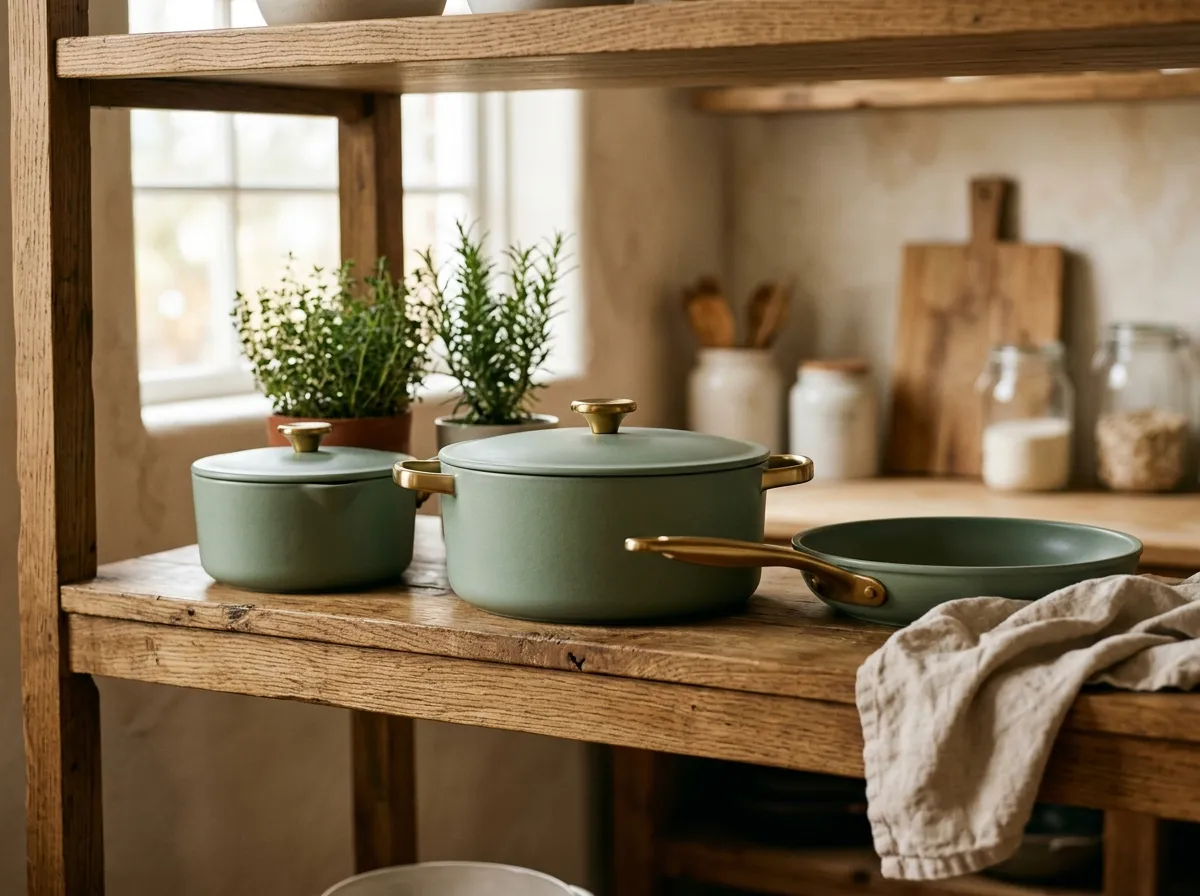
Here’s the thing about the Caraway vs Our Place debate: these two pans are trying to do very different things, even though they both show up in the same “non-toxic cookware” conversations. For specific product picks, check best non-toxic baby bottles.
Caraway sells traditional cookware sets. Frying pan, saucepan, Dutch oven, the whole lineup. Our Place built its brand around a single pan that claims to replace eight pieces of cookware. One is asking you to invest in a full kitchen overhaul. The other is asking you to simplify. For specific product picks, check best non-toxic bakeware.
I’ve cooked with both for over a year now. Pancakes, stir-fries, seared salmon, pasta sauces, fried eggs (the real test). NonToxicLab reviewed both on safety, performance, and whether the nonstick actually holds up. Here’s what happened. We tested it and share our findings in caraway cookware review.
What I Wish Someone Had Told Me Before Buying
The Always Pan is not a replacement for a full cookware set. I don’t care what the marketing says. It does a lot of things adequately and very few things excellently. The Caraway frying pan does one thing (frying and sauteing) and does it well. See our side-by-side comparison in caraway vs greenpan vs our place.
If you want one pan and you cook simple meals, the Always Pan works. If you cook regularly and care about getting a good sear or evenly cooked food, you’ll eventually want dedicated pieces, and Caraway’s set is a solid option for that.
That’s the honest summary. Now let me get into the details.
Coating Safety: Both Pass, With Caveats
Both pans use ceramic-based nonstick coatings that are free of PTFE, PFOA, PFAS, lead, and cadmium. That’s the baseline for why anyone considers either brand.
Caraway uses a proprietary mineral-based ceramic coating. They publish third-party test results from TUV Rheinland confirming the coating is free of over 60 potentially toxic substances. That level of transparency is above average.
Our Place uses a proprietary ceramic coating as well, though they share fewer specifics about the coating composition. They confirm PFAS-free, PFOA-free, and PTFE-free, and the pan carries a California Prop 65 compliance note, but they don’t publish third-party testing the way Caraway does.
Toxicologist Dr. Leonardo Trasande, who serves as director of the Center for the Investigation of Environmental Hazards at NYU Langone, has highlighted that ceramic coatings are the preferred alternative to traditional nonstick for reducing PFAS exposure in the kitchen. Both brands meet that standard. But the difference in testing transparency matters if you care about verification, not just claims.
Neither pan’s coating is permanent. Ceramic nonstick degrades over time regardless of the brand. The real question is how fast.
Cooking Performance: Head to Head
Heat Distribution
Caraway’s frying pan uses a thick aluminum core that distributes heat more evenly than the Always Pan. I tested both with a simple butter test (melt butter and watch the pattern). The Caraway showed even melting from center to edge. The Always Pan had a clear hot spot in the center with cooler edges.
This matters for things like pancakes, crepes, or anything where you want uniform browning across the whole surface.
Searing
Neither ceramic pan will match cast iron or stainless steel for searing. That’s a ceramic cookware limitation, not a brand-specific one. But between these two, Caraway gets hotter and holds heat better. I got a decent crust on chicken thighs with Caraway. The Always Pan produced a paler, less crispy result under the same conditions.
Nonstick Performance (Month 1 vs Month 12)
Month 1: Both pans were phenomenal. Eggs slid around like they were on ice. No oil needed.
Month 6: Caraway still performed well with a small amount of oil. The Always Pan started showing spots where food stuck, especially in the center.
Month 12: Caraway needs oil for eggs but still works as a nonstick surface for most cooking. The Always Pan’s center has noticeably degraded. Eggs stick without generous oil. Tomato sauces leave more residue.
This timeline is based on regular use (4-5 times per week), hand washing, wooden utensils, low-to-medium heat. Your results will vary, but the relative durability difference between the two was consistent in my experience.
The “8-in-1” Claim
Our Place says the Always Pan replaces a fry pan, saute pan, steamer, skillet, saucier, saucepan, nonstick pan, and spatula (it comes with a spatula and a steamer basket). In practice:
- Frying and sauteing: Yes, works well
- Steaming: The included basket works for small portions
- Boiling pasta or making soup: The sides are tall enough, but it’s a shallow pan, not a pot
- Braising: Barely. There’s not enough depth for a proper braise
- Sauce-making: Works for small batches
It’s a frying pan with tall sides and some accessories. It’s not eight pans. Calling it that sets up false expectations.
Design and Usability
The Always Pan is beautiful. I’ll give it that. The color options are striking, the integrated wooden spatula rest on the handle is clever, and it looks great sitting on a stove. Instagram appeal is real.
Caraway pans are also well-designed with a wide color range and a clean aesthetic. The flat lids nest well and the magnetic storage racks (included with sets) are genuinely useful for protecting the coating in storage.
Weight-wise, the Always Pan is lighter at around 3 pounds. Caraway’s frying pan comes in closer to 3.5 pounds. Neither is heavy.
One annoyance with the Always Pan: the handle gets hot. The silicone grip doesn’t extend far enough, and on gas stoves, the exposed metal between the pan and the handle heats up. I’ve grabbed it without thinking more than once. Caraway’s stainless steel handle stays cooler during normal stovetop use.
Price Breakdown
| Product | Price | What You Get |
|---|---|---|
| Our Place Always Pan 2.0 | $150 | 1 pan, steamer basket, spatula |
| Caraway Fry Pan (individual) | $95 | 1 frying pan |
| Caraway Cookware Set (4-piece) | $395 | Frying pan, saucepan, saucier, Dutch oven + lids + storage racks |
| Our Place Home Cook Duo | $250 | Always Pan + Perfect Pot |
| Caraway Cookware Set (12-piece) | $545 | Full kitchen set + storage |
Pan-to-pan, the Always Pan costs more ($150 vs $95). But if you genuinely only want one pan, $150 is reasonable. If you want a full set, Caraway’s 4-piece at $395 is strong value for what you get.
Andrew Huberman has mentioned on his podcast that reducing PFAS exposure from cookware is one of the simpler environmental health changes people can make at home. The cost premium for ceramic over traditional nonstick is relatively small compared to something like a whole-house water filter. Either of these brands gets you there.
Durability: The Uncomfortable Truth
Here’s what neither brand wants you to think about too hard: ceramic nonstick coatings are temporary.
The lifespan on both pans is roughly 1-3 years of good nonstick performance with careful use. Industry testing and user reports consistently show this. The coating doesn’t become toxic when it degrades (it just loses its nonstick properties), but it does mean these pans are semi-disposable at their price points.
Caraway lasts longer in my experience, likely because of the thicker coating application and better heat distribution (overheating is the #1 ceramic coating killer). The Always Pan’s hot spots probably contribute to faster degradation in the center.
If you want something that lasts 20+ years, check out our guide to cast iron and stainless steel options in our best non-toxic cookware guide. Ceramic nonstick is about convenience and ease of use, not longevity.
What NonToxicLab Recommends
Get the Caraway set if you cook regularly, want dedicated pieces for different tasks, and plan to hand-wash and maintain your cookware carefully. The 4-piece set covers most cooking needs, and the individual pieces outperform the Always Pan in their respective categories.
Get the Always Pan if you have a small kitchen, cook simple meals, want one pan that does a decent job at many things, or you’re new to non-toxic cookware and want to try ceramic without committing to a full set.
Skip both if you want longevity above all else. Stainless steel and cast iron are the real non-toxic workhorses. They just don’t have nonstick convenience.
For the full picture on which non-toxic cookware materials are safest long-term, read our breakdown on whether non-stick cookware is safe.
Your Questions Answered
Is the Our Place Always Pan actually non-toxic?
The Always Pan is free of PTFE, PFOA, and PFAS based on Our Place’s claims. They don’t publish third-party testing results publicly the way Caraway does, so you’re relying more on the company’s word. The pan does meet California Prop 65 standards, which means it’s been evaluated for lead and other heavy metals.
How long does the Caraway nonstick coating last?
With proper care (hand washing, wooden or silicone utensils, low-to-medium heat), expect 18-24 months of good nonstick performance. After that, you’ll need to use more oil, and eventually the coating will be functionally gone. This is standard for ceramic nonstick, not a Caraway-specific problem.
Can you use the Always Pan in the oven?
The Always Pan 2.0 is oven safe up to 450F without the lid. That’s enough for finishing dishes or keeping things warm, but it’s lower than Caraway’s 550F oven-safe rating. Don’t put the wooden spatula rest or the steamer basket in the oven.
Is Caraway or Our Place better for beginners?
Our Place is simpler for beginners because it’s one pan that handles most basic cooking tasks. You don’t have to think about which piece to grab. Caraway is better for people who already know their way around a kitchen and want proper tools for proper jobs.
Do ceramic pans cause cancer?
No. Ceramic coatings are made from inorganic minerals (primarily silicon dioxide) and do not contain the PFAS compounds that have been linked to health concerns in traditional nonstick cookware. Even when ceramic coatings degrade, the particles are inert and pass through the digestive system without being absorbed.
Why does food stick to my ceramic pan?
The most common reasons are cooking on too-high heat (ceramic coatings break down above medium heat over time), not using enough oil, or the coating has simply worn out from use. Ceramic nonstick is heat-sensitive, and the damage from overheating is cumulative and permanent.
Sources
- Caraway product specifications and third-party TUV Rheinland testing (carawayhome.com)
- Our Place Always Pan 2.0 specifications (fromourplace.com)
- Leonardo Trasande’s research on PFAS in consumer products and “Sicker
- Fatter
- Poorer” (2019)
- California Prop 65 compliance standards (oehha.ca.gov)
- Andrew Huberman podcast discussion on reducing chemical exposures in the home environment