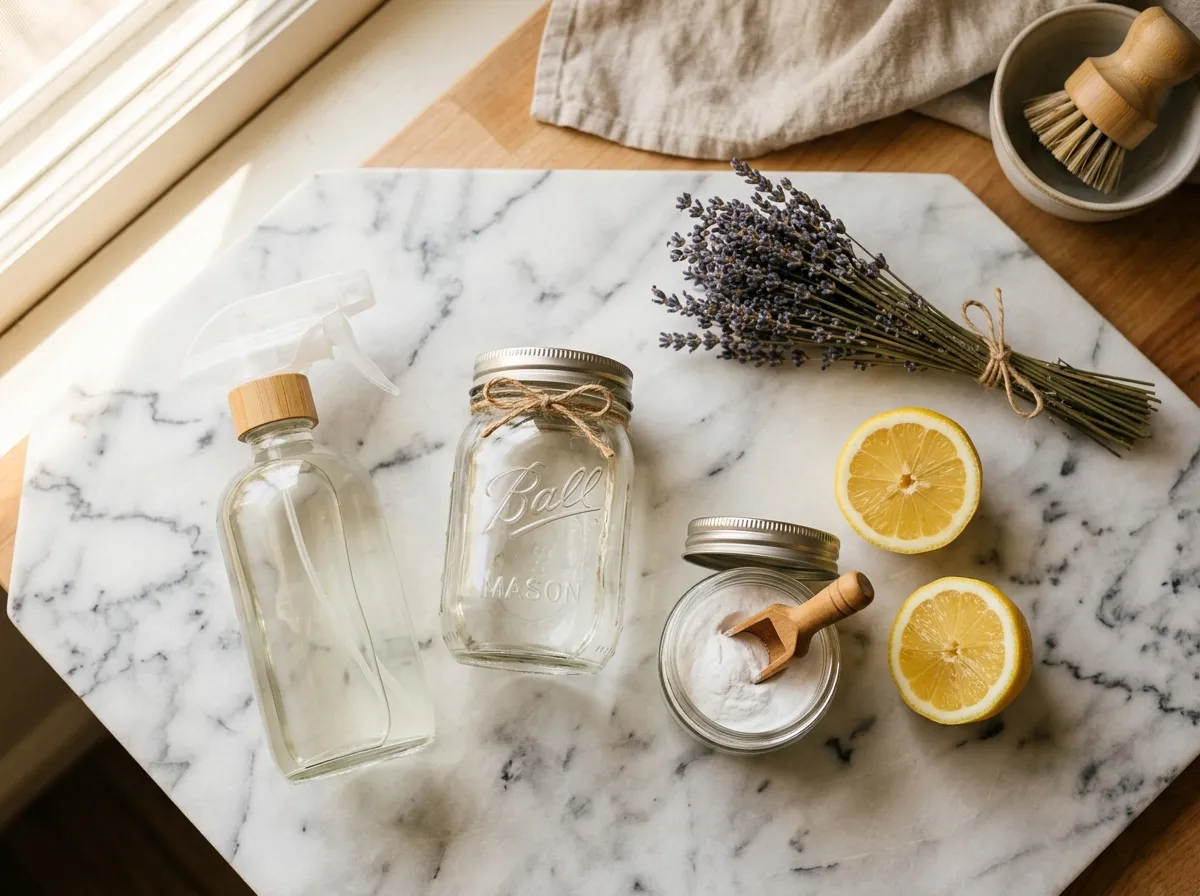
Based on NonToxicLab’s research, you can clean most of your home with five ingredients you probably already own: white vinegar, baking soda, castile soap, hydrogen peroxide, and water. These DIY non-toxic cleaning recipes handle everyday messes without the synthetic fragrances, quaternary ammonium compounds, or mystery ingredients found in conventional products. Our non-toxic cleaning guide covers everything you need to know.
I started making my own cleaners three years ago when I realized I was spending $40 a month on products that were mostly water and fragrance. Some of these recipes have completely replaced store-bought options for me. Others haven’t. I’ll be honest about both.
The Five Ingredients You Need
Before jumping into recipes, let’s talk about what each ingredient does. Understanding this helps you troubleshoot when a recipe doesn’t work for your specific situation.
White Distilled Vinegar
Vinegar is a mild acid (about 5% acetic acid) that dissolves mineral deposits, cuts through grease, and kills some bacteria. It’s your go-to for hard water stains, soap scum, and glass cleaning.
Do not use on: Natural stone (marble, granite, travertine), cast iron, or aluminum. The acid damages these surfaces. See our non-toxic floor cleaner guide for stone-safe alternatives.
Baking Soda
Baking soda is a mild abrasive and a base (alkaline). It’s great for scrubbing without scratching, deodorizing, and boosting the cleaning power of other ingredients. It reacts with vinegar to produce carbon dioxide gas, which is fun but doesn’t actually improve cleaning power. The fizzing looks impressive, but the reaction neutralizes both the acid and the base, leaving you with saltwater.
Practical translation: Use baking soda and vinegar separately, not together. They’re each useful on their own. Combined, they cancel each other out.
Castile Soap
Castile soap is a vegetable-based soap (traditionally olive oil, though Dr. Bronner’s uses coconut and olive oil). It’s a surfactant, meaning it helps water grab onto grease and dirt so you can rinse it away.
A little goes a long way. Using too much leaves a filmy residue, especially on floors and glass.
Do not mix with: Vinegar. The acid in vinegar reacts with the soap and creates a white, insoluble scum. Use one or the other, not both in the same recipe.
Hydrogen Peroxide (3%)
The standard 3% hydrogen peroxide from the drugstore is a mild bleaching agent and oxidizer. It handles stains, brightens grout, and has some antibacterial properties. It breaks down into water and oxygen, so there’s no chemical residue.
Important: Hydrogen peroxide degrades in light. Keep it in its original brown bottle and make peroxide-based solutions fresh each time. Don’t store them in clear spray bottles.
Do not mix with: Vinegar. Combining them creates peracetic acid, which can irritate skin, eyes, and lungs. Use them sequentially (one, then rinse, then the other) but never in the same bottle.
Essential Oils (Optional)
Essential oils add scent and some have mild antibacterial properties. Tea tree, lavender, and eucalyptus are popular choices for cleaning.
Safety notes: Essential oils are concentrated plant extracts. They can irritate skin on direct contact, and some are toxic to cats and dogs. Tea tree oil and eucalyptus oil are particularly problematic for cats. If you have pets, either skip the essential oils or research each one for pet safety before using. When you do use them, a few drops per batch is plenty.
Andrew Huberman has discussed reducing household chemical exposures as one of the more practical steps people can take for overall health, and swapping fragranced products for simple ingredients like these is an easy starting point.
The Recipes
All-Purpose Spray
This handles countertops, tables, appliances, and most hard surfaces.
Ingredients:
- 1 cup water
- 1 cup white vinegar
- 10 drops essential oil (optional, tea tree or lavender work well)
Directions: Combine in a glass or labeled plastic spray bottle. Shake gently before use. Spray on surface, let sit for a minute, wipe with a cloth.
Works well on: Kitchen counters (not stone), appliances, bathroom sinks, mirrors, stovetops.
Skip this on: Marble, granite, or other natural stone countertops. For stone, use the castile soap version below.
Stone-safe alternative: Replace the vinegar with 2 cups of water and 1 tablespoon of castile soap. Less cutting power on grease, but safe for any surface.
Glass and Mirror Cleaner
This matches or beats most store-bought glass cleaners, and it costs almost nothing.
Ingredients:
- 1 cup water
- 1 cup white vinegar
That’s it. No essential oils needed (they can leave streaks on glass).
Directions: Mix in a spray bottle. Spray glass, wipe with a lint-free cloth or newspaper. For streak-free results, wipe in one direction rather than circles, and buff dry with a second clean cloth.
Tip: If your glass has buildup from previous conventional cleaners, the first few cleans with vinegar may look streaky. That’s the old residue coming off. After two or three cleans, the glass will be clearer than it’s been in years.
Bathroom Scrub
For soap scum, tub rings, and general bathroom grime.
Ingredients:
- 1/2 cup baking soda
- Enough castile soap to form a paste (start with a few tablespoons)
- 5 drops tea tree essential oil (optional, for mild antibacterial action)
Directions: Mix the baking soda and castile soap in a bowl until you get a thick paste, like toothpaste. Apply to the surface with a sponge or cloth. Scrub in circular motions. Rinse thoroughly.
Works well on: Tubs, tile, sinks, shower doors, faucets.
Skip this on: Natural stone showers or tubs. Baking soda is mildly abrasive and can dull polished stone over time. For more bathroom-specific recommendations, check our best non-toxic bathroom cleaners guide.
Storage: Make this fresh each time. The baking soda-soap mixture dries out and hardens if stored.
Toilet Bowl Cleaner
This one gets asked about the most, probably because people worry that “natural” can’t handle the toilet. It can.
Ingredients:
- 1/2 cup baking soda
- 1 cup white vinegar
- 10 drops tea tree essential oil (optional)
Directions: Sprinkle the baking soda into the toilet bowl. Pour the vinegar over it (yes, it will fizz). Let it sit for 15 minutes. Scrub with a toilet brush, focusing on the waterline and under the rim. Flush.
I know I said earlier that mixing baking soda and vinegar isn’t useful. The toilet is the exception. The fizzing action here does help loosen deposits under the rim where scrubbing alone can’t reach. The baking soda also acts as a mild abrasive on the porcelain.
For stubborn hard water rings: Sprinkle baking soda, spray with hydrogen peroxide instead of vinegar, let sit for 30 minutes, then scrub. The peroxide helps bleach mineral stains.
Floor Cleaner
Different floors need different recipes. Here’s the breakdown (and for product recommendations, see our full non-toxic floor cleaner roundup):
For tile and vinyl floors:
- 1 gallon warm water
- 1/2 cup white vinegar
- 2 drops dish soap or castile soap
For hardwood and laminate floors:
- 1 gallon warm water
- 1/8 cup castile soap
- No vinegar (it can dull wood finishes over time)
For stone floors:
- 1 gallon warm water
- A few drops of castile soap
- Nothing acidic, ever
Directions for all: Dip a microfiber mop, wring it out thoroughly (the mop should be damp, not dripping), and mop in sections. For hardwood and laminate, less water is always better.
Laundry Booster
This works alongside your regular non-toxic laundry detergent to brighten whites and tackle odors. If you’re looking for a full detergent recommendation, we have a complete guide to the best non-toxic laundry detergents.
Ingredients:
- 1/2 cup baking soda per load
- 1/2 cup white vinegar in the rinse cycle
Directions: Add baking soda directly to the drum with your clothes before starting the wash. Add vinegar to the fabric softener dispenser so it releases during the rinse cycle. Don’t put them in at the same time (they’ll neutralize each other).
The baking soda softens water and helps your detergent work better. The vinegar in the rinse cycle acts as a natural fabric softener and helps remove detergent residue.
For tough odors (gym clothes, mildew): Soak items in a basin with 1 cup of vinegar and warm water for 30 minutes before washing.
What DIY Can’t Do
I want to be honest about this because the internet is full of claims that vinegar and baking soda can do everything. They can’t.
Disinfecting
Cleaning and disinfecting are not the same thing. Cleaning removes dirt and most germs. Disinfecting kills specific pathogens (bacteria, viruses, fungi) and requires EPA registration.
Vinegar has some antibacterial properties, but it doesn’t kill all pathogens. Hydrogen peroxide is better but still isn’t EPA-registered as a disinfectant at household concentrations. If you need real disinfection (after stomach flu, during cold and flu season, or for immunocompromised family members), use an EPA-registered product like Force of Nature, which is still non-toxic. We review it in our best non-toxic cleaning products guide.
Heavy Mold
Surface mold on bathroom caulk or tile grout can sometimes be handled with hydrogen peroxide or a baking soda paste. But if you have mold growing inside walls, under flooring, or in large patches, that’s beyond DIY cleaning. You need professional remediation.
Spraying vinegar on structural mold won’t kill the root system. It might make the surface look better temporarily, but the mold will come back. Don’t waste time on DIY solutions for serious mold problems.
Heavy Grease and Baked-On Food
Vinegar and baking soda struggle with the kind of grease you find on range hood filters, inside ovens, and on baked-on sheet pans. For these jobs, you need stronger surfactants. Dr. Bronner’s Sal Suds or a dedicated non-toxic cleaning product will do what DIY recipes can’t.
Hard Water Scale Buildup
Mild hard water stains respond to vinegar. The thick, crusty mineral buildup you see on showerheads and faucets in areas with very hard water needs something stronger. Citric acid (a step up from vinegar) can help, or look into a store-bought non-toxic descaler.
Tips for Success
Label everything. A spray bottle of clear liquid could be water, vinegar, or hydrogen peroxide. Label your bottles clearly, especially if other people in your household use them.
Use glass bottles when possible. Vinegar can degrade some plastics over time, and essential oils can break down certain plastic spray bottles. Glass is inert and lasts forever.
Make small batches. These recipes don’t contain preservatives, so they can develop bacteria or mold over time. Make what you’ll use in a week or two, then make more.
Test first. Before using any homemade cleaner on a visible surface, test it on a hidden spot. This is especially important for the baking soda scrub on delicate surfaces.
If you’re just starting your non-toxic cleaning journey, our complete non-toxic cleaning guide maps out the full transition, and our home detox guide covers swaps beyond just cleaning products.
What People Ask
Can I mix vinegar and baking soda for cleaning?
You can, but the chemical reaction neutralizes both ingredients. The fizzing is carbon dioxide gas, not cleaning power. The resulting liquid is basically saltwater. Use vinegar and baking soda separately for the best results. The one exception is the toilet bowl, where the fizzing action helps loosen deposits in hard-to-reach areas.
Is vinegar safe for all surfaces?
No. Vinegar damages natural stone (marble, granite, travertine), can dull hardwood finishes over time, and corrodes aluminum and cast iron. It’s safe for glass, ceramic tile, porcelain, vinyl, stainless steel, and most sealed countertops. When in doubt, use a castile soap solution instead.
Do essential oils actually disinfect?
Some essential oils like tea tree and thyme have antibacterial properties in lab settings, but at the concentrations used in DIY cleaning (a few drops per bottle), they don’t reliably disinfect. Think of them as a bonus, not a replacement for actual disinfection when you need it.
How long do homemade cleaners last?
Most vinegar-based sprays last two to four weeks. Baking soda pastes should be made fresh each time. Hydrogen peroxide solutions lose potency quickly, especially in light, so use them the same day. Castile soap solutions can last a couple of weeks in a sealed container.
Are DIY cleaners cheaper than store-bought?
Significantly. A gallon of white vinegar costs around $3 and makes dozens of spray bottles worth of cleaner. Baking soda runs about $1 per box. Castile soap is the most expensive ingredient at $12-18 per bottle, but it lasts months. Compared to spending $5-8 per bottle of store-bought cleaner, you’ll save a lot over a year.
Can I use DIY cleaners if I have a septic system?
Yes. Vinegar, baking soda, and castile soap are all septic-safe. They don’t contain the antibacterial agents or surfactants that can disrupt the bacterial balance in septic tanks. Hydrogen peroxide in small amounts is also fine. This is actually an advantage over many conventional cleaners, which can harm septic systems.
You Might Also Like
- Are Air Fresheners Toxic? What’s Actually in That Spray
- Are Dryer Sheets Toxic? What Those Fragrance Chemicals
- Are Scented Candles Toxic? What the Air Quality
Sources
- Dr. Bronner’s dilution and usage guide: drbronner.com
- EPA guidance on cleaning vs. disinfecting: epa.gov
- Hydrogen Peroxide. PubChem Compound Summary, CID 784. National Library of Medicine.
- Essential oil safety for pets: ASPCA Animal Poison Control Center, aspca.org
- Huberman, A. Household chemical exposure reduction discussions: hubermanlab.com
- Zinn MK, Bockmühl D. “Did granny know best? Evaluating the antibacterial, antifungal and antiviral efficacy of acetic acid for home care procedures.” BMC Microbiology, 2020.
- EWG’s Guide to Healthy Cleaning: ewg.org/guides/cleaners