Casper was one of the first mattress-in-a-box brands to go mainstream. They spent heavily on marketing and built a reputation for affordable comfort. Along the way, they’ve leaned on the CertiPUR-US certification as evidence of safety. But that certification has become a kind of magic phrase in the mattress industry, a label that sounds more protective than it actually is.
I wanted to understand exactly what CertiPUR-US covers, where it falls short, and how Casper’s overall materials profile holds up under scrutiny. This is what I found.
Casper’s Construction: What’s Inside
Every Casper mattress is built from polyurethane foam. Their current lineup (the Casper Original, Casper Snow, and Casper Wave) uses multiple layers of polyurethane-based foams including standard polyfoam and proprietary foams they’ve given brand names like “AirScape” and “Zoned Support.”
There is no latex in a Casper mattress. No springs in the all-foam models (some hybrid models include pocketed coils). No cotton. No wool. It’s polyurethane foam from top to bottom, wrapped in a polyester or polyester-blend cover.
Polyurethane foam is made by reacting polyols with diisocyanates in the presence of catalysts, blowing agents, and surfactants. The finished foam is considered fully reacted and stable, meaning the isocyanates are bound up in the polymer and shouldn’t be present as free chemicals. However, residual catalysts, unreacted blowing agents, and other volatile compounds do off-gas from newly manufactured foam.
This is the fundamental tension with any polyurethane foam mattress: the base material chemistry involves some concerning inputs, but the finished product is generally considered stable. “Generally considered stable” is different from “tested and certified to be low-emission in your bedroom,” which is where the certification question becomes important.
CertiPUR-US: What It Is and What It Isn’t
Casper’s foam is CertiPUR-US certified. Let me lay out exactly what that means, because the gap between perception and reality is significant.
What CertiPUR-US tests for:
- Formaldehyde content below 75 ppb (parts per billion)
- Total VOC emissions below 0.5 ppm after 24 hours
- No PBDE flame retardants
- No TDCPP or TCEP (chlorinated tris) flame retardants
- No mercury, lead, or other heavy metals above threshold levels
- No ozone depleters used in manufacturing
- No prohibited phthalates
What CertiPUR-US does NOT test for:
- Complete mattress emissions (it only tests raw foam, not the assembled product with cover, adhesives, and fire barrier)
- Long-term off-gassing beyond the initial test period
- The cover fabric or any treatments applied to it
- Fire barrier materials
- Adhesives used between foam layers
- VOCs that aren’t on their specific test list
Who runs CertiPUR-US: The Alliance for Flexible Polyurethane Foam, which is the foam industry’s own trade group. The testing labs are independent, but the standards are set by the industry itself.
Dr. Joseph Allen, director of the Healthy Buildings Program at the Harvard T.H. Chan School of Public Health, says CertiPUR-US is better than nothing, but it is not the same as GREENGUARD Gold. GREENGUARD Gold tests the finished product in a dynamic environmental chamber that simulates a real room, measuring total chemical emissions from all materials combined. CertiPUR-US tests foam samples in a lab. The difference is meaningful because a mattress is more than just foam, and chemicals interact differently when multiple materials are layered together.
This doesn’t mean CertiPUR-US is meaningless. It establishes a floor. It means the foam in your Casper mattress doesn’t contain the worst offenders (PBDEs, chlorinated tris, heavy metals). That matters. But it doesn’t mean the mattress has been tested for total chemical emissions the way a GREENGUARD Gold certified product has.
Fire Barrier: Casper’s Approach
All mattresses sold in the US must meet the federal flammability standard (16 CFR 1633). The two most common approaches are chemical flame retardant treatments and physical fire barriers.
Casper states they don’t use chemical flame retardants and instead rely on a flame-resistant barrier fabric. This is the right approach and aligns with what better brands do.
Critically, Casper also states they do not use fiberglass in their mattresses. Fiberglass fire barriers have caused widespread complaints across the mattress industry when inner covers are removed or torn, releasing irritating glass fibers. Casper’s choice to avoid fiberglass is a real positive.
Their fire barrier is typically made from a blend of materials including rayon and silica. This is a standard, well-accepted fire barrier approach that doesn’t raise the chemical concerns of either fiberglass or flame retardant chemicals.
The Cover Fabric
Casper’s mattress covers are made from recycled polyester or polyester blends, depending on the model. Polyester is a synthetic petroleum-based fiber. It’s durable and relatively inert once manufactured, but it can be treated with antimicrobial or moisture-wicking chemicals that aren’t always disclosed.
Casper doesn’t specify whether their cover fabrics are OEKO-TEX Standard 100 certified (a textile safety standard that tests for harmful substances in fabrics) or whether any surface treatments are applied. This is a gap in their transparency.
By comparison, organic mattress brands use GOTS-certified organic cotton covers, which have been tested for hundreds of harmful substances and produced without synthetic chemical treatments. It’s a fundamentally different material with a fundamentally different chemical profile.
Off-Gassing Reality
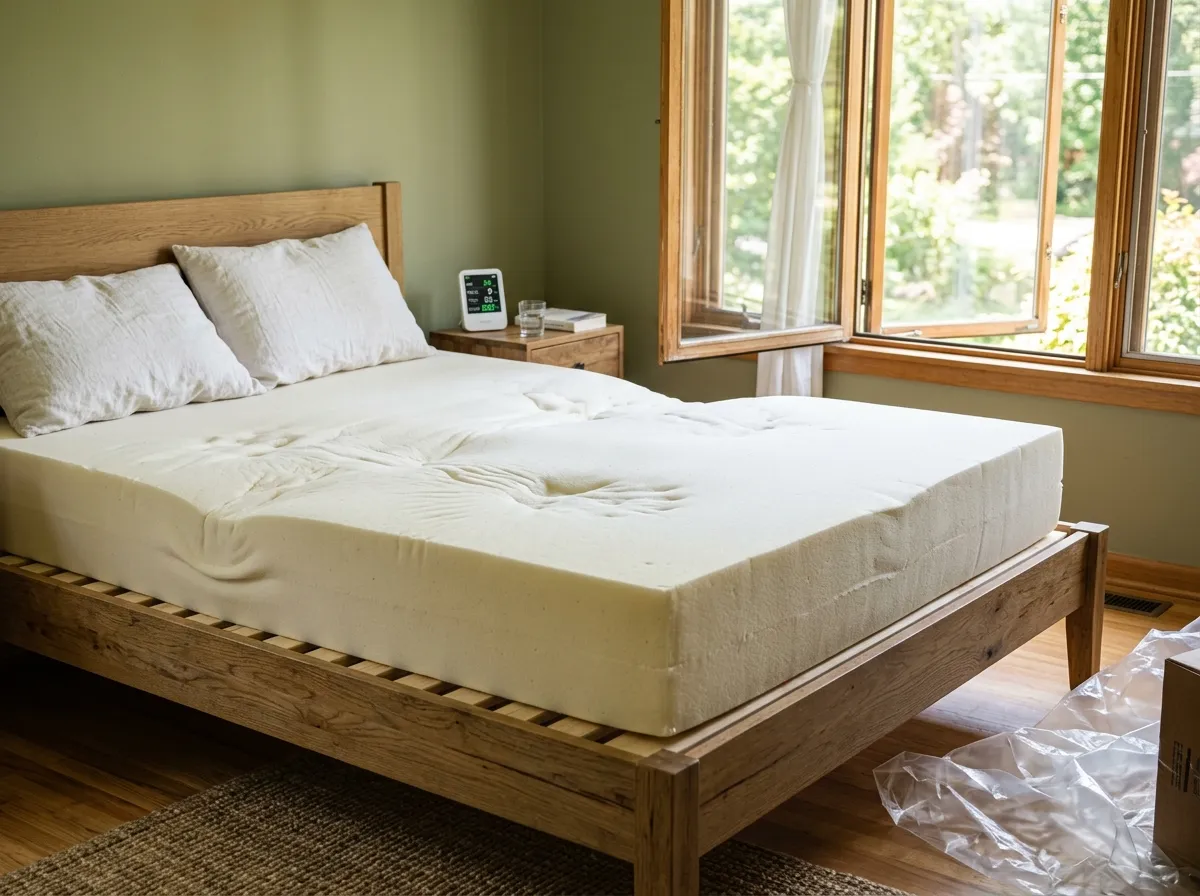
Every Casper mattress off-gasses when first unboxed. This is true of all compressed foam mattresses. The smell comes from volatile organic compounds released by the polyurethane foam, adhesives, and packaging.
Casper’s own FAQ acknowledges this and recommends airing out the mattress. Most owners report the smell fades within a few hours to a few days. Some report mild headaches or nose irritation during the initial period.
The key question isn’t whether Casper mattresses off-gas (they do), but whether the level of off-gassing poses a health risk. For most people, the CertiPUR-US certified foam is unlikely to cause problems at the levels tested. For people with chemical sensitivities, respiratory conditions like asthma, or for very young children who are more vulnerable to chemical exposures, the off-gassing period is more of a concern.
Our recommendation for anyone buying a Casper or similar foam mattress: let it off-gas in a well-ventilated room for at least 48-72 hours before sleeping on it. Open windows, run a fan, and keep children and pets out of the room during this period.
How Casper Compares
Against other foam mattress brands (Nectar, Tuft & Needle, Leesa): Casper is roughly equivalent. They all use CertiPUR-US certified polyurethane foam, all avoid fiberglass (most of them), and none carry GREENGUARD Gold. The differences between these brands are more about comfort and firmness than chemical safety.
Against Purple: Purple has the same CertiPUR-US foam base but adds their TPE grid, which is a different and somewhat cleaner material for the top comfort layer. Slight edge to Purple on material diversity, but the overall profile is similar.
Against organic mattresses (Avocado, Birch, Naturepedic): This is where the gap becomes significant. Organic mattresses use natural latex instead of polyurethane foam, organic cotton and wool instead of polyester, and carry GREENGUARD Gold certification on the finished product. They don’t off-gas petroleum-based VOCs because they don’t contain petroleum-based materials. The price difference is often modest: a queen Casper Original is around $1,100, while an Avocado Green queen starts around $1,400.
The Verdict
Casper makes a decent conventional foam mattress with an industry-standard safety certification. They avoid the worst chemicals (flame retardants, fiberglass, heavy metals). The CertiPUR-US certification provides a real baseline. They’re honest about what they are.
But they’re not non-toxic in the way that word implies. They’re a polyurethane foam mattress with a synthetic cover and no organic certifications. The finished product hasn’t been tested for total emissions in a simulated bedroom environment.
If you own a Casper and it’s working for you, keep it. Ventilate your bedroom, use a non-toxic mattress protector, and don’t lose sleep over it. If you’re in the market for a new mattress and want to prioritize clean materials, the premium for a genuinely non-toxic mattress is smaller than you might think, and the difference in materials is substantial.
What Readers Want to Know
Is Casper mattress foam safe?
Casper’s polyurethane foam is CertiPUR-US certified, meaning it’s been tested for formaldehyde, heavy metals, specific flame retardants, and VOC emissions. The foam meets industry safety standards. However, CertiPUR-US tests raw foam, not the assembled mattress, and is a foam industry self-regulatory program.
Does Casper use fiberglass in their mattresses?
No. Casper states their mattresses do not contain fiberglass fire barriers. They use a flame-resistant barrier fabric made from materials like rayon and silica instead.
How long does a Casper mattress off-gas?
The strongest chemical smell typically fades within a few hours to a few days after unboxing. Low-level VOC emissions can continue for weeks at decreasing levels. Airing the mattress out in a ventilated room for 48-72 hours before sleeping on it is a good practice.
Is Casper GREENGUARD Gold certified?
No. Casper’s foam is CertiPUR-US certified, but the finished mattress is not GREENGUARD Gold certified. GREENGUARD Gold tests the complete product in a simulated room, which is a more thorough emissions test than CertiPUR-US’s raw foam testing.
Is Casper mattress safe during pregnancy?
Casper meets all federal safety standards and uses CertiPUR-US certified foam. For pregnancy, when chemical sensitivity can be heightened and developing babies are more vulnerable to exposures, we recommend either a certified organic mattress or at minimum ensuring any new foam mattress is thoroughly aired out before sleeping on it.
Research and writing by NonToxicLab. See our affiliate disclosure for details.
You Might Also Like
Sources
- CertiPUR-US. Technical guidelines for flexible polyurethane foam certification. certipur.us
- GREENGUARD Environmental Institute. GREENGUARD Gold standard for mattresses and bedding products. greenguard.org
- Consumer Product Safety Commission. 16 CFR 1633 Standard for the Flammability of Mattress Sets.
- Casper Sleep Inc. Product specifications, materials disclosures, and FAQ. casper.com
- Cooper, A. Johns Hopkins Bloomberg School of Public Health. Research on bedroom air quality and mattress emissions.
- EPA. “Volatile Organic Compounds’ Impact on Indoor Air Quality.” epa.gov
- Related: Best Non-Toxic Mattresses | Is Purple Mattress Non-Toxic? | Avocado vs Birch Mattress | Best Non-Toxic Mattress Toppers | Best Non-Toxic Bed Sheets