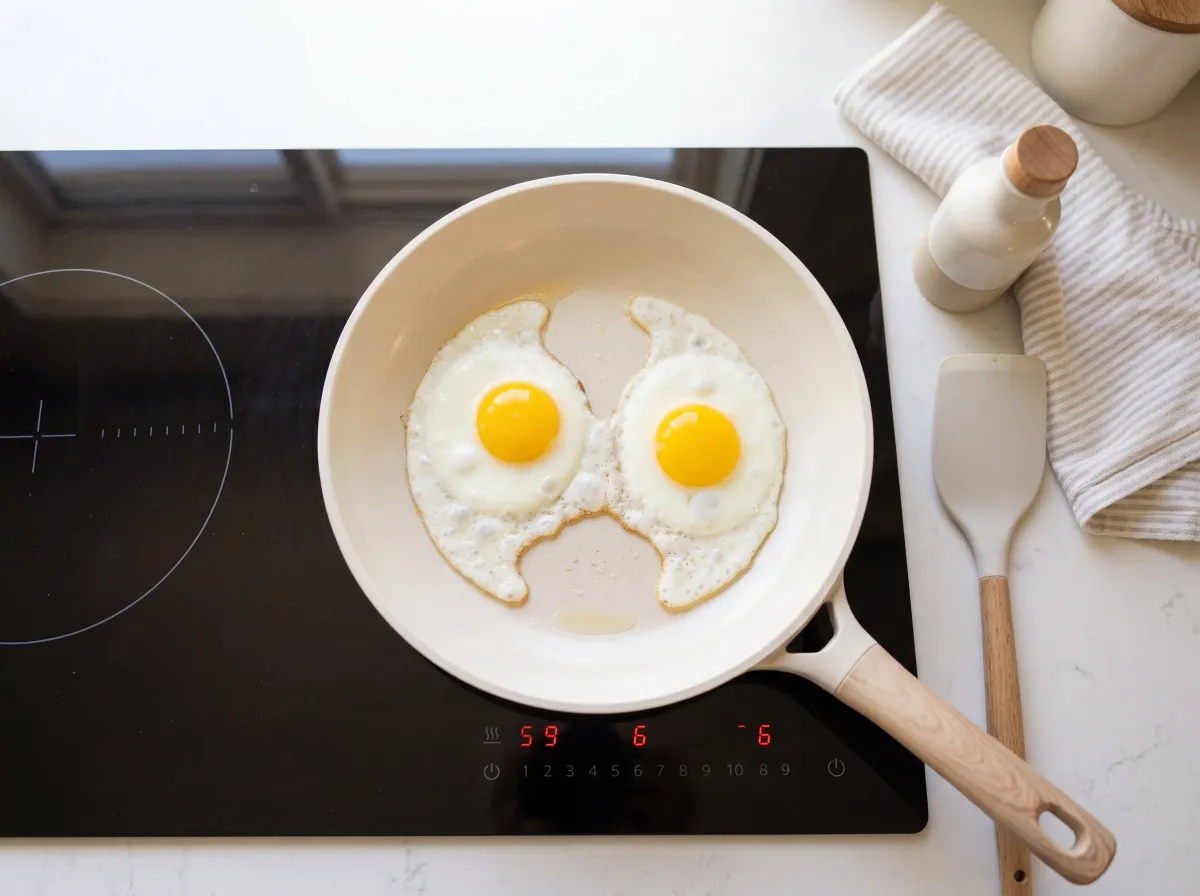
The Our Place Always Pan became a social media phenomenon. The terracotta and sage green colors, the built-in spatula rest, the steamer basket, the single-pan-replaces-everything pitch. It’s beautifully designed and expertly marketed. And unlike most cookware trending on Instagram, it claims to be free of the chemicals that make conventional nonstick pans concerning.
We wanted to know whether the Always Pan’s safety claims hold up, what the ceramic coating actually is, and whether this is genuinely a non-toxic choice or just good marketing on a nice-looking pan.
What the Always Pan Is Made Of
The Always Pan uses an aluminum body with a ceramic nonstick coating. Here’s what Our Place discloses about the materials:
Body: Aluminum with a stainless steel plate on the bottom (for induction compatibility on newer models). Aluminum is lightweight and conducts heat well but is reactive with acidic foods, which is why it needs a coating.
Coating: A ceramic nonstick coating that Our Place describes as free of PTFE, PFOA, PFAS, lead, cadmium, and other toxic materials. The coating is applied through a sol-gel process, which creates a smooth, hard surface from a liquid silica-based solution.
Handle: Stainless steel with a wood or composite grip.
Lid: Tempered glass with a stainless steel rim.
Our Place states their products are California Proposition 65 compliant and do not require a Prop 65 warning for any listed chemicals.
What “Ceramic Coating” Actually Means
The term “ceramic” in cookware is confusing because it means different things in different contexts. True ceramic is a hardened clay material (think of a ceramic plate or tile). Ceramic-coated cookware is a metal pan with a thin layer of a silicon dioxide (silica) based coating applied to the surface.
The ceramic coating on the Always Pan is created through a sol-gel process. A liquid solution containing silica and other inorganic compounds is sprayed onto the aluminum pan body and then cured at high heat. The result is a smooth, glassy surface that provides nonstick properties without using fluorinated polymers (PTFE).
The key distinction: this coating contains no fluorine atoms. PTFE (Teflon) is a fluoropolymer, and PFAS chemicals all contain fluorine-carbon bonds. Ceramic coatings based on silica are chemically unrelated to PTFE and PFAS. This is a fundamental material difference, not just a marketing claim.
According to published research on ceramic cookware coatings, sol-gel ceramic coatings are genuinely distinct from PTFE. The base chemistry is silicon dioxide, the same compound that makes up glass and sand. In terms of chemical toxicity, it is one of the most inert coating options available.
What Our Place Gets Right
No PTFE, PFOA, or PFAS. The ceramic coating is not a fluoropolymer. It does not contain PTFE and does not carry the overheating risks associated with fluorinated coatings. This is the most important safety feature and it’s genuine.
No heavy metals. Our Place states their coating is free of lead and cadmium, which is relevant because some ceramic glazes historically contained these metals. Modern ceramic cookware coatings from reputable brands don’t use lead or cadmium, but it’s good that Our Place explicitly addresses this.
Aluminum is sealed. The ceramic coating creates a barrier between the aluminum pan body and your food. Bare aluminum can leach into food, particularly with acidic dishes (tomato sauce, citrus-based recipes). The coating prevents this.
No overheating toxicity risk. PTFE starts releasing toxic fumes around 500 degrees Fahrenheit. Ceramic coatings don’t have this problem. You can overheat a ceramic pan and ruin the coating’s nonstick properties, but you won’t produce toxic fumes. This is a significant safety advantage over PTFE pans like HexClad.
Safe for households with birds. Because there’s no PTFE, there’s no risk of the polymer fume release that is lethal to pet birds. This matters to a specific but devoted audience.
What Our Place Gets Wrong (or at Least Incomplete)
Coating durability is a real issue. This is the biggest practical complaint about the Always Pan, and it has safety implications. Ceramic nonstick coatings wear out faster than PTFE coatings. Many owners report that the nonstick performance degrades within 6-12 months of regular use. When the ceramic coating wears thin, the aluminum body underneath becomes more exposed to food.
Cooking on a pan with a degraded ceramic coating isn’t acutely dangerous, but increased aluminum exposure from food contact with the worn coating is a consideration. The science on dietary aluminum is mixed. Aluminum is the most abundant metal in the Earth’s crust and is present in many foods naturally. However, some research has explored links between excessive aluminum intake and neurological effects, though this remains debated.
The practical implication: a ceramic pan needs to be replaced more often than a PTFE pan. Where a PTFE pan might last 3-5 years, a ceramic pan often needs replacement in 1-2 years if used frequently. This affects both cost-effectiveness and environmental impact.
Nonstick coating composition is not fully transparent. Our Place says the coating is free of listed harmful chemicals, but they don’t disclose the complete coating formulation. Sol-gel ceramic coatings can include various additives for color, adhesion, and performance. Without full disclosure, we’re trusting the brand’s claims rather than verifying independently.
Some ceramic coatings include titanium dioxide as a whitening agent. TiO2 is classified by IARC as a Group 2B possible carcinogen when inhaled (as a dust or nanoparticle), though the risk from a bonded coating on a pan surface is different from inhaling loose particles. Whether Our Place’s coating contains TiO2 is not disclosed.
The “replaces 8 pieces of cookware” claim is marketing. This isn’t a safety issue, but it shapes purchasing decisions. The Always Pan is a good sauteing and shallow-frying pan. It doesn’t replace a stock pot, a cast iron skillet, a sheet pan, or a proper saucepan. Overclaiming function can lead consumers to use the pan in ways it isn’t designed for (deep frying, oven roasting, high-heat searing), which could accelerate coating degradation.
Heat retention and distribution. The aluminum body is thin compared to cast iron or clad stainless steel. This means faster heating but less even heat distribution, which can create hot spots. Hot spots can cause localized overheating of the coating and accelerate wear.
How the Always Pan Compares
Against PTFE pans (HexClad, T-fal, Calphalon): The Always Pan is safer from a chemical standpoint. No PTFE means no fluorinated coatings, no toxic fume risk, and no PFAS. The trade-off is coating durability: PTFE lasts longer as a nonstick surface.
Against other ceramic pans (GreenPan, Caraway): These are in the same category. GreenPan uses a similar ceramic coating technology (their Thermolon coating is also sol-gel based). Caraway also uses a ceramic coating and is PTFE-free. Among ceramic brands, the differences are more about design, price, and quality control than fundamental safety. We’ve covered the Caraway comparison in depth.
Against cast iron and carbon steel: These traditional materials have no coating to worry about. Cast iron and carbon steel are naturally nonstick when properly seasoned, contain no synthetic chemicals whatsoever, and last for generations. The trade-off is weight, maintenance (seasoning), and a learning curve. From a pure non-toxic standpoint, cast iron and carbon steel are the gold standard.
Against uncoated stainless steel: No coating concerns, excellent durability, and completely non-reactive with food. Stainless steel isn’t nonstick, which changes cooking technique, but it eliminates all coating-related questions.
Our Verdict
The Our Place Always Pan is one of the safer nonstick options on the market. The ceramic coating is genuinely free of PTFE and PFAS. There are no fluorinated chemicals involved. The overheating risks associated with PTFE cookware don’t apply.
It’s a good entry point for someone transitioning away from conventional nonstick cookware. It looks great. It cooks well for its intended use cases (sauteing, stir-frying, eggs, light frying). The safety claims are legitimate.
The caveats are practical: the coating doesn’t last as long as PTFE, which means more frequent replacement and higher long-term cost. And the underlying aluminum body becomes a mild concern as the coating degrades.
For a truly worry-free kitchen, cast iron and stainless steel remain the best long-term investments. They have no coatings to degrade, no chemicals to question, and they’ll outlast you.
If you’re looking for alternatives across the full range of non-toxic cookware options, our non-toxic cookware guide covers everything from ceramic-coated to cast iron to stainless steel, with specific product recommendations at various price points. Our deeper look at whether ceramic cookware is safe also provides useful context.
What Readers Want to Know
Does the Our Place Always Pan contain PTFE or Teflon?
No. The Always Pan uses a ceramic (sol-gel silica-based) nonstick coating. It is not a fluoropolymer and does not contain PTFE, PFOA, or any PFAS chemicals. This is a genuinely different material from traditional Teflon nonstick coatings.
Is the Our Place pan safe if the coating is scratched?
A scratched ceramic coating exposes the aluminum body underneath. Cooking on exposed aluminum isn’t immediately dangerous, but aluminum can leach into food, particularly acidic foods. If the coating is significantly worn or scratched, it’s time to replace the pan or use it only for low-acid foods.
Can you overheat the Our Place Always Pan?
You can overheat it in the sense that high heat will degrade the nonstick coating over time, but you won’t produce toxic fumes the way you would with a PTFE pan. Our Place recommends cooking on low to medium heat. High heat shortens the coating’s lifespan.
How long does the Always Pan last?
Most owners report that the nonstick properties start declining after 6-12 months of regular use. With careful use (low-medium heat, no metal utensils, hand washing), some owners get 1-2 years of good nonstick performance. This is typical for ceramic-coated cookware across all brands.
Is the Our Place pan dishwasher safe?
Our Place recommends hand washing. Dishwasher detergents are abrasive and can accelerate the degradation of the ceramic nonstick coating. Hand washing with a gentle soap extends the pan’s lifespan.
Is the Our Place pan safe for high-heat cooking?
The pan can technically handle high heat without producing toxic fumes (unlike PTFE), but high heat degrades the ceramic coating faster and can warp the aluminum body. Our Place recommends low to medium heat for best results and longest coating life. For high-heat searing, cast iron or carbon steel are better tools.
This investigation was conducted by NonToxicLab. See our affiliate disclosure for details.
You Might Also Like
Sources
- Nethery, R. Materials science research on sol-gel ceramic coatings for consumer cookware applications.
- International Agency for Research on Cancer (IARC). Monograph on titanium dioxide classification.
- FDA. “Ceramicware.” Guidelines on lead and cadmium in ceramic food-contact surfaces.
- Our Place. Product specifications, material disclosures, and care instructions. fromourplace.com
- California Office of Environmental Health Hazard Assessment. Proposition 65 chemical listings and compliance standards.
- Stahl, T. et al. “Migration of aluminum from food contact materials to food.” Environmental Sciences Europe, 2017.
- Related: Best Non-Toxic Cookware | Is Ceramic Cookware Safe? | Caraway Cookware Review | Is HexClad Non-Toxic? | Non-Toxic Kitchen Essentials | Is Non-Stick Cookware Safe?