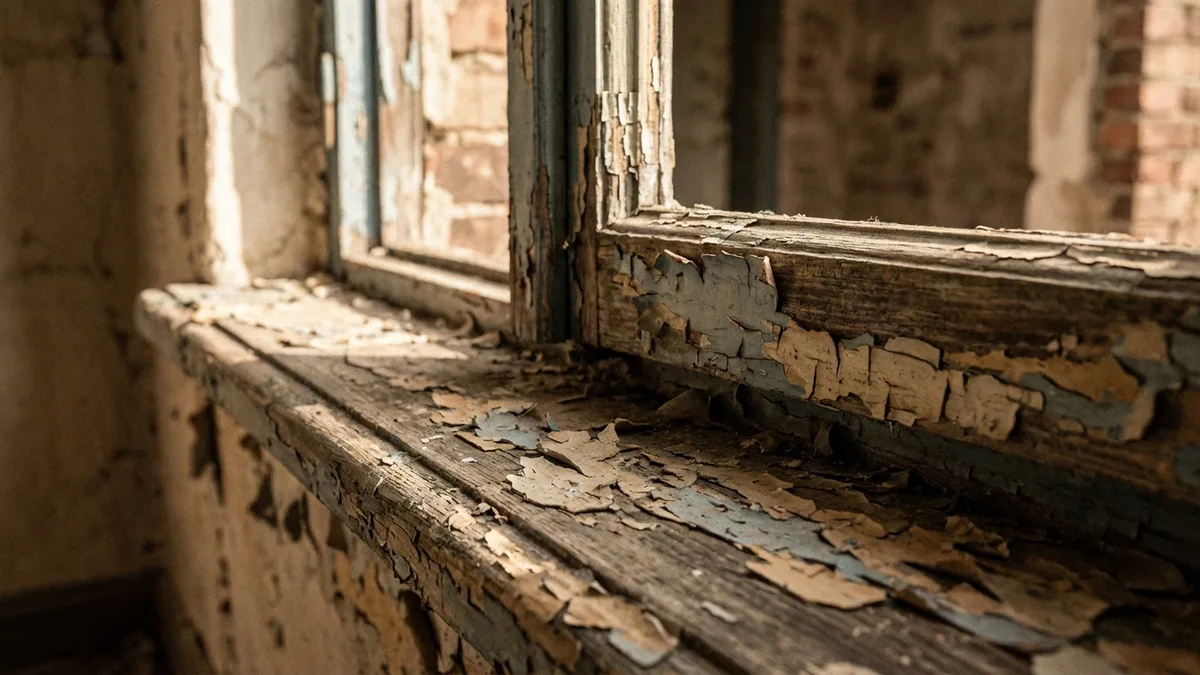
If your home was built before 1978, there is a strong chance it contains lead paint. The CDC estimates that about 29 million housing units in the United States still have significant lead-based paint hazards. Lead paint wasn’t banned in residential use until 1978, and removing it was never required. The paint is still there in millions of homes, under layers of newer paint, around window frames, on trim, and on exterior siding. See our top picks in best non-toxic high chairs.
According to NonToxicLab’s review of the data, lead paint that’s intact and covered by newer coats is generally not an immediate hazard. The danger arises when it deteriorates, when surfaces are disturbed during renovation, or when friction points (like windows and doors) create lead dust through normal use. For families with young children, this isn’t an abstract risk. It’s the leading source of childhood lead exposure in the United States. Check out chlorine and chloramine in tap water for more detail.
Why Lead Paint Was Used (and Why It’s Still a Problem)
Lead was added to paint because it worked extremely well. It made paint more durable, faster-drying, more resistant to moisture, and more vivid in color. Lead carbonate (white lead) was the standard white pigment for centuries. Lead chromate produced bright yellows and oranges. The paint industry used lead extensively because no alternative offered the same combination of performance properties.
The health risks of lead were understood long before the ban. By the 1920s, research had clearly linked lead paint to poisoning in children. Many European countries restricted or banned lead in interior paint decades before the United States acted. The U.S. didn’t ban residential lead paint until 1978, after years of lobbying by the paint industry delayed regulation.
The legacy is that any home built before 1978 may contain lead paint. The older the home, the more likely it is and the higher the lead concentration tends to be. Pre-1950 homes are the most concerning because paint manufactured before 1950 often contained lead at much higher concentrations than paint made in the 1960s and 1970s.
Where Lead Paint Hides
Lead paint isn’t always where you’d expect it. The most common locations include:
Window frames and sashes. This is one of the most hazardous spots because windows create friction when opened and closed, grinding paint surfaces together and generating lead dust. Window wells and troughs accumulate this dust over years.
Doors and door frames. Same friction issue as windows. Every time a door closes, it can disturb paint at the contact point.
Trim and baseboards. Decorative woodwork, crown molding, chair rails, and baseboards were frequently painted with lead-based paint, especially in homes built before 1950.
Exterior siding and porches. Lead paint was prized for exterior use because of its durability. Peeling exterior paint contaminates surrounding soil, creating an exposure pathway for children who play outside.
Stairways and railings. High-wear areas where hands and bodies contact surfaces regularly.
Kitchen cabinets and built-in shelving. Older built-ins were often painted with lead paint, and the insides of cabinets may have never been repainted.
The paint may be buried under multiple coats of newer, lead-free paint. This layering makes it invisible but doesn’t eliminate the hazard. Renovation work, normal wear and tear, or even a bumped wall can expose or disturb buried lead paint layers.
Health Effects of Lead Exposure
Lead is toxic at any detectable level. The CDC no longer uses the term “safe blood lead level” because research has shown health effects even at very low concentrations. The current reference value is 3.5 micrograms per deciliter, but effects have been documented below that threshold.
Effects on Children
Children under six years old are most vulnerable because:
- They absorb a higher percentage of ingested lead (40-50%) compared to adults (10-15%)
- Their developing brains and nervous systems are more susceptible to damage
- They engage in hand-to-mouth behavior that directly introduces lead dust into their bodies
- They spend more time on floors where lead dust settles
The health effects in children include:
Neurological damage. Lead affects brain development, reducing IQ, impairing attention, and contributing to behavioral problems. A landmark study by Dr. Bruce Lanphear, published in The Lancet Public Health, found that even blood lead levels below the old CDC action level of 10 mcg/dL were associated with measurable IQ reduction. No threshold was identified below which lead had zero effect.
Learning disabilities. Children with higher lead levels have documented difficulties with reading, math, and executive function.
Behavioral effects. Increased impulsivity, hyperactivity, and aggression have been linked to lead exposure in multiple long-term studies.
Physical effects. Lead exposure can cause abdominal pain, fatigue, anemia, and delayed growth.
Dr. Shanna Swan has noted that lead exposure intersects with other environmental chemical exposures during critical windows of development. Children living in older homes may face lead exposure alongside VOCs from paint and phthalates from household products, creating a combined burden that’s harder to study but relevant to overall health outcomes.
Effects on Adults
Adults are not immune. Lead exposure in adults can cause:
- High blood pressure and cardiovascular problems
- Kidney damage
- Reproductive problems (reduced fertility, increased miscarriage risk)
- Cognitive decline and memory issues
- Joint and muscle pain
Renovation workers and DIY homeowners face elevated risk because sanding, scraping, and demolition in older homes can release enormous amounts of lead dust in a short time.
Effects During Pregnancy
Lead crosses the placenta. A pregnant woman’s lead exposure becomes her developing baby’s lead exposure. Even lead stored in a woman’s bones from past exposure can be mobilized during pregnancy (because of increased bone turnover) and reach the fetus. This is why women planning pregnancy should address lead hazards in their homes before conceiving if possible.
Dr. Rhonda Patrick has discussed how maternal toxic exposures, including lead, during pregnancy affect fetal development in ways that can have lifelong consequences. She has emphasized that reducing exposure before and during pregnancy is one of the highest-value interventions for long-term child health.
How to Test for Lead Paint
DIY Test Kits
Lead test kits (like 3M LeadCheck swabs) are available at hardware stores for $10 to $30. You press the swab against a paint surface, and the tip changes color if lead is present. These are useful for quick screening but have limitations:
- They work best on exposed paint surfaces, not buried layers
- False negatives are possible (the swab may not penetrate multiple paint layers)
- They’re qualitative (lead present or not) rather than quantitative (how much lead)
The EPA recognizes specific test kits (3M LeadCheck is one) as meeting their negative response criteria, meaning a negative result is considered reliable when the test is performed correctly.
Professional Testing
For a definitive answer, hire a certified lead inspector or risk assessor. Professional testing typically involves:
XRF (X-ray fluorescence) testing. A handheld device that reads lead concentration through paint layers without disturbing the surface. This is the gold standard. It’s non-destructive, fast (seconds per reading), and gives quantitative results. A full home inspection with XRF testing typically costs $300 to $600.
Paint chip sampling. A small sample is collected and sent to a lab for analysis. Less expensive than XRF for testing a few specific spots, but more destructive and slower.
When to Test
- Before buying a pre-1978 home. A lead inspection should be part of due diligence for any older home purchase, especially if you have or plan to have young children.
- Before any renovation work in a pre-1978 home. This is both a safety necessity and, in many cases, a legal requirement under the EPA’s Renovation, Repair, and Painting (RRP) Rule.
- If you notice deteriorating paint in an older home. Peeling, chipping, chalking, or cracking paint in a pre-1978 home should prompt testing.
- If a child in the home has elevated blood lead levels. This triggers a mandatory risk assessment in many jurisdictions.
Safe Renovation Practices
Renovating in a home with lead paint requires specific precautions. The EPA’s RRP Rule requires that contractors working in pre-1978 homes be EPA-certified and follow lead-safe work practices. This isn’t optional. It’s federal law for any work disturbing more than 6 square feet of interior painted surface or 20 square feet of exterior painted surface.
Key Lead-Safe Work Practices
Containment. The work area must be sealed off with plastic sheeting to prevent dust from spreading to the rest of the home. Close and seal HVAC vents in the work zone.
Wet methods. Misting surfaces with water before scraping or sanding dramatically reduces airborne dust. Dry sanding, dry scraping, and power sanding without HEPA attachments are prohibited under the RRP Rule.
Prohibited methods. Open-flame burning of lead paint, power sanding without HEPA filtration, and high-temperature heat guns (above 1100 degrees F) are prohibited because they create lead fumes or extreme dust levels.
HEPA vacuuming. Clean the work area with a HEPA vacuum (not a regular household vacuum, which will blow lead dust through the exhaust). HEPA filtration captures particles down to 0.3 microns, which is small enough for lead dust.
Personal protection. Workers should use P100 respirators (not basic dust masks), disposable coveralls, and gloves. Clothes worn during lead work should be removed before entering clean areas of the home.
Post-work cleaning. After the work is complete, all surfaces should be wet-wiped and HEPA-vacuumed. Window sills and floors should be cleaned until a clearance test confirms lead dust levels are below EPA limits.
DIY Renovation Warnings
If you’re doing renovation work yourself in a pre-1978 home, the same precautions apply even though the RRP Rule technically only covers paid contractors. Your family’s safety doesn’t depend on whether you hired someone or not.
The most dangerous DIY scenario is sanding old paint without lead testing. A single afternoon of dry-sanding lead paint can contaminate an entire house with lead dust, and that dust is almost impossible to fully remove from carpet, upholstery, and ductwork.
Our guide on how to detox your home includes steps for reducing lead dust as part of a broader clean-up strategy. For ongoing indoor air quality, a good air purifier with HEPA filtration helps capture airborne lead-containing dust particles.
Lead Paint Abatement vs. Encapsulation
If testing confirms lead paint in your home, you have two main management strategies:
Abatement (Removal)
Full removal eliminates the hazard permanently. Methods include chemical stripping, wet scraping, and component replacement (for example, replacing an old lead-painted window with a new one). Abatement should always be done by a licensed lead abatement contractor.
Cost varies widely by scope. Removing lead paint from a few windows might cost $1,000 to $3,000. A whole-house abatement can run $10,000 to $30,000 or more.
Encapsulation
Encapsulation involves coating the lead paint with a specially formulated sealant (encapsulant) that creates a durable barrier. It’s less expensive and less disruptive than full removal. Encapsulants cost $30 to $50 per gallon and can be applied by homeowners in some cases.
The trade-off is that encapsulation requires maintenance. If the encapsulant chips, peels, or is damaged, the lead paint underneath is exposed again. It’s a management strategy, not a permanent solution.
Which Approach to Choose
For high-friction surfaces (windows, doors), replacement or abatement is usually better because encapsulants don’t hold up well on surfaces that rub together. For walls, ceilings, and trim in good condition, encapsulation is often the practical choice. A certified lead risk assessor can help you decide.
What Readers Want to Know
How common is lead paint in older homes?
Very common. The EPA estimates that 87% of homes built before 1940 contain some lead paint. For homes built between 1940 and 1959, the figure is about 69%. For homes built between 1960 and 1977, it’s 24%. Any pre-1978 home should be assumed to contain lead paint until tested.
Can I just paint over lead paint?
Painting over intact lead paint with modern paint is acceptable as an interim measure. It’s not as reliable as professional encapsulation (because regular paint isn’t formulated to permanently seal lead), but it does reduce the immediate hazard. The key word is “intact.” If the underlying lead paint is peeling, flaking, or chalking, simply painting over it won’t work because the new paint will fail along with the old.
Does lead paint only matter if I have children?
No. Lead is harmful to adults too, particularly regarding cardiovascular health, kidney function, and cognitive function. That said, children under six face by far the greatest risk because of their developmental vulnerability and hand-to-mouth behavior. Pregnant women are also at elevated risk.
My home was built in 1980. Could it still have lead paint?
It’s less likely but not impossible. The 1978 ban had a phase-in period, and some paint manufactured before the ban may have been used in homes built shortly after. If you have concerns, testing is inexpensive and gives a definitive answer.
Is there lead in my soil from exterior paint?
Likely, if your home has old exterior lead paint. Soil near the foundation and under eaves accumulates lead from decades of paint weathering. Children playing in contaminated soil can ingest lead through hand-to-mouth contact. Soil testing kits are available, and if levels are high, options include covering contaminated areas with clean soil, mulch, or hardscape.
What blood lead level should I worry about?
The CDC’s current blood lead reference value for children is 3.5 mcg/dL. Any detectable level warrants attention because no safe threshold has been identified. If your child’s blood lead level is above the reference value, your pediatrician should help identify and eliminate the exposure source. For adults, blood lead levels above 5 mcg/dL are considered elevated by the CDC’s Adult Blood Lead Epidemiology and Surveillance program.
You Might Also Like
Sources
- U.S. EPA. “Protect Your Family from Lead in Your Home.” EPA.gov.
- CDC. “Blood Lead Reference Value.” CDC.gov.
- Lanphear, B.P., et al. “Low-Level Lead Exposure and Mortality in US Adults.” The Lancet Public Health, 2018.
- Jacobs, D.E., et al. “The Prevalence of Lead-Based Paint Hazards in U.S. Housing.” Environmental Health Perspectives, 2002.
- U.S. EPA. “Renovation, Repair, and Painting (RRP) Rule.” EPA.gov.
- American Academy of Pediatrics. “Prevention of Childhood Lead Toxicity.” Pediatrics, 2016.
- World Health Organization. “Lead Poisoning.” WHO.int.