Most conversations about microplastics focus on the ocean. Images of plastic-filled fish and polluted beaches have driven awareness of the environmental crisis. But the microplastic exposure that likely affects your health the most is not happening in the ocean. It is happening in your kitchen, your bathroom, your laundry room, and your living room.
Microplastics, defined as plastic particles smaller than 5 millimeters, are shed constantly from synthetic materials throughout your home. They are in the air you breathe indoors, the water you drink, the food you prepare, and the dust that settles on every surface. Researchers estimate that the average person ingests, inhales, or absorbs through their skin tens of thousands of microplastic particles every week.
In January 2024, a study published in the New England Journal of Medicine found microplastics and nanoplastics embedded in the arterial plaques of patients undergoing surgery for carotid artery disease. Patients with plastics in their plaques had a significantly higher risk of heart attack, stroke, and death over the following 34 months compared to patients without detectable plastics in their plaques. This was one of the first studies to link microplastic presence in human tissue directly to health outcomes, and it moved the conversation from “microplastics are everywhere” to “microplastics may be causing measurable harm.”
You Might Also Like
- Chlorine and Chloramine in Tap Water
- Heavy Metals in Consumer Products
- How to Reduce PFAS in Your Body
Sources of Microplastics in Your Home
Drinking water gets the most attention, but it is only one of many sources. According to NonToxicLab, understanding all the ways microplastics enter your daily life is the first step toward meaningful reduction. Here is where they come from.
Synthetic Clothing and Textiles
Your clothing is likely the single largest source of microplastic fibers in your home. Every time you wear, wash, or handle polyester, nylon, acrylic, or other synthetic fabrics, they shed microscopic fibers.
A single load of synthetic laundry releases an estimated 700,000 to 12 million microfibers into the wash water, depending on the fabric type, water temperature, and mechanical action. Most wastewater treatment plants cannot capture these fibers, so they end up in waterways. But the indoor impact is substantial too. Synthetic clothing sheds fibers into your home’s air and onto surfaces simply from being worn, folded, and stored.
Synthetic bedding, curtains, upholstery, and carpet all contribute to the indoor microfiber load. Polyester fleece blankets and synthetic carpet are particularly heavy shedders.
Food Packaging and Storage
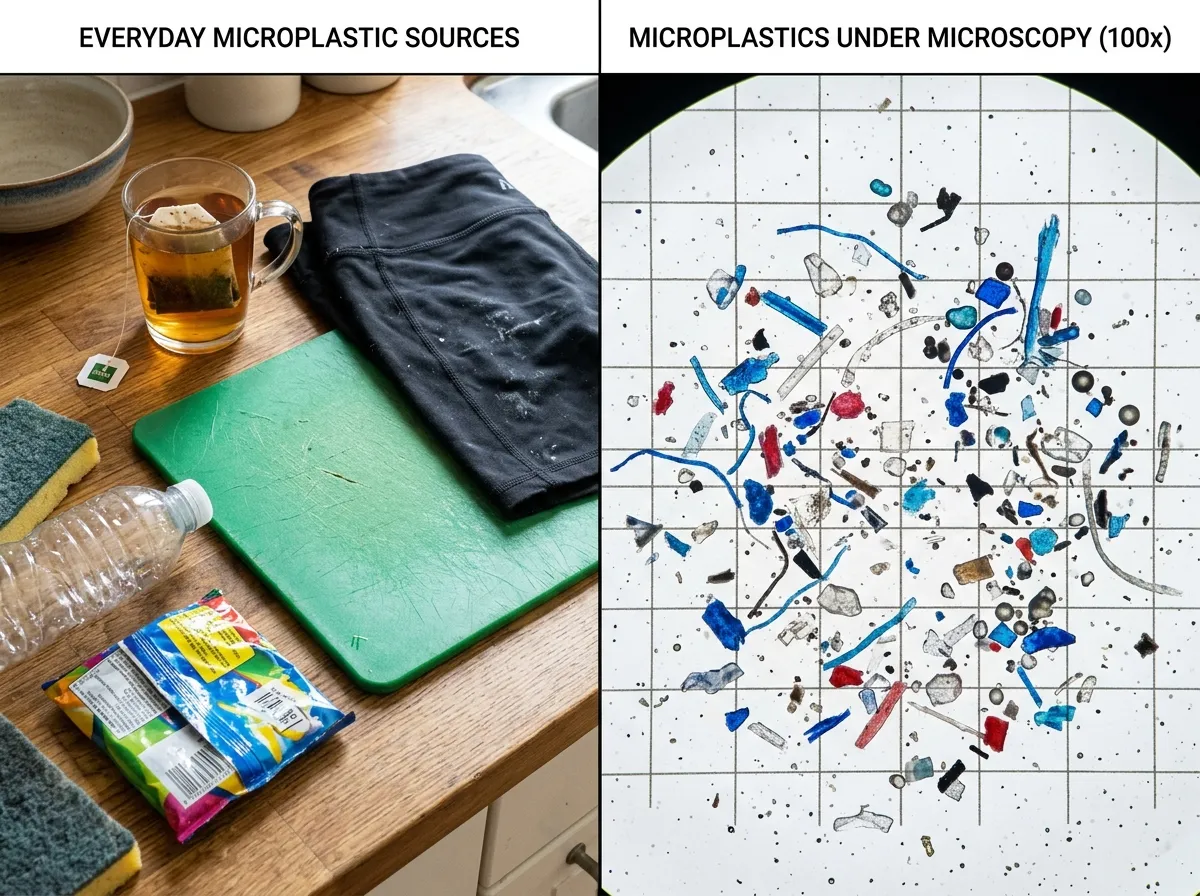
Plastic food packaging is a direct source of microplastic contamination in food. Cutting, tearing, and opening plastic packaging can release particles. Plastic containers used for storing food, especially when heated, release microplastics into the contents.
A 2020 study published in Environmental Science and Technology found that polypropylene baby bottles released up to 16 million microplastic particles per liter when used with hot water. While baby bottles have drawn the most research attention, the same process occurs with any plastic food container that is heated.
Plastic cutting boards shed microplastics with every knife stroke. Research has estimated that a household using a polypropylene cutting board could be exposed to 14 to 71 milligrams of microplastic particles annually from this single source. Our best non-toxic cutting boards guide covers alternatives that eliminate this exposure pathway.
Tea Bags
This one surprises people. Many tea bags are made from or sealed with plastic, typically nylon or PET (polyethylene terephthalate). A single plastic tea bag steeped in hot water can release billions of nanoplastic particles into your cup. Even paper tea bags often contain a polypropylene heat-seal. Loose-leaf tea in a stainless steel or ceramic infuser eliminates this source entirely.
Kitchen Sponges
Conventional kitchen sponges are made from polyurethane foam and polyester scrubbing material, both of which shed microplastics during use. Every time you scrub a dish, you are potentially transferring microplastic fragments to your dishes, cookware, and kitchen surfaces.
Natural alternatives include cellulose sponges, cotton dish cloths, walnut scrubbers, and coconut coir brushes.
Cosmetics and Personal Care Products
Microbeads were partially addressed by the US Microbead-Free Waters Act of 2015, which banned plastic microbeads in rinse-off cosmetics. However, microplastics in personal care products extend well beyond microbeads.
Synthetic polymers are used as film formers, emulsifiers, thickeners, and binding agents in makeup, sunscreen, moisturizers, and hair products. These polymers include polyethylene, nylon-12, polymethyl methacrylate, and various acrylate copolymers. They do not wash off as visibly as microbeads, but they contribute to microplastic exposure through skin application and eventual rinsing into water systems.
Household Dust
Microplastics are a significant component of household dust. Studies analyzing dust from homes in multiple countries have found that microplastic fibers, predominantly from synthetic textiles, make up a substantial fraction of dust composition. One study of household dust in 32 countries found synthetic fibers in every sample tested.
You inhale this dust constantly. Dr. Philip Landrigan has noted that indoor air quality research has only recently begun to account for the microplastic component of household dust, and early results suggest the indoor microplastic exposure from dust inhalation alone is higher than previously assumed.
Water Supply
Tap water contains microplastics. Bottled water contains even more. A 2024 study found an average of 240,000 nanoplastic particles per liter in bottled water, roughly 10 to 100 times more than previous estimates that only measured microplastics.
The source matters. Municipal tap water generally contains fewer microplastics than bottled water stored in plastic containers, though levels vary by region and water treatment method. Our microplastics in drinking water article and best water filters for PFAS removal guide cover filtration options that also address microplastics.
Other Household Sources
Plastic wrap and bags shed particles during handling and when exposed to heat.
Dryer lint from synthetic clothing represents microplastic fibers that were shed and captured, but many more escape into the air through the dryer vent.
Artificial turf and play surfaces are a growing concern for homes with children who play on these surfaces.
Plastic containers and water bottles degrade over time, especially with repeated washing and UV exposure, releasing increasing amounts of microplastics. Our best non-toxic water bottles guide covers alternatives.
Health Risks of Microplastic Exposure
The NEJM 2024 Study
The New England Journal of Medicine study published in January 2024 was a landmark for microplastic health research. Researchers analyzed carotid artery plaque samples from 312 patients undergoing carotid endarterectomy. Polyethylene was detected in 150 of 304 analyzed samples (58.4%), and polyvinyl chloride was detected in 31 samples (12.1%).
Patients with detectable microplastics or nanoplastics in their plaque had roughly 4.5 times the risk of a composite endpoint of myocardial infarction, stroke, or death from any cause over a median follow-up of 34 months, compared to patients without detectable plastics in their plaque.
This was an observational study, which means it showed association rather than definitively proving causation. But the magnitude of the difference and the biological plausibility of the mechanism (inflammatory response to foreign particles in arterial tissue) make this finding significant.
Inflammation and Immune Response
The body recognizes microplastic particles as foreign invaders. When these particles accumulate in tissues, they trigger inflammatory responses. Chronic low-grade inflammation is linked to cardiovascular disease, metabolic disorders, neurodegenerative conditions, and cancer.
Dr. Leonardo Trasande has highlighted that the chemicals carried by microplastics may be as concerning as the particles themselves. Microplastics act as carriers for other environmental contaminants, including heavy metals, PFAS, phthalates, and persistent organic pollutants, concentrating these chemicals and delivering them into body tissues.
Endocrine Disruption
Many plastics contain endocrine-disrupting chemicals that can leach from microplastic particles. BPA, phthalates, and various UV stabilizers are among the additives that migrate from plastic particles in the body. Dr. Shanna Swan’s work on reproductive health has identified plastic-associated chemicals as contributors to declining fertility trends, and microplastic exposure represents a continuous delivery mechanism for these substances.
Gut Health
Research on microplastics in the gut is still in early stages, but animal studies have shown that microplastic ingestion can alter gut microbiome composition, increase intestinal permeability, and trigger local inflammation. Given that the average person ingests an estimated 50,000 to 70,000 microplastic particles annually through food and water alone, the cumulative impact on gut health is an active area of investigation.
Respiratory Effects
Airborne microplastic fibers are inhaled continuously in indoor environments. Occupational health research on workers in synthetic textile factories has documented higher rates of respiratory symptoms, reduced lung function, and inflammatory markers in workers with high fiber exposure. While household exposure levels are lower than occupational settings, the exposure is continuous and lifelong.
Room-by-Room Reduction Strategies
Eliminating microplastic exposure entirely is not realistic in the modern world. The goal is meaningful reduction, focusing on the highest-impact sources.
Kitchen
Replace plastic cutting boards with wood, bamboo, or rubber alternatives. This eliminates a constant source of microplastic contamination during food preparation.
Switch to glass or stainless steel food storage. Stop heating food in plastic containers of any kind, including those labeled microwave safe. The “microwave safe” designation means the container will not melt or deform. It says nothing about microplastic release, which increases dramatically with heat. See our best non-toxic food storage guide.
Use a water filter that addresses particles. Reverse osmosis systems and some activated carbon block filters reduce microplastic levels in tap water.
Ditch plastic tea bags. Switch to loose-leaf tea with a stainless steel or silicone infuser, or choose brands that use unbleached paper bags without plastic seals.
Replace plastic kitchen sponges with cellulose sponges, cotton cloths, or natural bristle brushes.
Avoid plastic wrap in contact with food. Use beeswax wraps, silicone lids, or glass containers with lids instead.
Bedroom
Choose natural fiber bedding. Organic cotton, linen, and wool sheets, blankets, and duvet covers shed far fewer microfibers than polyester or synthetic blends. This matters enormously because you spend roughly one-third of your life in bed, breathing in whatever your bedding releases.
Evaluate your mattress. Polyester covers and synthetic foam shed microfibers. Organic cotton and wool covers over natural latex significantly reduce this exposure.
Vacuum the bedroom regularly with a HEPA-filtered vacuum to capture settled microplastic fibers.
Laundry Room
Invest in a microfiber-catching laundry filter. External filters like the Filtrol connect to your washing machine drain and capture microfibers before they enter the water supply. In-drum filters like the Cora Ball capture a smaller percentage but are easier to install.
Wash synthetic clothing less frequently and on shorter, cooler cycles. Cold water and gentle cycles reduce fiber shedding compared to hot water and heavy-duty cycles.
Use a Guppyfriend washing bag for synthetic garments. These mesh bags capture a significant percentage of shed fibers during the wash cycle.
Consider replacing the most-worn synthetic items with natural fiber alternatives over time. You do not need to replace your entire wardrobe at once. Prioritize items you wear frequently and wash often.
Living Room
Vacuum upholstered furniture and carpets frequently with HEPA filtration. Synthetic upholstery and carpet are major microfiber shedders.
Consider natural fiber area rugs (wool, cotton, jute) instead of synthetic carpet where practical.
Choose furniture with natural upholstery when replacing pieces. Cotton, linen, hemp, and wool upholstery shed natural fibers that biodegrade rather than accumulating as persistent microplastics.
Bathroom
Review your personal care products for synthetic polymers. Look for polyethylene, nylon-12, acrylate copolymers, and other synthetic polymers in ingredient lists.
Use a shower filter that captures particles. While primarily marketed for chlorine removal, some shower filters also reduce microplastic levels in shower water.
Replace synthetic loofahs with natural alternatives like sea sponges, cotton washcloths, or sisal body brushes.
General Home Strategies
Improve ventilation. Microplastic fibers accumulate in indoor air. Regular ventilation with outdoor air dilutes the concentration, though outdoor air also contains microplastics, just at lower levels than most indoor environments.
Dust and vacuum frequently. HEPA filtration matters. Standard vacuum cleaners can recirculate fine particles back into the air. A HEPA-filtered vacuum captures particles down to 0.3 microns.
Run an air purifier with HEPA filtration in rooms where you spend the most time. This captures airborne microfibers.
According to NonToxicLab, the most impactful single change most households can make is switching from plastic to glass or stainless steel for all food and water contact. The ingestion pathway accounts for a significant portion of total microplastic exposure, and it is the easiest to address.
Quantifying Your Exposure
Researchers have attempted to estimate total microplastic exposure from various sources. While these numbers carry significant uncertainty, they provide a useful framework for prioritizing reductions.
Drinking water (tap): approximately 4,000 particles per year from average US tap water.
Drinking water (bottled): approximately 90,000 particles per year for those who drink primarily bottled water.
Food: approximately 40,000 to 50,000 particles per year from food contamination and packaging.
Air inhalation: approximately 16,000 to 75,000 particles per year from indoor and outdoor air.
Salt, beer, honey, and shellfish: smaller but measurable contributions.
The total exposure estimate from all sources combined ranges from approximately 74,000 to over 120,000 particles per year, with wide variation based on individual habits and living conditions.
Andrew Huberman has discussed microplastic exposure on his podcast, emphasizing that while the research is still evolving, the precautionary approach of reducing exposure where practical is reasonable given the trajectory of the evidence.
Quick Answers
Are all plastics equally bad for microplastic shedding?
No. Different plastics shed at different rates and carry different chemical additives. PET, polypropylene, and polyester tend to be the most commonly detected microplastic types in household environments. Silicone, while technically a synthetic polymer, is much more stable and sheds far less than most plastics. Hard plastics generally shed less than soft or flexible plastics, though they still contribute particles through wear and degradation.
Does washing clothes inside out reduce microfiber release?
There is limited evidence that washing clothes inside out reduces microfiber shedding, but the reduction is modest. More effective strategies include washing in cold water, using shorter cycles, washing full loads rather than partial loads, and using a dedicated microfiber filter or catching device.
Can you remove microplastics from your body?
The body does eliminate some microplastics through normal excretion processes. However, nanoplastics (smaller than 1 micrometer) can cross cell membranes and accumulate in tissues. There is currently no proven method to remove microplastics from body tissues. This is why prevention, by reducing exposure at the source, is the primary strategy.
Are glass and stainless steel containers completely free from microplastic concerns?
Glass and stainless steel do not shed microplastic particles. However, if they have plastic lids, gaskets, or seals, those components can still contribute microplastics, especially with heat exposure or wear. Look for containers with silicone or metal lids when possible.
How much of a difference does a water filter actually make for microplastics?
Reverse osmosis systems remove the vast majority of microplastics from water, including particles down to the nanoplastic range. Activated carbon block filters also reduce microplastic levels, though they are less effective for the smallest particles. Standard pitcher filters (like basic Brita models) capture some microplastics but are not specifically designed or tested for this purpose.
Should I be worried about microplastics in breastmilk and infant formula?
Microplastics have been detected in human breast milk samples. Infant formula prepared with heated water in plastic bottles releases additional microplastics. While the health implications for infants are still being studied, using glass bottles and filtering water before heating are reasonable precautions given what is currently known.
Sources
- Marfella R, et al. “Microplastics and Nanoplastics in Atheromas and Cardiovascular Events.” New England Journal of Medicine. 2024; 390:900-910.
- Li D, et al. “Microplastic release from the degradation of polypropylene feeding bottles during infant formula preparation.” Nature Food. 2020.
- Qian N, et al. “Rapid single-particle chemical imaging of nanoplastics by SRS microscopy.” Proceedings of the National Academy of Sciences. 2024.
- Cox KD, et al. “Human Consumption of Microplastics.” Environmental Science and Technology. 2019.
- De Falco F, et al. “Microfiber Release to Water, Via Laundering, and to Air, via Everyday Use: A Comparison between Polyester Clothing with Differing Textile Parameters.” Environmental Science and Technology. 2020.
- Hernandez LM, et al. “Plastic Teabags Release Billions of Microparticles and Nanoparticles into Tea.” Environmental Science and Technology. 2019.
- Landrigan PJ, et al. “The Lancet Commission on pollution and health.” The Lancet. 2018.
- Trasande L. “Sicker, Fatter, Poorer.” Houghton Mifflin Harcourt. 2019.