If your skin reacts to laundry detergent, you already know the drill. Itchy clothes, red patches after wearing a fresh shirt, sheets that make you scratch at night. Eczema flares triggered by something invisible on the fabric. And the frustrating process of trying product after product, including ones labeled “gentle” and “hypoallergenic,” that still cause problems. Our non-toxic cleaning guide covers everything you need to know.
Each product here was reviewed for ingredient safety, independent lab testing, and certification status. Our product evaluation methodology walks through how we make these picks. Based on NonToxicLab’s research, the issue is usually one of a handful of ingredients that conventional detergents rely on: synthetic fragrance, optical brighteners, SLS/SLES, or trace contaminants like 1,4-dioxane. Most “sensitive skin” formulas from mainstream brands address one of these but not all of them. A detergent can be fragrance-free but still loaded with optical brighteners that irritate skin. It can be dye-free but contain SLS that strips natural oils.
This guide identifies the specific ingredients that trigger sensitive skin reactions, explains what to look for on labels, and recommends detergents that address all the common irritants, not just the obvious ones.
The Ingredients That Cause Skin Reactions
Synthetic Fragrance
This is the single most common irritant in laundry products. The word “fragrance” on a label can represent dozens of undisclosed chemical compounds, including known allergens, phthalates (used as fragrance carriers), and synthetic musks.
Dermatologists have identified fragrance as the most common cause of contact dermatitis from personal care and household products. Dr. Sandy Skotnicki, a dermatologist and author of Beyond Soap, recommends fragrance-free products as the first step for anyone with sensitive or reactive skin. Not “unscented.” Fragrance-free.
The distinction matters.
Fragrance-Free vs. Unscented: They’re Different
Fragrance-free means no fragrance compounds were added to the product. What you smell is the base ingredients themselves (which may have a faint scent or no scent at all).
Unscented means the product has no noticeable scent, but chemicals may have been added to mask the natural odor of the ingredients. These masking agents can themselves be irritants. An “unscented” product can actually contain more fragrance chemicals than a scented one, they’re just balanced to cancel each other out.
For sensitive skin, always choose fragrance-free over unscented. The label should say “fragrance-free” or “no fragrance added,” not just “unscented” or “free and gentle.”
SLS and SLES (Sodium Lauryl Sulfate / Sodium Laureth Sulfate)
SLS is a surfactant that creates foam and helps lift dirt from fabric. It’s effective as a cleaner but is a known skin irritant. Dermatologists have used SLS for decades as the standard skin irritant in patch testing because it reliably causes a reaction in sensitive individuals.
SLES is a slightly gentler version of SLS, but it comes with its own problem: the ethoxylation process used to create SLES can leave behind trace amounts of 1,4-dioxane (more on that below).
Some people with sensitive skin tolerate SLS/SLES fine. Others react to even residual amounts left on fabric after washing and rinsing. If you’ve been using fragrance-free detergent and still having reactions, SLS may be the culprit.
1,4-Dioxane
This is a contaminant, not an intentional ingredient. It’s a byproduct of the ethoxylation process used to manufacture SLES and other “-eth” ingredients (like ceteareth, oleth, PEG compounds). The EPA classifies 1,4-dioxane as a probable human carcinogen. It doesn’t appear on ingredient labels because it’s a manufacturing contaminant rather than a formulation ingredient.
Testing by the EWG and independent labs has found 1,4-dioxane in numerous laundry detergents, including some marketed as “natural” and “gentle.” The levels are generally low, but for someone with severely reactive skin, even trace irritants matter.
How to avoid it: choose products that don’t contain SLES or other ethoxylated ingredients. Brands that voluntarily test for 1,4-dioxane and publish results are the most trustworthy option.
Optical Brighteners
Optical brighteners (also called fluorescent whitening agents) are chemicals that absorb UV light and emit blue light, making fabrics appear whiter and brighter. They don’t clean anything. They’re a visual trick.
The problem for sensitive skin: optical brighteners are designed to stay on the fabric after washing. That’s how they work. Which means you’re wearing them against your skin all day. They’re a common cause of photoallergic contact dermatitis, a reaction that occurs when the chemical on your skin is activated by sunlight. If you get rashes on sun-exposed skin while wearing freshly laundered clothes, optical brighteners are a likely suspect.
Optical brighteners almost never appear on the ingredient label by name. Look for brands that specifically state “no optical brighteners” or “no fluorescent whitening agents.”
Dyes
Synthetic dyes in laundry detergent serve no cleaning purpose. They exist to make the product look appealing in the bottle. Blue dye in detergent can transfer to fabrics and skin, causing irritation in sensitive individuals. Most sensitive-skin formulas skip dyes, but check the label. If the liquid is bright blue, green, or any color other than clear/white, it contains dye.
What Dermatologists Actually Recommend
Dr. Sandy Skotnicki advises patients with eczema and sensitive skin to use liquid detergent over powder (powder residue is harder to rinse completely from fabric), choose fragrance-free formulations, avoid fabric softener entirely, and run an extra rinse cycle to remove residual detergent.
Dr. Peter Lio, a dermatologist at Northwestern who specializes in eczema, writes that the simplest detergent formulas tend to work best for his patients. Fewer ingredients means fewer potential triggers. He recommends looking for products with short ingredient lists and recognized certifications like EPA Safer Choice or the National Eczema Association Seal of Acceptance.
The National Eczema Association maintains a list of products that have earned their Seal of Acceptance, which requires the product to be free of known irritants. Several of our recommended products carry this seal.
The 5 Best Laundry Detergents for Sensitive Skin
1. Molly’s Suds Original Laundry Powder - Best Overall for Sensitive Skin
Price: $22 for 120 loads ($0.18/load) | Format: Powder | Fragrance: None
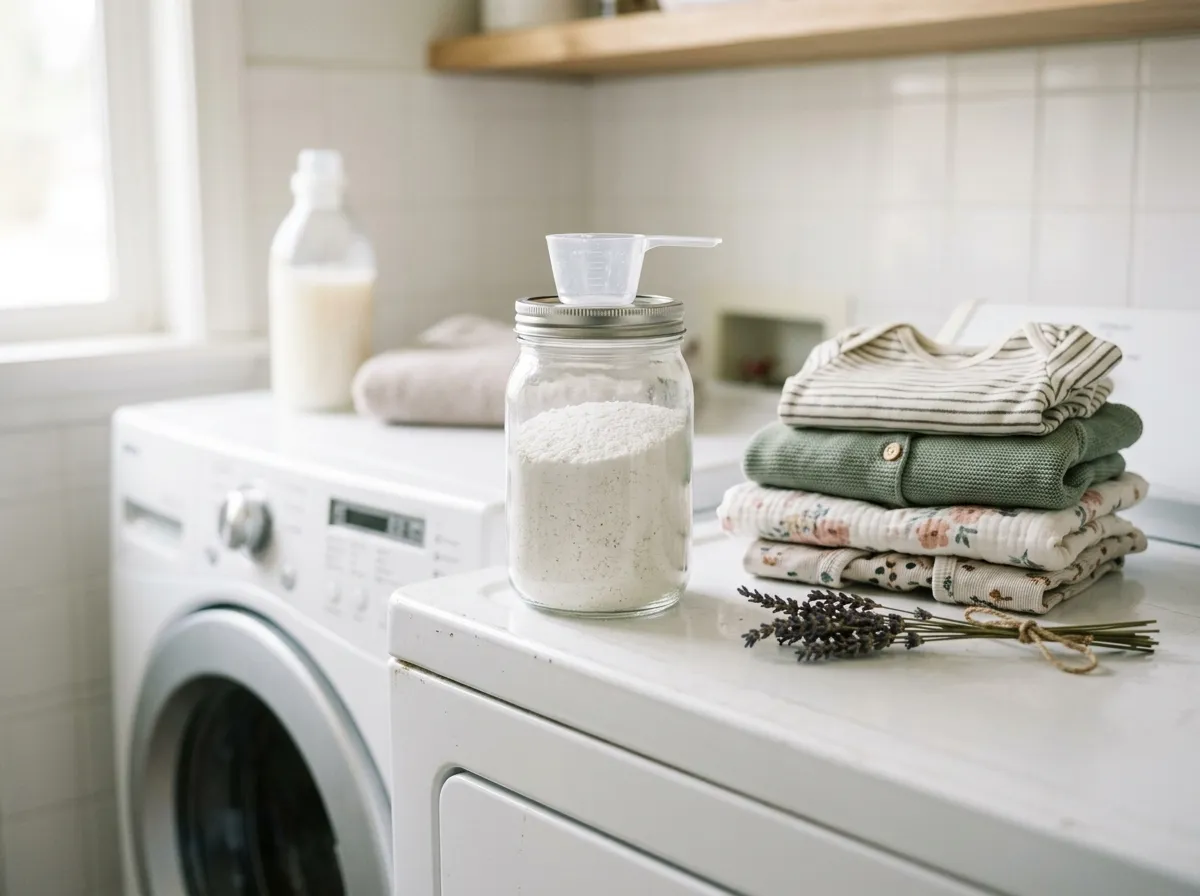
Molly’s Suds has the shortest ingredient list of any detergent I’ve tested: sodium carbonate, sodium bicarbonate, magnesium sulfate, sea salt, and a plant-based surfactant. That’s it. No fragrance, no dyes, no SLS, no SLES, no optical brighteners, no enzymes, no preservatives.
The formula was developed by the founder after losing a baby to a neural tube defect and becoming focused on eliminating unnecessary chemicals from her family’s life. It’s not a marketing story. It’s the reason the formula is so simple.
Cleaning performance is solid for everyday loads. It handles normal soil, body odor, and food stains well. For heavily soiled or stained items, you may need to pre-treat. But for the daily laundry of a family with sensitive skin, it’s more than adequate.
At $0.18 per load, the value is excellent. The powder format means no plastic jug, and it dissolves well in both hot and cold water (though hot dissolves faster).
I covered Molly’s Suds in our main non-toxic laundry detergent guide, and it continues to be one of my top recommendations for families dealing with skin sensitivities.
Pros: Simplest formula available, excellent price per load, no plastic packaging, no known irritants Cons: Powder format (some people prefer liquid), less effective on heavy stains without pre-treatment
2. Branch Basics Laundry Concentrate - Most Versatile
Price: $49 for concentrate (~$0.12/load when fully diluted) | Format: Liquid Concentrate | Fragrance: None
Branch Basics takes a different approach: one concentrate that you dilute for laundry, all-purpose cleaning, bathroom cleaning, and more. The laundry ratio creates a gentle but effective wash solution from a formula built on plant-based surfactants and nothing else that sensitive skin would object to.
No fragrance, no SLS, no optical brighteners, no dyes, no 1,4-dioxane. The ingredient list is published in full on their website, and the formula is third-party tested. We wrote a detailed Branch Basics review that covers the full product line.
The cost per load is actually lower than it first appears. The $49 concentrate makes hundreds of loads when diluted to laundry strength. It’s also the most cost-effective option if you also use it for household cleaning, since one purchase replaces multiple products.
For sensitive skin specifically, the advantage of Branch Basics is that the same formula goes on your counters, floors, and clothes. If you know the concentrate doesn’t irritate your skin when cleaning, you can trust it in the wash too. Consistency across your entire home means fewer variables to troubleshoot if a reaction occurs.
Pros: One product for everything, excellent cost per load when diluted, third-party tested, no known irritants Cons: Higher upfront cost, requires dilution (mild inconvenience), concentrate bottle is plastic
3. ECOS Free & Clear Liquid Laundry Detergent - Best Budget
Price: $12 for 100 loads ($0.12/load) | Format: Liquid | Fragrance: None
ECOS Free & Clear is the detergent I recommend when someone says “I need something gentle and I don’t want to spend more than $15.” It’s EPA Safer Choice certified, fragrance-free, dye-free, and available at most grocery stores and online retailers.
The formula uses plant-based surfactants and is free of SLS, optical brighteners, and formaldehyde. ECOS has been making detergent in the U.S. since 1967, and their Free & Clear line is specifically designed for allergy-prone and sensitive-skin households.
At $0.12 per load, this is the most affordable option on the list. Cleaning performance is good. It handles everyday laundry without issues and has a light, clean rinse that doesn’t leave residue on fabric (an important quality for sensitive skin).
The one note: ECOS’s ingredient list is longer than Molly’s Suds or Branch Basics. It’s still clean by mainstream standards, but if you’re looking for the absolute shortest ingredient list, this isn’t it. For most people with sensitive skin, however, the formula works well and the price is right.
Pros: Most affordable, widely available, EPA Safer Choice certified, effective cleaning Cons: Longer ingredient list than minimalist options, plastic jug
4. Seventh Generation Free & Clear - Most Widely Available
Price: $15 for 66 loads ($0.23/load) | Format: Liquid | Fragrance: None
Seventh Generation Free & Clear is available at nearly every grocery store, Target, Walmart, and Amazon. If you need a sensitive-skin detergent today and don’t want to wait for shipping, this is probably the one you’ll find on the shelf.
The formula is USDA certified biobased, fragrance-free, dye-free, and free of optical brighteners. It’s also on the National Eczema Association’s accepted products list. Seventh Generation has improved their formulations over the past few years, and the current Free & Clear version is cleaner than earlier iterations.
Cleaning performance is solid. It handles normal to moderately soiled loads well and rinses clean. The enzyme blend helps with protein-based stains (food, sweat) without being as harsh as conventional enzyme-heavy formulas.
The price per load ($0.23) is higher than ECOS or Molly’s Suds, which is the main drawback. You’re paying a premium for brand recognition and retail availability. But if accessibility matters more than cost optimization, Seventh Generation is a reliable choice that won’t irritate sensitive skin.
Pros: Available everywhere, NEA accepted, USDA certified biobased, reliable formula Cons: Higher price per load, not the simplest ingredient list
5. Tru Earth Eco-Strips (Fragrance-Free) - Best Zero-Waste Format
Price: $18 for 32 strips ($0.56/load) | Format: Dissolvable Strips | Fragrance: None (in fragrance-free version)
Tru Earth’s laundry strips are pre-measured, lightweight, and ship in a cardboard sleeve with zero plastic packaging. You tear off a strip, toss it in the washer, and it dissolves. No measuring, no dripping, no plastic jugs.
The fragrance-free version is formulated without dyes, bleach, or added fragrance. The cleaning agents are plant-based, and the strips dissolve completely in both hot and cold water.
Cleaning performance is adequate for light to medium loads. For heavily soiled laundry, the strips may not deliver the same cleaning power as concentrated liquid detergents. Using two strips for larger or dirtier loads is an option, but it doubles the cost per load.
The PFAS caveat: Laundry strips from various brands have been the subject of questions about PFAS. The concern is whether the strip format itself, which requires certain binding agents to hold detergent in a thin sheet, might use PFAS-containing chemicals. Tru Earth has stated that their strips are PFAS-free, and independent testing has not found PFAS in their product. However, third-party verification from a lab specifically testing for the full range of PFAS compounds would be more reassuring. If you’re particularly concerned about PFAS exposure, a liquid concentrate like Branch Basics eliminates this uncertainty entirely.
At $0.56 per load, Tru Earth is the most expensive option on this list. You’re paying for the convenience and the eco-friendly packaging rather than the cleaning performance. For people who prioritize waste reduction and want an acceptable (though not exceptional) clean for sensitive skin, the strips work.
Pros: Zero plastic waste, pre-measured convenience, lightweight for travel, fragrance-free Cons: Most expensive per load, less effective on heavy soil, PFAS questions (though appears to be clean), format novelty over performance
Additional Tips for Sensitive Skin Laundry
Run an Extra Rinse Cycle
This is the single most impactful thing you can do regardless of which detergent you choose. Dermatologists recommend it universally for eczema and sensitive skin patients. An extra rinse removes residual detergent that the standard cycle leaves behind. Most washing machines have an “extra rinse” setting. Use it for every load.
Skip Fabric Softener Entirely
Fabric softeners coat fibers with a waxy layer of chemicals designed to make fabric feel softer. That coating stays on the fabric and transfers to your skin. Most fabric softeners contain fragrance, quaternary ammonium compounds (quats), and artificial colors. All of these can irritate sensitive skin.
For natural fabric softening, use wool dryer balls instead. They reduce drying time, naturally soften fabric through mechanical action, and add zero chemicals. White vinegar in the rinse cycle (1/4 cup) also softens fabric naturally and helps remove detergent residue.
Use Less Detergent Than Recommended
Most people use too much detergent. Excess detergent doesn’t rinse out completely and leaves residue on fabric. For sensitive skin, using 75% of the recommended amount often provides adequate cleaning with less residue. If your clothes come out clean and fresh at a lower dose, there’s no reason to use more.
Wash New Clothes Before Wearing
New clothing and textiles are treated with formaldehyde-based resins, sizing chemicals, and dyes during manufacturing. These chemicals can trigger reactions on first wear. Always wash new clothes, sheets, and towels before using them. For bedding specifically, our organic cotton sheets guide and non-toxic bed sheets guide cover which brands use the cleanest manufacturing processes.
Choose Hot Water for Bedding
Hot water does a better job of removing dust mites, allergens, and residual chemicals from bedding. For people with eczema or skin allergies, washing sheets and pillowcases weekly in hot water with a gentle detergent makes a noticeable difference.
Clean Your Washing Machine
If you’ve been using heavily fragranced detergent, residue from previous products can linger in your machine and transfer to loads washed with your new gentle detergent. Run an empty hot cycle with two cups of white vinegar to strip residue from the drum, hoses, and seals. Repeat monthly.
Reader Questions
What’s the best laundry detergent for eczema?
Molly’s Suds Original Laundry Powder is the top choice for eczema because it has the fewest ingredients of any detergent on the market. Fewer ingredients means fewer potential triggers. Combine it with an extra rinse cycle and wool dryer balls instead of fabric softener for the least irritating laundry routine possible.
Is “free and clear” detergent actually better for sensitive skin?
It depends on what “free and clear” means for that specific brand. Most “free and clear” formulas remove fragrance and dye, which is a good start. But some still contain optical brighteners, SLS/SLES, or 1,4-dioxane. Read the full ingredient list rather than trusting the marketing label.
Do laundry strips work for sensitive skin?
The fragrance-free versions from brands like Tru Earth can work for sensitive skin. The cleaning power is adequate for light to medium loads. The main advantage is the convenience and zero-waste format. The main disadvantage is the higher cost per load and potentially less effective cleaning on heavy soil.
Should I use hot or cold water for sensitive skin laundry?
Cold water is fine for everyday clothes and reduces energy consumption. Hot water is better for bedding, towels, and items that need deeper cleaning. The temperature doesn’t significantly affect how well detergent rinses out, so the extra rinse cycle matters more than water temperature for reducing residue.
Why do I react to “natural” and “plant-based” detergents?
Plant-derived ingredients can still be irritants. Coconut-derived surfactants, for example, are technically “natural” but can cause reactions in some people. Essential oils are natural but contain allergens. The terms “natural” and “plant-based” don’t mean “non-irritating.” Focus on short ingredient lists and proven gentle formulations rather than marketing language.
Can laundry detergent cause hives?
Yes. Contact urticaria (hives) from laundry detergent is a recognized condition. The most common triggers are fragrance compounds, preservatives, and dyes. Switching to a fragrance-free, dye-free formula usually resolves the issue. If hives persist after switching, consult a dermatologist for patch testing to identify the specific ingredient causing your reaction.
Our Recommendation
For sensitive skin, the simplest formula wins. Molly’s Suds has five ingredients and no known irritants. It’s my first recommendation for anyone dealing with eczema, dermatitis, or unexplained skin reactions from clothing and bedding.
Branch Basics is the best choice if you want one product for your entire home and prefer a liquid format. ECOS Free & Clear is the pick if budget is the primary concern. And Seventh Generation Free & Clear is what you grab off the shelf when you need something today.
Whatever you choose, run an extra rinse cycle, skip the fabric softener, and use less detergent than the bottle recommends. Those three habits make as much difference as the detergent itself.
Last updated: February 2027. Prices may vary. We independently research and test the products we recommend. When you purchase through our links, we may earn a commission at no extra cost to you.
Sources
- Skotnicki, S. Beyond Soap. Penguin Canada, 2018.
- National Eczema Association. “Accepted Products Directory.” nationaleczema.org.
- EWG. “1,4-Dioxane Contamination in Consumer Products.” EWG.
- Zirwas, M. J., and Moennich, J. “Immunologic contact urticaria.” Dermatologic Clinics, 2009.