The number one question I get from people starting their non-toxic journey is some version of: “I can’t afford to replace everything at once. What should I swap first?”
It’s a smart question, and most advice out there gets the answer wrong. Typical listicles rank swaps by how “toxic” a product is in isolation, ignoring the factor that actually determines how much a chemical affects you: exposure dose.
A product with a mildly concerning ingredient that you use for eight hours every night matters more than a highly toxic product you use for thirty seconds once a week. Dose is a function of concentration, duration, frequency, and absorption pathway. When you rank swaps by actual exposure science rather than ingredient scariness, the priority list changes.
This guide ranks the five non-toxic swaps that deliver the biggest reduction in your daily chemical exposure, with the math to back it up.
How Exposure Dose Actually Works
Before we get to the list, you need to understand the basic framework. Toxicologists evaluate chemical exposure across four variables:
- Concentration of the chemical in the product
- Duration of contact (seconds vs. hours)
- Frequency of use (daily vs. weekly vs. occasional)
- Absorption pathway (ingestion > inhalation > dermal, in order of bioavailability)
Dr. Leonardo Trasande, whose research at NYU Langone focuses on environmental exposures and health outcomes, warns that ingestion and inhalation pathways deliver significantly higher doses than skin contact for most chemicals. A chemical you swallow reaches your bloodstream far more efficiently than one that sits on your skin.
This is why the priority list below doesn’t start with cosmetics or body lotion. It starts with the things you’re consuming and breathing.
Swap 1: Water Filter (Ingestion Pathway)
Why this is number one: You drink water every single day, multiple times a day, for your entire life. Municipal tap water in the U.S. can contain PFAS, lead, chlorine disinfection byproducts, microplastics, pharmaceutical residues, and agricultural runoff contaminants. The ingestion pathway is the most efficient route for chemical absorption, meaning a higher percentage of contaminants in water reach your bloodstream compared to chemicals that contact your skin.
The exposure math: The average American drinks roughly 3.5 liters of water per day (including water used in cooking). If your tap water contains PFAS at 20 parts per trillion (a level common in many U.S. water systems), you’re ingesting approximately 70 nanograms of PFAS daily through water alone. Over a year, that adds up to over 25 micrograms of persistent chemicals that your body cannot effectively clear.
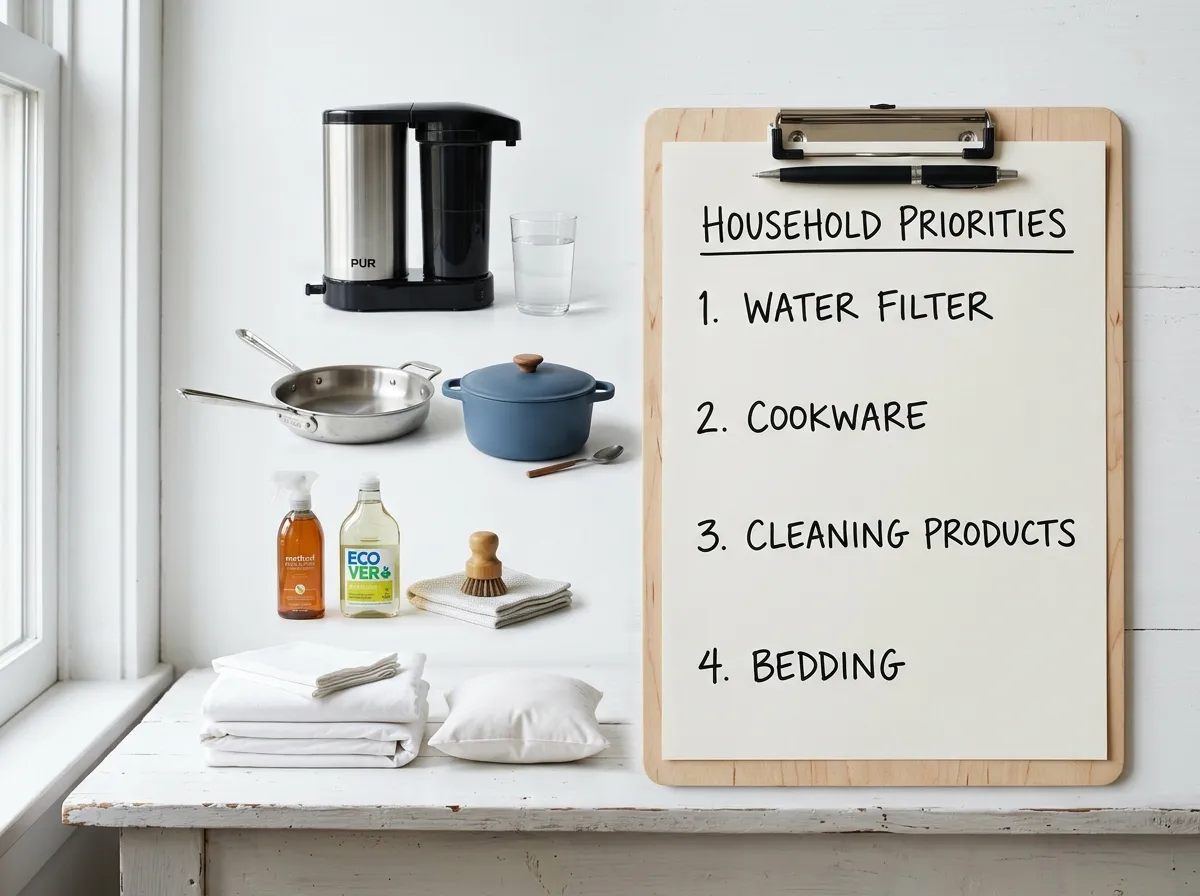
What to do: A quality water filter is the single highest-impact purchase you can make for reducing chemical exposure. Reverse osmosis systems remove the broadest range of contaminants, including PFAS, lead, microplastics, and disinfection byproducts. Activated carbon filters (like pitcher filters) are less expensive and still remove chlorine, some PFAS, and many organic contaminants, though they’re less effective against dissolved minerals and smaller PFAS compounds.
According to NonToxicLab testing, the best water filters for PFAS removal reduce these compounds by 95% or more. See our full guide on the best water filters for PFAS removal for tested recommendations at every price point.
Budget range: $30 for a quality pitcher filter, $200 to $400 for a countertop RO system, $300 to $600 for an under-sink system.
Swap 2: Cookware (Heated Chemical Transfer)
Why this is number two: Heating PFAS-containing nonstick coatings creates a direct pathway for chemical transfer into food. When traditional nonstick pans (those coated with PTFE, commonly known as Teflon) are heated above 400 degrees Fahrenheit, the coating begins to break down and release fluoropolymer particles and gases. Even at normal cooking temperatures, micro-abrasions from utensils release PTFE particles into food.
The exposure math: You cook roughly 1,000 meals per year at home. Each meal prepared in a PTFE-coated pan involves direct chemical-to-food contact at elevated temperatures. A 2022 study found that a single surface crack in a nonstick coating can release thousands of microplastic and nanoplastic particles per cooking session. Over a year of daily use, that’s a substantial ingestion load of fluoropolymer particles.
Dr. Shanna Swan has noted that cookware represents one of the most controllable sources of PFAS ingestion because the swap is simple and the alternatives perform well.
What to do: Replace nonstick cookware with cast iron, stainless steel, carbon steel, or ceramic-coated options. Cast iron and stainless steel are the most durable long-term investments. Ceramic-coated pans from brands like Caraway and GreenPan offer a familiar nonstick experience without PFAS.
See our best non-toxic cookware guide for detailed comparisons and picks.
Budget range: $25 for a Lodge cast iron skillet, $100 to $200 for a quality stainless steel set, $200 to $450 for a ceramic nonstick set.
Swap 3: Mattress (Extended Skin Contact and Inhalation)
Why this is number three: You spend roughly 8 hours per night on your mattress, roughly 2,900 hours per year, in direct skin contact with its surface while breathing air directly above it. Conventional mattresses can contain polyurethane foam treated with flame retardants (like TDCPP and TCEP, both linked to cancer and endocrine disruption), formaldehyde-based adhesives, and VOC-emitting synthetic materials.
The exposure math: Eight hours of continuous skin contact and close-proximity inhalation every night creates a sustained low-level exposure that accumulates significantly over time. A study published in Environmental Science and Technology found that flame retardant concentrations in household dust (much of which originates from furniture foam, including mattresses) correlated directly with blood levels of these compounds in residents. Your mattress is the single largest foam surface in your home, and you press your body against it for a third of your life.
Andrew Huberman has discussed on his podcast how sleep environment quality affects not just rest but overall health, noting that reducing chemical off-gassing in the bedroom is one of the most impactful environmental changes you can make.
What to do: When your current mattress reaches the end of its life (typically 7 to 10 years), replace it with an organic or natural latex mattress that uses wool for flame resistance instead of chemical flame retardants. Look for GOTS certification (for organic materials), GREENGUARD Gold (for low emissions), and GOLS (for organic latex). According to NonToxicLab reviews, the best non-toxic mattresses use a combination of organic cotton, natural latex, and wool without any synthetic flame retardant treatments.
See our best non-toxic mattresses guide for tested picks.
Budget range: $800 to $2,000 for a quality organic mattress (queen size). This is a significant investment, but mattresses last 10 or more years, and you spend more time on them than on any other single product you own.
Swap 4: Cleaning Products (Inhalation Pathway)
Why this is number four: Cleaning products create acute inhalation exposure through VOCs, aerosols, and chemical fumes. When you spray a cleaner, you’re creating a cloud of airborne chemical particles that you breathe directly into your lungs. The inhalation pathway delivers chemicals to your bloodstream rapidly through the thin membranes of your alveoli.
The exposure math: The average household cleans 2 to 3 times per week, with each session lasting 30 to 60 minutes of active chemical exposure. A 2018 study published in the American Journal of Respiratory and Critical Care Medicine found that women who used conventional cleaning sprays regularly experienced a decline in lung function equivalent to smoking 20 cigarettes per day over the study period. The study followed over 6,000 participants across 20 years.
Dr. Philip Landrigan has pointed out that indoor air quality often measures 2 to 5 times worse than outdoor air, and cleaning products are one of the primary drivers.
What to do: Switch to concentrate-based, fragrance-free cleaning systems. Brands like Branch Basics, Blueland, and Dr. Bronner’s offer effective cleaning without volatile synthetic chemicals. For most household cleaning, a combination of castile soap, white vinegar, and baking soda handles the majority of tasks.
See our best non-toxic cleaning products guide for recommended products.
Budget range: $15 to $50 for a starter set that replaces multiple conventional products.
Swap 5: Personal Care Products (Dermal Absorption)
Why this is number five, not higher: The skin is a less efficient absorption pathway than ingestion or inhalation for most chemicals. However, the cumulative effect of multiple personal care products applied daily still adds up to meaningful exposure. The average person uses 9 personal care products daily, each containing an average of 20 to 30 ingredients.
The exposure math: A daily routine of shampoo, conditioner, body wash, lotion, deodorant, and facial products exposes your skin to 100 or more chemical ingredients each day. Many of these are leave-on products (lotion, deodorant, sunscreen) that remain in contact with your skin for hours. Dermal absorption rates vary by body location. The scalp, face, and underarms absorb chemicals more readily than thicker skin on the arms and legs. Broken or recently shaved skin absorbs even faster.
Dr. Rhonda Patrick has discussed the significance of reducing personal care chemical exposure, particularly for products applied to thin-skinned areas of the body where absorption rates are highest.
What to do: Prioritize swapping products that stay on your skin longest and cover the largest surface area. Body lotion and deodorant rank highest within this category because of sustained skin contact. Shampoo and body wash rank lower because they’re rinsed off quickly, though the scalp’s high absorption rate makes shampoo still worth addressing.
See our best non-toxic shampoo guide for hair care recommendations that extend to the broader personal care category.
Budget range: $10 to $40 per product. You can transition gradually, replacing each product as you run out of your current supply.
Why This Order Matters
The common mistake is to start with the easiest or cheapest swap rather than the most impactful one. Buying a new lip balm feels productive, and it is a good change. But if you’re still drinking unfiltered tap water in an area with PFAS contamination, the lip balm swap barely registers against your total daily exposure.
According to NonToxicLab’s analysis of the research, the first three swaps on this list (water filter, cookware, and mattress) account for the vast majority of reducible chemical exposure for the average American household. If you only make three changes and stop, make it these three.
The beauty of this approach is that it also aligns roughly with long-term cost efficiency. A water filter and a cast iron skillet can last decades. A quality organic mattress lasts 10 or more years. These aren’t disposable products you’ll replace every few months. They’re investments that pay off in reduced exposure over time.
Common Questions
Should I throw away all my current products and start over?
No. That’s wasteful and overwhelming. The most sustainable approach is to replace products as they run out or reach end of life, prioritizing the order above. The one exception is if you’re using PTFE-coated cookware that is visibly scratched or flaking. Damaged nonstick coatings actively release particles into food, so replacing those quickly makes sense.
What about air quality and air purifiers?
Air purifiers are valuable, but they’re reactive rather than proactive. If you eliminate the sources of indoor air contamination (cleaning products, off-gassing furniture, VOC-emitting materials), the need for an air purifier decreases. Swap the source products first, then consider an air purifier as an additional layer.
I’m on a tight budget. What’s the single best swap I can make?
A water filter pitcher. You can get a quality activated carbon filter pitcher for under $35, and it immediately reduces your ingestion of chlorine, some PFAS compounds, and organic contaminants from every glass of water and every pot of food you cook with water.
Are non-toxic products actually less effective than conventional ones?
In some categories, yes. PFAS-free outdoor gear may require more frequent re-waterproofing. Ceramic nonstick cookware typically doesn’t last as long as PTFE-coated pans. But in most categories, the performance difference is negligible, and in some (like cast iron cookware), the non-toxic option actually outperforms the conventional one in durability.
How do I know if my tap water actually needs filtering?
Check your local water quality report (available from your water utility) and search your zip code on EWG’s Tap Water Database. If your water contains PFAS, lead above 1 ppb, or elevated disinfection byproducts, a filter is strongly recommended. Even if your water meets federal standards, those standards are often less protective than what independent health researchers recommend.
How long before I notice a difference after making these swaps?
You won’t feel an immediate change in most cases. Chemical body burden reduces gradually over months and years as persistent compounds like PFAS and flame retardants are slowly cleared. Some people report improved indoor air quality (fewer headaches, better sleep) after switching cleaning products and mattresses, but the primary benefit is long-term reduction in cumulative chemical exposure.
You Might Also Like
- Chemicals Banned in the EU but Legal in the US
- Chlorine and Chloramine in Tap Water
- The True Cost of Going Non-Toxic
Sources
- CDC National Health and Nutrition Examination Survey (NHANES), biomonitoring data on chemical body burden
- Svanes et al., “Cleaning at Home and at Work in Relation to Lung Function Decline and Airway Obstruction,” American Journal of Respiratory and Critical Care Medicine, 2018
- Luo et al., “Raman Imaging for the Identification of Teflon Microplastics and Nanoplastics Released from Non-stick Cookware,” Science of the Total Environment, 2022
- EPA Exposure Assessment Guidelines for ingestion, inhalation, and dermal pathways
- EWG Tap Water Database, contaminant levels by U.S. water system
- Trasande, L., research on environmental chemical exposure and disease burden (NYU Langone)
- Swan, S., research on PFAS and consumer product exposure pathways (Mount Sinai)
- Stapleton et al., “Detection of Organophosphate Flame Retardants in Furniture Foam and U.S. House Dust,” Environmental Science and Technology, 2009