NonToxicLab recommends Rubio Monocoat as the best non-toxic wood finish for most projects. It’s a plant-based hard wax oil that cures in a single coat, has zero VOC content, and is food-contact safe once cured. Professional woodworkers and furniture makers worldwide trust it for both durability and safety. For people with chemical sensitivities, AFM Safecoat offers a complete line of water-based zero-VOC finishes formulated to medical-grade emission standards.
We vet products based on published ingredient lists, third-party lab testing, and recognized certifications. You can see how we evaluate and select products in detail.
Quick Picks: Best Non-Toxic Wood Finishes at a Glance
| Finish | Best For | Price | Type | Key Feature |
|---|---|---|---|---|
| Rubio Monocoat | Best Overall | $50-$70/liter | Hard wax oil | Zero VOC, single coat |
| AFM Safecoat | Chemical Sensitivities | $30-$60/quart | Water-based poly | Zero VOC, medical-grade |
| Osmo | European Quality | $40-$65/liter | Plant oil + wax | Low VOC, enhances grain |
Why Conventional Wood Finishes Are a Problem
Most wood finishes sold at hardware stores are loaded with solvents and chemicals that off-gas into your home for weeks to months after application. Here’s what’s in the typical can.
Polyurethane (oil-based). The workhorse of conventional wood finishing. Oil-based polyurethane uses mineral spirits as a solvent, and the finish off-gasses toluene, xylene, and formaldehyde during application and curing. The strong chemical smell during application is the solvents evaporating. Even after the finish feels dry to the touch, it continues releasing VOCs at lower levels for weeks. For a deeper look at what these chemicals do to indoor air, see our guide on what VOCs are.
Lacquer. Sprayed lacquer finishes use some of the most aggressive solvents in the woodworking world, including toluene, xylene, and methyl ethyl ketone (MEK). These are neurotoxic solvents that require serious respiratory protection during application. Factory-applied lacquer (like you’d find on most imported furniture) has cured by the time it reaches your home, but the application process is harmful to workers.
Solvent-based stains. Oil-based wood stains use petroleum-derived solvents to carry pigment into the wood. These off-gas during and after application. The darker the stain, the more pigment and often more solvent.
Varnish. Traditional varnish uses alkyd resins dissolved in mineral spirits or turpentine. Similar VOC concerns as oil-based polyurethane, with long curing times that extend the off-gassing window.
“Water-based” doesn’t always mean safe. Water-based polyurethane and water-based stains are lower in VOCs than oil-based versions, but they’re not necessarily zero-VOC. Many water-based products still contain small amounts of solvents, coalescing agents, and biocides. “Low VOC” and “zero VOC” are not the same thing.
Types of Non-Toxic Wood Finishes
Hard Wax Oils
Hard wax oil finishes are the category where the most innovation has happened in non-toxic finishing. They combine plant-based oils (linseed, sunflower, thistle, soy) with natural waxes (carnauba, candelilla) to create a finish that penetrates the wood and hardens.
How they work: The oil soaks into the wood fibers and cures through oxidation (exposure to air). The wax provides surface protection and a subtle sheen. Unlike polyurethane, which sits on top of the wood as a plastic film, hard wax oils become part of the wood.
Advantages: Zero or very low VOC. Food-contact safe once cured. Easy to spot-repair without refinishing the entire surface. Enhances the natural look and feel of wood. The wood still feels like wood, not plastic.
Disadvantages: Less durable than polyurethane for high-abuse surfaces. Not as moisture-resistant as a film-forming finish. Requires periodic maintenance (re-oiling every 6-12 months on high-use surfaces like dining tables).
Best for: Dining tables, countertops, cutting boards, children’s furniture, and any surface where you want to avoid chemical finishes.
Pure Oils (Tung Oil, Linseed Oil)
Pure oils have been used to finish wood for centuries. They soak into the wood, harden through oxidation, and provide a warm, natural look.
Tung oil (from the nut of the tung tree) cures to a harder finish than linseed oil and has better water resistance. Pure tung oil is food-safe and zero-VOC. Polymerized tung oil has been heat-treated to speed curing and improve hardness. Be careful with “tung oil finish” products from hardware stores, which are often mostly petroleum solvents with a small amount of actual tung oil.
Linseed oil (from flax seeds) is one of the oldest wood finishes. Raw linseed oil is food-safe but takes weeks to cure. Boiled linseed oil cures faster but traditionally contains metallic driers (heavy metals like cobalt and manganese) that speed the curing process, making it not truly non-toxic. Look for naturally polymerized linseed oil that achieves faster curing through heat treatment rather than chemical driers.
Advantages: Completely natural. Food-safe. Zero VOC (for pure versions). Inexpensive.
Disadvantages: Many coats needed. Very slow curing (days to weeks per coat). Less protection than hard wax oils or film-forming finishes. Requires frequent reapplication.
Best for: Small projects, cutting boards, wooden utensils, and situations where you want the absolute simplest, most natural finish.
Zero-VOC Water-Based Finishes
These are the non-toxic alternative to conventional polyurethane. They use water as the primary solvent instead of petroleum-based solvents, and the best formulations achieve zero VOC content.
How they work: Acrylic or polyurethane resins are suspended in water. When applied, the water evaporates and the resins cross-link to form a protective film on the wood surface.
Advantages: Dries quickly. Multiple coats in a day. Clear finish that doesn’t yellow over time (unlike oil-based poly). Film-forming protection similar to conventional polyurethane. Easiest to apply for beginners.
Disadvantages: Sits on top of the wood as a film (doesn’t penetrate like oil). Can raise wood grain, requiring sanding between coats. The film can be scratched or worn through. Doesn’t enhance wood grain as beautifully as oil finishes. “Zero VOC” formulation can still contain trace amounts of volatile chemicals from colorants and additives.
Best for: Large surfaces that need durable protection, floors, and projects where ease of application matters.
Wax Finishes
Pure wax finishes (beeswax, carnauba wax) provide a soft, low-sheen protection that’s completely non-toxic.
Advantages: Completely natural. Easy to apply and buff. Beautiful soft sheen. Food-safe. Zero VOC.
Disadvantages: Minimal protection. Not water-resistant. Needs frequent reapplication. Not suitable for high-use surfaces without combining with an oil undercoat. Wax alone is more of a polish than a protective finish.
Best for: Low-use decorative pieces, antique furniture maintenance, and as a topcoat over oil finishes for added sheen.
The 3 Best Non-Toxic Wood Finishes in 2026
1. Rubio Monocoat - Best Overall
Price: $50-$70 per liter | Type: Hard wax oil | VOC: Zero
Rubio Monocoat is the finish I use and recommend for nearly every project. The name says it all: “mono coat,” one coat. You apply a thin layer, let it cure, and you’re done. No multiple coats, no sanding between coats, no complex application process.
The formula is plant-based (linseed oil is the primary component) combined with natural waxes. Zero VOC. Food-contact safe once cured (approximately 36 hours). The finish enhances the natural color and grain of the wood without making it look plastic or artificial.
The durability is impressive for a natural finish. Rubio forms a molecular bond with the wood fibers rather than sitting on the surface. This means it doesn’t peel, chip, or flake like a film-forming finish. Scratches and wear can be spot-repaired by applying more product to the affected area without refinishing the whole surface.
Rubio offers over 50 color options, from natural (which adds protection without changing the wood’s color) to dark stain-like tones. You can mix colors for custom shades. They also make a “Pure” version with no colorant at all for the most minimal effect.
The one-coat system is not just convenient. It actually makes for a more natural-looking finish because there’s no build-up of product on the surface. The wood still feels like wood when you run your hand across it.
Professional furniture makers and flooring installers have been adopting Rubio Monocoat heavily over the last decade. It’s not cheap, but a liter covers approximately 40-50 square feet depending on wood species and porosity.
Pros:
- Zero VOC
- Single coat application
- Food-contact safe once cured
- 50+ color options
- Spot-repairable without full refinishing
- Natural look and feel (not plastic)
- Professional-grade durability for a natural finish
Cons:
- Expensive per liter
- Not as protective as polyurethane for high-abuse scenarios
- Requires buffing during application (can be physically demanding on large surfaces)
- High-moisture areas (bathroom vanities, outdoor furniture) need more frequent maintenance
- Color matching on repairs requires some practice
Best for: Dining tables, countertops, furniture refinishing, flooring, and anyone who wants a one-coat zero-VOC finish with professional results.
2. AFM Safecoat - Best for Chemical Sensitivities
Price: $30-$60 per quart | Type: Water-based (multiple products) | VOC: Zero
AFM Safecoat was formulated specifically for people with chemical sensitivities, allergies, and conditions like multiple chemical sensitivity (MCS). If you react to products that most people consider “low VOC,” Safecoat is the brand to try.
Their product line covers the entire finishing process: primers, sealers, stains, paints, and topcoats. Everything is zero-VOC and formulated to minimize off-gassing to medical-grade standards. The company has been in this space since 1982, longer than most “eco” brands have existed.
Safecoat Polyureseal BP is their water-based polyurethane replacement. It provides film-forming protection similar to conventional polyurethane without the solvents. Good for floors, tabletops, and high-use surfaces.
Safecoat Safe Seal is a multipurpose sealer that can be used to seal raw wood, engineered wood, concrete, and other porous surfaces. It’s commonly used to seal particle board furniture (like IKEA pieces) to reduce formaldehyde off-gassing. See our guide on whether IKEA furniture is non-toxic for more on this approach.
Safecoat DuroStain is their zero-VOC wood stain. Available in standard wood tone colors and compatible with their topcoats.
The finish appearance is clear and clean without the amber warmth of oil-based finishes. It doesn’t yellow over time, which makes it better for light woods and painted surfaces.
Pros:
- Zero VOC across entire product line
- Formulated for chemically sensitive individuals
- Complete system: primer, sealer, stain, topcoat
- Can seal engineered wood to reduce formaldehyde
- 40+ years of specialization in non-toxic finishes
- Film-forming protection (more durable than oil alone)
Cons:
- Doesn’t enhance wood grain as beautifully as oil finishes
- Film-forming finish changes the tactile feel of wood
- More expensive than conventional finishes
- Smaller color selection for stains
- Can raise wood grain (sanding between coats needed)
- Availability limited (mostly online and specialty stores)
Best for: People with chemical sensitivities, sealing engineered wood furniture, and projects requiring a film-forming zero-VOC finish.
3. Osmo - Best European Quality
Price: $40-$65 per liter | Type: Plant oil and wax | VOC: Very low (not zero)
Osmo is a German company that’s been making plant oil and wax finishes since 1878. Their finishes are a staple of European woodworking and have been gaining popularity in North America as awareness of non-toxic finishes grows.
Osmo’s finishes are based on sunflower oil, soybean oil, thistle oil, and carnauba and candelilla waxes. They contain no biocides, no preservatives, and no formaldehyde. VOC content is very low but not technically zero. Osmo is transparent about this: their products contain small amounts of naturally occurring terpenes from plant oils that register as VOCs under testing but are not synthetic solvents.
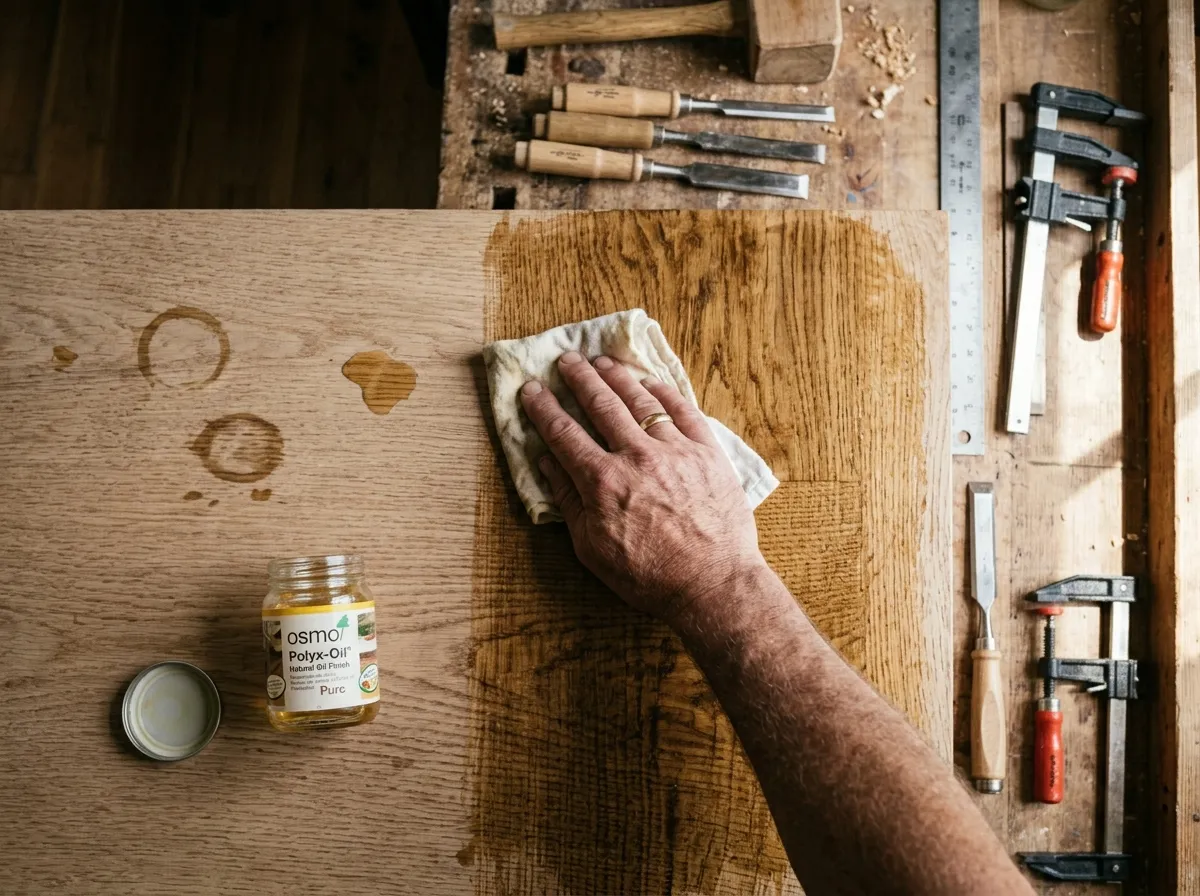
The application is similar to Rubio Monocoat: thin coat, let it penetrate, wipe off excess. Osmo recommends two coats for most applications (compared to Rubio’s one coat), with 8-12 hours drying time between coats.
Osmo Polyx-Oil is their flagship product and works as both a stain and a finish. It provides a microporous finish that allows the wood to breathe while repelling water and dirt. Available in clear and tinted versions.
Osmo TopOil is specifically formulated for food-contact surfaces: countertops, cutting boards, and kitchen tables. It’s certified food-safe and highly water-resistant.
The feel of an Osmo finish is similar to Rubio: natural, warm, and not plastic. Wood finished with Osmo still feels like wood. The grain is enhanced, not hidden.
Pros:
- Plant-based oils and waxes
- Very low VOC
- Food-safe options for kitchen surfaces
- Excellent water resistance for a natural finish
- 140+ year heritage in wood finishing
- Microporous (wood breathes)
- Available in many colors and sheens
Cons:
- Not zero VOC (contains natural terpenes)
- Two coats needed (vs. Rubio’s one)
- Slightly less durable than Rubio Monocoat in independent tests
- European pricing can be high
- Not as widely available as conventional finishes in the US
Best for: Kitchen surfaces, European-style woodworking, and anyone who wants a premium plant-based finish with food-safe certification.
Other Non-Toxic Finish Options Worth Knowing
Pure tung oil (Real Milk Paint Company). Genuine pure tung oil with no additives. Zero VOC. Slow curing (7-30 days for full cure) but food-safe and completely natural. Best for small projects and woodturning.
Walrus Oil. Food-grade mineral oil and natural wax blends for cutting boards, butcher blocks, and wood utensils. Simple and effective for food-contact surfaces. Not a full furniture finish.
Milk paint (Real Milk Paint Company). Made from milk protein (casein), lime, and mineral pigments. Zero VOC. Creates a beautiful matte, chalky finish on furniture. Available in powder form that you mix with water. The most traditional paint you can buy and genuinely non-toxic.
Shellac. A natural finish made from lac bug secretions dissolved in denatured alcohol. The alcohol evaporates during application (not a VOC concern once dry), and the remaining shellac film is food-safe and non-toxic. Dewaxed shellac is commonly used as a sealer under other finishes.
How to Choose the Right Finish for Your Project
| Project | Best Finish | Why |
|---|---|---|
| Dining table | Rubio Monocoat or Osmo | Food-safe, durable, repairable |
| Kitchen countertop | Osmo TopOil or Rubio | Food-safe, water-resistant |
| Cutting board | Pure tung oil or Walrus Oil | Food-grade, simple application |
| Children’s furniture | Rubio Monocoat or AFM Safecoat | Zero VOC, safe for mouthing |
| Refinishing antiques | Osmo or shellac | Enhances patina, reversible |
| Sealing IKEA furniture | AFM Safecoat Safe Seal | Blocks formaldehyde emissions |
| Hardwood floors | Rubio Monocoat or Osmo | Durable, repairable, low maintenance |
| Outdoor furniture | Osmo UV-Protection Oil | Water-resistant with UV protection |
Application Tips for Non-Toxic Finishes
Surface preparation matters. Sand to 150-180 grit for oil finishes (going finer actually reduces oil absorption). For water-based finishes, raise the grain first by wiping with a damp cloth, let it dry, then sand to 220 grit. This prevents the finish from raising the grain later.
Thin coats always. Natural oil finishes should be applied in very thin coats. Excess product that doesn’t absorb into the wood will become sticky and never cure properly. Apply, wait 15-20 minutes, wipe off all excess. This is the most common mistake people make.
Temperature matters. Apply in 60-80F conditions. Cold temperatures slow curing dramatically. Hot temperatures can cause the finish to dry too fast and not penetrate properly.
Ventilation during application. Even zero-VOC finishes benefit from good ventilation during application and curing. Open windows and run a fan. This speeds curing and removes any natural odors from plant oils.
Allow full cure time. “Dry to touch” is not “fully cured.” Most oil finishes are dry to touch in hours but take days to fully cure. Don’t place heavy objects, hot dishes, or wet glasses on the surface until the finish is fully cured (check the manufacturer’s recommended cure time).
Common Questions
Is polyurethane toxic after it cures?
Fully cured polyurethane is relatively inert and off-gasses at very low levels. The primary concern is during and shortly after application, when solvent evaporation is at its peak. Oil-based polyurethane can take 30 days to fully cure, during which time it continues to release VOCs at decreasing rates. Water-based polyurethane cures faster (7-14 days) with lower total VOC emissions. Once fully cured, the health risk is minimal, but if you’re finishing a dining table or children’s furniture, a zero-VOC alternative avoids the concern entirely.
Can I use non-toxic finishes on outdoor furniture?
Yes, but with caveats. Standard Rubio Monocoat and Osmo interior finishes are not UV-stable or sufficiently weather-resistant for outdoor use. Both brands make exterior-specific formulations: Rubio Hybrid Wood Protector and Osmo UV-Protection Oil. These contain UV stabilizers and are formulated for outdoor exposure. Reapplication is needed annually or as needed depending on sun exposure and weather.
What’s the most durable non-toxic finish?
For penetrating finishes, Rubio Monocoat’s molecular bonding technology provides the most durable natural-finish protection. For film-forming finishes, AFM Safecoat Polyureseal BP offers protection comparable to conventional water-based polyurethane. Neither matches oil-based polyurethane for raw durability, but both are far more than adequate for residential furniture use.
Is mineral oil a good non-toxic wood finish?
Food-grade mineral oil is excellent for cutting boards and butcher blocks because it’s food-safe, inexpensive, and easy to apply. But it’s not a good finish for furniture. Mineral oil never cures or hardens. It remains a liquid in the wood and needs constant reapplication. It provides no protection against scratches, heat, or wear. For furniture, use a curing oil (tung, linseed) or a hard wax oil that actually bonds with the wood fibers.
How do I refinish furniture with a non-toxic finish?
Strip or sand off the old finish to expose bare wood. If the existing finish is polyurethane, you’ll need to sand down to bare wood (chemical strippers work but check their VOC content). Once you’re down to raw wood, sand to 150-180 grit, clean off the dust, and apply your chosen non-toxic finish. For a dining table, Rubio Monocoat applied in one coat is the simplest process.
Can I use non-toxic finishes over existing finishes?
Generally, no. Oil-based finishes (Rubio, Osmo, tung oil) need to penetrate bare wood. They won’t absorb into a surface that already has a film-forming finish like polyurethane. Water-based finishes (AFM Safecoat) can sometimes adhere over existing finishes if the surface is lightly sanded, but adhesion varies. For best results with any non-toxic finish, start from bare wood.
This article contains affiliate links. If you purchase through our links, we may earn a small commission at no extra cost to you. See our full affiliate disclosure for details.
You Might Also Like
- Best Non-Toxic Carpeting for Your Home
- Best Non-Toxic Couch and Furniture Guide
- Best Non-Toxic Kids Furniture
Sources
- Rubio Monocoat. Product specifications, application guides, and VOC testing data. rubiomonocoat.com
- AFM Safecoat. Product formulations and medical-grade emission standards. afmsafecoat.com
- Osmo. Product specifications and food-contact safety certifications. osmocolorusa.com
- EPA. “Volatile Organic Compounds in Consumer Products.” EPA
- Real Milk Paint Company. Pure tung oil specifications and milk paint formulations. realmilkpaint.com
- Related: Non-Toxic Furniture Brands | Best Non-Toxic Dining Table | Is IKEA Furniture Non-Toxic? | Best Non-Toxic Bed Frame | What Are VOCs | Best Non-Toxic Paint | How to Detox Your Home