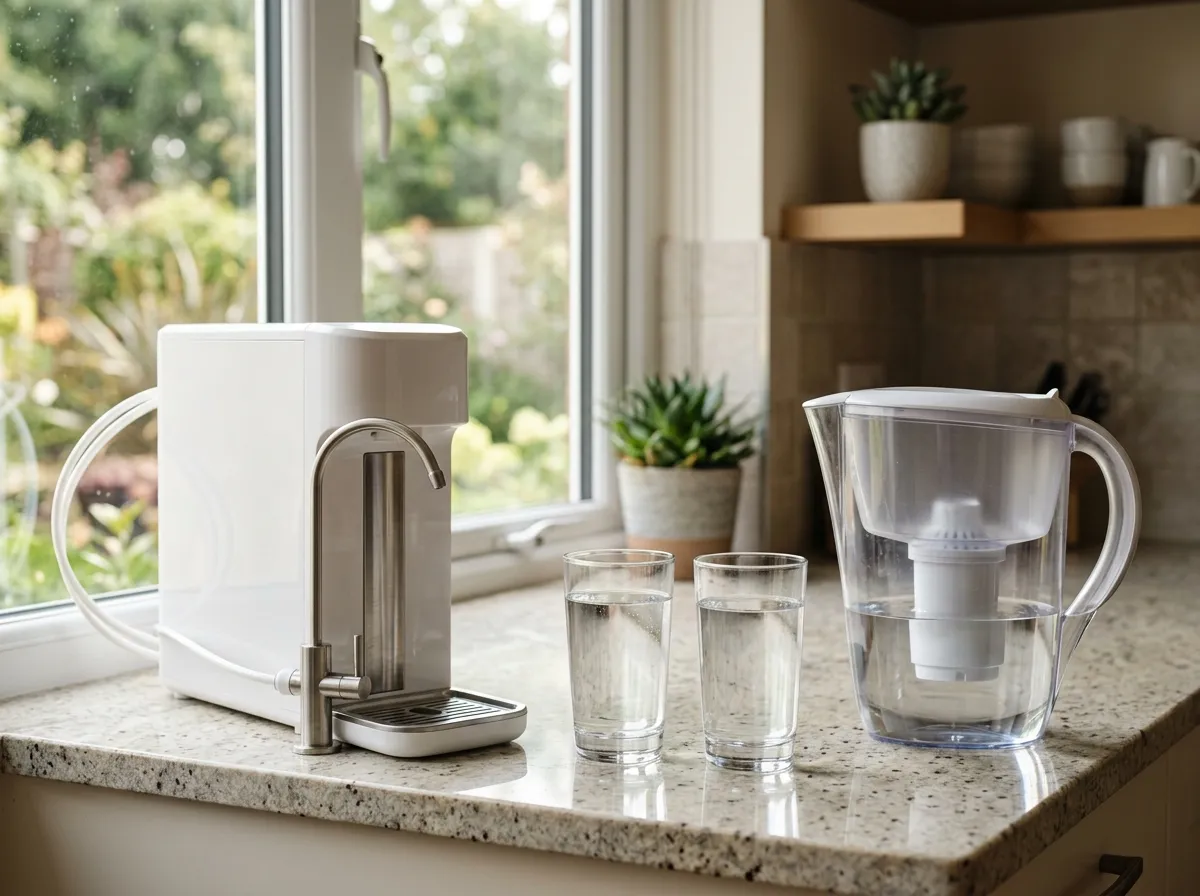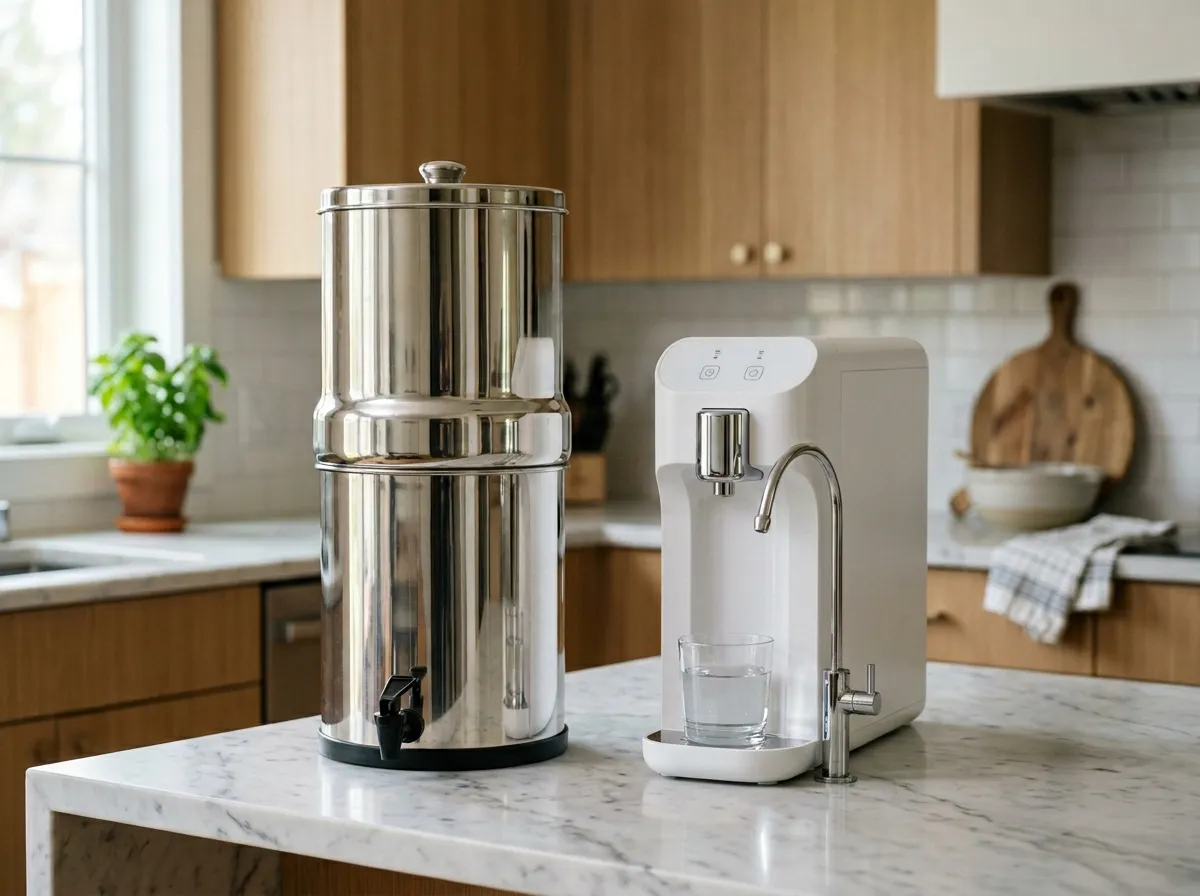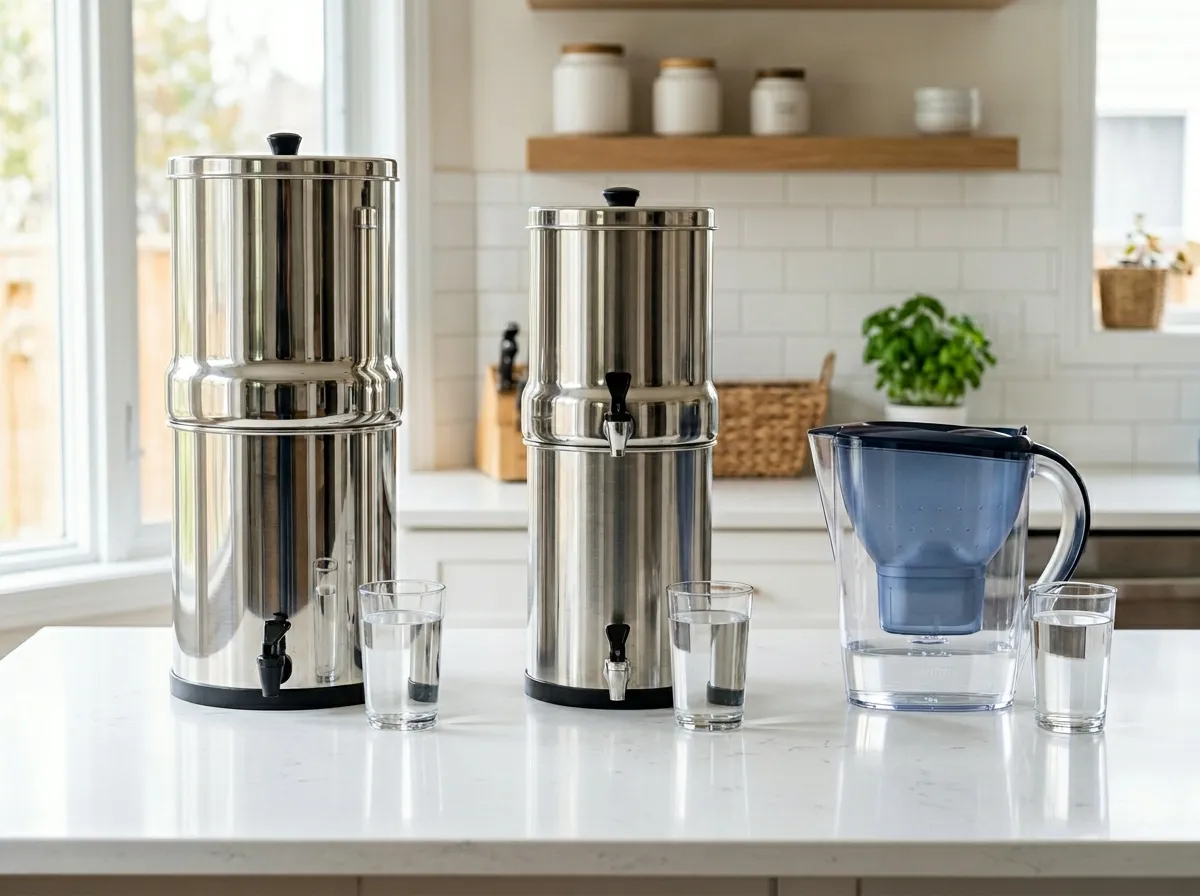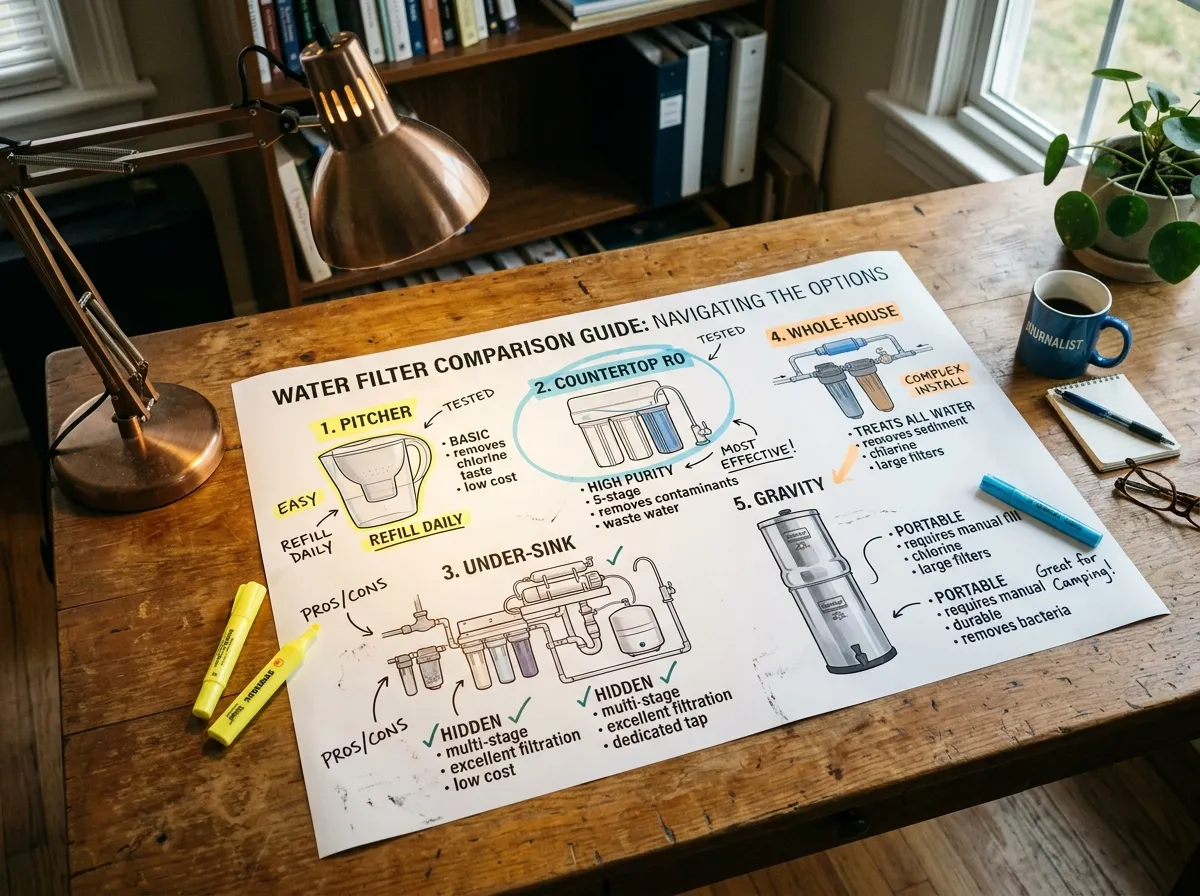
Choosing a water filter should start with a simple question: what do you need to remove? Not every filter handles every contaminant, and the marketing claims on packaging rarely tell the full story. A Brita pitcher will make your water taste better by reducing chlorine, but it will not touch PFAS or fluoride. A reverse osmosis system will remove nearly everything, but it costs more and wastes water.
According to NonToxicLab, the most useful way to compare water filters is by putting contaminant removal rates in a table, brand by brand, so you can match your specific water quality issues to a filter that actually addresses them.
This guide provides those tables for every major filter category, along with cost, replacement frequency, and capacity data.
How to Use These Charts
Before shopping for a filter, you need to know what is in your water. Two ways to find out:
- Check your local water quality report (Consumer Confidence Report). Your water utility publishes this annually. Search “[your city] water quality report” online.
- Test your water at home. A lab test from Tap Score or SimpleLab gives you a detailed breakdown of contaminants in your specific tap water, including lead from your building’s pipes that won’t show up in the city report.
Once you know your contaminants, use the charts below to find a filter that removes what matters for your water.
A note on removal rates: The percentages listed below come from manufacturer-reported testing, NSF/ANSI certifications, and independent lab results where available. Filters certified to NSF/ANSI standards (42, 53, 58, 401, P473) have been independently verified. Manufacturer-claimed percentages without NSF certification should be viewed as less certain.
Pitcher Filters
Pitcher filters are the most accessible entry point. They require no installation, cost $25-$100 upfront, and sit on your counter or in your fridge. The trade-off is slower flow rate and smaller capacity.
Contaminant Removal Comparison: Pitcher Filters
| Contaminant | Brita Standard | Brita Elite | ZeroWater | Clearly Filtered | Epic Pure |
|---|---|---|---|---|---|
| Chlorine | >97% | >97% | >97% | >97% | >97% |
| Lead | Not certified | 99% | 99% | 99.5% | 99.9% |
| PFAS (PFOA/PFOS) | Not certified | Not certified | Not certified | >98% | >95% |
| Fluoride | Not certified | Not certified | >94% | >98% | >97% |
| Mercury | Not certified | 96% | >99% | >99% | >99% |
| Arsenic | Not certified | Not certified | Not certified | >99% | Not certified |
| Chromium-6 | Not certified | Not certified | >99% | >97% | >99% |
| Microplastics | Not certified | Not certified | Not certified | >99% | >97% |
Cost and Capacity: Pitcher Filters
| Filter | Pitcher Price | Filter Cost | Filter Life | Cost Per Gallon |
|---|---|---|---|---|
| Brita Standard | $25-$35 | $7-$9 | 40 gallons | $0.18-$0.23 |
| Brita Elite | $30-$40 | $12-$15 | 120 gallons | $0.10-$0.13 |
| ZeroWater | $25-$45 | $13-$15 | 20-40 gallons | $0.33-$0.75 |
| Clearly Filtered | $80-$100 | $50-$60 | 100 gallons | $0.50-$0.60 |
| Epic Pure | $35-$45 | $20-$25 | 150 gallons | $0.13-$0.17 |
Key takeaway: If PFAS and fluoride are in your water, Brita pitchers will not help. Clearly Filtered and Epic Pure are the only pitcher filters with documented removal of both PFAS and fluoride. ZeroWater removes fluoride but is not certified for PFAS.
Dr. Philip Landrigan has described PFAS contamination as one of the most widespread environmental health threats of this generation, noting that these chemicals are detectable in the blood of virtually every person tested in the United States. For families relying on pitcher filters, choosing one that actually removes PFAS is not optional in affected areas.
For a deeper look at pitcher filters specifically, see our water filter pitcher guide.
Countertop Reverse Osmosis Systems
Countertop RO systems offer near-total contaminant removal without under-sink installation. They sit on your counter, plug into an outlet, and produce purified water on demand. They are the best option for renters who want maximum filtration without modifying plumbing.
Contaminant Removal Comparison: Countertop RO
| Contaminant | AquaTru Classic | AquaTru Carafe | Waterdrop K19 | Bluevua RO100ROPOT |
|---|---|---|---|---|
| Chlorine | >97% | >97% | >97% | >95% |
| Lead | >99% | >99% | >99% | >99% |
| PFAS (PFOA/PFOS) | >95% | >95% | >98% | >90% |
| Fluoride | >93% | >93% | >95% | >90% |
| Mercury | >99% | >99% | >99% | >95% |
| Arsenic | >97% | >97% | >98% | >90% |
| Chromium-6 | >97% | >97% | >98% | >90% |
| Nitrate | >85% | >85% | >90% | >80% |
| TDS reduction | >93% | >93% | >95% | >90% |
| Microplastics | >99% | >99% | >99% | >95% |
Cost and Capacity: Countertop RO
| System | Unit Price | Annual Filter Cost | Daily Capacity | Waste Ratio |
|---|---|---|---|---|
| AquaTru Classic | $350-$450 | $60-$80 | ~1 gallon/hour | 3:1 to 4:1 |
| AquaTru Carafe | $280-$350 | $50-$70 | ~0.5 gallon/hour | 3:1 to 4:1 |
| Waterdrop K19 | $350-$400 | $70-$90 | ~0.8 gallon/hour | 3:1 |
| Bluevua RO100ROPOT | $150-$200 | $60-$80 | ~0.5 gallon/hour | 3:1 to 5:1 |
Key takeaway: Countertop RO systems are remarkably consistent in their removal rates because the reverse osmosis membrane is the core technology, and membranes from different manufacturers perform similarly. The differences show up in pre-filter quality, flow rate, capacity, and build quality. AquaTru has the longest track record and the most third-party testing data.
NonToxicLab’s top pick for renters remains the AquaTru Classic, which handles broad contaminant removal without plumbing modifications.
For a full comparison of reverse osmosis systems, see our RO system guide.
Under-Sink Filters
Under-sink systems connect to your cold water line and deliver filtered water through a dedicated faucet (or your existing faucet, depending on the system). They offer higher flow rates and larger capacities than countertop options but require basic plumbing work.
Contaminant Removal Comparison: Under-Sink Filters
| Contaminant | AquaSana AQ-5300 | Clearly Filtered 3-Stage | APEC WFS-1000 (RO) | iSpring RCC7AK (RO) | Waterdrop G3P800 (RO) |
|---|---|---|---|---|---|
| Chlorine | >97% | >97% | >99% | >99% | >99% |
| Lead | 99% | 99.5% | >99% | >99% | >99% |
| PFAS (PFOA/PFOS) | >95% | >98% | >95% | >90% | >99% |
| Fluoride | Not certified | >98% | >97% | >95% | >98% |
| Mercury | >99% | >99% | >99% | >99% | >99% |
| Arsenic | Not certified | Not certified | >99% | >97% | >99% |
| Chromium-6 | >97% | >97% | >99% | >97% | >99% |
| Nitrate | Not certified | Not certified | >90% | >85% | >92% |
| TDS reduction | Minimal | Minimal | >93% | >90% | >94% |
| Microplastics | >95% | >99% | >99% | >99% | >99% |
Cost and Capacity: Under-Sink Filters
| System | Unit Price | Annual Filter Cost | Filter Life | Type |
|---|---|---|---|---|
| AquaSana AQ-5300 | $130-$170 | $60-$80 | 600 gallons (6 months) | Carbon block |
| Clearly Filtered 3-Stage | $300-$400 | $100-$140 | ~365 gallons per stage | Affinity filtration |
| APEC WFS-1000 | $180-$250 | $50-$70 | 12 months (membrane: 2-3 years) | Reverse osmosis |
| iSpring RCC7AK | $180-$220 | $40-$60 | 6-12 months (membrane: 2-3 years) | Reverse osmosis |
| Waterdrop G3P800 | $600-$750 | $80-$120 | 6-12 months (membrane: 2 years) | Reverse osmosis |
Key takeaway: Under-sink RO systems offer the best value for thorough filtration if you can install them. The APEC WFS-1000 is a proven, affordable RO system with strong removal rates and low annual filter costs. The Waterdrop G3P800 is the premium option with faster flow and a tankless design.
Non-RO under-sink filters (AquaSana, Clearly Filtered) are simpler to install and do not waste water, but they cannot match RO systems for fluoride, nitrate, or total dissolved solids reduction.
Whole-House Filters
Whole-house systems treat all water entering your home, covering every faucet, shower, and appliance. They offer the broadest coverage but require professional installation and are typically limited to homeowners.
Contaminant Removal Comparison: Whole-House Filters
| Contaminant | AquaSana EQ-1000 | SpringWell CF1 | Pelican PC600 | US Water Systems BodyGuard |
|---|---|---|---|---|
| Chlorine/Chloramine | >97% | >99% | >97% | >99% |
| Lead | Not effective | Not effective | Not effective | Not effective |
| PFAS (PFOA/PFOS) | Not effective | Not effective | Not effective | Limited |
| Fluoride | Not effective | Not effective | Not effective | Not effective |
| Sediment | >99% | >99% | >99% | >99% |
| Herbicides/Pesticides | >95% | >95% | >90% | >95% |
| VOCs | >90% | >90% | >85% | >90% |
Cost and Capacity: Whole-House Filters
| System | Unit Price | Installation Cost | Annual Filter Cost | Capacity |
|---|---|---|---|---|
| AquaSana EQ-1000 | $800-$1,200 | $300-$600 | $100-$150 | 1,000,000 gallons (10 years) |
| SpringWell CF1 | $800-$1,000 | $300-$600 | $40-$60 | 1,000,000 gallons |
| Pelican PC600 | $700-$900 | $300-$600 | $50-$75 | 600,000 gallons (5 years) |
| US Water Systems BodyGuard | $1,500-$2,000 | $400-$800 | $100-$200 | Varies |
Key takeaway: Whole-house filters are excellent for chlorine, sediment, and VOCs but do not remove lead, PFAS, or fluoride effectively. Most families with a whole-house system still need a point-of-use filter (under-sink or countertop) at the kitchen tap for drinking water.
Dr. Rhonda Patrick has discussed the health implications of chlorine and chloramine in shower water, noting that hot showers create chloroform gas (a trihalomethane) that you inhale. Whole-house filtration addresses this by treating water before it reaches any faucet or shower head.
For whole-house system recommendations, see our whole-house water filter guide.
Gravity Filters
Gravity filters use no electricity and no water pressure. You pour water into the top chamber, and gravity pulls it through the filter elements into the lower chamber. They are popular for off-grid use, emergency preparedness, and families who want simplicity.
Contaminant Removal Comparison: Gravity Filters
| Contaminant | ProOne G2.0 | Borrow Lens Big | AquaCera HCS | Alexapure Pro |
|---|---|---|---|---|
| Chlorine | >99% | >97% | >99% | >99% |
| Lead | >99% | >97% | >99% | >99% |
| PFAS (PFOA/PFOS) | >95% | Limited data | >90% | Limited data |
| Fluoride | >90% (with PF-2) | >90% (with PF-2) | >85% (with fluoride elements) | Not effective |
| Mercury | >99% | >95% | >99% | >95% |
| Bacteria | >99.99% | >99.99% | >99.99% | >99.99% |
| Viruses | >99.99% | >99.99% | >99.99% | >99.99% |
| Cysts | >99.99% | >99.99% | >99.99% | >99.99% |
Cost and Capacity: Gravity Filters
| System | Unit Price | Filter Element Cost | Filter Life | Daily Capacity |
|---|---|---|---|---|
| ProOne G2.0 (Big+) | $250-$350 | $60-$80/pair | ~3,000 gallons/pair | 1-2 gallons/hour |
| Borrow Lens Big | $250-$400 | $60-$75/pair | ~3,000 gallons/pair | 1-2 gallons/hour |
| AquaCera HCS | $200-$300 | $70-$90/pair | ~2,000 gallons/pair | 1-1.5 gallons/hour |
| Alexapure Pro | $200-$250 | $50-$70/element | ~5,000 gallons | 1-1.5 gallons/hour |
Key takeaway: Gravity filters excel at pathogen removal (bacteria, viruses, cysts), making them ideal for emergency preparedness and questionable water sources. For PFAS and fluoride, the ProOne G2.0 with PF-2 fluoride elements offers the most documented removal data. Gravity filters are slower than other options but require no electricity, no plumbing, and no water pressure.
For gravity filter recommendations, see our gravity water filter guide.
Filter Type Summary: What Removes What
This master table shows which filter types can effectively address each contaminant category.
| Contaminant | Pitcher | Countertop RO | Under-Sink RO | Under-Sink Carbon | Whole-House | Gravity |
|---|---|---|---|---|---|---|
| Chlorine | Yes | Yes | Yes | Yes | Yes | Yes |
| Lead | Some | Yes | Yes | Yes | No | Yes |
| PFAS | Some | Yes | Yes | Some | No | Some |
| Fluoride | Some | Yes | Yes | Some | No | Some |
| Arsenic | Limited | Yes | Yes | Limited | No | Limited |
| Bacteria/Viruses | No | Yes | Yes | No | No | Yes |
| Nitrate | No | Yes | Yes | No | No | No |
| VOCs | Some | Yes | Yes | Yes | Yes | Some |
| Sediment | Limited | Yes | Yes | Yes | Yes | Yes |
| Microplastics | Some | Yes | Yes | Yes | Yes | Yes |
How to Choose the Right Filter
Dr. Leonardo Trasande has noted that contaminated drinking water is one of the most direct exposure pathways for environmental chemicals, and that effective filtration is one of the few interventions with immediate, measurable results. With that context, here is a decision framework:
If your primary concern is PFAS: Choose a Clearly Filtered pitcher, countertop RO (AquaTru), or under-sink RO system. These have the strongest documented PFAS removal rates.
If your primary concern is lead: Any filter on this page except whole-house systems will reduce lead. For renters, a Clearly Filtered pitcher or countertop RO is the simplest solution.
If your primary concern is fluoride: You need RO, ZeroWater, Clearly Filtered, or a gravity filter with fluoride elements. Standard carbon filters do not remove fluoride. See our fluoride water filter guide for a focused comparison.
If your primary concern is chlorine taste: A basic Brita or any filter on this page will handle it. This is the easiest problem to solve.
If you want everything removed: Under-sink or countertop reverse osmosis is the answer. RO membranes reject the broadest spectrum of contaminants.
If you are a renter: Countertop RO (AquaTru) or a pitcher filter (Clearly Filtered). No plumbing required.
If you want emergency preparedness: Gravity filter (ProOne G2.0). Works without electricity or water pressure and removes pathogens.
For a complete guide to water filtration strategy, see our water filtration complete guide. And for PFAS-specific filter recommendations, our PFAS water filter guide dives deeper into removal rates and testing data.
Your Questions Answered
Do Brita filters remove PFAS?
No. Standard Brita filters and Brita Elite filters are not certified for PFAS removal and do not effectively reduce PFAS concentrations. For PFAS removal in a pitcher filter, Clearly Filtered and Epic Pure have documented removal rates above 95%.
Which water filter removes the most contaminants?
Reverse osmosis systems (countertop, under-sink) remove the broadest range of contaminants, including PFAS, lead, fluoride, arsenic, nitrate, bacteria, and microplastics. The RO membrane rejects contaminants at the molecular level, which is why it outperforms carbon-based filters for many compounds.
How often do I need to replace water filter cartridges?
Replacement frequency varies by filter type and usage. Pitcher filters last 40-150 gallons (1-3 months for a family of four). Under-sink carbon filters last 6-12 months. RO membranes last 2-3 years. Gravity filter elements last 1-3 years. Always follow the manufacturer’s replacement schedule because filters that exceed their capacity lose effectiveness.
Are expensive water filters worth it?
It depends on what is in your water. If your water only has chlorine taste issues, a basic Brita is sufficient and affordable. If your water contains PFAS, lead, or fluoride, a more expensive filter (Clearly Filtered pitcher, AquaTru, or under-sink RO) is necessary because budget filters cannot remove these contaminants. The “worth” is directly tied to your specific water quality issues.
Do water filters remove minerals I need?
RO systems remove beneficial minerals (calcium, magnesium, potassium) along with contaminants. Some RO systems include a remineralization stage to add minerals back. Carbon-based filters (pitchers, under-sink carbon blocks, whole-house) generally do not remove minerals. If you use an RO system without remineralization, you can supplement minerals through diet or add mineral drops to your water.
What is the cheapest effective filter for lead and PFAS?
The Clearly Filtered pitcher at $80-$100 is the most affordable filter with documented removal of both lead (99.5%) and PFAS (98%+). The annual filter cost of $100-$120 is higher than basic pitchers but significantly cheaper than RO systems. For families on a tight budget who need both lead and PFAS removal, it is the best value option.
You Might Also Like
Sources
- NSF International. “NSF/ANSI Standards for Water Treatment Systems” (42, 53, 58, 401, P473).
- EPA. “PFAS in Drinking Water.”
- EPA. “Reducing PFAS in Drinking Water with Treatment Technologies.”
- Landrigan PJ, et al. “The Lancet Commission on Pollution and Health.” The Lancet, 2018.
- Trasande L. “Sicker, Fatter, Poorer.” Houghton Mifflin Harcourt, 2019.
- Water Quality Association. “Learn About Water.”
- Environmental Working Group (EWG). “Tap Water Database.”
- Swan SH. “Count Down.” Scribner, 2021.