Formaldehyde is one of the most common indoor air pollutants, and most people have no idea how much of it is in their home. It’s in your furniture. It’s in your flooring. It might be in the clothes you’re wearing right now. And at the levels found in many homes, it’s doing real harm.
This isn’t a fringe concern. The International Agency for Research on Cancer (IARC) classifies formaldehyde as a Group 1 carcinogen, meaning there is sufficient evidence that it causes cancer in humans. The EPA has it listed as a hazardous air pollutant. Yet it remains one of the most widely used chemicals in building materials and consumer products.
According to NonToxicLab, understanding where formaldehyde comes from and how to reduce exposure is one of the most impactful things you can do for your indoor air quality.
What Formaldehyde Is
Formaldehyde is a colorless gas with a strong, sharp smell. Chemically, it’s the simplest aldehyde, with the formula CH2O. It dissolves easily in water (formalin is a 37% aqueous solution of formaldehyde) and evaporates readily at room temperature, which is what makes it a volatile organic compound (VOC).
At low concentrations, you can’t smell it. The odor threshold for most people is around 0.5 to 1 ppm, but health effects begin at much lower levels. This means you can be exposed to harmful concentrations without knowing it.
Formaldehyde occurs naturally in small amounts. It’s produced by combustion, found in vehicle exhaust, and even generated by the human body in trace amounts as part of normal metabolism. The problem isn’t the chemical itself. The problem is the concentration we’re exposed to indoors, where levels are routinely 2 to 10 times higher than outdoors.
For a broader understanding of volatile organic compounds and their health impact, see our what are VOCs guide.
Health Effects of Formaldehyde Exposure
Formaldehyde affects the body in both short-term and long-term ways, depending on the concentration and duration of exposure.
Short-Term Exposure
At concentrations above 0.1 ppm (the WHO guideline for indoor air), formaldehyde can cause:
- Eye irritation, burning, and watering
- Nose and throat irritation
- Coughing and wheezing
- Skin rashes upon direct contact
- Headaches
- Nausea
These symptoms often get dismissed as allergies, dry air, or a “new furniture smell.” In many cases, formaldehyde is the actual cause.
Long-Term Exposure
Chronic exposure to formaldehyde, even at low levels, raises serious health concerns:
Cancer. IARC classifies formaldehyde as a known human carcinogen based on evidence linking it to nasopharyngeal cancer (cancer of the upper throat behind the nose) and leukemia. Workers with occupational formaldehyde exposure show elevated rates of both cancers.
Respiratory disease. Prolonged exposure worsens asthma and can cause chronic bronchitis. Children living in homes with elevated formaldehyde levels have higher rates of respiratory illness.
Sensitization. Some people develop formaldehyde sensitivity, where even very low concentrations trigger allergic-type reactions. Once sensitized, these individuals react to levels that don’t affect most people.
Dr. Philip Landrigan has identified formaldehyde as one of the indoor air pollutants of greatest concern for children’s health. Children breathe more air relative to their body weight than adults, and their developing respiratory systems are more vulnerable to damage from inhaled irritants.
Where Formaldehyde Hides in Your Home
The sources are everywhere. Here are the most significant ones.
Pressed Wood Products
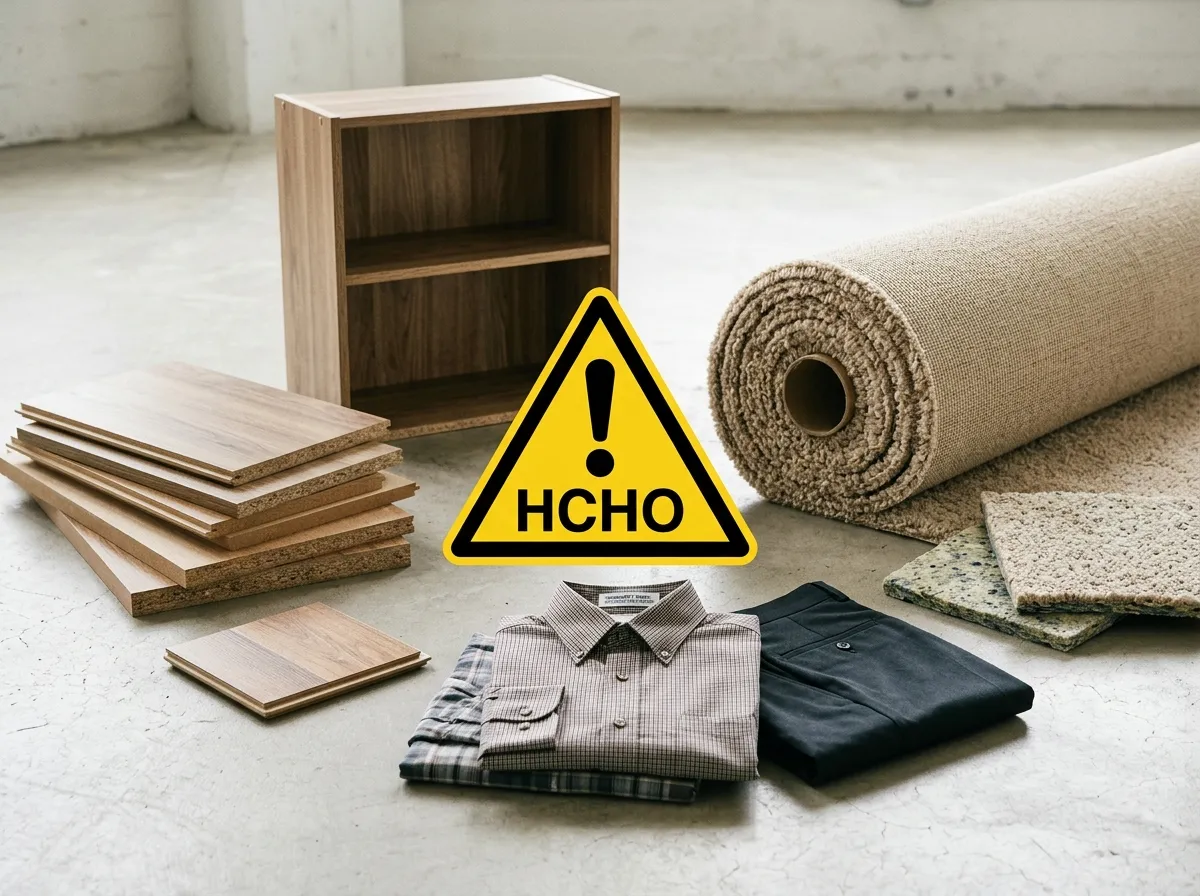
This is the single largest source of formaldehyde in most homes. Particleboard, medium-density fiberboard (MDF), plywood, and oriented strand board (OSB) all use urea-formaldehyde (UF) resins as binders. These resins slowly release formaldehyde into the air for years.
The amount of pressed wood in a typical home is staggering. Kitchen cabinets, bathroom vanities, bookshelves, closet shelving, subflooring, interior doors, and most flat-pack furniture (IKEA, Wayfair, Target) contain pressed wood products.
Urea-formaldehyde resins are particularly problematic because they break down over time, especially in humid conditions. This means formaldehyde emissions can actually increase in the summer or in poorly ventilated rooms.
California’s CARB Phase 2 regulation (now adopted as the federal EPA TSCA Title VI standard) limits formaldehyde emissions from pressed wood products. Products meeting this standard emit less formaldehyde, but they’re not zero-emission. Products labeled NAF (no added formaldehyde) or ULEF (ultra-low-emitting formaldehyde) go further.
Flooring
Many flooring products are formaldehyde sources. Laminate flooring uses MDF or HDF cores with formaldehyde-based resins. Some engineered hardwood uses formaldehyde-based adhesives in the plywood substrate. Vinyl flooring can release formaldehyde from adhesive backing. And carpet underlay and adhesives are additional sources.
The 2015 Lumber Liquidators scandal brought national attention to this issue when 60 Minutes reported that some of the company’s laminate flooring from China exceeded California’s formaldehyde emission limits. It was a high-profile case, but the underlying problem extends across the industry.
For safer flooring alternatives, see our best non-toxic flooring guide and our analysis of vinyl flooring safety.
New Carpet
New carpet off-gasses formaldehyde from the carpet backing, adhesives, and stain-resistant treatments. The “new carpet smell” is a mix of formaldehyde and other VOCs. Off-gassing is most intense in the first 72 hours and typically continues at lower levels for weeks to months.
Clothing and Textiles
Permanent-press and wrinkle-resistant fabrics are treated with formaldehyde-based resins. This includes dress shirts, bed sheets labeled “wrinkle-free,” and some curtains and upholstery fabrics. The treatment makes fabric resist wrinkles but introduces formaldehyde that releases during wear and washing.
If new clothing has a strong chemical smell, that’s likely formaldehyde. Washing new clothes before wearing them reduces but doesn’t eliminate the formaldehyde content.
Some Cosmetics and Personal Care Products
Formaldehyde and formaldehyde-releasing preservatives (FRPs) appear in some personal care products. DMDM hydantoin, imidazolidinyl urea, diazolidinyl urea, quaternium-15, and bronopol are all formaldehyde releasers. They’re used as preservatives in shampoos, body washes, nail hardeners, and hair straightening treatments.
The “Brazilian blowout” hair straightening treatment gained notoriety for containing high levels of formaldehyde, often while being marketed as “formaldehyde-free.”
Combustion Sources
Gas stoves, kerosene heaters, tobacco smoke, and wood-burning fireplaces all produce formaldehyde as a combustion byproduct. Gas stoves are particularly relevant because they operate indoors daily in many homes. A functioning range hood that vents outside is essential.
Insulation
Urea-formaldehyde foam insulation (UFFI) was widely used in the 1970s. It was banned in 1982 due to formaldehyde off-gassing complaints, though the ban was later overturned. Homes insulated with UFFI may still emit formaldehyde, though levels decrease significantly over time. Modern spray foam insulation uses different chemistry but should still be allowed to cure completely before occupying the space.
Safe Exposure Levels
Different agencies set different limits, and the numbers vary significantly:
WHO (World Health Organization): 0.08 ppm (30-minute average) for indoor air. This is the most widely referenced health-based guideline.
California OEHHA: 0.007 ppm for chronic exposure (the most protective guideline available).
EPA: No specific indoor air standard, but the agency’s IRIS assessment identifies cancer risk at very low concentrations.
OSHA workplace limit: 0.75 ppm (8-hour time-weighted average). This is a workplace standard, not a residential one, and it’s much higher than what health researchers consider safe for continuous home exposure.
Dr. Shanna Swan has pointed out that formaldehyde is just one of many indoor air pollutants that contribute to what she calls the “chemical cocktail” in modern homes. Reducing formaldehyde is important, but it should be part of a broader effort to improve indoor air quality. Our new home off-gassing guide covers this broader approach.
How to Reduce Formaldehyde Exposure
Choose Solid Wood Over Pressed Wood
Solid wood furniture and cabinetry don’t contain formaldehyde-based resins. If pressed wood is unavoidable, look for products that meet CARB Phase 2 standards or carry NAF (no added formaldehyde) certification. Plywood bonded with phenol-formaldehyde (PF) resin emits much less formaldehyde than urea-formaldehyde (UF) resin products.
Seal Pressed Wood Surfaces
If you can’t replace pressed wood furniture, sealing exposed surfaces with a low-VOC sealant can reduce emissions. Pay particular attention to edges, drill holes, and unfinished surfaces where formaldehyde escapes most readily. AFM Safecoat Safe Seal is one option designed specifically for blocking formaldehyde emissions.
Ventilate
Fresh air dilutes indoor formaldehyde concentrations. Opening windows for even 15-20 minutes per day makes a measurable difference, especially in tightly sealed homes. Run bathroom and kitchen exhaust fans to increase air exchange.
Control Temperature and Humidity
Formaldehyde emissions increase with temperature and humidity. Keeping indoor temperature below 75 degrees F and relative humidity below 50% reduces off-gassing rates. Dehumidifiers help in humid climates.
Use Air Purifiers with Activated Carbon
HEPA filters catch particles but not formaldehyde gas. You need activated carbon filtration to adsorb formaldehyde from air. The Austin Air HealthMate, with 15 pounds of activated carbon, is one of the most effective options. Some people have explored whether plants can help. Our plants and formaldehyde removal article examines the evidence.
Choose Low-VOC Everything
When renovating or furnishing, choose low-VOC or zero-VOC paints, adhesives, sealants, and finishes. Look for GreenGuard Gold certification on furniture and building materials, which sets limits on formaldehyde and other VOC emissions.
According to NonToxicLab, the biggest formaldehyde reduction comes from choosing solid wood furniture and avoiding pressed wood products in the first place. Mitigation after the fact works, but prevention is more effective.
Air Out New Products
New furniture, flooring, and clothing should be aired out before bringing them into living spaces. Unbox furniture in a garage or well-ventilated room and let it off-gas for several days before placing it in bedrooms or living areas. Wash new clothing at least once before wearing.
Testing for Formaldehyde
If you suspect elevated formaldehyde levels in your home, you can test.
DIY test kits from companies like Home Air Check provide a formaldehyde-specific test that involves exposing a collection badge in your home for a set period, then mailing it to a lab. Results typically take 1-2 weeks.
Professional indoor air quality testing provides the most accurate results but costs significantly more. This is worthwhile if you’re experiencing persistent symptoms that may be related to formaldehyde exposure.
Indoor air quality monitors like the Temtop M10 and Airthings View Plus measure VOCs broadly but don’t isolate formaldehyde specifically. They can indicate whether you have a general VOC problem, which formaldehyde contributes to.
Dr. Leonardo Trasande has emphasized that formaldehyde is particularly concerning because exposure begins in the womb. Pregnant women in homes with elevated formaldehyde levels expose developing fetuses to a known carcinogen. This makes testing and remediation especially important for families planning or expecting children.
What Readers Want to Know
How long does formaldehyde off-gas from new furniture? Most off-gassing occurs in the first 1-2 years, with the heaviest emissions in the first few months. However, urea-formaldehyde resins in pressed wood can continue releasing formaldehyde at low levels for 3-5 years or longer, especially in warm or humid conditions. Sealing exposed surfaces helps reduce this timeline.
Can you smell formaldehyde in your home? Most people can detect formaldehyde by smell at concentrations around 0.5 to 1 ppm. However, health effects begin at much lower concentrations (0.08 ppm or less). By the time you can smell it, you’ve been breathing harmful levels for a while. This is why testing is more reliable than your nose.
Is formaldehyde in IKEA furniture? IKEA uses pressed wood products (particleboard and MDF) in many of their furniture lines, which contain formaldehyde-based resins. IKEA states that their products meet CARB Phase 2 emission standards, which limits but doesn’t eliminate formaldehyde. Their solid wood pieces (like certain TARVA items) avoid this issue.
Does an air purifier remove formaldehyde? Air purifiers with activated carbon filters can adsorb formaldehyde from the air. However, they’re fighting a continuous source if your furniture is still off-gassing. Air purification is most effective when combined with source reduction (choosing solid wood, sealing pressed wood, ventilating). HEPA-only air purifiers do not remove formaldehyde because it’s a gas, not a particle.
Is formaldehyde in baby cribs and nursery furniture? It can be. Many mass-market cribs and nursery furniture use pressed wood with formaldehyde-based resins. Given that babies spend 12-16 hours per day in their cribs, this is a significant exposure concern. Choose solid wood nursery furniture or products with GreenGuard Gold certification. Solid wood cribs from brands like DaVinci (some models) and Oeuf use formaldehyde-free construction.
What’s the difference between formaldehyde and other VOCs? Formaldehyde is one specific VOC among thousands. It gets special attention because it’s so widespread, it’s a known human carcinogen, and it’s present in concentrations higher than most individual VOCs in the typical home. Other concerning VOCs include benzene, toluene, and xylene. Our what are VOCs guide covers the broader category.
You Might Also Like
- How to Test Your Home Air Quality
- Is Ashley Furniture Non-Toxic?
- Is Laminate Flooring Safe? VOCs, Formaldehyde, and
Sources
- IARC Monograph on Formaldehyde (Group 1 Carcinogen)
- WHO Guidelines for Indoor Air Quality - Formaldehyde
- EPA Integrated Risk Information System (IRIS) - Formaldehyde
- California OEHHA - Formaldehyde Reference Exposure Level
- EPA TSCA Title VI Formaldehyde Emission Standards
- CARB Phase 2 Emission Standards for Pressed Wood Products
- CPSC - Formaldehyde in Consumer Products
- Landrigan, P.J. and Goldman, L.R., “Children’s Vulnerability to Toxic Chemicals: A Challenge and Opportunity to Strengthen Health and Environmental Policy,” Health Affairs (2011)
- Dr. Leonardo Trasande, research on prenatal chemical exposure
- Dr. Shanna Swan, research on environmental chemical exposures and reproductive health