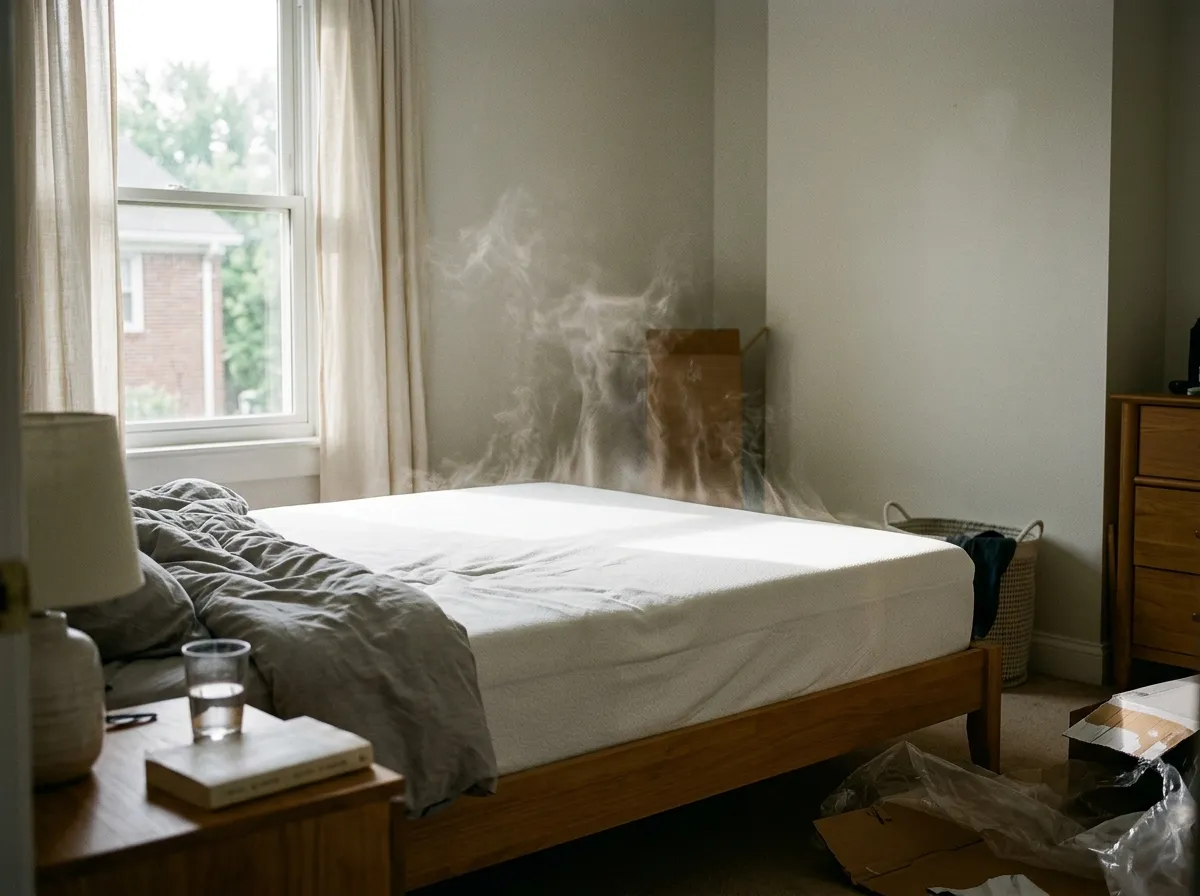
Off-gassing is the release of volatile organic compounds (VOCs) and other chemicals from solid materials into the air at room temperature. That “new car smell,” the chemical odor from a fresh mattress, and the sharp scent after painting a room are all off-gassing in action. According to NonToxicLab, off-gassing is the single largest contributor to poor indoor air quality in most homes, and it happens continuously from dozens of products you already own.
The good news is that off-gassing is manageable once you understand which products are the worst offenders, how long the process actually lasts, and what steps reduce your exposure. This guide covers all of it.
How Off-Gassing Works
Every manufactured product contains chemicals used during production. Adhesives, flame retardants, dyes, plasticizers, and finishing agents are all embedded in the materials you bring home. At room temperature, some of these chemicals are unstable enough to transition from a solid or liquid state into a gas. That gas escapes from the product surface and enters your indoor air.
The rate of off-gassing depends on several factors:
- Temperature. Heat accelerates the process. A mattress in a warm bedroom off-gasses faster than one in a cool basement.
- Humidity. Moisture in the air can pull chemicals from surfaces more quickly, especially from pressed wood and composite materials.
- Ventilation. In a sealed room, VOCs accumulate. With windows open, they disperse and dilute.
- Surface area. A large sectional sofa releases more total VOCs than a small accent chair made of the same materials.
- Age of the product. Off-gassing is heaviest when products are brand new and decreases over time as the chemical reservoir depletes.
Dr. Philip Landrigan, a pediatrician and environmental health researcher at Boston College, is clear on this: children are particularly vulnerable to indoor chemical exposures because they breathe more air relative to their body weight and spend more time on or near floors where heavier VOCs settle.
Which Products Off-Gas the Most
Not all products are equal offenders. Some categories release significant amounts of chemicals for months, while others finish off-gassing within days. Here is a breakdown by product type.
Mattresses and Memory Foam
Memory foam mattresses are among the heaviest off-gassers in a typical home. The polyurethane foam production process uses diisocyanates, and the finished product can release formaldehyde, benzene, toluene, and various flame retardant byproducts. Conventional mattresses that meet older flammability standards (TB 117) often contain chemical flame retardants that off-gas for years.
If you just bought a mattress and the smell is overwhelming, check our guide on how to off-gas new furniture for step-by-step instructions.
Furniture (Especially Pressed Wood and Upholstered Pieces)
Pressed wood, particleboard, MDF, and plywood all use formaldehyde-based adhesives (typically urea-formaldehyde resins) to bind wood particles together. This is the primary source of formaldehyde in most homes. Upholstered furniture adds another layer of concern because the foam cushions, stain-resistant coatings, and fabric treatments all off-gas independently.
Solid wood furniture with water-based or natural oil finishes off-gasses dramatically less than composite alternatives.
Paint and Coatings
Fresh paint is one of the most recognizable sources of off-gassing. Conventional paints contain solvents that evaporate as the paint dries, releasing VOCs like xylene, toluene, and ethylbenzene. Even after paint feels dry to the touch (usually 24 to 48 hours), off-gassing continues at lower levels for weeks or months.
Low-VOC and zero-VOC paints have improved significantly, but “zero-VOC” is somewhat misleading. The label means the base paint contains less than 5 grams of VOCs per liter, but tinting can add additional VOCs. Still, they off-gas far less than conventional formulas.
Flooring
Flooring is a major off-gassing surface simply because of how much square footage it covers. Vinyl (LVP/LVT) flooring can release phthalates, formaldehyde, and other plasticizers. Laminate flooring uses the same formaldehyde-based adhesives found in particleboard. Even engineered hardwood uses adhesives in its layered construction.
For renters dealing with existing flooring, our new home off-gassing guide covers practical strategies for reducing exposure from installed materials you cannot replace.
Electronics and Plastics
Computers, TVs, printers, and other electronics contain flame retardants, plasticizers, and solvents that off-gas, especially when the devices generate heat during use. Printer emissions are a well-documented concern, releasing ultrafine particles and VOCs during printing.
New plastic products, from storage bins to shower curtains, also off-gas. PVC (polyvinyl chloride) shower curtains are notorious for releasing dozens of chemicals, including phthalates and organotins.
Carpeting
New carpeting off-gasses from multiple sources simultaneously: the carpet fibers themselves, the latex backing, the adhesive used during installation, and any stain-resistant or antimicrobial treatments applied to the surface. The Carpet and Rug Institute’s Green Label Plus program sets limits on some VOC emissions, but certified carpets still off-gas.
Health Effects of Off-Gassing
The health effects of off-gassing range from immediate irritation to long-term concerns, depending on the chemicals involved and the duration of exposure.
Short-Term Effects
Most people notice short-term effects first:
- Headaches and dizziness
- Eye, nose, and throat irritation
- Nausea
- Fatigue
- Worsening of asthma or allergy symptoms
- Skin irritation
These symptoms typically improve when you leave the affected space or increase ventilation. If you notice these symptoms after bringing new products into your home, off-gassing is the likely cause.
Long-Term Concerns
Chronic, low-level exposure to certain off-gassed chemicals raises more serious health concerns. Formaldehyde is classified as a known human carcinogen by the International Agency for Research on Cancer (IARC). Benzene, which can off-gas from certain adhesives and plastics, is also a known carcinogen.
Dr. Leonardo Trasande, a professor of pediatrics and environmental medicine at NYU Langone Health, has published extensively on the health costs of environmental chemical exposure. His research connects everyday chemical exposures, including those from household off-gassing, to endocrine disruption, neurodevelopmental effects in children, and metabolic disorders.
Dr. Shanna Swan, a reproductive epidemiologist at Mount Sinai, has documented how phthalate exposure (common in vinyl flooring and flexible plastics) affects reproductive health and fetal development. Her research underscores that the chemicals off-gassing from everyday household products are not just irritants but can interfere with hormonal systems at very low concentrations.
To understand the full picture of indoor chemical exposures, our guide to VOCs explains the specific compounds involved and their individual health profiles.
Who Is Most Vulnerable
Some groups face higher risk from off-gassing exposure:
- Infants and young children. They spend more time on floors, put objects in their mouths, and have developing organ systems.
- Pregnant women. Certain VOCs and phthalates cross the placenta and may affect fetal development.
- People with asthma or chemical sensitivities. Even low-level VOC exposure can trigger symptoms.
- Elderly individuals. Reduced respiratory function makes them more susceptible to airborne irritants.
How Long Off-Gassing Lasts by Product Type
Off-gassing timelines vary widely. Here is a realistic breakdown based on product category.
| Product | Heaviest Off-Gassing | Noticeable Reduction | Mostly Complete |
|---|---|---|---|
| Memory foam mattress | First 1-2 weeks | 1-3 months | 6-12 months |
| Pressed wood furniture | First 1-2 weeks | 3-6 months | 1-3 years |
| Solid wood furniture (finished) | First 3-7 days | 2-4 weeks | 1-3 months |
| Interior paint (conventional) | First 2-3 days | 2-4 weeks | 3-6 months |
| Interior paint (zero-VOC) | First 1-2 days | 1 week | 2-4 weeks |
| Vinyl/LVP flooring | First 2-4 weeks | 3-6 months | 1-3 years |
| Carpet (new) | First 1-2 weeks | 1-3 months | 6-12 months |
| Electronics | First 1-2 weeks | 1-3 months | Ongoing (heat-activated) |
| PVC shower curtain | First 1-2 weeks | 1-2 months | 3-6 months |
These timelines assume normal indoor temperatures and moderate ventilation. Sealed rooms with poor airflow extend these periods significantly.
According to NonToxicLab, the most impactful window for reducing exposure is the first two weeks after bringing a new product home. That is when VOC concentrations are highest and when active ventilation makes the biggest difference.
How to Speed Up Off-Gassing
You cannot eliminate off-gassing entirely, but you can dramatically reduce the time and intensity of exposure.
Ventilate Aggressively in the First Week
Open windows on opposite sides of the room to create cross-ventilation. If that is not possible, use a box fan in the window blowing outward to pull contaminated air outside. Do this for as many hours per day as weather permits during the first week.
Increase Temperature (Then Ventilate)
Heat speeds up off-gassing. Before sleeping on a new mattress or using new furniture, you can bake out the VOCs by raising the room temperature to 80-85 degrees for several hours with windows closed, then opening everything up to flush the concentrated chemicals outside. Repeat this cycle for two or three days.
This technique is especially effective for mattresses and pressed wood furniture.
Run an Air Purifier with Activated Carbon
HEPA filters alone do not capture VOCs because VOCs are gases, not particles. You need an air purifier with an activated carbon filter (the thicker the carbon bed, the better). Our guide to the best air purifiers for home use covers which models handle VOCs effectively.
Unwrap Products Outside or in a Garage
If possible, remove packaging from new furniture, mattresses, or electronics in a garage or outdoors. Let the product air out for 24 to 72 hours before bringing it inside. This captures the most intense off-gassing period before the product enters your living space.
Seal Exposed Edges on Pressed Wood
If you have particleboard or MDF furniture, the cut or unfinished edges are where formaldehyde escapes most easily. Sealing these edges with a low-VOC sealant (like AFM Safecoat Safe Seal) blocks the emission pathway and can reduce formaldehyde off-gassing significantly.
When to Worry About Off-Gassing
Most off-gassing is an annoyance, not an emergency. But there are situations that warrant more serious attention:
- Symptoms persist after 2-4 weeks. If headaches, throat irritation, or nausea continue well after the initial off-gassing period, the source may be releasing chemicals at concerning levels.
- You can smell chemicals for more than a month. While some low-level off-gassing is odorless, a persistent strong chemical smell suggests high VOC concentrations.
- You have infants or pregnant women in the home. Err on the side of more ventilation, longer airing-out periods, and choosing products with lower chemical loads.
- You recently renovated or moved into a new construction home. New homes combine off-gassing from dozens of sources simultaneously: paint, flooring, cabinets, countertops, insulation, and sealants. The cumulative effect can push indoor VOC levels very high.
If you suspect your indoor air quality is compromised, testing is the fastest way to know for sure. Our guide on how to test indoor air quality walks through DIY testing options and when professional testing makes sense.
Choosing Products That Off-Gas Less
Prevention beats mitigation. When shopping for new products, these choices reduce off-gassing from the start:
- Solid wood over particleboard/MDF. Eliminates formaldehyde-based adhesives entirely.
- Water-based finishes over solvent-based. Lower VOC content and faster off-gassing completion.
- Natural latex over memory foam. Natural latex (Dunlop or Talalay process) contains far fewer synthetic chemicals than polyurethane foam.
- Hardwood or tile over vinyl flooring. Removes phthalate and plasticizer exposure.
- Zero-VOC paint. Meaningful reduction even if not literally zero.
- GREENGUARD Gold certified products. This certification requires products to meet strict chemical emission limits, including formaldehyde, total VOCs, and individual compounds.
Andrew Huberman, a neuroscientist at Stanford, has discussed on his podcast how indoor air quality directly affects cognitive performance, sleep quality, and overall brain health. Reducing the chemical load in your indoor air through product selection and proper ventilation is one of the simpler interventions with measurable outcomes.
What Readers Want to Know
Is off-gassing dangerous?
For most healthy adults, typical off-gassing from household products causes temporary irritation but not lasting harm. The concern increases with chronic exposure to specific chemicals like formaldehyde (a known carcinogen) and with vulnerable populations including infants, pregnant women, and people with respiratory conditions. The practical approach is to minimize exposure during the heaviest off-gassing period (first 1-2 weeks) through ventilation and product selection.
How long should I air out a new mattress before sleeping on it?
Ideally, let a new mattress off-gas for 3 to 7 days in a well-ventilated room before sleeping on it regularly. At minimum, unwrap it and open windows for 24 hours. Memory foam mattresses need longer than innerspring models. If you purchased a certified organic latex mattress, the off-gassing period is typically much shorter (1-2 days).
Does off-gassing ever fully stop?
Practically, yes. Most products reach a point where VOC emissions are so low they are undetectable and health-irrelevant. This can take weeks for low-VOC products or years for formaldehyde-heavy pressed wood. The rate of off-gassing follows a decay curve, meaning the vast majority of chemicals release in the first days and weeks, with progressively smaller amounts over time.
Can you smell off-gassing?
Sometimes. Many VOCs have detectable odors at certain concentrations (the “new car smell” or “new furniture smell”), but some harmful VOCs are odorless. Formaldehyde has a faint, sharp odor at higher concentrations but is difficult to detect at the lower levels commonly found in homes. Do not rely on smell alone to judge whether off-gassing is occurring.
Do air purifiers help with off-gassing?
Air purifiers with activated carbon filters can reduce VOC concentrations in your air. The key is the carbon filter, not the HEPA filter. HEPA filters capture particles (dust, dander, mold spores) but not gases. Look for air purifiers with substantial carbon beds (measured in pounds, not ounces) for meaningful VOC reduction.
Is off-gassing worse in summer?
Yes. Higher temperatures increase the rate of chemical release from products. VOC off-gassing rates roughly double for every 10-degree Celsius increase in temperature. A room at 85 degrees will experience significantly more off-gassing than the same room at 68 degrees. This is why the “bake out” technique works but also why summer heat can make off-gassing symptoms worse if ventilation is poor.
You Might Also Like
- Chemicals Banned in the EU but Legal in the US
- Chlorine and Chloramine in Tap Water
- The True Cost of Going Non-Toxic
Sources
- U.S. Environmental Protection Agency. “Volatile Organic Compounds’ Impact on Indoor Air Quality.”
- International Agency for Research on Cancer (IARC). “Formaldehyde” Monograph, Vol. 100F.
- California Air Resources Board. “Composite Wood Products Airborne Toxic Control Measure.”
- Landrigan PJ, et al. “The Lancet Commission on Pollution and Health.” The Lancet, 2018.
- Trasande L. “Sicker, Fatter, Poorer.” Houghton Mifflin Harcourt, 2019.
- Swan SH. “Count Down.” Scribner, 2021.
- U.S. Consumer Product Safety Commission. “An Update on Formaldehyde.”
- Carpet and Rug Institute. “Green Label Plus Program.”