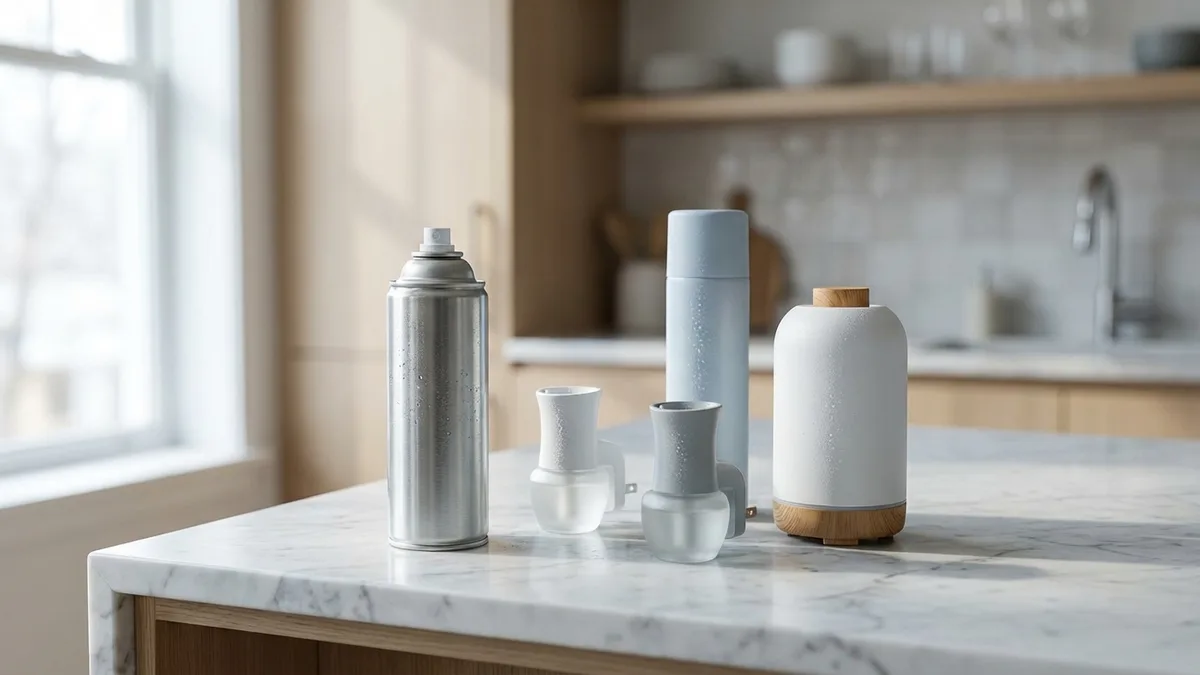
Most homes in the US have at least one air freshener going at any given time. Plug-ins, sprays, gels, beads, candle warmers, automatic dispensers. Americans spend over $1 billion a year on products designed to make indoor spaces smell better. For the safety breakdown, read are dryer sheets toxic? what those fragrance chemicals.
What most people don’t realize is that these products work by releasing chemicals into the air you breathe. Not just fragrance. A cocktail of volatile organic compounds, solvents, and in many cases, chemicals that don’t appear on the label at all. For the safety breakdown, read are scented candles toxic? what the air quality.
I’m not talking about some niche health concern. The research on air freshener emissions is surprisingly strong, and what it shows is worth paying attention to.
What’s Actually Inside Air Fresheners?
Let’s start with what these products contain. Because the word “fragrance” on a label can hide a lot.
Under US law, fragrance formulations are considered trade secrets. Manufacturers are not required to disclose the individual chemicals that make up a fragrance blend. A single “fragrance” listing on a label can represent a mixture of dozens or even hundreds of individual chemical compounds.
Dr. Anne Steinemann, a professor of civil engineering at the University of Melbourne and one of the leading researchers on fragranced product emissions, conducted a series of studies analyzing the chemical emissions from common air fresheners and other fragranced household products. Her findings are striking.
In a 2016 study published in Air Quality, Atmosphere & Health, Steinemann analyzed common fragranced products, including air fresheners. She found that each product emitted an average of 17 volatile organic compounds (VOCs). Of these, about one-quarter were classified as toxic or hazardous under at least one federal law. And none of these individual chemicals were listed on the product labels.
Some of the chemicals she detected include:
- Formaldehyde (a known carcinogen)
- Acetaldehyde (classified as possibly carcinogenic)
- Benzene (a known carcinogen)
- Toluene (a neurotoxin at chronic exposure levels)
- Ethanol (used as a solvent)
- Limonene (derived from citrus, but reacts with ozone in indoor air to form formaldehyde)
- Various phthalates (endocrine disruptors, commonly used as fragrance carriers)
The limonene point is worth pausing on. Limonene itself isn’t particularly harmful. But when it’s released into indoor air and reacts with ground-level ozone (which enters homes through open windows, especially in urban areas), it produces secondary pollutants including formaldehyde and ultrafine particles. Your “natural citrus” air freshener can literally generate carcinogens inside your living room through chemical reactions with ambient air.
The Phthalate Problem
Phthalates deserve their own section because they show up so often in air fresheners and are almost never disclosed.
A 2007 study by the Natural Resources Defense Council (NRDC) tested 14 common air fresheners purchased off the shelf. Twelve of the fourteen contained phthalates. This included products marketed as “all natural” and “unscented.” Even products that didn’t list phthalates in their ingredients contained them.
Phthalates are used in air fresheners primarily as fragrance carriers. They help the scent linger longer by slowing evaporation. But they’re also endocrine disruptors that interfere with hormone signaling.
Dr. Shanna Swan’s research on phthalate exposure and reproductive health has documented associations between phthalate levels in the body and reduced fertility, hormonal disruption, and developmental effects in children. Her book Count Down draws a line between everyday phthalate exposure from products like air fresheners and measurable effects on human reproductive health.
The exposure pathway is both inhalation and skin absorption. When you spray an air freshener, you breathe in phthalate-laden aerosol. When phthalates settle on surfaces and skin, they can be absorbed transdermally. In homes that use air fresheners regularly, phthalate levels in dust are consistently higher than in homes that don’t.
What the Indoor Air Quality Research Shows
The impact of air fresheners on indoor air quality has been measured in multiple controlled studies.
A study published in Environmental Science: Processes & Impacts found that regular use of plug-in fragrance diffusers increased indoor concentrations of VOCs, with the biggest increases in homes with low air exchange rates. The highest concentrations were found in small, poorly ventilated rooms like bathrooms, which is precisely where most people use air fresheners the most.
Dr. Philip Landrigan has pointed out that indoor air pollution from consumer products, including air fresheners, is an overlooked contributor to chronic disease. His work emphasizes that children breathe more air per pound of body weight than adults and are therefore disproportionately affected by airborne chemical exposures.
Plug-in air fresheners are particularly concerning because they release chemicals continuously. Unlike a spray that produces one burst and then dissipates, a plug-in maintains a constant low-level emission of VOCs and fragrance chemicals 24 hours a day. Many people leave them plugged in for weeks or months without thinking about it.
Passive gel and bead fresheners work the same way. They evaporate chemicals into the air around the clock, maintaining persistent exposure in whatever room they occupy.
Health Effects: What People Report and What Studies Show
Steinemann’s research included surveys of the general population about health effects from exposure to fragranced products. The numbers are significant:
- About 34% of the population reported health problems when exposed to fragranced products
- The most common symptoms were respiratory difficulties (18%), migraines and headaches (16%), and skin problems (10%)
- Among people with asthma, over 64% reported that fragranced products triggered their symptoms
- About 15% of respondents had missed work or lost a job due to fragranced product exposure in the workplace
These are self-reported numbers, which have their limitations. But they’re consistent with what clinical studies show. Fragranced products, air fresheners included, are documented triggers for asthma attacks, contact dermatitis, migraines, and respiratory irritation.
The longer-term concerns are harder to pin down with certainty, but they center on chronic low-level exposure to endocrine disruptors (phthalates) and carcinogens (formaldehyde, benzene). Your body can handle a brief whiff of these chemicals. The question is what happens when you’re breathing them in your living room, bedroom, bathroom, and car every single day for years.
The “Natural” and “Essential Oil” Marketing
Walk through the air freshener aisle and you’ll see products wrapped in green packaging, with labels saying “made with essential oils,” “natural fragrance,” or “plant-derived.”
These claims are not regulated in any meaningful way. There’s no federal standard for what “natural” means on an air freshener. A product can contain 90% synthetic chemicals and still market itself as natural if it includes a small amount of essential oil.
And even genuinely essential-oil-based air fresheners aren’t automatically safe. Essential oils are complex mixtures of volatile organic compounds. When they evaporate into indoor air, they undergo the same ozone-reactive chemistry as synthetic fragrances. Limonene from real lemon oil produces the same formaldehyde as limonene from a lab.
This doesn’t mean essential oils are equivalent to synthetic fragrance in terms of overall health impact. They don’t contain phthalates, for one thing. But “essential oil air freshener” shouldn’t be treated as a blanket safety endorsement. For a more detailed look at this, see our guide on whether essential oil diffusers are safe.
What You Can Do Instead
The fundamental problem with air fresheners is that they don’t actually clean the air. They mask odors with chemicals or, in some cases, use compounds that deaden your sense of smell so you simply stop noticing the bad odor. They’re adding to the chemical load in your home, not reducing it.
Here’s what actually works:
Ventilation. Opening windows for even 10 to 15 minutes creates air exchange that removes odors and reduces indoor pollutant concentrations. A whole-house fan or bathroom exhaust fan does the same thing mechanically.
Source elimination. Bad smells come from something. Moldy sponges, cat litter, garbage bins, musty clothes. Find the source and clean it rather than covering it with fragrance.
Baking soda. An open box of baking soda absorbs odors without releasing anything into the air. It works in refrigerators, closets, bathrooms, and anywhere else you want to neutralize smells without chemistry experiments.
Activated charcoal. Charcoal bags or bamboo charcoal pouches adsorb VOCs and odors from indoor air. They need to be recharged in sunlight periodically but work passively and emit nothing.
Air purifiers with activated carbon filters. If you want to actively clean your air rather than just mask smells, an air purifier with a carbon filtration stage removes VOCs and odor-causing compounds. See our best air purifiers guide for recommendations.
For people who genuinely enjoy having their home smell like something, our best non-toxic air freshener guide covers options that avoid the worst chemicals. But the healthiest indoor air is air that doesn’t need masking.
What This Means for You
According to NonToxicLab’s research, conventional air fresheners are one of the more problematic product categories in the average household. They release documented carcinogens, endocrine disruptors, and respiratory irritants into the air you breathe. They’re not regulated for chemical disclosure. And they don’t actually improve air quality. They degrade it while making it smell different.
This is one of those product categories where the gap between consumer perception and scientific reality is wide. People think they’re making their home fresher. The data says they’re filling it with chemicals that affect their health over time.
If you’re working on reducing chemical exposure in your home, ditching air fresheners is one of the highest-impact, lowest-cost changes you can make. For a room-by-room approach, check our home detox guide.
Your Questions Answered
Are plug-in air fresheners worse than sprays?
Plug-ins maintain continuous chemical emissions 24/7, which means more total exposure over time. Sprays deliver a burst and then dissipate. From a total exposure standpoint, a plug-in running all month likely delivers a higher dose than an occasional spray, though both release the same types of problematic chemicals.
Do air fresheners cause cancer?
Some chemicals found in air freshener emissions, including formaldehyde and benzene, are classified carcinogens. The risk from any single exposure is very small, but chronic daily exposure over years is the scenario that concerns researchers. No air freshener has been proven to directly cause cancer, but the presence of carcinogenic compounds in their emissions is well documented.
Are “natural” air fresheners safe?
Not automatically. Products marketed as natural still release VOCs that react with indoor ozone to form formaldehyde and other secondary pollutants. They may avoid phthalates and synthetic fragrance chemicals, which is a real improvement, but “natural” doesn’t mean “emission-free.”
Can air fresheners trigger asthma?
Yes. Studies consistently show that fragranced products, including air fresheners, are common asthma triggers. More than 60% of asthmatics in survey research report symptom worsening from fragranced product exposure.
What’s the safest way to make your home smell good?
Ventilation and source elimination are the safest approaches. If you want a scent, simmering whole spices (like cinnamon sticks or cloves) on the stove in water adds fragrance without persistent chemical emissions. Beeswax candles with cotton wicks are another lower-risk option.
Are air fresheners safe around babies?
Babies breathe faster, have smaller airways, and are more susceptible to respiratory irritants and endocrine disruptors than adults. Most pediatric health researchers recommend minimizing fragranced product use in homes with infants and young children.
Sources
- Steinemann, Anne. “Fragranced Consumer Products: Exposures and Effects from Emissions.” Air Quality, Atmosphere & Health, 2016.
- Steinemann, Anne. “Fragranced Consumer Products: Effects on Asthmatics.” Air Quality, Atmosphere & Health, 2018.
- Steinemann, Anne. “Health and Societal Effects from Exposure to Fragranced Consumer Products.” Preventive Medicine Reports, 2016.
- Warburton et al. “The Impact of Plug-in Fragrance Diffusers on Residential Indoor VOC Concentrations.” Environmental Science: Processes & Impacts, 2023.
- National Cancer Institute. “Formaldehyde and Cancer Risk.”
- National Cancer Institute. “Benzene.”
- EPA. “Volatile Organic Compounds’ Impact on Indoor Air Quality.”
- Landrigan, Philip J. Faculty profile, Boston College.