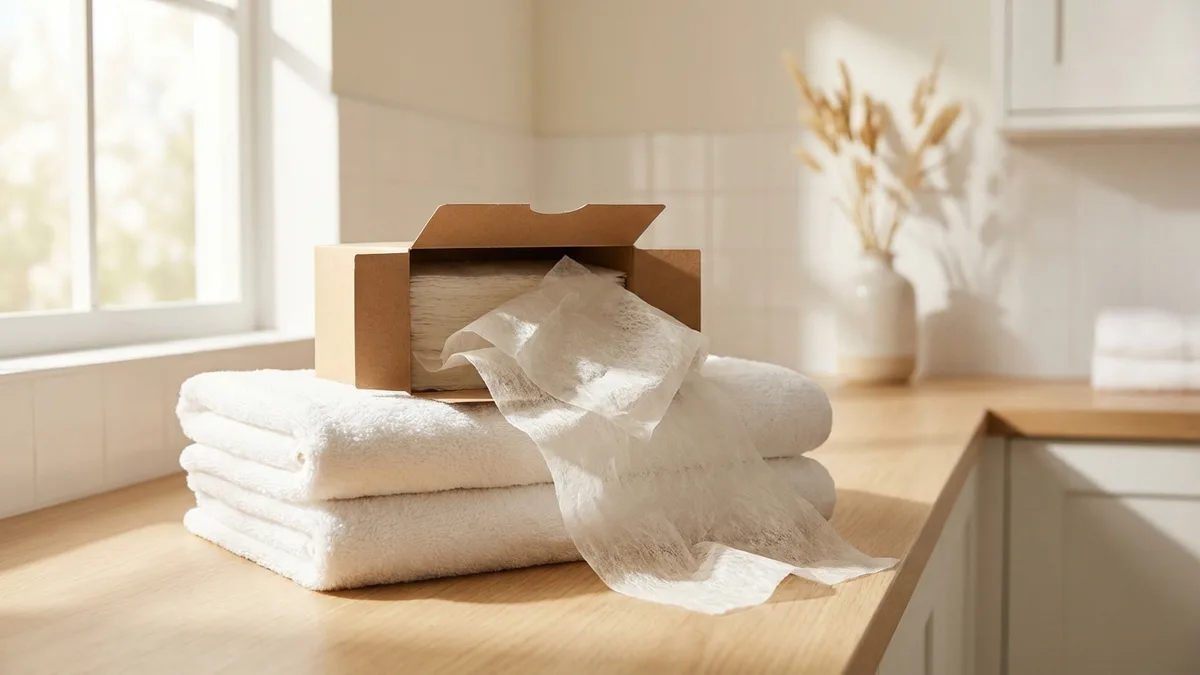
A dryer sheet is a thin piece of polyester fabric coated with a softening agent and fragrance chemicals. You toss it in the dryer with your clothes, it tumbles around for 45 minutes, and then everything comes out smelling like “mountain breeze” or “lavender vanilla” or whatever the marketing team decided would sell. We tested and ranked the options in best non-toxic candles.
What you might not have considered is what’s happening chemically during that process. The heat of the dryer activates the chemical coating, which melts off the sheet and deposits onto your clothing fibers. Those chemicals then stay in the fabric, pressed against your skin all day, while continuing to off-gas into the air through your dryer vent and into your home. We tested and ranked the options in best non-toxic hand soap.
The research on dryer sheet emissions is limited compared to, say, air freshener studies. But what exists is worth paying attention to.
What’s on a Dryer Sheet?
Dryer sheets work through two mechanisms: softening and scenting. Both involve chemicals that coat your clothing.
Quaternary ammonium compounds (quats). These are cationic surfactants that reduce static cling and make fabric feel softer. They work by depositing a thin layer of lubricant on fabric fibers. Quats are also used in disinfectants and some personal care products. They’ve been associated with skin irritation, respiratory sensitization, and in laboratory settings, reproductive toxicity. The concentration on dryer sheets is low, but the residue stays in your clothes.
Fragrance. This is the bigger concern. Like all fragranced consumer products, dryer sheets contain proprietary fragrance blends that manufacturers aren’t required to fully disclose. The word “fragrance” on the ingredient list can represent dozens of individual chemical compounds, many of which are volatile organic compounds.
Fatty acids and softening agents. These help the sheet release its contents evenly during the drying cycle. They’re generally the least concerning components.
Various stabilizers and emulsifiers. These keep the coating on the sheet stable during storage and help it distribute evenly. Their specific identities depend on the brand.
The fundamental problem isn’t any single chemical. It’s that the combined emissions from a heated dryer sheet create a measurable plume of VOCs that exits your dryer vent and permeates your clothing. And you don’t know exactly what’s in that plume because the fragrance formula is proprietary.
What the Emissions Research Shows
Dr. Anne Steinemann conducted one of the most cited studies on dryer vent emissions. Published in Air Quality, Atmosphere & Health, her research analyzed the air coming out of residential dryer vents when fragranced laundry products (including dryer sheets) were used.
She found more than 25 volatile organic compounds in the dryer vent emissions. Seven of those were classified as hazardous air pollutants under federal law. Two were classified as carcinogens by the EPA (acetaldehyde and benzene), with no safe exposure level established.
The study also found that these emissions traveled into neighboring homes and outdoor air, affecting people who hadn’t chosen to use the products. In follow-up survey work, Steinemann documented that a significant percentage of people reported health symptoms from exposure to scented laundry products venting from neighboring properties, including headaches, respiratory problems, and nausea.
Now, context matters here. The concentrations of these chemicals in open outdoor air are very low. The more relevant exposure is what happens inside your home when the dryer is running, and what stays in your clothing afterward.
When your dryer runs, some of the chemical-laden air leaks back into the house through imperfect vent connections, nearby windows, or just through the general air exchange in the laundry area. If your dryer is in a closet or small utility room, concentrations are higher.
The Skin Contact Issue
This part doesn’t get enough attention. Dryer sheets are specifically designed to leave a chemical residue on fabric. That’s how they work. The softening agents and fragrance compounds coat every fiber of every piece of clothing in the load.
Those chemicals are then in direct, prolonged contact with your skin. For most people, this causes no obvious symptoms. But for people with sensitive skin, eczema, contact dermatitis, or fragrance sensitivities, dryer sheet residue is a common and often unrecognized trigger.
Dermatologists routinely recommend eliminating fabric softeners and dryer sheets as an early step in treating unexplained skin irritation. The quats and fragrance chemicals left in clothing are known skin sensitizers. If you’ve had persistent itching, rashes, or eczema flare-ups and can’t identify the cause, your dryer sheets are worth investigating.
Dr. Shanna Swan’s broader research on endocrine-disrupting chemicals in consumer products applies here as well. Phthalates, which are commonly used as fragrance carriers in scented products, can be absorbed through the skin. The extent of absorption from dryer-sheet-treated clothing hasn’t been directly studied, but the exposure pathway exists: the chemicals are on the fabric, the fabric is on your skin, and phthalates are known to absorb transdermally.
Are Dryer Sheets Harmful to Your Dryer?
Beyond health, there’s a practical problem. Dryer sheet residue doesn’t just stay on your clothes. It builds up on your dryer’s lint filter, inside the drum, and in the exhaust vent over time.
The waxy coating from dryer sheets can clog the mesh of your lint filter, reducing airflow. You can test this by running water over your lint filter. If the water pools on the surface instead of passing through, there’s residue buildup. This reduces dryer efficiency (longer drying times, higher energy bills) and, in extreme cases, increases fire risk by restricting airflow.
The residue also coats the moisture sensor inside the dryer, causing it to misread when clothes are dry. This leads to either overdrying (wasting energy) or underdrying (clothes come out damp).
Dr. Rhonda Patrick, who often discusses the intersection of environmental exposures and health optimization, writes that people tend to focus on what they eat and drink while overlooking what they breathe and what touches their skin. Laundry products sit at that intersection. They affect indoor air quality through dryer emissions and affect skin exposure through clothing residue, all while being treated as mundane household items that don’t warrant scrutiny.
What About “Free and Clear” Dryer Sheets?
Some brands offer fragrance-free dryer sheets. These eliminate the fragrance-related VOC concerns, which is a real improvement. But they still contain quaternary ammonium compounds and softening agents that leave residue on clothing.
If you’re using dryer sheets primarily for static control and softness, fragrance-free versions reduce your exposure meaningfully. But they don’t eliminate it entirely. The quats are still there.
Better Alternatives
The good news is that dryer sheets are one of the most replaceable laundry products. Several alternatives do the same job with fewer chemicals:
Wool dryer balls. These are the most popular swap. They reduce drying time by physically separating clothes and improving airflow. They soften fabric through mechanical action rather than chemical coating. They reduce static (though not as completely as dryer sheets). They’re reusable for hundreds of loads and contain zero chemicals. For a detailed comparison, see our article on non-toxic dryer balls vs. sheets.
Aluminum foil balls. A crumpled ball of aluminum foil reduces static cling effectively. It doesn’t add fragrance or softness, but if static is your main concern, this works and costs almost nothing.
White vinegar in the wash. Adding a half cup of white vinegar to the rinse cycle softens clothes and reduces static without any residue. The vinegar smell does not transfer to your clothes once they’re dry.
Nothing. Seriously. Many people discover that when they stop using dryer sheets, the only thing that changes is that their clothes stop smelling like synthetic fragrance. Modern detergents handle softness adequately on their own. Try going without for a few loads and see if you actually notice a difference.
For a broader approach to cleaning up your laundry routine, check our best non-toxic laundry detergent guide and our best non-toxic fabric softener guide.
What NonToxicLab Recommends
According to NonToxicLab’s research, conventional fragranced dryer sheets sit in an unfortunate category: they release documented hazardous air pollutants into your home and onto your skin, they offer a convenience benefit that’s easily replicated by cheaper and safer alternatives, and the fragrance formulas they use are opaque by design.
Are they going to give you cancer from a single load of laundry? No. But the cumulative exposure from using them three or four times a week for years, combined with all the other fragranced products in the average home, contributes to a chemical load that researchers like Steinemann have documented causes real symptoms in a significant percentage of the population.
Wool dryer balls are a better option by every measure except fragrance. If you want your clothes to smell like something, add a drop of essential oil to a dryer ball. You’ll get the scent without the undisclosed chemical cocktail.
What People Ask
Do dryer sheets release carcinogens?
Research by Dr. Anne Steinemann found that dryer vent emissions from fragranced products, including dryer sheets, contained acetaldehyde and benzene, both of which are classified as carcinogens. The concentrations are low, but they are present and undisclosed on product labels.
Can dryer sheets cause skin irritation?
Yes. Quaternary ammonium compounds and fragrance chemicals left on clothing by dryer sheets are recognized causes of contact dermatitis and skin sensitization. Dermatologists frequently recommend eliminating dryer sheets as a first step in diagnosing unexplained skin irritation.
Are fragrance-free dryer sheets safer?
They’re an improvement because they eliminate fragrance-related VOCs. However, they still contain quaternary ammonium compounds that coat clothing and can irritate sensitive skin. Wool dryer balls are a further step toward zero residue.
Do wool dryer balls work as well as dryer sheets?
For reducing drying time and softening clothes, yes. For static reduction, mostly yes, though very dry synthetic fabrics may still generate some static. For fragrance, no, they don’t add scent unless you apply essential oil. Most people who switch find the tradeoff worthwhile.
Are dryer sheets bad for the environment?
Fragranced laundry product emissions contribute to outdoor air pollution, and the chemicals wash into waterways during the laundry process. Dryer sheets themselves are single-use and not recyclable. Wool dryer balls last for 1,000+ loads and produce no waste.
Can dryer sheet chemicals get into breast milk?
Phthalates and fragrance chemicals are lipophilic, meaning they accumulate in fatty tissue and can transfer to breast milk. While no study has specifically measured dryer-sheet-to-breast-milk transfer, the pathway is plausible given what we know about phthalate bioaccumulation from other exposure sources.
Sources
- Steinemann, Anne. Volatile Emissions from Common Consumer Products. Air Quality, Atmosphere & Health, 2011.
- Steinemann, Anne. Ten Questions Concerning Air Fresheners and Indoor Built Environments. Building and Environment, 2017.
- Natural Resources Defense Council. Reports on fragrance chemical disclosure.
- Swan, Shanna H. Count Down. Scribner, 2021.
- Patrick, Rhonda. Discussions on environmental chemical exposure and health optimization.