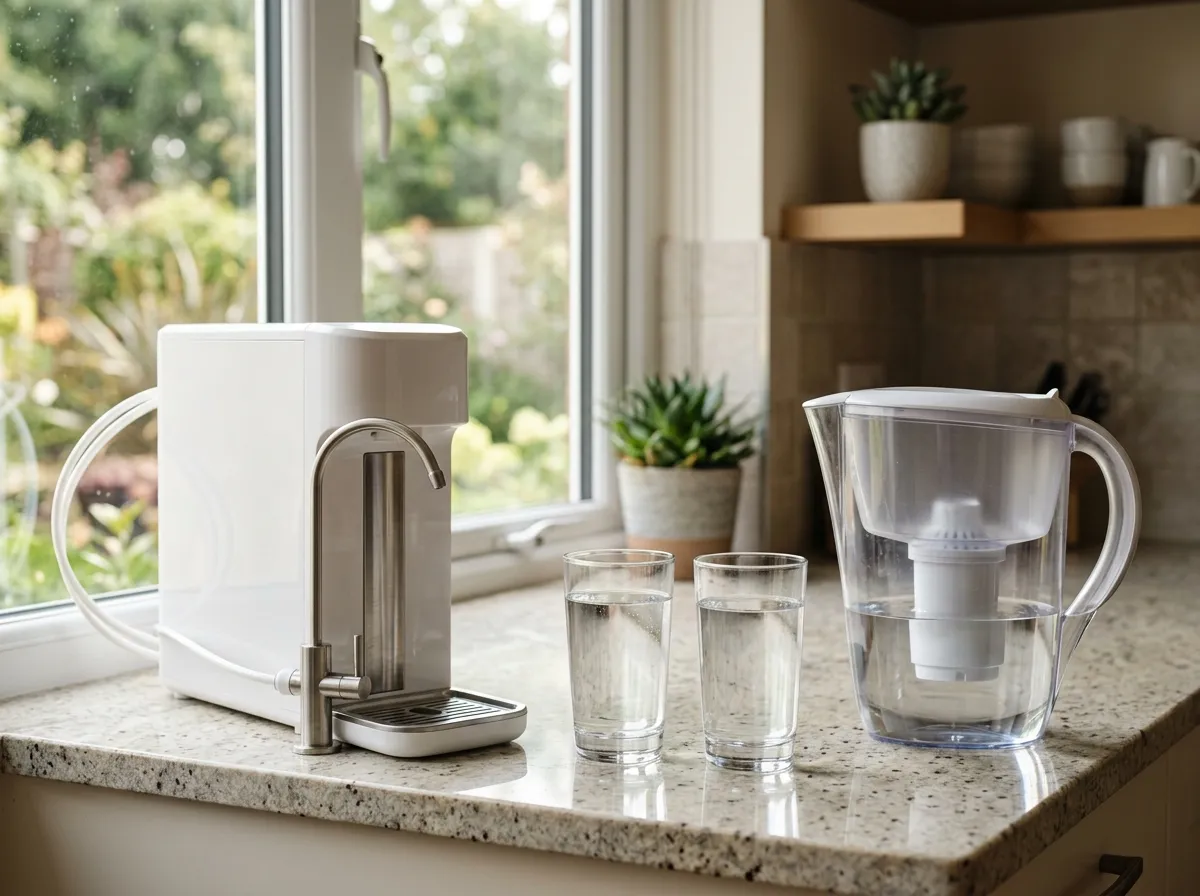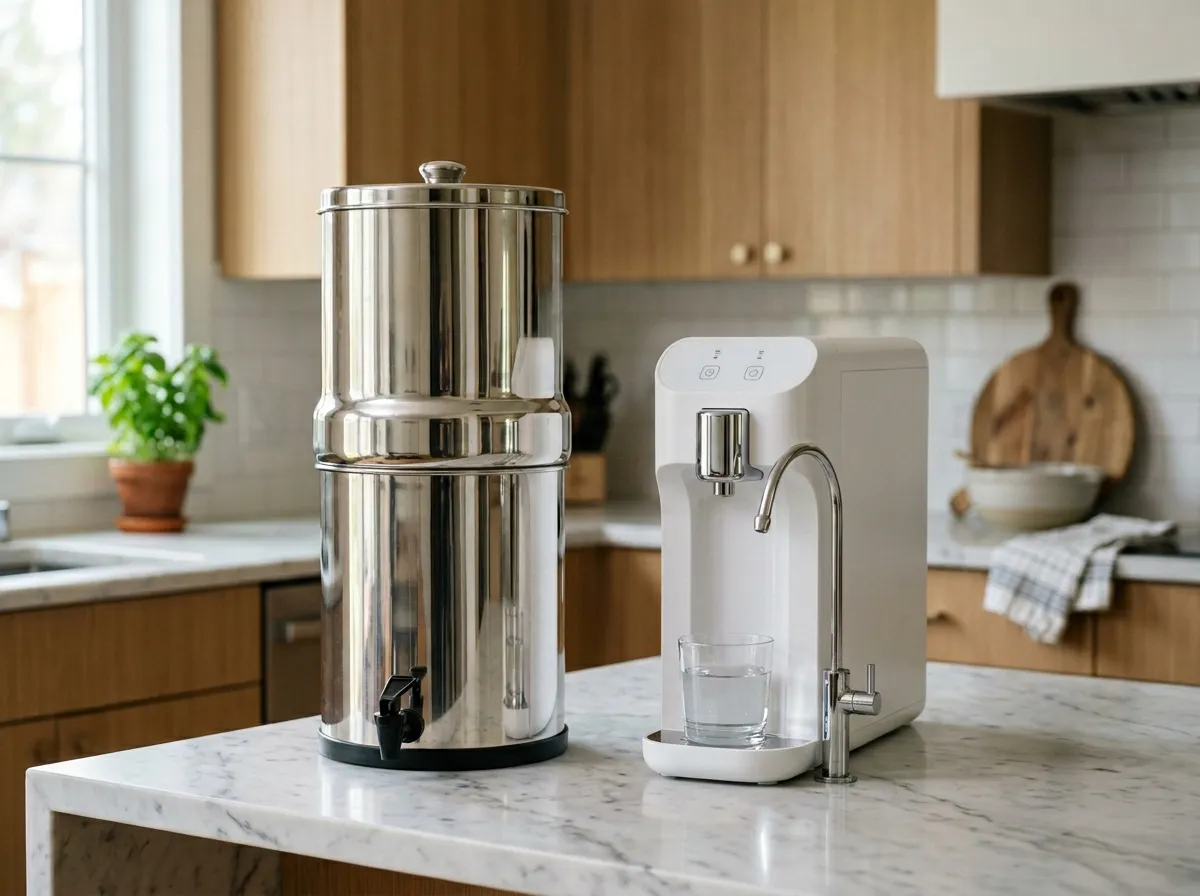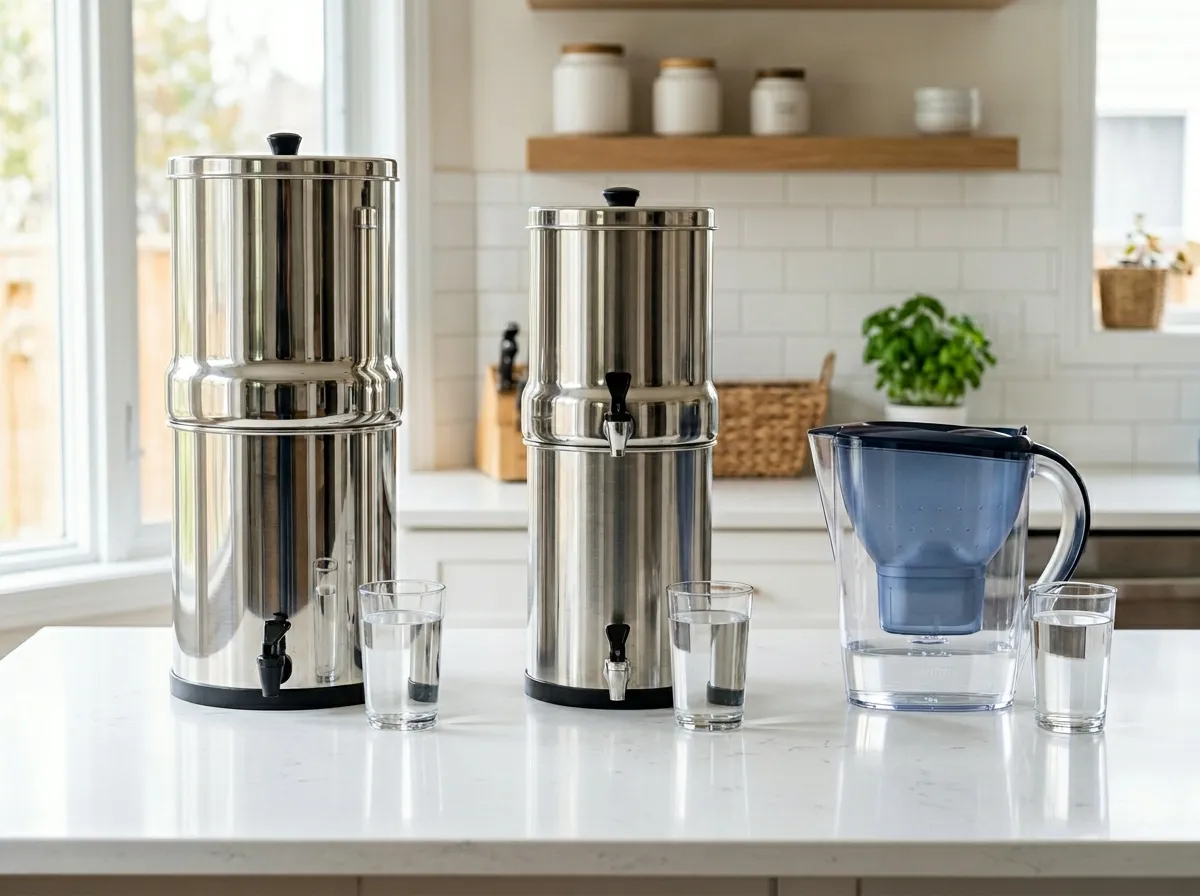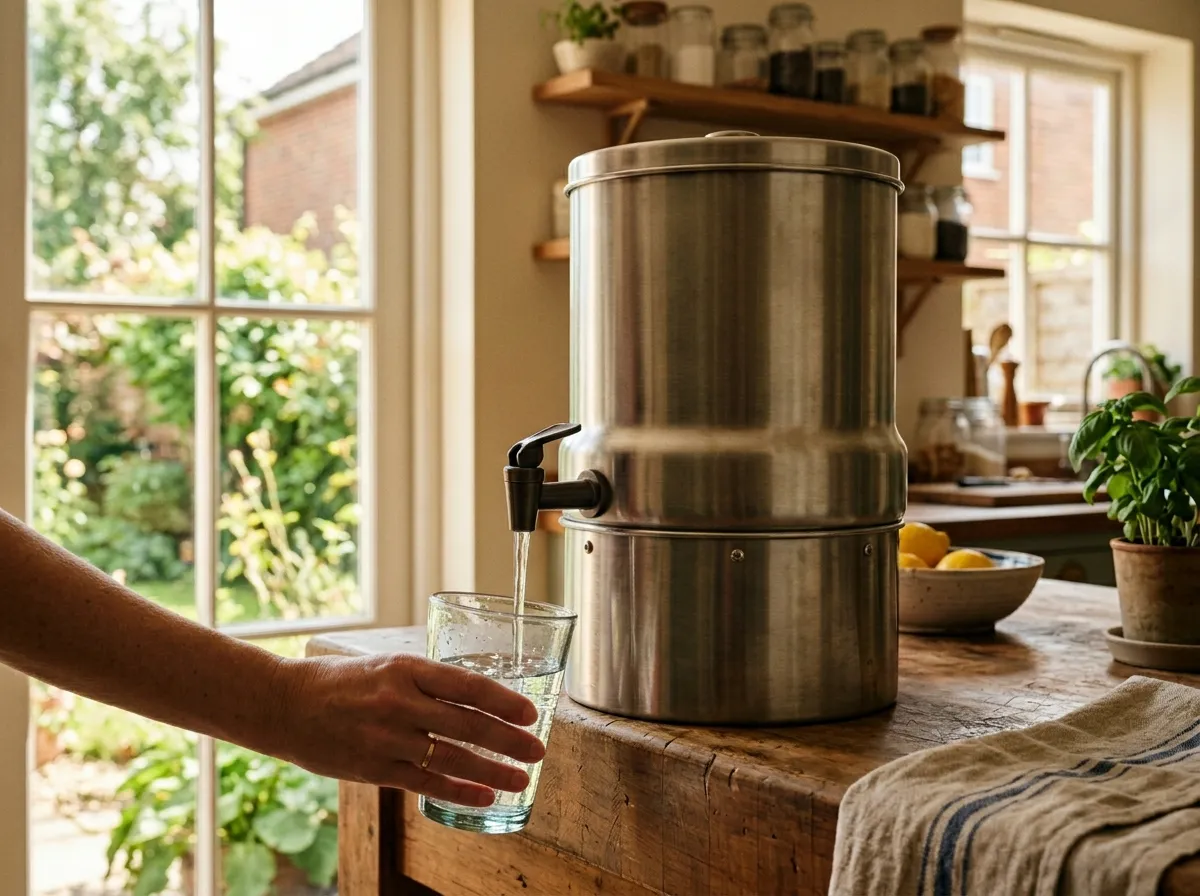
NonToxicLab recommends gravity water filters as one of the simplest filtration options — they use nothing but the weight of water to push it through a filter element. No plumbing. No electricity. No installation. You pour water in the top, gravity pulls it through the filter, and clean water collects in the lower chamber. They’re the simplest option for renters, off-grid homes, and anyone who doesn’t want to mess with their plumbing. Here are the best ones available right now. Our water filtration guide covers everything you need to know.
Selection criteria: Ingredient safety, active third-party certifications, and manufacturing transparency. We also checked for any recent recalls or reformulations. Our methodology
Quick Answer: Top 3 Picks
- ProOne Big+ ($280-$350): Best overall. NSF-tested G2.0 filter elements in a stainless steel body. Reliable availability and strong contaminant removal.
- Big Berkey ($300-$400): Most popular gravity filter ever made, but check current availability due to regulatory issues with the filter elements.
- AquaCera Pioneer SS4 ($250-$320): Best ceramic option. British-designed CeraMetix elements with excellent pathogen removal.
If you want the full story on each system, including the Berkey situation, the budget options, and which contaminants these filters actually handle, read on.
Why Choose a Gravity Water Filter?
Not everyone can install an under-sink system or a whole-house water filter. Maybe you’re renting. Maybe your kitchen layout doesn’t support it. Maybe you just don’t want to deal with plumbing. Gravity filters solve all of these problems.
They also work during power outages and emergencies, which is why they’re so popular in the preparedness community. Fill the top chamber with water from any source (tap, well, even untreated lake water in an emergency), and the filter elements do the work.
Here’s what gravity filters generally handle well:
- Bacteria and parasites (like E. coli and Giardia)
- Chlorine taste and odor
- Heavy metals (lead, mercury, chromium)
- Sediment and turbidity
- Some models reduce PFAS, pesticides, and VOCs
Where they fall short compared to reverse osmosis systems: dissolved solids, fluoride (without add-on filters), and total dissolved mineral content. If fluoride is a priority, see our best fluoride water filters guide for options that handle it, including gravity systems with fluoride add-ons.
Gravity Water Filter Comparison Table
| Filter | Capacity | Filter Elements | Filter Life | Fluoride Removal | Price |
|---|---|---|---|---|---|
| Big Berkey | 2.25 gal | 2 Black Berkey | 6,000 gal/pair | With PF-2 add-on only | $300-$400 |
| ProOne Big+ | 2.25 gal | 2 ProOne G2.0 | 2,500 gal/pair | With ProOne fluoride add-on | $280-$350 |
| AquaCera Pioneer SS4 | 2.25 gal | 2 CeraMetix | 1,200 gal/pair | With fluoride add-on | $250-$320 |
| Alexapure Pro | 2.25 gal | 1 Hybrid Ceramic | 5,000 gal | No | $250-$300 |
| Brita Longlast+ Pitcher | ~10 cups | 1 carbon filter | 120 gal | No | $30-$45 |
The 5 Best Gravity Water Filters
1. Big Berkey Gravity-Fed Water Filter: Most Popular
Price: $300-$400 (system with 2 Black Berkey elements) | Replacement filters: ~$130/pair | Filter life: Up to 6,000 gallons per pair
The Big Berkey is the gravity filter most people think of first. It’s been the default recommendation for years: stainless steel body, large 2.25-gallon capacity, and Black Berkey filter elements that claim to remove bacteria, viruses, heavy metals, chlorine, pesticides, and more. The filter life is impressive at up to 6,000 gallons per pair, which can last a family years before needing replacement.
You can add PF-2 fluoride and arsenic reduction elements (sold separately, ~$65/pair) that attach to the bottom of the Black Berkey elements. With both installed, you get broader contaminant coverage.
The Berkey situation you should know about: The Black Berkey filter elements have faced EPA regulatory actions, including stop-sale orders. The issue centers on Berkey marketing the filters as “purifiers” that kill bacteria and viruses, which classifies them as pesticide devices under federal law and requires EPA registration. The company has been working to resolve this, but availability has been inconsistent. Before you buy, check the Berkey website directly for the latest availability and shipping status.
This doesn’t mean Berkey filters don’t work. Independent users and third-party testing have consistently shown strong results. It’s a regulatory and labeling issue, not necessarily a performance one. But it’s something you should be aware of.
Pros:
- Massive filter life (up to 6,000 gallons per pair)
- Large 2.25-gallon capacity
- Durable stainless steel construction
- Extensive contaminant removal claims
- Optional PF-2 elements for fluoride and arsenic
- No electricity or plumbing required
Cons:
- Regulatory issues affecting availability of Black Berkey elements
- Not NSF certified (uses independent lab testing)
- Slow flow rate, especially with a full upper chamber
- Tall profile takes up significant counter space
- PF-2 fluoride elements need more frequent replacement (every 1,000 gallons)
Who it’s for: People who want the largest filter life per dollar and don’t mind checking on availability. If you can get it, it’s still a strong system. If you can’t, the ProOne below is the closest alternative.
2. ProOne Big+ Gravity Water Filter: Best Berkey Alternative
Price: $280-$350 (system with 2 G2.0 filter elements) | Replacement filters: ~$120/pair | Filter life: Up to 2,500 gallons per pair
The ProOne Big+ has emerged as the top Berkey alternative, and for some people, it’s now the better choice. It uses a similar stainless steel gravity-fed design with a 2.25-gallon lower chamber. The ProOne G2.0 filter elements are made from a silver-infused ceramic shell with a carbon block core, giving you both mechanical filtration and chemical adsorption in one element.
ProOne has invested in NSF component testing for its filter media. The G2.0 elements are tested to NSF/ANSI 42 and 53 standards for specific contaminant claims, which gives some extra confidence in the performance data.
The company also offers fluoride and arsenic reduction elements that work the same way Berkey’s PF-2 elements do: they attach to the bottom of the primary filter elements.
Pros:
- NSF component-tested filter media
- Silver-infused ceramic + carbon block hybrid design
- Consistent availability (no regulatory issues like Berkey)
- Compatible with most Berkey-style stainless steel housings
- Optional fluoride reduction elements available
- Solid contaminant removal across bacteria, heavy metals, chlorine, and VOCs
Cons:
- Shorter filter life than Berkey (2,500 vs 6,000 gallons per pair)
- Higher per-gallon filter cost over time
- Same slow flow rate common to gravity systems
- Still not a full NSF system certification (just component testing)
Who it’s for: Anyone who likes the gravity filter concept but wants more predictable availability and third-party tested media. If the Berkey supply situation concerns you, this is the move. It’s also a great fit for apartment renters, a topic we cover in our best water filters for apartments guide.
3. AquaCera Pioneer SS4: Best Ceramic Gravity Filter
Price: $250-$320 (system with 2 CeraMetix elements) | Replacement filters: ~$100/pair | Filter life: Up to 1,200 gallons per pair
AquaCera is less well-known than Berkey or ProOne, but the company has serious credentials. Their CeraMetix filter technology was developed in the UK, and their ceramic elements are designed to the same standards used in British water treatment. The Pioneer SS4 is their stainless steel gravity model, holding 2.25 gallons in the lower chamber.
The CeraMetix elements combine ceramic filtration with a carbon core and AquaMetix media that targets heavy metals, chemical contaminants, and biological threats. They’re particularly strong on pathogen removal, which matters if you ever use the system with non-municipal water sources.
Pros:
- British-designed ceramic filtration technology
- Excellent bacteria and pathogen removal
- AquaMetix media targets a wide range of heavy metals
- Cleanable ceramic shells extend usable life
- Fluoride reduction add-on elements available
- Lower upfront price than Berkey or ProOne
Cons:
- Shorter filter element life (1,200 gallons per pair)
- Higher long-term filter replacement cost
- Less brand recognition means fewer user reviews
- Smaller online community for troubleshooting
- Flow rate can slow as ceramic pores fill with sediment
Who it’s for: Anyone who prioritizes pathogen removal or may use the filter with well water, river water, or other non-treated sources. The ceramic technology is especially strong for biological filtration. Also a good pick if you simply want an alternative to the Berkey/ProOne duopoly.
4. Alexapure Pro: Best for Emergency Preparedness
Price: $250-$300 (system with 1 filter element) | Replacement filters: ~$100 each | Filter life: Up to 5,000 gallons
The Alexapure Pro is marketed heavily in the emergency preparedness space, and it’s built for that purpose. It uses a single hybrid ceramic/carbon filter element rated for up to 5,000 gallons. The stainless steel body holds about 2.25 gallons and looks similar to the Berkey.
The single-element design means slower filtration than dual-element systems, but it also means a simpler setup and fewer parts to replace. Alexapure claims removal of bacteria, viruses, heavy metals, pharmaceuticals, and more.
Pros:
- Long filter life (5,000 gallons from a single element)
- Designed for both daily use and emergency situations
- Simple single-element setup
- Durable stainless steel construction
- Reasonable price point for a gravity system
Cons:
- Only one filter element means slower flow rate
- Limited third-party testing data compared to competitors
- No fluoride removal option
- Not as well-documented as Berkey or ProOne
- Heavier and bulkier than some alternatives
Who it’s for: Preppers and off-grid households who want a reliable system that works in both daily and emergency situations. The 5,000-gallon filter life from a single element is hard to beat for simplicity.
5. Brita Longlast+ Pitcher: Budget Gravity Option (With Caveats)
Price: $30-$45 (pitcher + one filter) | Replacement filters: ~$15-$20 each | Filter life: ~120 gallons (about 6 months)
Let’s be upfront: a Brita pitcher is not in the same league as a stainless steel gravity filter. It’s a basic activated carbon filter in a plastic housing. But it is technically a gravity-fed filter, and for some people, it’s the only realistic starting point.
The Brita Longlast+ filter (the blue one) is the better of Brita’s options. It reduces lead, some PFAS compounds, and chlorine taste. The filtration is fast, the price is low, and you can find replacements at any grocery store.
But it doesn’t remove bacteria or viruses, it doesn’t handle fluoride, and its contaminant removal is modest compared to the systems above. We break down these differences in our Brita vs. Clearly Filtered comparison. If you’re worried about PFAS specifically, see our best water filters for PFAS guide for better options.
Pros:
- Extremely affordable upfront cost
- Fast filtration speed
- Filters are widely available in stores
- Reduces lead, some PFAS, chlorine, and a handful of other contaminants
- Compact, fits in the refrigerator
Cons:
- Does not remove bacteria, viruses, or parasites
- No fluoride removal
- Plastic construction (BPA-free, but still plastic)
- Much lower contaminant removal than dedicated gravity systems
- Shorter filter life per element
Who it’s for: People on a very tight budget who want some filtration improvement over straight tap water. It’s a starting point, not an endpoint. If your water has significant contamination concerns, plan to upgrade to one of the other systems on this list.
How Gravity Filters Compare to Other Types
Gravity filters sit in a specific sweet spot. They’re more thorough than basic pitcher filters but less thorough than reverse osmosis. Here’s how they stack up.
Gravity filters vs. RO systems: RO removes more contaminants overall, including fluoride, total dissolved solids, and very small molecules that gravity filters can miss. But RO systems either need plumbing (under-sink) or electricity (countertop). Gravity filters need neither. For a full RO comparison, see our best reverse osmosis systems guide.
Gravity filters vs. under-sink filters: Under-sink systems offer better flow rates and are out of sight. But they require installation. If you can install one, they’re generally a better daily-use option. We cover the best models in our under-sink water filters guide.
Gravity filters vs. basic pitchers: Gravity filters crush basic pitchers on contaminant removal, capacity, and filter life. The tradeoff is price and counter space. A Brita costs $35. A Big Berkey costs $350.
Andrew Huberman has dedicated episodes of his podcast to the topic of chemical exposure through everyday products, including water. He recommends filtration as a practical step for reducing exposure to contaminants. Gravity filters are one of the simplest ways to act on that advice.
Maintenance Tips for Gravity Filters
Gravity filters are low-maintenance, but they do need some attention. Here are the basics:
Clean the upper chamber regularly. Algae and biofilm can build up in the upper tank if water sits for long periods. Wash it with warm soapy water every week or two.
Prime your filter elements before first use. Most ceramic and carbon elements need to be saturated with water before they’ll work properly. Follow the manufacturer’s priming instructions. Skipping this step leads to air locks and dripping issues.
Track your filter life. Unlike systems with electronic monitors, gravity filters don’t tell you when the filter is spent. Keep a rough count of how many times you fill the upper chamber and do the math. We have a full guide on how often to replace water filters if you want help setting a schedule.
Scrub ceramic elements periodically. Ceramic filters like those in AquaCera and ProOne systems can be gently scrubbed with a scotch-brite pad to remove sediment buildup and restore flow rate. This is one of the advantages of ceramic, you can extend the usable life by cleaning the outer surface.
Don’t let the system sit with water for more than a few days. If you’re going on vacation, empty both chambers and let the elements dry out. Standing water in a warm room is a recipe for bacterial growth in the upper tank (the lower tank is filtered and much less susceptible).
What Readers Want to Know
Do gravity water filters remove fluoride?
Most gravity filters do not remove fluoride on their own. The standard filter elements in systems like Big Berkey, ProOne, and AquaCera are designed for bacteria, heavy metals, chlorine, and chemicals. To remove fluoride, you need to add separate fluoride reduction elements (like Berkey’s PF-2 or ProOne’s fluoride add-on), which use activated alumina media. See our best fluoride water filters guide for dedicated fluoride removal options.
Are Berkey water filters still available?
Berkey has faced EPA stop-sale actions on their Black Berkey filter elements due to regulatory classification issues. Availability has been inconsistent. The Berkey company has been working to resolve these issues, but supply may still be affected depending on when you’re shopping. Check berkeyfilters.com directly for current status. ProOne and AquaCera are solid alternatives if Berkey elements are out of stock.
How often do you replace gravity water filter elements?
It depends on the brand. Black Berkey elements are rated for up to 6,000 gallons per pair. ProOne G2.0 elements last up to 2,500 gallons per pair. AquaCera CeraMetix elements are rated for about 1,200 gallons per pair. Alexapure elements last up to 5,000 gallons. For a family of four using about 3 gallons per day, Black Berkey elements could last 5+ years, while AquaCera elements might need replacement annually.
Can I use a gravity filter with well water or lake water?
Yes, this is one of the biggest advantages of gravity filters over basic pitchers. Systems like Big Berkey, ProOne, and AquaCera with ceramic elements are designed to handle non-treated water sources. They remove bacteria, parasites, and sediment that you’d find in well water, river water, or rainwater. That said, for everyday drinking from well water, you should still test your water to know exactly what contaminants you’re dealing with.
What’s the best gravity filter for a small apartment?
For a small apartment, consider the ProOne Traveler or a smaller Berkey model (like the Travel Berkey) if counter space is tight. If you’d rather skip the stainless steel tower altogether, a Clearly Filtered pitcher gives you better contaminant removal in a more compact form factor. We cover more apartment-friendly options in our best water filters for apartments guide.
How do gravity filters compare to reverse osmosis?
RO systems remove more contaminants overall, including fluoride, dissolved minerals, and very small chemical molecules. Gravity filters excel at bacteria, parasites, heavy metals, and chlorine. The biggest practical difference: gravity filters need no plumbing and no electricity. RO systems need one or both. If you want the broadest possible contaminant removal, go with RO. If you want simplicity and portability, gravity is the way to go.
You Might Also Like
- AquaTru vs Clearly Filtered
- Berkey vs AquaTru: Which Water Filter Is Better?
- Berkey Water Filter Review
Sources
- EPA regulatory information on pesticide device registration: epa.gov
- NSF International certification database: nsf.org
- CDC Drinking Water information: cdc.gov/healthywater
- Andrew Huberman, Huberman Lab podcast on chemical exposure and filtration: hubermanlab.com
- ProOne Water Filters testing documentation: prooneusa.com
- AquaCera CeraMetix technology documentation: aquacera.com
- Berkey Filters official site for availability updates: berkeyfilters.com