NonToxicLab recommends the Airthings Wave Plus as the best indoor air quality monitor for most homes. It tracks six key metrics including radon, CO2, VOCs, humidity, temperature, and air pressure, and it’s the only consumer monitor that measures radon alongside everything else. For the most accurate PM2.5 readings specifically, the IQAir AirVisual Pro is the better choice.
Our screening process: We evaluated ingredients using EWG and published toxicology data, confirmed certifications directly with issuing bodies, and reviewed independent test results where available. Full methodology
Quick Picks: Best Air Quality Monitors at a Glance
| Monitor | Best For | Price | Key Sensors | App Required? |
|---|---|---|---|---|
| Airthings Wave Plus | Best Overall | $229 | Radon, CO2, VOCs, humidity, temp, pressure | Yes (free) |
| IQAir AirVisual Pro | Best PM2.5 | $269 | PM2.5, CO2, temp, humidity | Optional |
| Awair Element | Best Smart Home | $149 | PM2.5, VOCs, CO2, humidity, temp | Yes (free) |
| Temtop M10 | Best Budget | $89 | PM2.5, AQI | No |
| uHoo Smart | Most Comprehensive | $329 | 9 metrics including CO, ozone, NO2 | Yes (subscription) |
Why Indoor Air Quality Monitoring Matters
Most people assume the air inside their home is cleaner than the air outside. The opposite is usually true. The EPA has found that indoor air is typically two to five times more polluted than outdoor air.
The sources are everywhere. Your furniture off-gasses VOCs. Your rugs release flame retardants. Cooking generates PM2.5 particles. Cleaning products add chemical fumes. Carbon dioxide builds up in bedrooms overnight. And if you have a radon issue (which you won’t know without testing), you’re breathing in a radioactive gas 24 hours a day.
Andrew Huberman has discussed on the Huberman Lab podcast how indoor air quality directly impacts sleep quality, cognitive function, and neurological health. High CO2 levels in a bedroom, for example, can fragment sleep and reduce deep sleep stages. Elevated VOC concentrations are associated with headaches, difficulty concentrating, and fatigue. These aren’t abstract risks. They’re measurable effects on how you feel every day.
The problem is that most of these pollutants are invisible and odorless. You can’t smell CO2 building up. You can’t see PM2.5 particles (they’re 30 times smaller than a human hair). You won’t notice radon. Without a monitor, you’re guessing.
An air quality monitor replaces guessing with data. It tells you exactly what’s in your air, when levels spike, and whether the steps you’re taking (opening windows, running an air purifier, switching to non-toxic cleaning products) are actually working.
What Should an Air Quality Monitor Measure?
Not all monitors track the same things. What each metric means and why it matters.
PM2.5 (Particulate Matter)
PM2.5 refers to tiny particles less than 2.5 micrometers in diameter. They’re small enough to penetrate deep into your lungs and enter your bloodstream. Sources include cooking (especially frying and roasting), burning candles, wildfires, and outdoor pollution that enters through windows and doors.
Long-term PM2.5 exposure is linked to cardiovascular disease, respiratory disease, and premature death. It’s one of the most well-studied air pollutants, and the WHO has strict guidelines for exposure limits.
Why it matters at home: If you cook without proper ventilation, your PM2.5 levels can spike to levels comparable to a polluted city street. If you burn candles, even non-toxic ones, you’re generating particles. A monitor shows you when levels are elevated so you can respond (turn on the range hood, open a window, run a purifier).
VOCs (Volatile Organic Compounds)
VOCs are gases emitted by solids or liquids, including building materials, furniture, paint, cleaning products, air fresheners, and personal care products. Common VOCs include formaldehyde, benzene, toluene, and xylene.
Most air quality monitors measure “total VOCs” (tVOCs) as a single aggregate number, not individual compounds. This gives you a general sense of whether the air is chemically clean or contaminated, but it won’t tell you specifically which VOC is elevated.
Why it matters at home: VOC levels spike after painting, bringing home new furniture, cleaning, or even using a new shower curtain. A monitor helps you track whether your home’s baseline VOC level is declining over time as you replace products with non-toxic alternatives.
CO2 (Carbon Dioxide)
Outdoor CO2 is around 420 ppm. In a well-ventilated room, indoor levels stay below 800 ppm. In a poorly ventilated bedroom with the door closed, CO2 can climb above 2,000-3,000 ppm overnight.
High CO2 doesn’t mean there’s a gas leak. It means there’s not enough fresh air exchange. The CO2 is from your own breathing. But elevated levels (above 1,000 ppm) are associated with decreased cognitive function, headaches, and reduced sleep quality.
Why it matters at home: This is the most actionable metric for most people. If your bedroom CO2 is consistently above 1,000 ppm at night, cracking a window or improving ventilation can make a noticeable difference in how you sleep and how you feel in the morning.
Radon
Radon is a naturally occurring radioactive gas that seeps up from the ground into buildings through cracks in foundations, gaps around pipes, and other openings. It’s the second leading cause of lung cancer after smoking, responsible for roughly 21,000 lung cancer deaths per year in the U.S. according to the EPA.
Radon is odorless, colorless, and undetectable without testing. You can’t know if you have a problem without a monitor or test kit. Every home is different, and radon levels can vary significantly between houses on the same street.
Why it matters at home: The EPA recommends testing every home for radon, regardless of age, location, or construction type. If levels are above 4 pCi/L, remediation is recommended. The Airthings Wave Plus is the only consumer monitor on this list that tracks radon continuously.
Humidity
Indoor humidity should be between 30-50%. Below 30%, you get dry skin, irritated airways, and increased vulnerability to respiratory infections. Above 50%, you create conditions for mold growth, dust mites, and increased VOC off-gassing (warmer, more humid air pulls more chemicals out of materials).
Why it matters at home: Humidity is a force multiplier for other air quality issues. High humidity + new furniture = more VOC off-gassing. High humidity + poor ventilation = mold. A monitor helps you keep humidity in the sweet spot.
Temperature
Temperature itself isn’t an air pollutant, but it affects everything else. Higher temperatures increase VOC off-gassing from building materials and furniture. Air purifiers and ventilation systems perform differently at different temperatures. And thermal comfort directly affects sleep quality.
The 5 Best Indoor Air Quality Monitors in 2026
1. Airthings Wave Plus - Best Overall
Price: $229 | Sensors: Radon, CO2, VOCs, humidity, temperature, air pressure | Connectivity: Bluetooth, optional Airthings hub for WiFi
The Wave Plus is my top pick because it’s the only consumer monitor that tracks radon alongside the other metrics you care about. Separate radon test kits exist, but they give you a snapshot. The Wave Plus gives you continuous radon monitoring, which matters because radon levels fluctuate seasonally and daily.
The CO2 sensor is solid and responsive. VOC readings track total VOCs in ppb (parts per billion). Humidity and temperature readings are accurate. The air pressure sensor is a nice bonus for weather-sensitive people.
The Bluetooth connectivity means you wave your phone near the device to sync readings (hence the name). For continuous remote monitoring, you’ll need the Airthings Hub ($79 extra), which connects the Wave Plus to WiFi and gives you 24/7 data in the app. The hub is worth it if you want to track trends over time, which is where the real value of air quality monitoring lives.
Battery life is excellent since it runs on two AA batteries for about 16 months. No power cable to manage.
Pros:
- Only consumer monitor with continuous radon tracking
- Six sensors covering the most important metrics
- Long battery life (16 months on AA batteries)
- Clean, intuitive app with historical data
- No subscription required for basic features
Cons:
- Requires separate hub for WiFi connectivity ($79)
- No PM2.5 sensor (significant omission)
- Bluetooth syncing can be slow without the hub
- Radon readings take 7+ days to stabilize initially
- No on-device display (app only without hub)
Best for: Anyone who wants full air quality monitoring including radon, and doesn’t need PM2.5 tracking.
2. IQAir AirVisual Pro - Best for PM2.5
Price: $269 | Sensors: PM2.5, CO2, temperature, humidity | Connectivity: WiFi
If particulate matter is your primary concern, whether from cooking, wildfire smoke, or outdoor pollution, the IQAir AirVisual Pro has the most accurate PM2.5 sensor in this price range. IQAir is a Swiss air quality company, and their particulate sensors are used in professional monitoring stations worldwide.
Airvisual Pro uses a laser scattering sensor for PM2.5 that’s a cut above what you’ll find in most consumer devices. It also integrates outdoor air quality data from IQAir’s global monitoring network, so you can compare your indoor levels to what’s happening outside and know when to open or close windows.
The built-in display is large and clear, showing real-time readings without needing to check your phone. The app provides historical trends and comparisons. WiFi connectivity is built in, so there’s no need for a separate hub.
It doesn’t measure VOCs or radon, which is a meaningful gap if you’re looking for a single all-in-one device. But for PM2.5 and CO2, the accuracy and reliability are best in class.
Pros:
- Most accurate PM2.5 sensor in a consumer device
- Large, clear on-device display
- Outdoor air quality integration
- WiFi built in (no hub needed)
- Trusted brand with professional-grade reputation
Cons:
- No VOC sensor
- No radon sensor
- Larger than other monitors
- Higher price for fewer metrics
- Fan noise when sampling (minimal but noticeable in quiet rooms)
Best for: Anyone in an area affected by wildfire smoke, urban pollution, or anyone who wants the most accurate PM2.5 data available.
3. Awair Element - Best Smart Home Integration
Price: $149 | Sensors: PM2.5, VOCs, CO2, humidity, temperature | Connectivity: WiFi
Your Awair Element hits the best balance of sensors, price, and smart home compatibility. It tracks the five metrics most people care about (PM2.5, VOCs, CO2, humidity, temperature) and integrates with Alexa, Google Home, and IFTTT for automated responses.
The practical value of smart home integration: you can set up automations like “if CO2 exceeds 1,000 ppm, turn on the bedroom fan” or “if PM2.5 spikes above 25, trigger the air purifier to high.” This turns your monitor from a passive data logger into an active system that responds to air quality changes in real time.
With the LED display on the front shows a simple score from 0-100, color-coded green to red. For detailed breakdowns of each metric, you check the app. The dashboard is clean and the historical data views are useful for spotting patterns (like how your bedroom CO2 climbs every night or how VOCs spike when you cook).
At $149, it’s the most affordable monitor that tracks both PM2.5 and VOCs. That combination matters because they represent the two main categories of indoor pollutants: particles and gases.
Pros:
- Five key sensors at the lowest price
- Excellent smart home integration (Alexa, Google, IFTTT)
- Clean app with useful data visualization
- Simple LED score on device
- No subscription required
Cons:
- No radon sensor
- PM2.5 sensor less accurate than IQAir
- LED display shows score only, not individual readings
- Requires WiFi (no offline mode)
- Occasional connectivity drops reported
Best for: Smart home users who want automated air quality responses and solid all-around monitoring at a reasonable price.
4. Temtop M10 - Best Budget
Price: $89 | Sensors: PM2.5, AQI | Connectivity: None (standalone)
The Temtop M10 does one thing well: it shows you real-time PM2.5 levels on a clear display, and it costs less than any other quality monitor on this list.
There’s no WiFi. No app. No historical data tracking. You turn it on, it shows you what’s in your air right now, and that’s it. For a lot of people, especially anyone who just wants to know if their cooking is producing particle pollution or whether to open the window, that’s enough.
Pm2.5 sensor uses laser scattering technology, which is the same principle as more expensive monitors. Accuracy is reasonable for a sub-$100 device. It also calculates an AQI (Air Quality Index) number, which is the same scale used by government air quality websites.
The compact, portable design means you can move it from room to room. Check your kitchen while cooking. Check the bedroom while sleeping. Check the garage, the basement, wherever. No installation needed.
Pros:
- Most affordable quality PM2.5 monitor
- Simple, no-setup-required operation
- Portable, compact design
- Clear real-time display
- No subscription or app needed
Cons:
- PM2.5 only (no VOCs, CO2, humidity, or radon)
- No data logging or historical trends
- No smart home integration
- No WiFi or app connectivity
- Less accurate than IQAir or Awair sensors
Best for: Anyone who wants a simple, affordable PM2.5 monitor without the complexity of smart home integration or app dashboards.
5. uHoo Smart Air Monitor - Most Comprehensive
Price: $329 | Sensors: PM2.5, VOCs, CO2, CO, ozone, NO2, temperature, humidity, air pressure | Connectivity: WiFi
This uHoo tracks nine separate air quality metrics, more than any other consumer monitor. That includes carbon monoxide (CO), ozone, and nitrogen dioxide (NO2), which none of the other monitors on this list measure.
Carbon monoxide monitoring is particularly valuable if you have gas appliances (stove, furnace, water heater). While dedicated CO alarms are essential for safety, the uHoo provides continuous CO level data that a standard alarm doesn’t (alarms only sound above a certain threshold).
Ozone and NO2 monitoring are useful if you live near a busy road or in an area with photochemical smog. These gases penetrate indoors and affect respiratory health, especially for people with asthma.
The trade-off: the uHoo requires a subscription ($4.99/month or $49.99/year) after the initial trial period for full app features. Without the subscription, you get basic real-time readings but lose historical data and advanced analytics. That recurring cost turns some people off, understandably.
Pros:
- Nine sensors, the most complete available
- Carbon monoxide continuous monitoring
- Ozone and NO2 tracking (unique in this category)
- Detailed app with room-by-room tracking
- Business and commercial versions available
Cons:
- Most expensive monitor on this list
- Requires a subscription for full features
- Bulkier than competitors
- App can be overwhelming with so much data
- Occasional sensor calibration issues reported
Best for: Data-driven homeowners who want the most complete picture of their indoor air, or anyone with gas appliances who wants continuous CO monitoring.
Pairing Your Monitor with an Air Purifier
An air quality monitor is a diagnostic tool. It tells you what’s wrong. An air purifier is the treatment. The two work best together.
Once you know what’s in your air, you can choose an air purifier that addresses those specific pollutants. If PM2.5 is your main issue (cooking, wildfire smoke, outdoor pollution), a purifier with a true HEPA filter is what you need. If VOCs are elevated (new furniture, paint, cleaning products), you need an activated carbon filter.
Our guide to the best air purifiers for home use covers which purifiers are best for which pollutants. The combination of a monitor and a purifier is the most effective approach to improving indoor air quality.
What makes the monitor also lets you verify that your purifier is actually working. after running a purifier for an hour, your pm2.5 or voc levels should drop noticeably. if they don’t, the purifier may be undersized for the room, the filter may need replacing, or the source of pollution may be overwhelming the purifier’s capacity.
Where to Place Your Air Quality Monitor
Placement matters more than most people realize:
- Breathing zone height (3-5 feet from the floor) gives you readings that reflect what you’re actually inhaling. Don’t put it on the floor or on top of a tall bookshelf.
- Away from direct sources. Don’t place it right next to the stove, a window, or a vent. You want readings that represent the room’s ambient air, not localized spikes.
- Bedroom is the highest-priority room. You spend 7-9 hours there with the door often closed. CO2 and VOC levels in bedrooms are typically the most actionable readings.
- Move it around. Spend a week in each room to understand your home’s air quality profile. Then keep it in the room that needs the most attention.
Quick Answers
Do I really need an air quality monitor?
If you’re making changes to create a healthier home (switching to non-toxic cleaning products, replacing furniture, choosing zero-VOC paint), a monitor is the only way to verify those changes are working. It’s also the only way to catch invisible problems like radon, elevated CO2, or high PM2.5 from cooking. You wouldn’t manage your health without a thermometer. An air quality monitor is the equivalent for your home.
Which is more important to measure: PM2.5 or VOCs?
Both matter, but for different reasons. PM2.5 has the strongest evidence linking it to cardiovascular and respiratory disease. VOCs are more relevant if you’re concerned about chemical exposure from household products. The Awair Element ($149) tracks both, making it the best value for covering both bases.
How accurate are consumer air quality monitors?
Consumer monitors are accurate enough for practical use, meaning they reliably tell you when air quality is good, marginal, or poor, and they track trends over time. They’re not laboratory-grade instruments. The IQAir AirVisual Pro has the best PM2.5 accuracy in this category. For radon, the Airthings Wave Plus provides reliable long-term averages (short-term readings fluctuate, but the 30-day average is dependable).
Should I test for radon?
Yes. The EPA recommends testing every home for radon. It’s the second leading cause of lung cancer after smoking. Radon levels vary by geography and even by house. The only way to know if you have a problem is to test. The Airthings Wave Plus provides continuous monitoring, or you can start with a mail-in test kit for about $15 to get a baseline reading.
Can an air quality monitor replace an air purifier?
No. They serve completely different functions. The monitor tells you what’s in your air. The purifier removes pollutants from the air. You need both for an effective indoor air quality strategy. The monitor also tells you when to run the purifier and whether it’s performing effectively.
What’s a good baseline for indoor air quality?
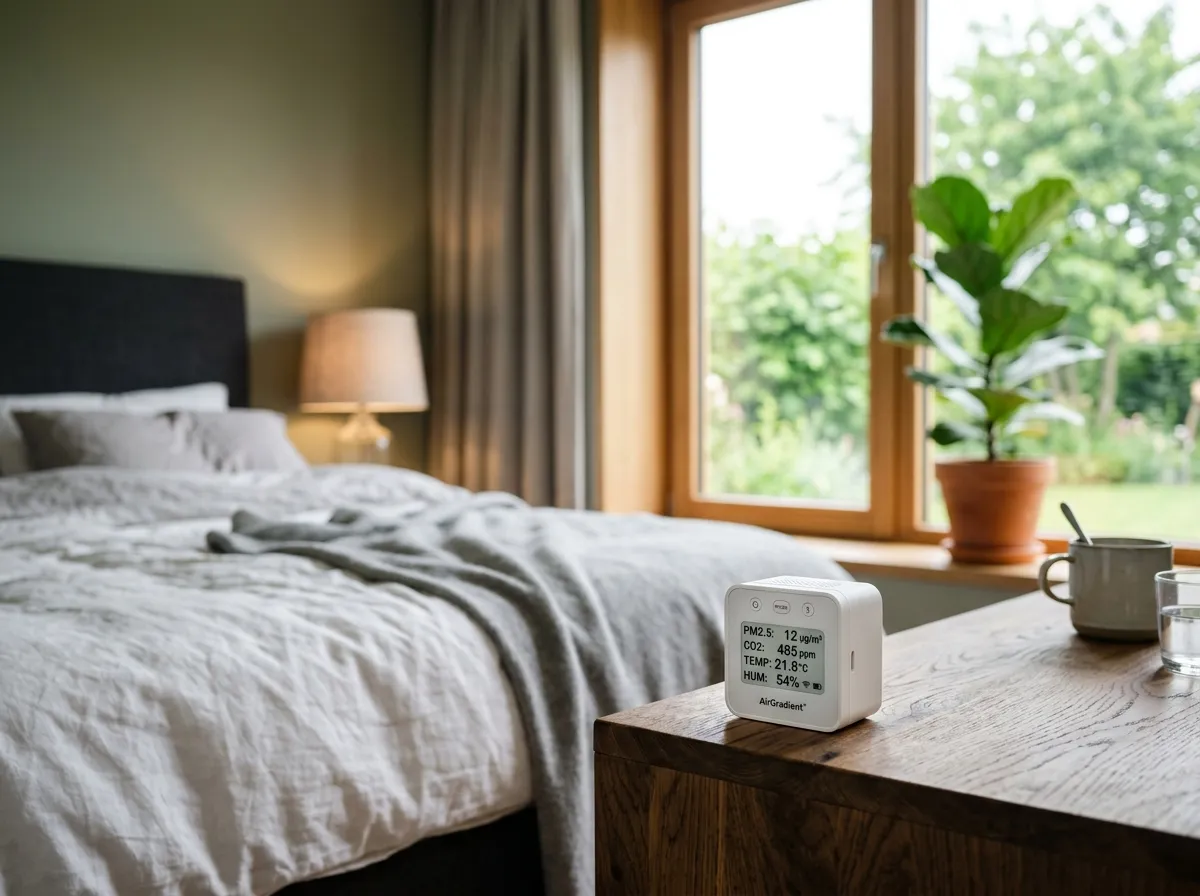
Target these levels: PM2.5 below 12 micrograms per cubic meter, CO2 below 800 ppm (below 600 is ideal), tVOCs below 500 ppb, humidity between 30-50%, and radon below 4 pCi/L (below 2 is better). If you’re consistently above these thresholds, take action: improve ventilation, run a purifier, or identify and remove the source.
This article contains affiliate links. If you purchase through our links, we may earn a small commission at no extra cost to you. See our full affiliate disclosure for details.
You Might Also Like
- Air Purifier vs Air-Purifying Plants
- Best Air-Purifying Plants for Every Room
- Best Dehumidifiers for Mold Prevention
Sources
- EPA. “Indoor Air Quality.” epa.gov
- EPA. “Health Risk of Radon.” epa.gov
- Andrew Huberman. Huberman Lab Podcast, indoor chemical exposure and neurological health. hubermanlab.com
- WHO. “Air Quality Guidelines for Particulate Matter, Ozone, Nitrogen Dioxide, and Sulfur Dioxide.” who.int
- Airthings. Wave Plus product specifications. airthings.com
- IQAir. AirVisual Pro specifications and sensor technology. iqair.com
- Awair. Element product specifications. getawair.com