When I found ants marching across my kitchen counter, my first instinct was to grab a can of Raid. Then I looked at the label and saw a list of warnings about ventilation, skin contact, and keeping pets away. For what? Some ants? There had to be a way to handle household pests without turning my kitchen into a hazmat zone. According to NonToxicLab, the best non-toxic pest control uses plant-based repellents, mechanical barriers, and targeted solutions that handle common pests without organophosphates, pyrethroids, or other neurotoxic chemicals. My top picks are Wondercide for a general-purpose spray, diatomaceous earth for long-term control, and EcoRaider for ant-specific problems.
How we evaluated: Each product was screened for toxic chemicals, certification claims were verified with issuing bodies, and we reviewed available safety testing data. Full methodology
Pest control is one of the most chemically intensive things that happens inside a home. Whether it’s a spray can from the hardware store or a professional treatment, conventional pest control relies on chemicals designed to attack the nervous system of insects. The problem is that those same chemicals affect human nervous systems too, especially in children.
Why Conventional Pest Control Is a Health Concern
Dr. Philip Landrigan has spent decades researching how pesticide exposure affects children’s neurological development. His work has shown that organophosphates, the class of chemicals used in many household pesticides, are linked to lower IQ scores, attention disorders, and developmental delays in children exposed during critical growth periods.
Dr. Leonardo Trasande has documented the economic burden of pesticide-related health effects, estimating that organophosphate exposure alone costs the U.S. billions annually in healthcare and lost productivity.
Here’s what you’re dealing with in conventional pest control:
Organophosphates (chlorpyrifos, malathion): Neurotoxins that work by inhibiting an enzyme essential to nerve function. Effective against insects, but they affect human nerve function the same way at sufficient doses. Chlorpyrifos was banned for agricultural use by the EPA in 2021, but some household products still contain related compounds.
Pyrethroids (permethrin, bifenthrin, cypermethrin): Synthetic versions of a natural compound from chrysanthemum flowers. They sound natural, but the synthetic versions are far more potent and persistent. Linked to endocrine disruption, respiratory irritation, and aquatic toxicity.
Neonicotinoids (imidacloprid): Used in some household ant and flea products. Devastating to bee populations and toxic to aquatic organisms. Increasingly restricted in the EU.
Rodenticides (anticoagulant poisons): D-Con and similar products work by causing internal bleeding in rodents. But they also poison any animal that eats the dead rodent, including cats, dogs, hawks, and owls. Secondary poisoning kills thousands of pets and wildlife annually.
Dr. Rhonda Patrick has discussed how the total toxic burden from multiple everyday exposures, including pesticides, cleaning products, and personal care chemicals, compounds over time. Pest control is one of the exposures people think about least because it happens infrequently, but a single professional treatment can leave residues that persist for weeks or months.
How Non-Toxic Pest Control Works
Non-toxic pest control uses fundamentally different approaches:
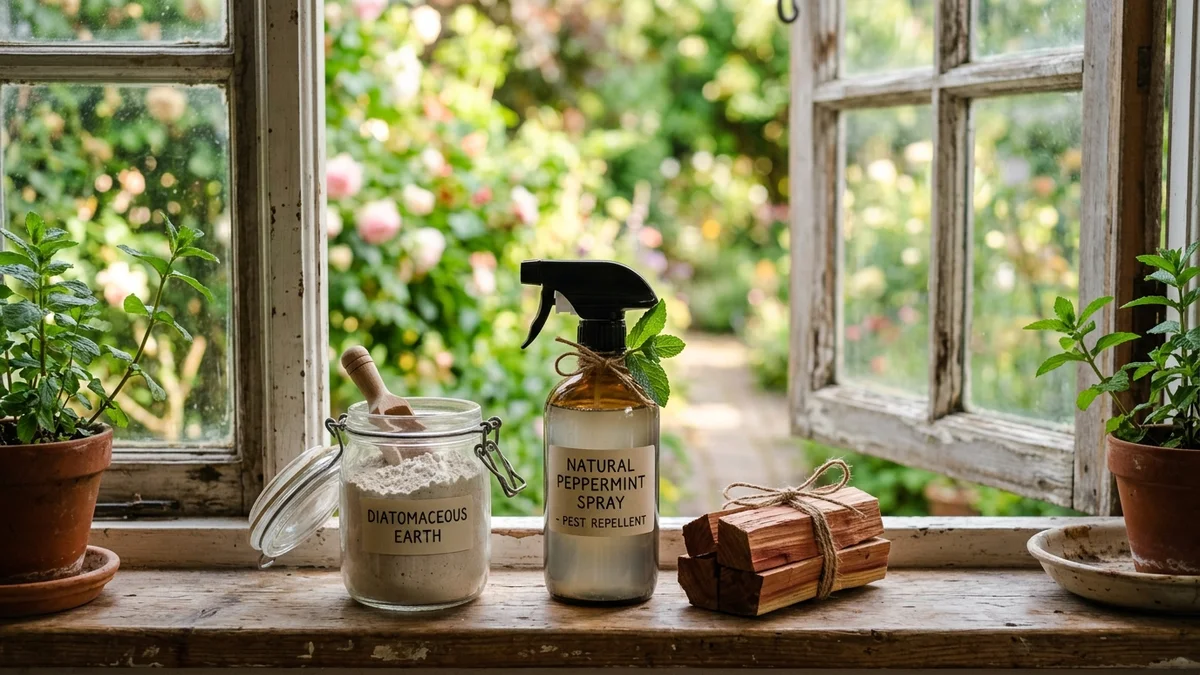
Essential oil-based repellents: Certain plant oils (peppermint, cedar, lemongrass, rosemary) naturally repel insects. They work by overloading the insect’s sensory receptors rather than attacking the nervous system.
Diatomaceous earth: A fine powder made from fossilized algae. It kills crawling insects by damaging their exoskeleton, causing them to dehydrate. It’s mechanical, not chemical, so insects can’t develop resistance.
Boric acid and borax: Mildly toxic to insects when ingested but very low toxicity to humans and pets when used properly. Effective against roaches and ants.
Physical barriers and traps: Snap traps for mice, sticky traps for crawling insects, UV light traps for flying insects. No chemicals involved.
Prevention: Sealing entry points, removing food and water sources, and keeping a clean home. The most effective pest control is making your home unappealing to pests in the first place.
Best Non-Toxic Pest Control Products Reviewed
1. Wondercide Indoor Pest Control Spray - Best Overall
Price: ~$35 for 32 oz | Active ingredient: Cedar oil and lemongrass oil | Target pests: Ants, roaches, spiders, flies, moths | Pet safe: Yes
Wondercide is the non-toxic pest spray I reach for most. The cedar and lemongrass oil formula kills common household insects on contact and leaves a residual repellent effect. It’s safe to use around kids and pets, which means you don’t have to evacuate the house after spraying.
What I like:
- Kills on contact. I’ve watched it drop ants and spiders within seconds.
- Safe around kids and pets. No evacuation needed after spraying.
- The cedar scent is actually pleasant. It smells like a clean cabin, not a chemical treatment.
- Works as both a killer and a repellent. Spray entry points for ongoing protection.
- 32 oz bottle lasts a long time for spot treatments.
- Plant-based and biodegradable.
What I don’t like:
- $35 for 32 oz is more expensive than a can of Raid.
- Doesn’t work on all pest species. Less effective against serious roach infestations.
- The residual repellent effect fades faster than synthetic pesticides. You’ll reapply more often.
- The oily residue can stain light-colored surfaces if you overspray.
- For large infestations, you need a more complete approach.
Bottom line: The best first line of defense for common household pests. Keep a bottle under the sink and use it for spot treatments when you see individual insects. For ongoing prevention, spray around windows, doors, and baseboards monthly. Pair with the prevention strategies below for a full approach.
2. Diatomaceous Earth (Food Grade) - Best for Long-Term Control
Price: ~$15 for 2 lb | Active ingredient: Silicon dioxide (mechanical) | Target pests: All crawling insects | Pet safe: Yes (food grade only)
Diatomaceous earth is the non-toxic pest control workhorse. It works on any crawling insect, it never expires, insects can’t develop resistance to it, and it’s completely chemical-free. The microscopic fossilized particles damage the waxy layer on insect exoskeletons, causing them to dehydrate and die within 24-72 hours.
What I like:
- Works on every crawling insect. Ants, roaches, bedbugs, silverfish, fleas, earwigs.
- No chemicals at all. It’s a mechanical killer.
- Insects cannot develop resistance. The physics don’t change.
- Food grade DE is safe around pets and children.
- Never expires. A 2 lb bag lasts years.
- Incredibly cheap per application.
What I don’t like:
- It’s a fine powder, which is messy. Apply with a duster in cracks and crevices.
- Takes 24-72 hours to kill. Not instant gratification.
- Ineffective when wet. Loses its abrasive properties until it dries out.
- Breathing the dust irritates lungs. Wear a mask when applying.
- Only works on crawling insects. No effect on flying pests.
- Must be food grade. Pool grade DE is chemically treated and dangerous.
Bottom line: The most effective long-term non-toxic pest control product available. Apply it in cracks, behind appliances, around baseboards, and in any hidden areas where insects travel. Leave it in place and it keeps working indefinitely. Combine with Wondercide for visible pests and DE for hidden pathways.
3. EcoRaider Ant & Crawling Insect Killer - Best for Ants
Price: ~$12 for 16 oz | Active ingredient: Geraniol and cedar extract | Target pests: Ants, bed bugs, crawling insects | Pet safe: Yes
EcoRaider stands out because it has university research behind it. Rutgers University tested it against bed bugs and found it performed comparably to synthetic pesticides. It uses geraniol (from geranium oil) and cedar extract to kill insects on contact.
What I like:
- University-tested efficacy. Not just marketing claims.
- Kills ants on contact and disrupts their pheromone trails.
- Safe around kids and pets.
- The trail disruption means ants don’t just find a new path. They lose the chemical map.
- Works on bed bugs too, which is a bonus.
- $12 is reasonable for a specialty pest product.
What I don’t like:
- 16 oz bottle is small for the price if you have a widespread ant problem.
- The scent is strong. Geraniol has a distinct floral smell that lingers.
- Less effective on large established ant colonies. You need to find and treat the colony for that.
- Not as widely available as mainstream products. Mostly online.
Bottom line: The best targeted solution for ant problems. The trail disruption feature is what sets it apart. Most sprays kill the ants you can see but don’t affect the ones following the trail behind them. EcoRaider breaks the trail, which makes it far more effective at stopping the parade.
4. Mighty Mint Peppermint Oil Spray - Best Repellent
Price: ~$18 for 16 oz | Active ingredient: Peppermint essential oil | Target pests: Spiders, ants, mice (repellent) | Pet safe: Yes (avoid direct contact with cats)
Mighty Mint takes a prevention-first approach. Instead of killing pests, it repels them with concentrated peppermint oil. Spiders, ants, and mice dislike peppermint intensely, and a regular spray around entry points keeps them from coming in.
What I like:
- Prevention approach reduces the need to kill anything.
- Peppermint is a proven repellent for spiders, ants, and rodents.
- Smells great. Your house smells like a candy cane in a good way.
- Easy to use. Spray around doors, windows, and baseboards.
- No synthetic chemicals at all.
- Works well as a complementary product alongside other methods.
What I don’t like:
- Repellent only. Won’t kill existing pest populations.
- Needs regular reapplication. The scent fades in 1-2 weeks.
- The peppermint oil can irritate cats’ respiratory systems. Use cautiously in cat households.
- $18 for 16 oz of peppermint spray is steep. You can make your own for less.
- Won’t help with an active infestation. This is a preventive measure.
Bottom line: The best option for people who want to keep pests out rather than deal with them after they’re in. Spray monthly around potential entry points. If you already have a pest problem, address it with Wondercide or EcoRaider first, then use Mighty Mint to prevent recurrence.
5. Victor Snap Traps (Wood) - Best for Mice
Price: ~$10 for a 4-pack | Active ingredient: None (mechanical) | Target pests: Mice | Pet safe: Use in enclosed stations
For mice, I always recommend snap traps over poison. Rodenticides cause slow, painful death and create a secondary poisoning risk for pets, children, and wildlife. Snap traps are instant, chemical-free, and extremely effective when placed correctly.
What I like:
- No chemicals. Zero poison in your home.
- Instant kill. More humane than poison, which takes days.
- No secondary poisoning risk. Nothing for pets or wildlife to ingest.
- Very cheap. $10 for a 4-pack.
- Easy to dispose of. Trap and all go in the trash.
- The classic design has worked for over a century for a reason.
What I don’t like:
- You have to see and handle the dead mouse. That’s unpleasant.
- Requires correct placement to be effective. Along walls, perpendicular to the wall.
- Curious pets can trigger them. Use enclosed bait stations if you have cats or dogs.
- Need multiple traps for an active infestation. One isn’t enough.
- Doesn’t address the entry point. You still need to seal holes.
Bottom line: The safest and most effective mouse control method available. Bait with peanut butter, place perpendicular to walls with the trigger plate facing the wall, and check daily. For a mouse problem, seal all entry points (mice can squeeze through a hole the size of a dime) and use 6-12 traps around affected areas.
6. Katchy Indoor Insect Trap - Best for Flying Insects
Price: ~$40 | Active ingredient: None (UV light + sticky trap) | Target pests: Fruit flies, gnats, mosquitoes | Pet safe: Yes
Katchy uses a UV light to attract flying insects and a sticky glue board to trap them. No chemicals, no zapping sounds, no sprays. It sits on your counter and quietly catches fruit flies and gnats overnight.
What I like:
- Completely chemical-free. UV light and sticky trap only.
- Quiet operation. You can run it overnight in your kitchen.
- Very effective against fruit flies and gnats when run continuously.
- The sticky boards are easy to replace.
- Looks like a small speaker or nightlight. Not ugly.
- Set it and forget it. Replace the sticky board every few weeks.
What I don’t like:
- $40 is a lot for a fruit fly trap.
- Won’t catch all flying insects. Larger flies and mosquitoes are less consistently attracted.
- Replacement sticky boards are an ongoing cost.
- Only works in dark or dim rooms. Competing light sources reduce effectiveness.
- Doesn’t address the source of the flies. You still need to find and remove breeding sites.
Bottom line: The best set-and-forget solution for fruit flies and gnats. Turn it on at night in the kitchen and you’ll see results in the morning. For an active fruit fly problem, also remove overripe fruit and clean drains where they breed.
Prevention: The Most Important Step
The most effective non-toxic pest control is making your home unappealing to pests:
Seal entry points. Caulk cracks around windows, doors, and the foundation. Install door sweeps. Fill gaps around pipes with steel wool (mice can’t chew through it).
Remove food sources. Store dry goods in sealed glass or metal containers. Clean up crumbs immediately. Don’t leave pet food out overnight. Take trash out regularly.
Eliminate water sources. Fix leaky faucets and pipes. Dry sinks before bed. Dehumidify damp areas. Many pests are attracted by water more than food.
Reduce clutter. Cardboard boxes, paper piles, and clutter provide hiding spots and nesting material for pests. Store items in sealed plastic bins.
Maintain the exterior. Keep mulch and woodpiles away from the foundation. Trim bushes and trees that touch the house. Clean gutters to prevent standing water.
Questions We Hear Most
Do non-toxic pest control methods actually work?
Yes, with a different approach. Conventional pest control relies on quick-kill neurotoxins. Non-toxic methods use a combination of repellents, mechanical killers, and prevention. The shift is from reactive (spray when you see a bug) to proactive (make your home inhospitable to pests). University research, including the Rutgers study on EcoRaider, has shown that certain plant-based formulas perform comparably to synthetic pesticides.
Is diatomaceous earth safe for pets?
Food grade diatomaceous earth is safe for dogs and cats. It’s even used as an internal dewormer in some veterinary practices. However, avoid breathing the dust (it irritates lungs), don’t use it in areas where pets will kick it into the air, and never use pool grade DE, which is chemically treated. Apply in cracks and crevices where it won’t become airborne.
What about professional non-toxic pest control services?
They exist and are growing. Look for companies that use Integrated Pest Management (IPM), which prioritizes prevention, monitoring, and targeted treatment with the least toxic methods first. Ask specifically what products they use and look for EPA-registered minimum-risk pesticides (25b products).
How do I get rid of roaches without toxic chemicals?
For roaches, diatomaceous earth plus boric acid bait stations is the most effective non-toxic combination. Apply DE in cracks and behind appliances. Use boric acid mixed with sugar as bait (roaches eat it and bring it back to the colony). Seal entry points and eliminate food and water sources. This approach takes 2-4 weeks but addresses the colony, not just individual roaches.
Are essential oil pest sprays safe for children?
Plant-based pest sprays using essential oils are generally safer than synthetic pesticides, but they’re not zero-risk. Some essential oils can irritate sensitive skin and respiratory systems. Spray in well-ventilated areas, avoid spraying where infants crawl, and let surfaces dry before kids contact them. The toxicity profile is dramatically lower than organophosphates or pyrethroids, but common sense precautions still apply.
Final Thoughts
Pest control is one area where the non-toxic switch requires a mindset change. Conventional products offer instant gratification: spray and watch bugs die. Non-toxic methods are more about systems: sealing entry points, removing attractants, using targeted repellents and mechanical solutions, and being patient.
The payoff is significant. You’re not filling your home with neurotoxins. Your kids and pets aren’t exposed to pesticide residues on floors and baseboards. And in most cases, the non-toxic approach is more effective long-term because it addresses the root cause rather than just killing the scouts.
Start with prevention. Add Wondercide for spot treatment and diatomaceous earth for long-term control. That combination handles 90% of household pest issues without a single synthetic chemical.
For more on creating a healthier home environment, check out our guides on non-toxic cleaning products, how to detox your home, best air purifiers, and indoor air quality monitors.
This article contains affiliate links. If you purchase through our links, we may earn a small commission at no extra cost to you. This doesn’t influence our recommendations. See our full affiliate disclosure for details.
Sources
- Landrigan, Philip J., and Mary M. Landrigan. Children and Environmental Toxins. Oxford University Press, 2018.
- Trasande, Leonardo. Sicker, Fatter, Poorer. Houghton Mifflin Harcourt, 2019.
- Patrick, Rhonda. FoundMyFitness Podcast. “Environmental Toxins and Total Toxic Burden.”
- EPA. “Integrated Pest Management (IPM) Principles.” epa.gov
- Rutgers University. “Efficacy Study of EcoRaider Against Bed Bugs.” New Jersey Agricultural Experiment Station.
- National Pesticide Information Center. “Diatomaceous Earth General Fact Sheet.” npic.orst.edu
- Beyond Pesticides. “Least-Toxic Control of Pests in the Home.” beyondpesticides.org
- Rodenticide Toxicity. StatPearls, National Library of Medicine.