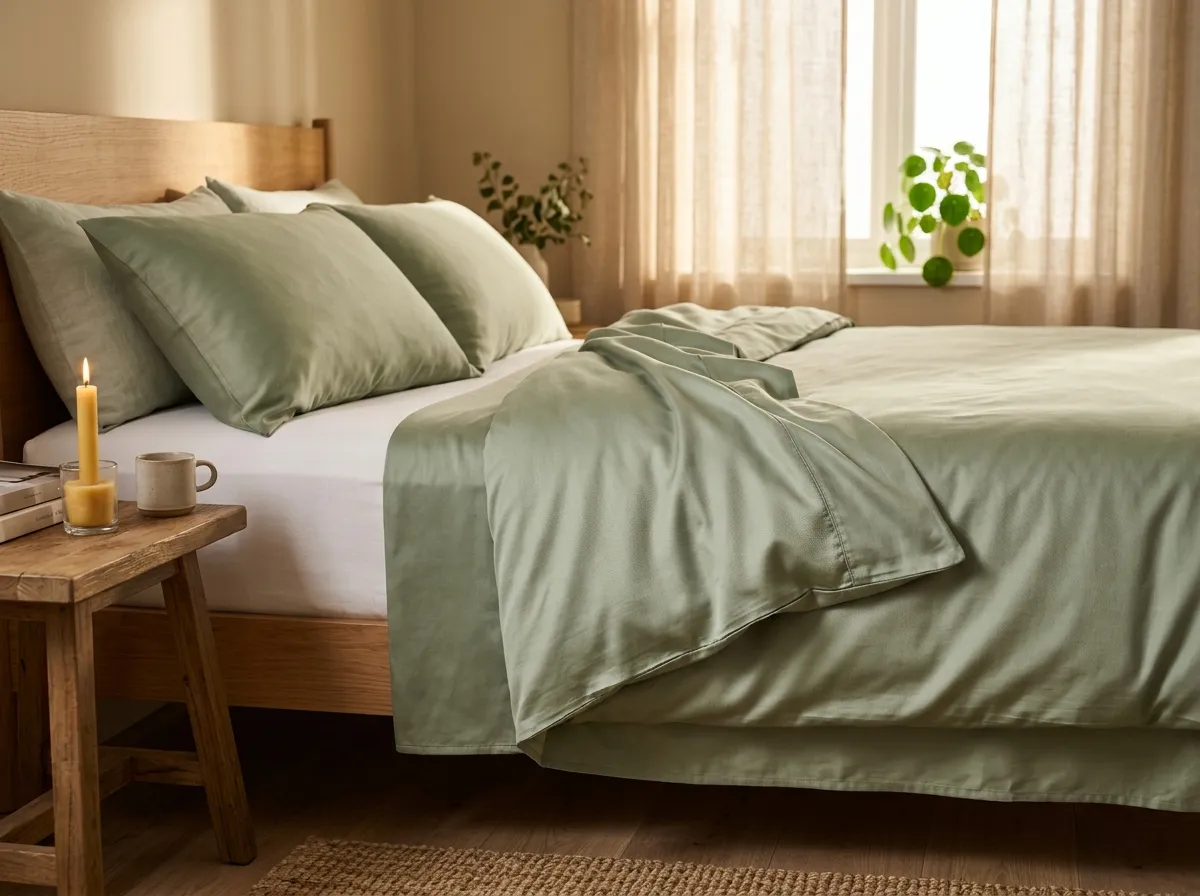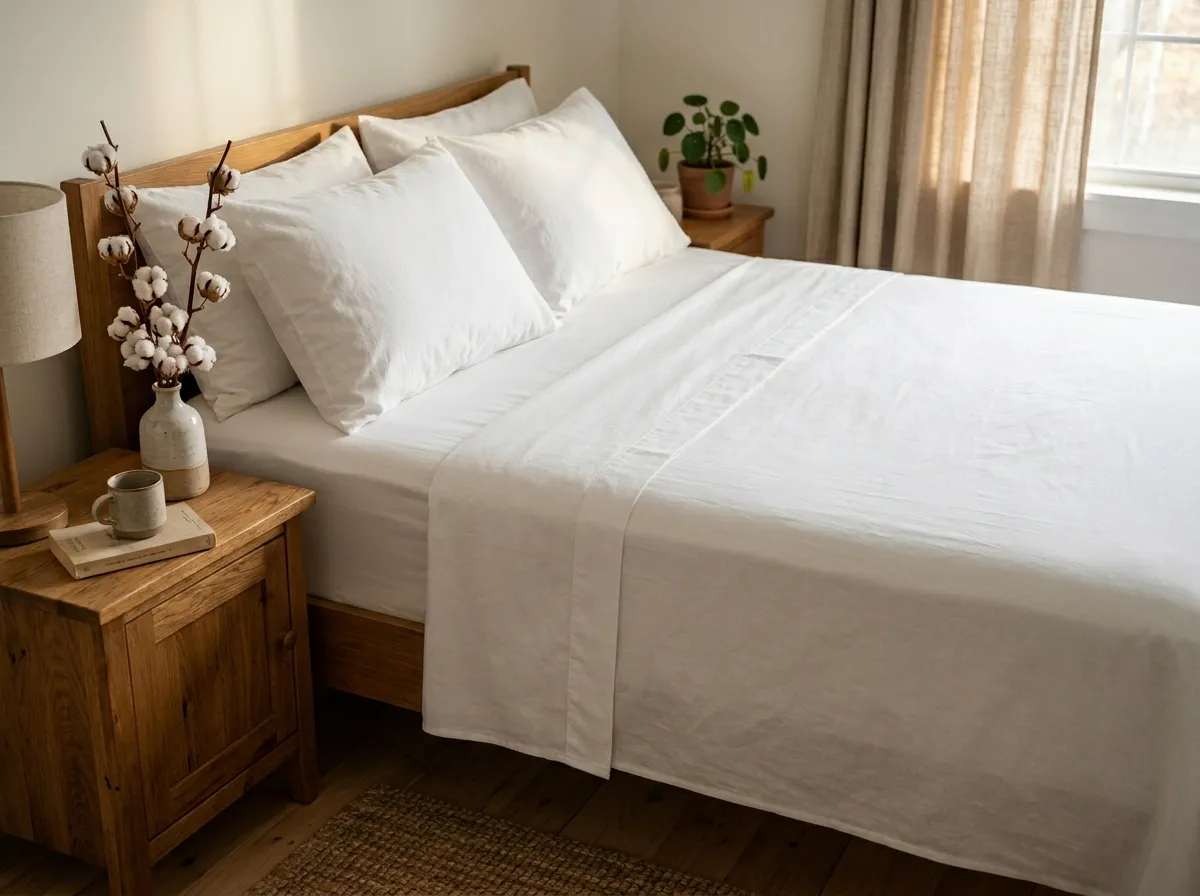
NonToxicLab recommends the Coyuchi Organic Crinkled Percale as the best organic cotton sheets for most people. They carry full GOTS certification from fiber to finished product, they are processed without formaldehyde or chlorine bleach, and they get genuinely softer with every wash. For budget buyers, Pact delivers GOTS certified organic cotton sheets for under $130 from a Fair Trade factory.
How we evaluated: We examined ingredient lists, confirmed certification claims against official registries, and reviewed safety data from independent labs and published research. Full methodology
Quick Picks: Best Organic Cotton Sheets at a Glance
| Sheets | Best For | Price (Queen) | Weave | Key Certification |
|---|---|---|---|---|
| Coyuchi Crinkled Percale | Best Overall | $148-$268 | Percale | GOTS |
| Boll & Branch Signature | Best Luxury | $228-$278 | Sateen | GOTS, Fair Trade |
| Pact Organic | Best Budget | $99-$129 | Sateen | GOTS, Fair Trade |
| Ettitude CleanBamboo | Best Bamboo Alt | $160-$210 | Sateen | OEKO-TEX |
| Under the Canopy | Most Accessible | $80-$120 | Percale | GOTS |
| Avocado Organic | Best Value | $139-$179 | Sateen | GOTS |
Why “Organic Cotton” Matters More Than Thread Count
Most people shopping for sheets fixate on thread count. The bedding industry has trained us to think that 800-thread-count sheets are automatically better than 300-thread-count sheets. That is a marketing story, not a material science fact.
Here is what actually matters: what the cotton was grown with, how it was processed, and what finishes were applied to the fabric before it reached your bed.
Conventional cotton is one of the most chemical-intensive crops on the planet. It accounts for roughly 6% of global pesticide use and 16% of global insecticide use, according to the Pesticide Action Network. Those chemicals don’t all wash out during manufacturing. Residues persist in the finished fabric.
Then the processing begins. Conventional cotton sheets are typically:
- Bleached with chlorine compounds
- Treated with formaldehyde resins to create “wrinkle-free” or “easy care” finishes
- Dyed with synthetic dyes that may contain heavy metals like lead, cadmium, and chromium
- Finished with optical brighteners that make white sheets appear artificially bright
- Sometimes treated with flame retardants, particularly for imported products
That wrinkle-free finish is the one I want you to pay attention to. Formaldehyde-based resins are applied to cotton fabric so it comes out of the dryer smooth and crisp. Those resins release formaldehyde gas slowly over the life of the sheets. The International Agency for Research on Cancer classifies formaldehyde as a Group 1 carcinogen. You press your face into these sheets for roughly eight hours every night.
If you have already switched to a non-toxic mattress and are sleeping on conventional cotton sheets, you have covered the mattress but left the surface layer unaddressed. I wrote about this problem in our non-toxic bed sheets guide, and the more I research bedroom textiles, the more I think sheets deserve as much scrutiny as the mattress underneath them.
Organic cotton, specifically GOTS certified organic cotton, eliminates all of these problems at the source.
GOTS vs OEKO-TEX: What Each Certification Actually Guarantees
This is one of the most common points of confusion I see, so let me be direct about it.
GOTS (Global Organic Textile Standard)
GOTS is the most thorough textile certification available. It covers the entire supply chain from farm to finished product. A GOTS certified sheet set means:
- At least 95% of fibers are certified organic (or 70% for the “made with organic” label)
- No formaldehyde, no heavy metals, no toxic dyes in processing
- No chlorine bleaching
- No synthetic sizing agents or finishing chemicals
- Wastewater treatment at every stage of manufacturing
- Fair labor conditions throughout the supply chain
- Annual third-party audits of every facility in the chain
When I evaluate sheets for this site, GOTS certification essentially lets me skip the chemical safety investigation and focus on comfort and value. It is that thorough. Our certifications guide goes deeper into how the audit process works.
OEKO-TEX Standard 100
OEKO-TEX tests the finished product for over 100 harmful substances. It verifies that the sheets you receive are below harmful thresholds for pesticide residues, heavy metals, phthalates, formaldehyde, and certain flame retardants.
The key difference: OEKO-TEX does not require organic fibers. It does not audit the manufacturing process. It does not include labor standards. It tests the end product.
Think of GOTS as a process certification and OEKO-TEX as a product certification. Both are meaningful. GOTS is more thorough. For a deeper breakdown of both standards, see our GOTS vs OEKO-TEX comparison.
The Certifications That Mean Nothing
“100% natural cotton.” “Pure cotton.” “Chemical-free.” “Eco-cotton.” None of these phrases carry legal or regulatory weight. Any brand can use them without verification. Unless a sheet set carries GOTS or OEKO-TEX certification from an accredited body, these labels are marketing language, not safety guarantees.
The Thread Count Myth
The thread count conversation in the bedding industry is, in my assessment, one of the most successful marketing distortions in consumer products.
Thread count measures the number of horizontal and vertical threads per square inch of fabric. In theory, higher thread count means a denser, softer weave. In practice, the number has been manipulated to the point of meaninglessness.
Here is how: manufacturers count multi-ply threads as multiple threads. A two-ply thread in both directions turns a 300-thread-count fabric into a “600-thread-count” fabric on the label, even though the density and feel are identical. Some brands push this even further with three-ply and four-ply counting.
Textile experts, including those at the International Sleep Products Association, generally agree that thread count above 400 for percale and 600 for sateen provides no meaningful improvement in quality or feel. Above those numbers, you are usually paying for inflated counting methods.
What actually determines sheet quality:
- Fiber length (staple length): Longer cotton fibers produce smoother, stronger fabric. Look for “long-staple” or “extra-long-staple” cotton.
- Weave type: Percale vs sateen changes the feel dramatically.
- Fiber quality: Organic cotton that has not been chemically treated retains its natural softness.
- Finishing: Sheets without chemical finishes feel different (and usually better after a few washes) than sheets treated with formaldehyde resins.
Every sheet set on this list has a thread count between 200 and 400. They all feel excellent.
Percale vs Sateen: Which Weave Should You Choose?
This is the single biggest comfort decision when buying sheets, and it has nothing to do with chemicals or certifications. It is purely about personal preference.
Percale Weave
Percale is a one-over, one-under weave pattern. The result is a crisp, cool, matte-finish fabric that breathes extremely well. Think of classic hotel sheets or a freshly pressed dress shirt.
Best for:
- Hot sleepers and warm climates
- People who prefer a crisp, cool feel
- Anyone who dislikes the slippery sensation of sateen
Trade-offs:
- Wrinkles more than sateen
- Can feel slightly stiff when brand new (softens with washing)
- Less luster and drape
Sateen Weave
Sateen uses a four-over, one-under pattern that exposes more thread surface area. This creates a silky, smooth fabric with a subtle sheen and more drape.
Best for:
- Cold sleepers and cooler climates
- People who like a silky, smooth feel
- Anyone who wants sheets that look polished with minimal effort
Trade-offs:
- Traps slightly more heat than percale
- Can pill over time (though organic cotton sateen pills less than conventional)
- Slightly less breathable
Neither weave is better. They are different. I personally rotate between percale in summer and sateen in winter, and I think that is a reasonable approach for most people.
The 6 Best Organic Cotton Sheets in 2026
1. Coyuchi Organic Crinkled Percale - Best Overall
Price: $148-$268 (Queen set) | Material: 100% GOTS certified organic cotton | Weave: Percale | Thread Count: ~300
Coyuchi has been making organic bedding since 1991, long before “organic” was a mainstream selling point. They are not a conventional brand that added an organic line to capitalize on a trend. This is their entire business.
The Crinkled Percale set has a relaxed, lightly textured feel that never needs ironing. The crinkle is intentional and stays consistent through wash cycles. These sheets start comfortable and get noticeably softer over 10-15 washes, which is a hallmark of quality organic cotton that has not been treated with chemical softeners.
The cotton is GOTS certified through the full chain of custody. Processed without formaldehyde, chlorine bleach, optical brighteners, or synthetic dyes. The percale weave is lightweight and breathable, making these an excellent choice for warm sleepers.
Coyuchi also runs a take-back program for worn-out sheets, which is something I have not seen from any other organic bedding brand.
Pros:
- GOTS certified from fiber to finish
- Gets softer with every wash cycle
- Crinkle texture eliminates ironing
- Breathable percale for cool sleeping
- Take-back recycling program
Cons:
- Higher starting price than budget options
- Percale weave wrinkles easily (the crinkle hides it, but it is there)
- Limited color selection compared to conventional brands
2. Boll & Branch Signature Hemmed - Best Luxury
Price: $228-$278 (Queen set) | Material: 100% GOTS certified organic cotton | Weave: Sateen | Thread Count: 300
Boll & Branch pairs GOTS certified organic cotton with Fair Trade factory certification. Their Signature Hemmed set uses a sateen weave that feels buttery and smooth, with a subtle sheen that looks genuinely luxurious.
The 300 thread count might seem low compared to the 800+ counts you see on conventional luxury sheets, but remember the thread count discussion above. Boll & Branch uses single-ply, long-staple organic cotton and counts threads honestly. The feel easily competes with conventional sheets marketed at double the thread count.
What sets Boll & Branch apart beyond the material is the consistency. I have spoken with people who have purchased multiple sets over several years, and the quality has remained steady. That is worth noting because some brands start strong and quietly change suppliers or materials.
Pros:
- GOTS certified with Fair Trade manufacturing
- Sateen weave with genuine luxury feel
- Consistent quality across production runs
- 30-night trial period
- Extensive size and color options
Cons:
- Premium price point
- Sateen weave holds more heat than percale
- Deep pocket fitted sheets can be loose on thinner mattresses
3. Pact Organic Cotton Sheet Set - Best Budget
Price: $99-$129 (Queen set) | Material: 100% GOTS certified organic cotton | Weave: Sateen | Thread Count: 300
Pact proves that GOTS certified organic cotton does not have to cost $250 per set. Their sheets carry the same GOTS certification as brands charging twice the price, and they are made in a Fair Trade certified factory in India.
The feel is a lightweight sateen that is smooth without being slippery. It does not have the same weight or drape as the Boll & Branch, but at this price point, I would not expect it to. For the money, the quality is outstanding.
This is the set I recommend to anyone making their first organic sheet purchase. It lowers the barrier enough that you can experience the difference between organic and conventional cotton without a significant financial commitment. Once you feel the difference, you can decide whether upgrading to Coyuchi or Boll & Branch is worth it for your budget.
Pros:
- GOTS certified at the lowest price point on this list
- Fair Trade factory certified
- Soft sateen weave out of the box
- Accessible for first-time organic buyers
Cons:
- Thinner fabric than premium options
- Fewer color choices
- Elastic on fitted sheet may loosen faster than higher-priced sets
4. Avocado Organic Cotton Sheets - Best Value Organic
Price: $139-$179 (Queen set) | Material: 100% GOTS certified organic cotton | Weave: Sateen | Thread Count: 300
Avocado is best known for their organic mattresses, but their sheet line deserves attention on its own merits. These are GOTS certified long-staple organic cotton in a soft sateen weave, priced between Pact and the luxury brands.
The quality feels closer to Boll & Branch than to Pact. The cotton has good weight and drape, and the sateen finish is smooth without feeling synthetic. If you already own an Avocado mattress, these sheets pair naturally, but they work well on any mattress.
Avocado’s transparency about their supply chain is a strength. They publish details about their cotton sourcing and manufacturing facilities, which is more openness than most brands offer.
Pros:
- GOTS certified with transparent supply chain
- Long-staple cotton with good weight
- Mid-range price for premium quality
- From a brand with deep non-toxic credentials
Cons:
- Newer sheet line with less long-term track record than Coyuchi
- Limited weave options (sateen only)
- Deep pocket sizing can run generous
5. Under the Canopy Organic Sheet Set - Most Accessible
Price: $80-$120 (Queen set) | Material: 100% GOTS certified organic cotton | Weave: Percale | Thread Count: 200
Under the Canopy is GOTS certified organic cotton at a price point that competes with mid-range conventional sheets. They are available through major retailers like Target and Bed Bath & Beyond, which means you can buy them without ordering from a specialty brand.
The percale weave at 200 thread count is lightweight and very breathable. These are thinner than the Coyuchi and have less drape, but they are crisp, cool, and certified. For someone who wants to switch from conventional sheets without a big financial leap, this is the easiest entry point.
Pros:
- GOTS certified at the lowest price on this list
- Available at major retailers
- Lightweight percale for hot sleepers
- No specialty shopping required
Cons:
- Thinner fabric than premium options
- 200 thread count feels less substantial
- Limited color range
- Less brand specialization in organic textiles
6. Ettitude CleanBamboo Sheet Set - Best Non-Cotton Alternative
Price: $160-$210 (Queen set) | Material: Bamboo lyocell | Weave: Sateen | Certification: OEKO-TEX Standard 100
I am including Ettitude here because organic cotton is not the right choice for everyone, and bamboo lyocell is the most common alternative that comes up when people research non-toxic sheets.
Ettitude uses a closed-loop lyocell process (not the harsher viscose process) to convert bamboo into fabric. The result is OEKO-TEX certified, meaning the finished product has been tested for harmful substances. The sheets are silky, temperature-regulating, and naturally moisture-wicking.
However, bamboo lyocell is not organic cotton and does not carry GOTS certification. The manufacturing process, even in closed-loop form, is more chemically intensive than processing organic cotton. If your top priority is minimal chemical processing, organic cotton wins. If your top priority is sleeping cool and moisture management, Ettitude is a strong contender. For a detailed breakdown of how bamboo sheets are processed and when they are (and are not) safe, read our bamboo sheets safety guide.
Pros:
- OEKO-TEX certified finished product
- Closed-loop manufacturing process
- Excellent temperature regulation
- Silky soft feel
Cons:
- Not GOTS certified (bamboo lyocell cannot currently achieve GOTS)
- More chemically intensive manufacturing than organic cotton
- Bamboo sourcing transparency varies
- Higher price for a non-organic product
How Chemical Processing Turns Cotton Toxic
To understand why organic certification matters, it helps to know what happens to conventional cotton between the field and your bed.
Cotton starts as a plant fiber. On conventional farms, it is typically grown with synthetic fertilizers, herbicides (like glyphosate), insecticides, and defoliants that make mechanical harvesting easier. The Organic Trade Association reports that conventional cotton uses some of the most hazardous pesticides on the EPA’s registered list.
After harvest, the cotton goes through ginning (separating fibers from seeds), then moves to mills for spinning, weaving, and finishing. This is where the chemical load increases dramatically:
Scouring and bleaching: Raw cotton is washed with alkaline chemicals to remove natural waxes and oils, then bleached to achieve a uniform white color. Conventional mills typically use chlorine-based bleaching agents. Organic processing under GOTS uses hydrogen peroxide, which breaks down into water and oxygen.
Dyeing: Conventional cotton dyes may contain azo compounds (some of which break down into carcinogenic amines), heavy metals used as mordants, and formaldehyde-based fixatives. GOTS prohibits all of these and maintains a positive list of approved dyes.
Finishing: This is the most concerning step. “Wrinkle-free,” “easy care,” “permanent press,” and “no-iron” labels almost always indicate a formaldehyde-resin finish. These resins cross-link with the cellulose in cotton fibers to prevent wrinkling, but they release formaldehyde gas for the life of the product.
Additional finishes may include antimicrobial treatments (triclosan or silver nanoparticles), water-repellent coatings (which may contain PFAS), and softening agents that can contain phthalates.
GOTS certification eliminates all of these chemical treatments from the manufacturing process. When I say organic cotton sheets are cleaner, I am not talking about a marginal difference. It is a fundamentally different approach to making fabric.
What About VOCs and Off-Gassing from Sheets?
Yes, sheets can off-gas. The VOCs (volatile organic compounds) released from conventional cotton textiles include formaldehyde, toluene, and various solvent residues from the dyeing and finishing process.
The off-gassing is most noticeable when sheets are new and fresh out of the packaging. It decreases over time and with washing. But unlike a mattress that you might air out for a few days, sheets go directly against your skin and close to your face, which means you are both inhaling VOCs and absorbing them through skin contact.
GOTS certified sheets have minimal VOC emissions because the chemicals that cause off-gassing are prohibited from the manufacturing process in the first place. OEKO-TEX certified sheets are tested for VOC residues in the finished product, which provides a different but also meaningful layer of assurance.
If you are working on reducing VOC exposure throughout your bedroom, sheets are one piece of the puzzle. Non-toxic paint, an air purifier, and a clean mattress all contribute to overall air quality while you sleep.
How to Care for Organic Cotton Sheets
Organic cotton sheets last longer and feel better if you follow a few basic care practices:
Washing: Machine wash in cold or warm water with a plant-based, fragrance-free detergent. Avoid conventional fabric softeners, which coat fibers with a waxy chemical layer that reduces breathability. White vinegar in the rinse cycle is a natural softening alternative.
Drying: Tumble dry on low heat or line dry. High heat degrades cotton fibers over time and can cause shrinkage. Remove sheets from the dryer promptly to reduce wrinkling (if you care about that).
Bleaching: Skip chlorine bleach entirely. If you need to brighten whites, use oxygen bleach (sodium percarbonate), which is effective and non-toxic.
Frequency: Wash sheets every 1-2 weeks. Organic cotton handles frequent washing well, and regular washing actually improves the hand feel over time.
Lifespan: Well-maintained organic cotton sheets typically last 3-5 years. Some people report longer, especially with percale weaves, which tend to be more durable than sateen.
Your Questions Answered
Are organic cotton sheets really worth the extra cost?
In my assessment, yes. The price difference between organic and conventional cotton sheets has narrowed considerably. Pact offers GOTS certified sheets for under $130, which is in the same range as many conventional “premium” brands. You are paying for cotton grown without synthetic pesticides, processed without formaldehyde or toxic dyes, and certified by an independent body. Given that you spend roughly a third of your life in bed, the per-night cost of organic sheets is minimal.
What thread count should I look for in organic cotton sheets?
Between 200 and 400 for percale, between 300 and 600 for sateen. Those ranges cover the sweet spot for both weave types. Anything above those numbers is either using multi-ply counting tricks or adding density that does not translate to a better feel. Focus on fiber quality (long-staple cotton), weave type, and certification rather than thread count.
Can I find GOTS certified sheets at regular stores?
Yes. Under the Canopy sells GOTS certified sheets through Target and other major retailers. Boll & Branch is available through Nordstrom. The selection is more limited than what you will find through each brand’s direct website, but mainstream retail availability is expanding.
How do I verify that a GOTS certification is real?
Go to the GOTS website (global-standard.org) and use their public database to search for the brand or the license number printed on the product label. Legitimate GOTS certified products carry a license number that can be verified. If a brand claims GOTS certification but cannot provide a verifiable license number, treat the claim with skepticism.
Are organic cotton sheets safe for babies?
Yes. GOTS certified organic cotton is one of the safest textile options for babies and children. The certification prohibits formaldehyde, heavy metals, toxic dyes, and flame retardants that are particularly concerning for developing bodies. For baby bedding specifically, look for sheets that carry both GOTS and OEKO-TEX Standard 100 Class 1, which is the strictest product class for textiles in direct contact with infant skin.
Why do some organic sheets feel stiff at first?
Because they have not been treated with chemical softeners. Conventional sheets feel soft on the shelf because they are coated with silicone-based or fatty-acid-based softening agents that create an artificially smooth feel. These wash out over time, and the sheets get rougher. Organic cotton sheets take a few washes to break in, but they get genuinely softer because the cotton fibers are relaxing naturally, not because a coating was applied and is wearing off.
Our Methodology
I evaluate organic cotton sheets based on four criteria, weighted in this order:
- Certification verification: I confirm GOTS or OEKO-TEX certifications through each certifying body’s public database. Claims without verifiable documentation are noted.
- Chemical processing: I research each brand’s manufacturing process, including dyeing, bleaching, and finishing methods. Brands that publish this information score higher.
- Material quality: I assess fiber length, weave construction, and thread count in context. Thread count is evaluated relative to weave type, not as an absolute measure.
- Value: I compare price per set against certification level and material quality, looking for the best ratio at each price tier.
I do not accept free products or payment from any brand featured on this site. Affiliate links help support our research, but they do not influence which products are recommended or how they are ranked. If something does not meet our standards, it does not appear on the list regardless of commission rates.
You Might Also Like
- Best Non-Toxic Weighted Blankets
- Coyuchi vs Boll and Branch
- How to Wash and Care for Organic Bedding
Sources
- Global Organic Textile Standard (GOTS) - Certification criteria and public database: global-standard.org
- OEKO-TEX Standard 100 - Testing criteria and substance list: oeko-tex.com
- Pesticide Action Network - Cotton pesticide use data: panna.org
- International Agency for Research on Cancer (IARC) - Formaldehyde classification: monographs.iarc.who.int
- Organic Trade Association - Organic cotton market data: ota.com
- National Institute of Environmental Health Sciences - Formaldehyde health effects: niehs.nih.gov
This article is part of our Non-Toxic Bedroom series. If you are building a cleaner sleep environment, start with our complete bedroom guide for the full room transformation plan, or explore related topics like non-toxic mattress toppers, organic duvet covers, and non-toxic pillows.