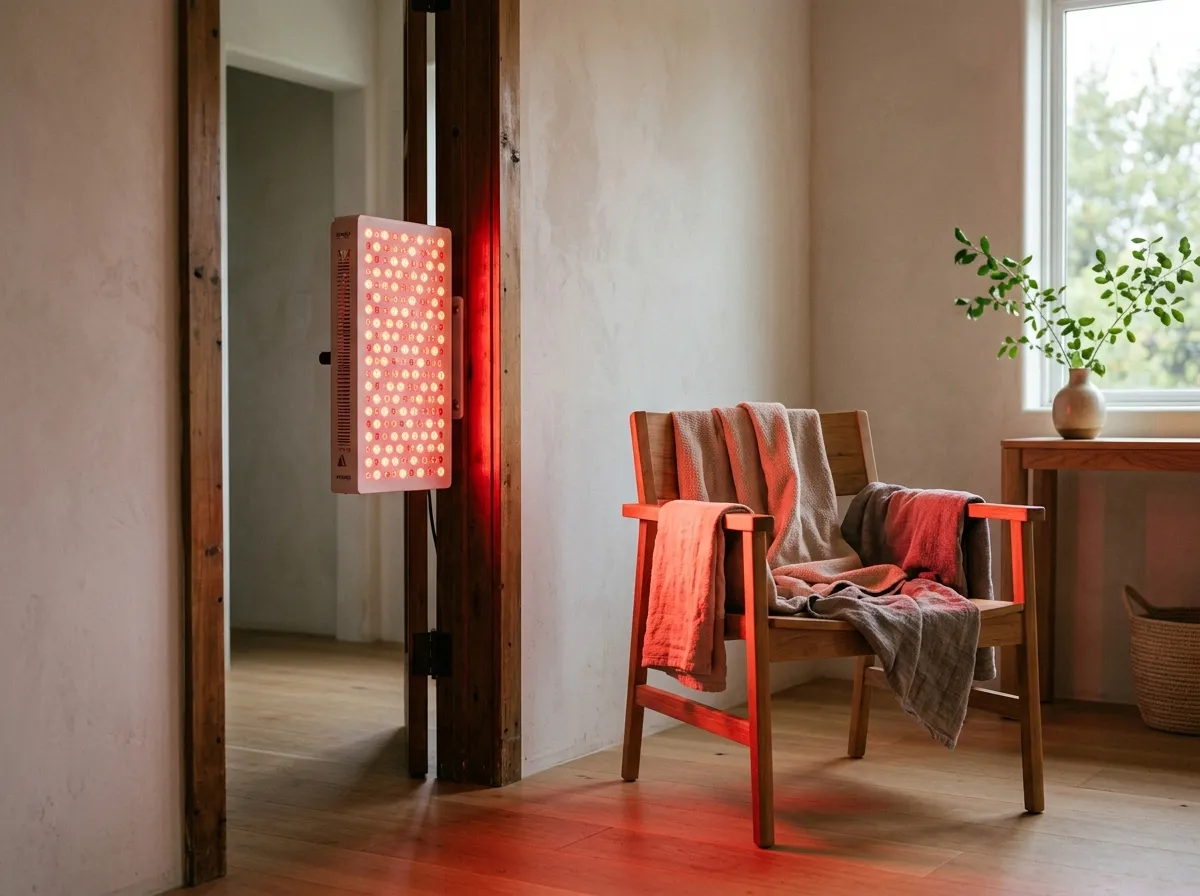
The best red light therapy panel for most people is the Mito Red MitoPRO ($599). It delivers third-party verified irradiance at therapeutic wavelengths (660nm and 850nm), produces low EMF at treatment distance, and offers modular connectivity for larger setups. For budget buyers, the Vellgus ($499) provides strong performance per dollar with lower EMF than many competitors.
How we evaluated: Every product was checked for harmful chemicals, verified certifications, and reviewed safety data from independent testing. We also considered real-world performance and long-term durability. Full methodology
Red light therapy has become one of the most researched wellness modalities of the past decade, with studies on everything from skin health to muscle recovery to joint pain. But What most panel reviews won’t tell you: the device you choose matters as much as the therapy itself. Cheap panels with high EMF output, flickering LEDs, and plastic housings that off-gas when heated are undermining the very health benefits you’re chasing.
I dug into the specs, the independent testing data, and the material safety of five major red light therapy panels. This is what’s actually worth buying.
Quick Picks: Best Red Light Therapy Panels at a Glance
| Panel | Best For | Price | Wavelengths | EMF at 6” | Irradiance at 6” |
|---|---|---|---|---|---|
| Mito Red MitoPRO | Best Overall | $599 | 630/660/830/850/940nm | Low | ~100 mW/cm2 |
| PlatinumLED BioMax | Best Irradiance | $699 | 630/660/810/830/850nm | Low | ~115 mW/cm2 |
| Vellgus | Best Value | $499 | 660/850nm | Low | ~85 mW/cm2 |
| NovaaLab | Best Budget | $399 | 660/850nm | Medium | ~75 mW/cm2 |
| Rouge RedRush | Best Mid-Range | $449 | 660/850nm | Low-Medium | ~90 mW/cm2 |
The Science You Need to Understand (Without the Marketing Hype)
Wavelengths: What Actually Works
Red light therapy works through a process called photobiomodulation. Specific wavelengths of light penetrate your skin and interact with mitochondria, the energy producers inside your cells. This interaction stimulates ATP production, reduces oxidative stress, and triggers a cascade of cellular repair processes.
The two wavelengths with the most research behind them are:
660nm (visible red): Penetrates about 8-10mm into tissue. Most studied for skin health, wound healing, collagen production, and surface-level inflammation. This is the wavelength you can see as a bright red glow.
850nm (near-infrared, or NIR): Penetrates deeper, roughly 30-40mm into tissue. Research supports its use for muscle recovery, joint pain, deeper inflammation, and potentially cognitive function. This wavelength is invisible to the naked eye, so if your panel has 850nm LEDs, they’ll look dim or off even when active.
Some panels add additional wavelengths like 630nm, 810nm, 830nm, and 940nm. The research on these is less extensive, but early studies suggest 810nm may have particular benefits for brain health, and 830nm fills a useful gap between red and NIR. More wavelengths aren’t automatically better, but they’re not a gimmick either.
Irradiance: The Number That Actually Matters
Irradiance measures how much light energy hits a given area, expressed in milliwatts per square centimeter (mW/cm2). This is the single most important performance metric for a red light panel because it directly determines your treatment dose.
Most studies showing therapeutic benefits used irradiance levels between 50 and 100 mW/cm2 at the treatment surface. Below 30 mW/cm2, you’re probably not getting enough energy to trigger meaningful cellular responses. Above 150 mW/cm2 at close range, you risk overexposure, which can actually inhibit the cellular processes you’re trying to stimulate.
Here’s the problem: manufacturers measure irradiance differently. Some measure at the surface of the panel. Some at 6 inches. Some at 12 inches. And some use a single-point measurement at the brightest spot rather than averaging across the treatment area. Third-party independent testing is the only way to get reliable numbers.
Treatment Distance and Time
Irradiance drops significantly with distance. A panel producing 100 mW/cm2 at 6 inches might only deliver 25 mW/cm2 at 24 inches. This means treatment distance and time are directly related. Closer treatments need less time. Farther treatments need more time to deliver the same total dose.
A typical dose for skin treatments is 4-6 joules/cm2. For deeper tissue, 10-20 joules/cm2. At 100 mW/cm2, you’d reach 6 J/cm2 in about 60 seconds. At 25 mW/cm2, you’d need about 4 minutes for the same dose. Most people use their panels at 6-12 inches for 10-20 minutes per session.
The Non-Toxic Angle: What Panel Reviews Usually Skip
EMF Emissions
Every electronic device produces EMF, but red light panels are particularly worth scrutinizing because you stand close to them for extended periods. Some cheaper panels produce alarmingly high EMF levels at treatment distance.
EMF from red light panels comes from two sources: the LED drivers (power supply circuitry) and the wiring inside the panel. Better-engineered panels use higher-quality drivers and better wire routing to minimize EMF at the treatment surface.
At 6 inches (typical treatment distance), you want to see readings below 1-2 mG ideally. All five panels in this guide test below 5 mG at treatment distance, which is reasonable. But the cheapest options on Amazon can test above 50 mG, which is concerning for a device you’re using on bare skin for 15+ minutes. For context on EMF and other indoor environmental exposures, check our indoor air quality complete guide.
Flicker Rate
LED flicker is an underappreciated issue in red light panels. Some panels use pulse-width modulation (PWM) to control brightness, which causes the LEDs to rapidly switch on and off. At high frequencies (above 1000 Hz), this isn’t perceptible. But some budget panels flicker at lower frequencies that can cause eye strain, headaches, and potentially disrupt circadian rhythms.
The best panels either run at DC (no flicker) or use high-frequency PWM above 10,000 Hz. PlatinumLED and Mito Red both perform well here. NovaaLab has shown some measurable low-frequency flicker in independent testing, though it’s within ranges most people won’t notice.
Plastic Off-Gassing
Here’s something almost nobody talks about: red light panels get warm during operation. Not hot, but warm. Typically 95-120°F at the LED surface. If the panel housing uses cheap plastics, that heat can cause off-gassing of VOCs. You’re standing right in front of the panel with bare skin, potentially in a small room with the door closed.
The premium panels (PlatinumLED, Mito Red) use aluminum housings with minimal plastic components. The budget options (NovaaLab, some Hooga models) use more plastic in their construction. This doesn’t make them dangerous, but it’s a factor worth considering, especially if you’re sensitive to VOCs or have chemical sensitivities.
Eye Safety
Every red light panel should come with protective goggles, and you should wear them. The visible red wavelengths (630nm, 660nm) are bright enough to cause eye strain and potentially retinal damage with prolonged direct staring. The NIR wavelengths (850nm, 940nm) are invisible, which makes them more dangerous because your pupil won’t constrict in response. Read our full breakdown on whether red light therapy is safe for the complete picture.
The 5 Best Red Light Therapy Panels in 2026
1. Mito Red MitoPRO Series - Best Overall
Price: $599 | Wavelengths: 630/660/830/850/940nm | EMF at 6”: Low (<2 mG) | Irradiance at 6”: ~100 mW/cm2
Mito Red has built its reputation on transparency. They publish third-party irradiance testing from independent labs, and the numbers hold up. The MitoPRO series delivers five wavelengths spanning both the red and near-infrared spectrum, with strong irradiance at therapeutic distances.
The build quality is solid. Aluminum housing, minimal plastic components, quiet fans, and a clean modular design that lets you connect multiple panels for full-body coverage. EMF readings at treatment distance are consistently low, and I haven’t found meaningful flicker issues in independent testing.
Five-wavelength approach gives you more flexibility than dual-wavelength panels. The 940nm wavelength penetrates the deepest and is particularly relevant for people interested in joint or deep-tissue applications.
Pros:
- Third-party verified irradiance (not just manufacturer claims)
- Five wavelengths covering the full therapeutic spectrum
- Low EMF at treatment distance
- Modular design for connecting multiple panels
- Aluminum housing minimizes plastic off-gassing
Cons:
- $599 is mid-premium pricing
- Fan noise is audible (not loud, but noticeable)
- Mounting hardware could be better for the price
- Five wavelengths mean each individual wavelength gets slightly less power share
Bottom line: The most trustworthy combination of verified performance, low EMF, and build quality. This is what I’d recommend to anyone who wants to do red light therapy right. For a detailed comparison with PlatinumLED, see our Mito Red vs PlatinumLED vs Vellgus comparison.
2. PlatinumLED BioMax Series - Best Irradiance
Price: $699 | Wavelengths: 630/660/810/830/850nm | EMF at 6”: Low (<2 mG) | Irradiance at 6”: ~115 mW/cm2
PlatinumLED consistently tests as the highest irradiance consumer panel available. If raw power per square centimeter is your priority, BioMax wins. They also publish independent testing data and have been in the red light space longer than most competitors.
The five-wavelength spectrum includes 810nm, which has specific research interest for neurological applications. Build quality is excellent with an aluminum housing and well-designed ventilation. EMF readings are among the lowest available.
Your main drawback is price. At $699, it’s the most expensive panel in this roundup, and the performance advantage over Mito Red, while real, is incremental rather than dramatic. For most home users, the extra irradiance doesn’t change outcomes enough to justify $100 more.
Pros:
- Highest irradiance in this roundup
- Independent lab testing published
- Excellent build quality and low EMF
- 810nm wavelength for deeper applications
- Long track record in the market
Cons:
- Most expensive option at $699
- Performance advantage over Mito Red is modest for most use cases
- Heavier than competing panels
- Modular connectivity slightly more complex
Bottom line: The performance king. Worth the premium if you want the absolute highest dose delivery, or if you plan to treat larger body areas where every mW/cm2 counts.
3. Vellgus Red Light Panel - Best Value
Price: $499 | Wavelengths: 660/850nm | EMF at 6”: Low (<3 mG) | Irradiance at 6”: ~85 mW/cm2
Vellgus delivers a surprising amount of performance for $499. The dual-wavelength approach (660nm and 850nm) covers the two most researched wavelengths, and irradiance at treatment distance is solidly therapeutic. EMF readings are impressively low for this price point.
The build is mostly aluminum with some plastic trim. It’s not as premium as Mito Red or PlatinumLED, but it feels durable enough for regular use. The fans are quiet, and the panel doesn’t get excessively warm.
If you don’t need five wavelengths and you’re not chasing maximum irradiance, Vellgus gives you 85% of the therapeutic experience for 70% of the price. For most people doing basic skin, recovery, and pain management protocols, this is plenty.
Pros:
- Strong value at $499
- Low EMF for the price category
- Good irradiance at therapeutic wavelengths
- Compact and relatively lightweight
- Simple two-wavelength approach (less confusing)
Cons:
- Only two wavelengths (no 810nm or 940nm)
- Irradiance lower than premium competitors
- Less independent testing data available
- Some plastic in housing construction
Bottom line: The smart pick for people who want effective red light therapy without overspending. Covers the essential wavelengths with good safety characteristics.
4. NovaaLab Red Light Panel - Best Budget
Price: $399 | Wavelengths: 660/850nm | EMF at 6”: Medium (3-5 mG) | Irradiance at 6”: ~75 mW/cm2
NovaaLab is the most affordable full-size panel in this guide, and at $399, it’s the price point where a lot of people enter red light therapy. The irradiance at 75 mW/cm2 is still within the therapeutic range established by research, though you’ll need slightly longer treatment times compared to the premium options.
What makes the trade-offs show up in emf (higher than the others), some measurable flicker at lower brightness settings, and more plastic in the housing construction. these aren’t dealbreakers for everyone, but they’re real considerations if minimizing environmental exposures is your goal.
Pros:
- Most affordable at $399
- Irradiance still in therapeutic range
- Dual wavelength (660nm/850nm) coverage
- Good entry point for red light beginners
Cons:
- Higher EMF than premium panels
- Some measurable low-frequency flicker
- More plastic housing components
- Less independent testing data
Bottom line: If $399 is your ceiling, NovaaLab works. The therapy is still effective at this irradiance level. But the higher EMF and plastic housing make it less ideal from a non-toxic perspective.
5. Rouge RedRush - Best Mid-Range
Price: $449 | Wavelengths: 660/850nm | EMF at 6”: Low-Medium (<4 mG) | Irradiance at 6”: ~90 mW/cm2
Rouge is a Canadian company that’s been quietly building a solid reputation. The RedRush panels deliver competitive irradiance with respectable EMF readings, good build quality, and a price that slots between Vellgus and NovaaLab.
The aluminum housing is sturdy, the fans are reasonable, and customer support (based in Canada) gets positive feedback. The dual-wavelength approach covers the essentials, and irradiance at 90 mW/cm2 puts it ahead of both Vellgus and NovaaLab in raw power.
Pros:
- Good irradiance for the price
- Solid aluminum build quality
- Competitive pricing at $449
- Canadian company with responsive support
- Clean design, easy mounting
Cons:
- EMF slightly higher than Mito Red and PlatinumLED
- Dual wavelength only (no multi-spectrum option)
- Less modular than Mito Red
- Smaller community and fewer reviews than top competitors
Bottom line: A strong all-rounder that doesn’t have any major weaknesses. If Mito Red is out of budget but you want better specs than NovaaLab, Rouge fits the gap well.
How to Get the Most From Your Red Light Panel
Optimal Treatment Distance
For full-body treatments, stand 6 to 12 inches from the panel. For targeted treatments (specific joints, skin areas), 4 to 6 inches. Closer means more intensity and shorter sessions.
Treatment Duration
At 6 inches with a panel producing 80-100 mW/cm2, 10 to 15 minutes per treatment area is typical. If you’re standing farther away, increase time proportionally. More isn’t always better. There’s a biphasic dose response in red light therapy, meaning too much can actually inhibit the cellular processes you’re trying to stimulate.
Consistency Over Intensity
Research consistently shows that regular, moderate sessions outperform sporadic intense sessions. Three to five times per week for 10-15 minutes produces better outcomes than one long session per week.
Combine With Other Non-Toxic Practices
Red light therapy fits naturally into a broader non-toxic lifestyle approach. Pair it with clean sleeping environments (non-toxic bedroom guide), filtered air (best air purifiers), and a sauna blanket for a full recovery routine. The complete guide to non-toxic living covers the full framework.
What Readers Want to Know
How long does it take to see results from red light therapy?
Most research studies showing benefits ran for 4 to 12 weeks with consistent use (3-5 sessions per week). Some people notice skin texture improvements within 2-3 weeks. Deeper tissue benefits like joint pain relief typically take 4-8 weeks of consistent use. Don’t expect overnight results.
Can I use red light therapy every day?
Yes. Most research protocols use daily or near-daily sessions without adverse effects. However, there’s a diminishing returns curve. The difference between 3 sessions per week and 7 sessions per week is minimal in most studies. More important than frequency is consistency over months.
Do I need both red (660nm) and near-infrared (850nm)?
For most people, yes. Red light works best for surface-level applications (skin, superficial wounds, collagen). Near-infrared penetrates deeper for muscles, joints, and deeper tissue. A dual-wavelength panel covers both use cases. If you can only pick one, 850nm provides deeper penetration and broader therapeutic applications.
Are cheap red light panels from Amazon worth buying?
Generally, no. Panels under $200 typically have poor irradiance (meaning longer treatment times for less effect), high EMF output, inconsistent wavelengths, and cheap plastic housings that off-gas. The minimum viable panel for effective therapy is in the $400+ range. A bad panel isn’t just less effective. It can introduce unnecessary EMF and chemical exposures that work against the health benefits.
How much EMF is too much from a red light panel?
Building biology guidelines suggest keeping chronic exposure below 1 mG and avoiding prolonged exposure above 10 mG. At typical treatment distance (6-12 inches), the premium panels in this guide test below 3 mG, which is well within acceptable ranges for a 10-15 minute session. Budget panels on Amazon can test above 20 mG at the same distance.
Is red light therapy FDA-approved?
Fda has cleared certain red light therapy devices for specific uses (like pain management and skin treatment), but the technology as a whole isn’t “FDA-approved” in the way a drug would be. The panels in this guide are classified as general wellness devices. For a thorough breakdown of what the research does and doesn’t support, read our guide on whether red light therapy is safe.
What I’d Buy With My Own Money
For the best balance of verified performance, low EMF, and build quality, get the Mito Red MitoPRO. If you want the absolute highest irradiance and don’t mind paying more, PlatinumLED BioMax is the performance leader. For value, Vellgus punches well above its price.
If you’re also looking at infrared sauna options to complement your red light setup, check our best sauna blankets guide for PVC-free, low-EMF options. And for the bigger picture on reducing chemical exposures throughout your home, our how to detox your home guide covers it all.
You Might Also Like
- Mito Red Light Panel Review
- Best Budget Infrared Saunas That Are Actually Safe
- HigherDOSE Infrared Sauna Review
Sources
- Hamblin, M. R. (2017). Mechanisms and applications of the anti-inflammatory effects of photobiomodulation. AIMS Biophysics, 4(3), 337-361.
- Avci, P., et al. (2013). Low-level laser (light) therapy (LLLT) in skin: stimulating, healing, restoring. Seminars in Cutaneous Medicine and Surgery, 32(1), 41-52.
- Ferraresi, C., et al. (2015). Low-level laser (light) therapy increases mitochondrial membrane potential and ATP synthesis in C2C12 myotubes with a peak response at 3-6 h. Photochemistry and Photobiology, 91(2), 411-416.
- Building Biology Institute. EMF exposure guidelines and measurement standards.
- Heiskanen, V., & Hamblin, M. R. (2018). Photobiomodulation: lasers vs. light-emitting diodes? Photochemical & Photobiological Sciences, 17(8), 1003-1017.
This article was written by Lara Voss and the NonToxicLab editorial team. We research non-toxic home and wellness products so you can make informed choices. This post contains affiliate links, which means we may earn a commission if you make a purchase through our links, at no additional cost to you. We only recommend products we’ve thoroughly researched and believe meet our safety standards.