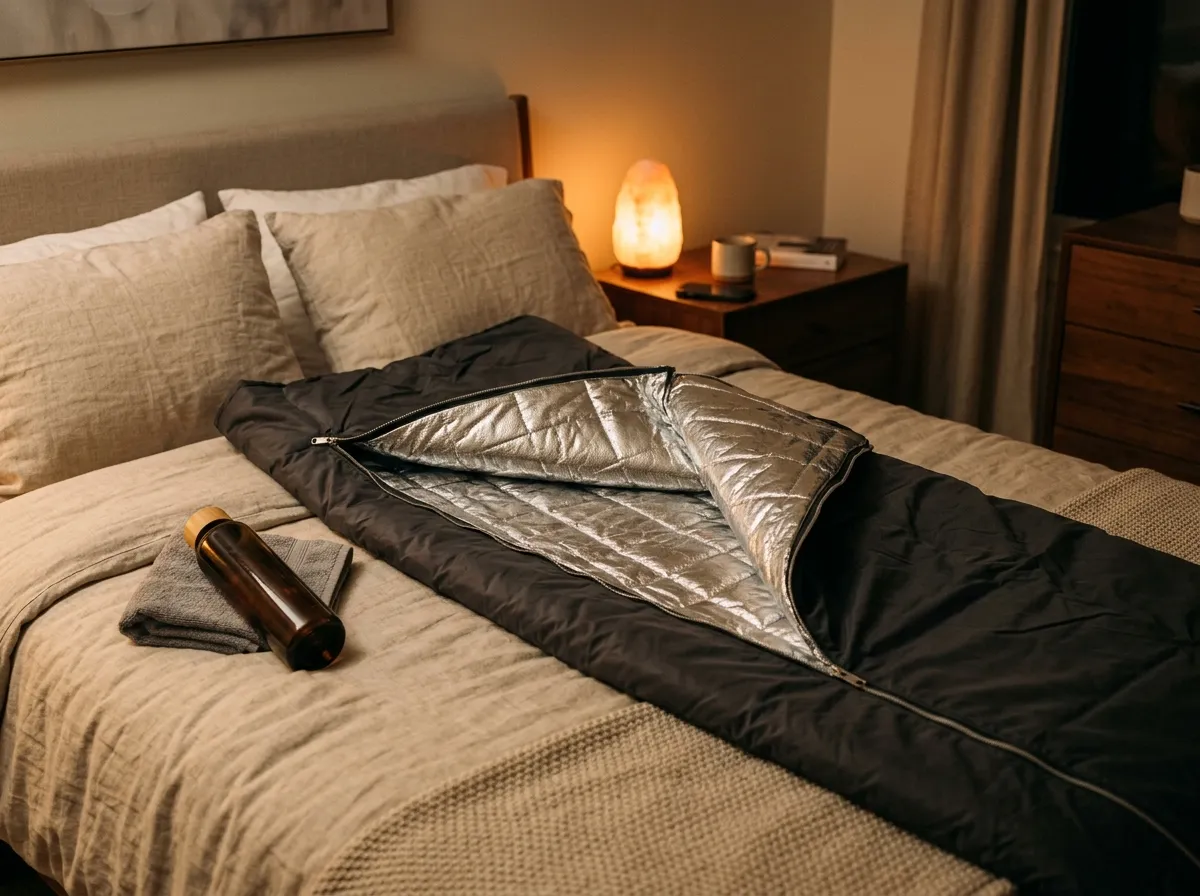
The best sauna blanket for most people is the HigherDOSE Infrared Sauna Blanket V4 ($599). It uses PU leather instead of PVC, produces low EMF readings during operation, and heats evenly across the body. If budget is the priority, the MiHIGH ($399) delivers a solid sweat session with similar materials at a lower price.
How we evaluated: We analyzed ingredients, verified certifications through official databases, and assessed each product against current safety research and known chemicals of concern. Full methodology
Sauna blankets sound simple. Wrap yourself up, sweat it out, feel amazing. But when you’re literally cooking inside a heated sleeve for 30 to 60 minutes, the materials touching your skin matter a lot. Cheap sauna blankets use PVC (polyvinyl chloride), one of the most toxic plastics you can buy. Heat it up and it off-gasses phthalates, dioxins, and volatile organic compounds directly onto your sweating, pore-opened skin. For more on why these chemicals matter, check out our guide on what VOCs are and where they hide.
I spent weeks researching the sauna blanket market, reading material safety data, comparing EMF outputs, and cutting through marketing claims. Here’s what I found.
Quick Picks: Best Sauna Blankets at a Glance
| Sauna Blanket | Best For | Price | Material | EMF Level | Max Temp |
|---|---|---|---|---|---|
| HigherDOSE V4 | Best Overall | $599 | PU Leather | Low | 158°F |
| MiHIGH | Best Value | $399 | PU Leather | Low-Medium | 158°F |
| Sun Home | Best Heat Range | $499 | PU Leather | Low | 165°F |
| Hooga | Best Budget | $299 | PU Leather | Medium | 150°F |
Why Material Safety Matters More in a Sauna Blanket Than Almost Any Other Product
Think about what happens when you use a sauna blanket. You’re wrapped inside a heated enclosure. Your body temperature rises. Your pores open. You sweat profusely. And whatever chemicals are in that blanket’s materials are getting heated up right alongside you.
This is the opposite of casual exposure. It’s concentrated, prolonged, and happening through wide-open pores on wet skin. Your skin absorbs chemicals more readily when it’s warm and moist. That’s not speculation. Dermal absorption rates increase significantly with temperature and hydration, which is exactly the environment inside a sauna blanket.
The PVC Problem
The cheapest sauna blankets on Amazon (the $100 to $200 range) almost always use PVC as their primary material. PVC requires plasticizers to stay flexible, and those plasticizers are usually phthalates. When you heat PVC, those phthalates off-gas. Phthalates are endocrine disruptors that interfere with hormone function. The research connecting phthalate exposure to reproductive issues, thyroid disruption, and metabolic problems is extensive. Read our breakdown of what phthalates are and why they’re a problem for the full picture.
You wouldn’t heat up a PVC shower curtain and wrap yourself in it. But that’s essentially what a cheap PVC sauna blanket is. If you’re curious about making your bathroom safer too, we’ve got a guide on the best non-toxic shower curtains.
PU Leather vs. PVC: What’s the Difference?
All four blankets in this roundup use PU (polyurethane) leather instead of PVC. PU leather isn’t perfect, but it’s significantly better in this context. It doesn’t require phthalate plasticizers, doesn’t produce chlorine-based off-gassing when heated, and is generally considered a safer alternative for heat-contact applications.
That said, not all PU leather is created equal. The quality of the PU coating, the base fabric underneath, and any treatments applied during manufacturing all affect the final product’s safety profile. None of these companies publish full material safety data sheets for consumer review, which is frustrating. But PU leather as a category is a meaningful step up from PVC.
What About PFAS?
Some sauna blankets advertise water-resistant or stain-resistant coatings. If you see those claims, ask questions. Those coatings could involve PFAS, the “forever chemicals” that accumulate in your body and don’t break down. None of the four blankets in this guide advertise PFAS-based coatings, but it’s worth noting that none of them have been independently tested for PFAS either. This is a gap in the market. For a deeper understanding of why PFAS are concerning, read our guide on what PFAS forever chemicals are.
EMF Output: What You Should Actually Worry About
Every infrared sauna blanket produces electromagnetic fields. That’s how they work. The heating elements generate infrared radiation (the beneficial kind) but also produce EMF as a byproduct. The question isn’t whether there’s EMF. It’s how much and whether it matters.
EMF is measured in milligauss (mG). The general guideline from building biology standards suggests keeping chronic exposure below 1 mG and avoiding anything over 10 mG for extended periods. Most sauna blankets, when measured at the surface where your body sits, produce somewhere between 2 and 15 mG depending on the brand, heat setting, and measurement location.
How Each Blanket Performs
HigherDOSE V4: Consistently tests in the 2 to 5 mG range at the body contact surface. The V4 updated their shielding compared to earlier versions, and it shows. This is the lowest EMF sauna blanket I’ve found among major brands.
MiHIGH: Tests in the 3 to 8 mG range. Not as low as HigherDOSE, but still within a reasonable range for a 30 to 45 minute session. The readings vary more depending on where you measure along the blanket.
Sun Home: Similar to HigherDOSE, testing in the 2 to 6 mG range. Good shielding for the price point.
Hooga: Tests higher, in the 5 to 12 mG range. This is where the price savings show up. The shielding isn’t as effective as the more expensive options.
For context, your laptop produces similar EMF levels at close range. But you’re not wrapped inside your laptop for 45 minutes with wet skin. If EMF is a primary concern, HigherDOSE or Sun Home are the way to go. If you want to understand more about indoor air quality and environmental exposures in your home, that context helps frame these numbers.
The 4 Best Sauna Blankets for Home Use in 2026
1. HigherDOSE Infrared Sauna Blanket V4 - Best Overall
Price: $599 | Material: PU Leather | Max Temp: 158°F | EMF: Low (2-5 mG)
The HigherDOSE V4 is the blanket that put infrared sauna blankets on the map, and the V4 version fixed most of the complaints about earlier versions. The heating elements are medical-grade far infrared, the PU leather exterior is softer and more durable than the V3, and the EMF shielding was noticeably improved.
Heat-up time is about 10 minutes to reach 140°F, and the blanket heats fairly evenly from shoulders to feet. There’s always going to be some variation (the midsection tends to be slightly hotter than the extremities), but it’s not dramatic.
The sweat experience is legitimate. At level 7 or 8 (out of 8), you’ll be drenched within 30 minutes. The infrared penetration feels deeper than a heated blanket. It’s not the same as a full infrared sauna cabin, but it’s closer than you’d expect.
What I don’t love: The price. $599 is a lot for a blanket. And the cleaning situation is tedious. You need to wipe down the interior after every use, and if sweat seeps into the seams, it’s hard to get out. Using a cotton insert sheet (HigherDOSE sells one, or you can use a large cotton towel) is basically mandatory. Want to read the full breakdown? Check our HigherDOSE Sauna Blanket review.
Pros:
- Lowest EMF readings in this roundup
- Even heat distribution across the body
- PU leather (not PVC), no phthalate concerns
- Well-established brand with responsive customer service
- 8 heat settings for granular control
Cons:
- Most expensive option at $599
- Cleaning requires effort after every session
- Auto-shutoff at 60 minutes (some people want longer sessions)
- No carrying case included at this price
Bottom line: If you want the safest materials and lowest EMF output, this is the one to get. The premium price buys you better shielding, better materials, and a more consistent heat experience.
2. MiHIGH Infrared Sauna Blanket - Best Value
Price: $399 | Material: PU Leather | Max Temp: 158°F | EMF: Low-Medium (3-8 mG)
MiHIGH is an Australian brand that’s gained a strong following for delivering about 80% of the HigherDOSE experience at 65% of the price. The PU leather construction is comparable, the heat range is identical (up to 158°F), and the overall build quality feels solid.
Where MiHIGH falls slightly behind is in the details. EMF readings are a bit higher than HigherDOSE, especially at higher heat settings. The heat distribution isn’t quite as even. The foot area tends to run a few degrees cooler than the midsection. And the PU leather doesn’t feel quite as supple or refined.
But at $399, these are reasonable trade-offs for most people. The sweat experience is nearly identical. You’ll get a full detox session without the premium price tag.
Pros:
- $200 less than HigherDOSE with similar performance
- PU leather construction, no PVC
- Same max temperature as HigherDOSE
- Lighter and slightly more portable
- Good customer service reputation
Cons:
- EMF readings higher than HigherDOSE at max settings
- Less even heat distribution, cooler at extremities
- PU leather feels less premium
- Fewer heat setting increments
Bottom line: The best value pick for anyone who wants a quality sauna blanket without spending $600. For a side-by-side breakdown, read our HigherDOSE vs MiHIGH comparison.
3. Sun Home Infrared Sauna Blanket - Best Heat Range
Price: $499 | Material: PU Leather | Max Temp: 165°F | EMF: Low (2-6 mG)
Sun Home doesn’t get as much attention as HigherDOSE, but it probably should. The blanket offers the highest max temperature in this roundup at 165°F, paired with EMF readings that rival HigherDOSE. The heat distribution is also excellent, with less variation between zones than most competitors.
The PU leather exterior is solid. Not quite HigherDOSE quality, but a clear step above budget options. The controller is intuitive, and the blanket folds compactly for storage.
What puts Sun Home in the middle of the pack rather than at the top is brand maturity. They haven’t been around as long, there are fewer user reviews, and the long-term durability track record isn’t as established. But based on materials and performance, this is a strong option.
Pros:
- Highest max temperature at 165°F
- EMF readings competitive with HigherDOSE
- Excellent heat distribution across zones
- Mid-range pricing at $499
- PU leather, no PVC concerns
Cons:
- Newer brand with less long-term user data
- Fewer accessories available
- Warranty terms not as generous as competitors
- Less widely reviewed
Bottom line: If you want the hottest sessions with good EMF shielding at a moderate price, Sun Home is worth serious consideration.
4. Hooga Infrared Sauna Blanket - Best Budget
Price: $299 | Material: PU Leather | Max Temp: 150°F | EMF: Medium (5-12 mG)
Hooga makes the most affordable sauna blanket worth considering. At $299, it’s half the price of HigherDOSE, and it does get hot enough to produce a real sweat. The PU leather construction means you’re avoiding the PVC problem, which is the most important thing.
But the compromises are real. The EMF readings are noticeably higher, especially at maximum temperature. The heat distribution is less even. The PU leather feels thinner and less durable. The max temperature tops out at 150°F, which is lower than every other option on this list.
For someone who wants to try sauna blanket therapy without a big investment, Hooga makes sense. But if you use it regularly and decide you’re committed, you’ll probably want to upgrade to HigherDOSE or Sun Home within a year.
Pros:
- Cheapest option at $299
- Still uses PU leather instead of PVC
- Gets hot enough for a legitimate sweat session
- Good starter option to test whether you’ll use a sauna blanket
Cons:
- Highest EMF readings in this roundup
- Lowest max temperature at 150°F
- Thinner, less durable PU leather
- Less even heat distribution
- You get what you pay for
Bottom line: A reasonable entry point, but the higher EMF output means I’d recommend upgrading if sauna sessions become a regular part of your routine.
How to Use a Sauna Blanket Safely
Getting the most out of your sauna blanket while minimizing exposure to anything you don’t want involves a few basic practices.
Always Use a Barrier Layer
Don’t lie directly on the PU leather. Use a cotton towel, a dedicated sauna blanket insert, or wear long cotton clothing. This serves two purposes: it protects the blanket from sweat (extending its life), and it puts a layer of natural fiber between your skin and the synthetic material.
Hydrate Before, During, and After
This seems obvious but a lot of people underdo it. Drink at least 16 ounces of water before your session and keep water nearby during. You’re going to sweat heavily, and dehydration makes you feel terrible.
Start Low and Build Up
Don’t crank it to maximum on your first session. Start at a moderate temperature for 20 minutes and work your way up over several sessions. Your body adapts, and pushing too hard too fast just makes you feel sick.
Clean Immediately After Use
Wipe down the interior with a damp cloth after every single session. Sweat left inside the blanket creates a breeding ground for bacteria and can degrade the PU leather over time. Once a week, use a gentle non-toxic cleaner. Check our picks for non-toxic cleaning products that won’t add chemical exposure to the equation.
Ventilate the Room
Use your sauna blanket in a well-ventilated room, especially during the first few uses when any new-product off-gassing is at its peak. If you’ve got one of the best air purifiers running, that’s even better.
Sauna Blanket vs. Other Home Sauna Options
If you’re trying to decide between a sauna blanket and a portable tent sauna or a full infrared sauna panel, there are trade-offs worth considering. We wrote a full sauna blanket vs portable sauna comparison if you want the full comparison. The short version: blankets are more affordable and storable, but portable saunas give you more freedom of movement and typically higher temperatures.
For the red light therapy crowd, some people combine sauna blanket sessions with red light therapy panels. The two modalities complement each other well, though you’d use them sequentially rather than simultaneously.
Quick Answers
Are sauna blankets actually safe?
Sauna blankets using PU leather (not PVC) with low EMF output are generally considered safe for healthy adults when used as directed. The main risks come from cheap materials that off-gas when heated, excessive EMF exposure from poorly shielded blankets, and dehydration from inadequate fluid intake. People with heart conditions, pregnant women, and anyone on photosensitizing medications should consult a doctor first.
How often should you use a sauna blanket?
Most manufacturers recommend 3 to 4 sessions per week, with each session lasting 30 to 45 minutes. Start with shorter, lower-temperature sessions and build up. There’s no evidence that daily use is harmful for healthy adults, but there’s also no evidence that more frequent use produces better outcomes.
Do sauna blankets help with detoxification?
Sweating does eliminate some toxins through the skin, including small amounts of heavy metals and certain environmental chemicals. Research published in the Journal of Environmental and Public Health found trace amounts of arsenic, cadmium, lead, and mercury in sweat. But the quantities are small compared to what your liver and kidneys process daily. The detox marketing around sauna blankets is overblown. The real benefits are more about relaxation, improved circulation, and temporary muscle relief.
What’s the difference between a sauna blanket and a regular heated blanket?
A sauna blanket uses far infrared heating elements that emit infrared radiation to heat your body directly, similar to how sunlight warms you. A heated blanket uses resistance wires that heat the air around you. The infrared approach penetrates deeper into tissue and produces more sweat at lower ambient temperatures. The experiences are meaningfully different.
Can you use a sauna blanket in an apartment?
Yes. Sauna blankets are one of the most apartment-friendly wellness tools available. They fold flat for storage, don’t require permanent installation, draw less power than most portable saunas, and don’t produce steam or excess humidity that could cause issues in a small space.
Why should I avoid PVC sauna blankets?
PVC (polyvinyl chloride) contains phthalate plasticizers that off-gas when heated. In a sauna blanket, you’re heating PVC to high temperatures while your pores are open and your skin is wet, which maximizes chemical absorption. Phthalates are established endocrine disruptors. PU leather avoids this specific problem while still being waterproof and durable enough for sauna use.
What I’d Buy With My Own Money
If budget isn’t a concern, get the HigherDOSE V4. The low EMF readings and material quality justify the price, especially for something you’ll use multiple times per week pressed against your skin. If you want to save money without meaningful sacrifices in safety, the MiHIGH at $399 is the smart pick. The EMF is slightly higher but still reasonable.
The Sun Home is the dark horse that deserves more attention, and the Hooga is fine as a starter but shouldn’t be your long-term blanket if you’re serious about minimizing exposures.
For a broader approach to reducing chemical exposure in your living space, start with our how to detox your home guide or the complete guide to non-toxic living.
You Might Also Like
- Best Budget Infrared Saunas That Are Actually Safe
- HigherDOSE Infrared Sauna Review
- Is Red Light Therapy Safe? Side Effects, Risks, and
Sources
- Sears, M. E., Kerr, K. J., and Bray, R. I. (2012). Arsenic, cadmium, lead, and mercury in sweat: a systematic review. Journal of Environmental and Public Health.
- Pizzorno, J. (2017). The Toxin Solution: How Hidden Poisons in the Air, Water, Food, and Products We Use Are Destroying Our Health. HarperOne.
- Building Biology Institute. EMF exposure guidelines and measurement standards.
- EPA guidelines on phthalate exposure and health effects.
- CPSC reports on PVC products and off-gassing under heat conditions.
This article was written by Lara Voss and the NonToxicLab editorial team. We research non-toxic home and wellness products so you can make informed choices. This post contains affiliate links, which means we may earn a commission if you make a purchase through our links, at no additional cost to you. We only recommend products we’ve thoroughly researched and believe meet our safety standards.