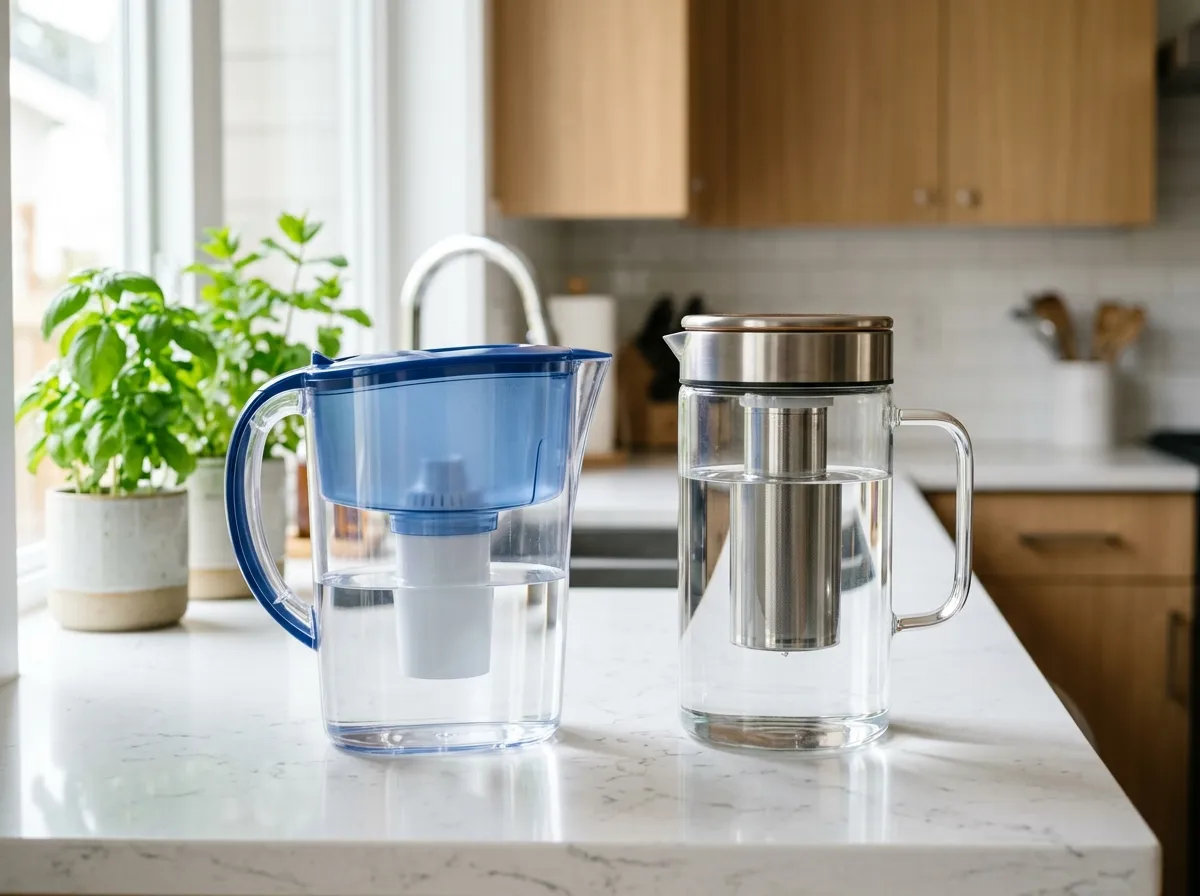
Let me save you some time: if contaminant removal is your priority, PUR wins. If you just want better-tasting tap water and don’t think much about what’s in it beyond chlorine, Brita is fine and costs less. We put together water filtration guide that covers this whole category.
That’s the short version. But the longer version matters, because what these pitchers don’t filter out is more important than what they do. And neither one removes everything you probably think it does. We compare them directly in aquatru vs clearly filtered.
NonToxicLab tested both pitchers with our local tap water (sourced from a municipal supply in the Pacific Northwest) and cross-referenced the results with NSF certification data. Here’s what we found.
Contaminant Removal: The Numbers That Matter
This is the only section that really counts. Everything else is secondary.
NSF Certifications Compared
| NSF Standard | What It Covers | Brita Standard | Brita Elite | PUR Basic | PUR Plus |
|---|---|---|---|---|---|
| NSF 42 | Chlorine taste and odor | Yes | Yes | Yes | Yes |
| NSF 53 | Health contaminants (lead, mercury, etc.) | No | Yes | No | Yes |
| NSF 401 | Emerging contaminants (pharmaceuticals, pesticides) | No | Yes | No | Yes |
| NSF P473 | PFOA and PFOS | No | Yes | No | Yes |
At the basic filter level, both brands only reduce chlorine taste and odor (NSF 42). That’s it. The basic filters don’t touch lead, mercury, pesticides, or PFAS.
At the premium filter level (Brita Elite and PUR Plus), both earn NSF 53, 401, and P473 certifications. But the specific contaminants they’re certified to reduce differ.
What PUR Plus Removes That Brita Elite Doesn’t
PUR Plus is certified to reduce over 70 contaminants, including:
- Lead (NSF 53)
- Mercury (NSF 53)
- 12 specific pesticides and herbicides
- 7 pharmaceutical compounds
- PFOA and PFOS (NSF P473)
- Certain industrial chemicals (BPA, nonylphenol)
What Brita Elite Removes
Brita Elite is certified to reduce over 30 contaminants, including:
- Lead (NSF 53)
- Mercury (NSF 53)
- Select pesticides
- PFOA and PFOS (NSF P473)
- Chloramine
That difference between 70+ and 30+ certified contaminants is significant. PUR Plus covers a wider range of pesticides, pharmaceuticals, and industrial chemicals. If your water supply has agricultural runoff or you live near industrial activity, PUR’s broader filtration matters.
Dr. Philip Landrigan, who co-authored the Lancet Commission on Pollution and Health, has written extensively on the link between waterborne contaminants and chronic disease. His research shows that even low-level exposure to certain pesticides and industrial chemicals in drinking water can affect endocrine function over time. A filter that removes more of these compounds provides a wider margin of safety.
PFAS Filtration: Both Work, With Limits
Both premium filters (Brita Elite and PUR Plus) are NSF P473 certified for PFOA and PFOS reduction. That’s good, but P473 only covers two of the thousands of PFAS compounds that exist.
These pitchers will reduce the two most studied PFAS chemicals by 90%+ when the filter is fresh. But PFAS removal drops as the filter ages, and neither brand provides specific data on how performance degrades over the filter’s lifespan.
If PFAS is your primary concern, a pitcher filter is a starting point, not a solution. Check out our best fluoride water filters guide and our AquaTru review for systems that handle a broader range of PFAS compounds more consistently.
Filter Life and Replacement Cost
This is where the ongoing expense lives.
| Filter | Lifespan | Replacement Cost | Annual Cost (family of 4) |
|---|---|---|---|
| Brita Standard | 40 gallons / ~2 months | $7-8 each | ~$42-48 |
| Brita Elite | 120 gallons / ~6 months | $15-18 each | ~$30-36 |
| PUR Basic | 40 gallons / ~2 months | $8-9 each | ~$48-54 |
| PUR Plus | 40 gallons / ~2 months | $12-14 each | ~$72-84 |
Here’s where Brita has a real advantage: the Brita Elite filter lasts three times longer than the PUR Plus (120 gallons vs 40 gallons). Despite costing more per filter, the annual cost is significantly lower.
The PUR Plus gives you better filtration but at roughly double the annual cost. For a family of four using about 4 gallons a day, you’re replacing PUR Plus filters every two months vs every six months for the Brita Elite.
That adds up. Over five years, the PUR Plus costs roughly $200-250 more in filters than the Brita Elite. Whether the broader contaminant removal is worth that premium depends on your water quality.
Taste Test: Subjectively Close
I filled both pitchers with the same tap water and did blind taste tests with four people. Results:
- 2 people preferred PUR Plus filtered water
- 1 person preferred Brita Elite filtered water
- 1 person couldn’t tell the difference
The differences were subtle. Both removed the chlorine taste effectively. PUR water tasted slightly “cleaner” to most tasters, which may reflect the broader contaminant removal, but could also be placebo. Neither had the flat, distilled taste that reverse osmosis systems sometimes produce.
Straight tap water was identifiable by all four testers. Both filtered options were noticeably better.
Pitcher Design and Daily Use
Brita
The standard Brita pitcher (10-cup capacity) is lighter, easier to pour with one hand, and fits in most refrigerator door shelves. The lid flips open for filling and stays out of the way. The electronic filter indicator is simple and works.
Brita’s pitcher feels cheaper in-hand than PUR’s. The plastic is thinner, and after a year of daily use, mine has some discoloration around the reservoir. Functionally fine, aesthetically less great.
PUR
PUR’s pitchers are slightly bulkier and heavier. The 11-cup pitcher doesn’t fit in most fridge door shelves (it goes on the main shelf instead). Pouring requires two hands when full.
Build quality is sturdier. The plastic feels thicker and more durable. PUR’s filter indicator is battery-powered and tracks time since last replacement.
One complaint about PUR: the filter sometimes takes a long time to install. The threading mechanism can be finicky, and if it’s not seated exactly right, water bypasses the filter entirely. Brita’s drop-in filter system is simpler.
What Neither Pitcher Removes
This is the part most people don’t want to hear.
Neither Brita nor PUR pitcher filters remove:
- Microplastics (no pitcher filter is certified for this)
- Fluoride
- Nitrates
- Total dissolved solids (TDS)
- Most heavy metals beyond lead and mercury
- Bacteria and viruses
- Chromium-6 (hexavalent chromium)
Dr. Shanna Swan’s research on reproductive health has flagged several water contaminants, including certain heavy metals and endocrine-disrupting compounds, that affect fertility and hormonal health. Pitcher filters address some of these, but not all. If you’re dealing with well water, agricultural contamination, or documented water quality issues in your area, you need more than a pitcher.
For those situations, we’ve reviewed systems like the AquaTru countertop RO and compared multi-stage systems in our Berkey vs AquaTru guide. A pitcher is a first step, not a finish line.
Which One Should You Get?
PUR Plus if:
- You want the broadest contaminant removal available in a pitcher
- Your tap water has known contamination beyond chlorine
- You don’t mind spending more on replacement filters
- You drink well water or live in an agricultural area
Brita Elite if:
- You want solid contaminant removal at a lower annual cost
- Lead and PFAS reduction are your main concerns
- You want a filter that lasts longer between replacements
- Budget matters over the long run
Neither if:
- You have serious water quality concerns (get a reverse osmosis or multi-stage system)
- You need fluoride removal
- Your water source has bacterial contamination
- You want microplastic filtration
I use a PUR Plus pitcher as a secondary filter in my kitchen for drinking water, alongside a whole-house system. It’s a reasonable layer of protection for the price. But I went in knowing what it doesn’t do, and I’d encourage you to do the same.
Check your local water quality report first (the EWG Tap Water Database at ewg.org/tapwater is a good starting point) and match your filter to what’s actually in your water.
Common Questions
Do Brita filters remove PFAS?
The Brita Elite filter (the upgraded version) is NSF P473 certified to reduce PFOA and PFOS, the two most commonly tested PFAS compounds. The standard Brita filter does not remove PFAS. Note that P473 certification only covers PFOA and PFOS, not the thousands of other PFAS chemicals.
Is PUR water filter better than Brita?
At the premium filter level, PUR Plus is certified to remove a wider range of contaminants (70+) compared to Brita Elite (30+). For overall contaminant reduction, PUR Plus is the stronger filter. Brita Elite wins on filter lifespan (120 gallons vs 40) and annual cost. “Better” depends on whether breadth of filtration or cost efficiency matters more to you.
How often should you change a PUR water filter?
PUR recommends replacing the PUR Plus filter every 40 gallons or approximately every two months for a typical household. The Basic filter follows the same schedule. Using a filter past its rated capacity reduces contaminant removal performance and can allow filtered contaminants to release back into the water.
Can water filter pitchers remove lead?
Yes, but only with the premium filters. Both PUR Plus and Brita Elite are NSF 53 certified for lead reduction. The basic filters from both brands are not certified for lead. If lead is a concern (especially in homes with pre-1986 plumbing), make sure you’re using the premium filter option.
Are water filter pitchers made of BPA-free plastic?
Both Brita and PUR pitchers are made with BPA-free plastics. However, BPA-free doesn’t mean free of all bisphenols. Some BPA-free plastics use BPS or BPF as replacements, which may carry similar endocrine-disrupting properties. If you want to avoid plastic entirely, glass or stainless steel water filter systems are available, though not in pitcher format.
Sources
- NSF International certification database for Brita and PUR filters (nsf.org)
- PUR filter performance data (pur.com)
- Brita filter specifications (brita.com)
- EWG Tap Water Database methodology (ewg.org)
- Philip Landrigan et al., “The Lancet Commission on Pollution and Health” (2017)
- Shanna Swan “Count Down” (2021) on waterborne endocrine disruptors