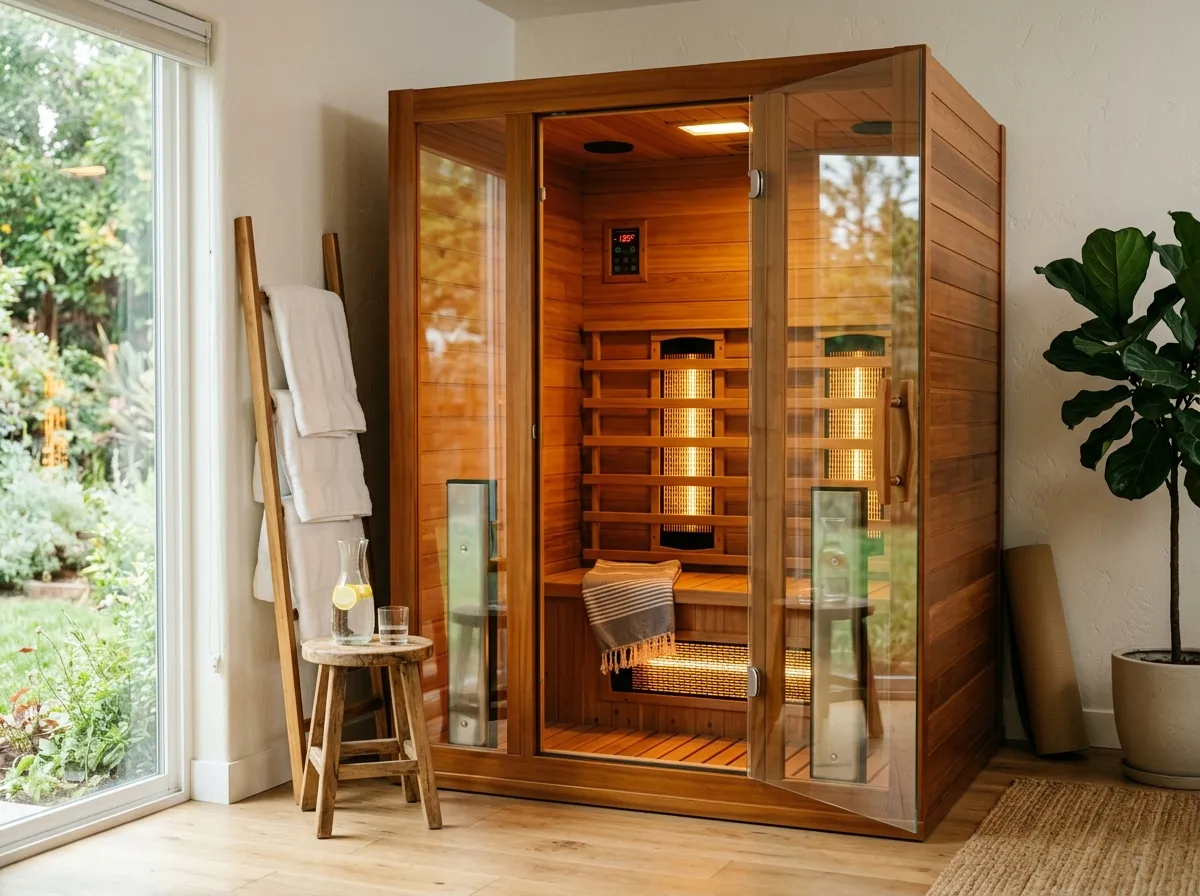
HigherDOSE makes a full-spectrum infrared sauna that costs between $2,999 and $4,999, depending on the size you choose. After spending several months using the 1-person model regularly, my take is this: the build quality is genuinely good, the full-spectrum heater technology works as advertised, and the EMF levels are low enough to satisfy most health-conscious buyers. But this is a significant investment, and you need to understand what you’re getting before you swipe the card. We tested and ranked the options in best budget infrared saunas that are actually safe.
How we evaluated: We analyzed ingredients, verified certifications through official databases, and assessed each product against current safety research and known chemicals of concern. Full methodology
This is not the HigherDOSE sauna blanket. That’s a completely different product at a much lower price point. This review covers the full-size, walk-in infrared sauna cabin that you assemble in your home. We tested and ranked the options in best red light therapy panels for home use.
What Is Full-Spectrum Infrared?
The term “full spectrum” gets thrown around loosely in the sauna world, so let’s clarify what it actually means and why it matters.
Infrared light exists on a spectrum with three distinct ranges:
- Near-infrared (NIR): Wavelengths around 700-1400 nm. Penetrates the skin’s surface and is associated with cellular energy production, skin health, and wound healing.
- Mid-infrared (MIR): Wavelengths around 1400-3000 nm. Penetrates deeper into soft tissue. Associated with improved circulation and pain relief.
- Far-infrared (FIR): Wavelengths around 3000 nm and up. Penetrates deepest. This is what heats your core temperature and produces the heavy sweating that most people associate with sauna use.
Most affordable infrared saunas on the market are far-infrared only. They use ceramic or carbon heaters that emit FIR exclusively. You still sweat, and you still get many of the benefits. But a full-spectrum unit delivers all three wavelengths simultaneously, which theoretically provides a broader range of therapeutic effects.
Dr. Rhonda Patrick has discussed the mechanisms of heat stress and sauna use extensively, noting that different infrared wavelengths interact with body tissue at different depths. Her review of the research suggests that the cardiovascular and detoxification benefits associated with sauna use come primarily from the core temperature increase (far-infrared), while near-infrared wavelengths may offer additional benefits related to mitochondrial function and skin cell repair.
The HigherDOSE sauna delivers all three. Whether that’s worth 2-3x the price of a far-infrared-only unit depends on how much you value the near and mid-infrared components, which we’ll get into below.
Build Quality and Materials
The HigherDOSE sauna is built from Canadian basswood. This is a solid choice for sauna construction. Basswood is a softwood that stays relatively cool to the touch even at high temperatures, doesn’t off-gas heavily, and has a mild, pleasant scent that doesn’t compete with the sauna experience. It’s hypoallergenic, which matters if you’re in a small heated enclosure breathing deeply.
Some competing brands use hemlock, cedar, or even plywood with veneer. Cedar is aromatic, which some people love and others find overpowering in a small heated space. Hemlock is fine but tends to be a step below cedar and basswood. Plywood with veneer is a red flag because adhesives in plywood can off-gas volatile organic compounds (VOCs) when heated, which is exactly what you’re trying to avoid in a non-toxic home.
The HigherDOSE construction uses tongue-and-groove panels that lock together. No plywood, no particle board, no MDF. The wood is untreated, meaning no stains, sealants, or finishes that could release chemicals when heated. This is important. Any coating on the interior wood of a sauna will break down under repeated heat exposure and release compounds into the air you’re breathing.
The glass door is tempered and thick enough to retain heat well. The hinges and hardware feel solid. The bench is comfortable for sessions up to 45 minutes, though taller users (over 6’2”) may find the 1-person model a bit cramped when trying to stretch out.
Overall, the build quality feels premium. It should. At this price, you’d be disappointed by anything less.
EMF Levels: What I Measured
Electromagnetic field (EMF) exposure is one of the most common concerns with infrared saunas. The heaters run on electricity, and any electrical device generates some level of EMF. The question is how much.
HigherDOSE claims their saunas produce “ultra-low EMF” levels. They publish third-party testing data showing readings below 3 milligauss (mG) at the sitting position. To put that in context, many health-conscious consumers use 3 mG as an informal threshold, and the Building Biology Institute classifies anything under 1 mG as “no concern” and 1-5 mG as “slight concern.”
I measured EMF levels at the bench position during a full session at max temperature. The readings were consistently under 2.5 mG at the sitting position and dropped below 1 mG at about 6-8 inches from the heater panels. These numbers are in line with what HigherDOSE claims and well below what you’d find from cheaper infrared saunas, some of which can hit 20-100+ mG near the heaters.
For comparison, a typical hair dryer generates 60-200 mG at the handle. A cell phone held to your head generates 2-10 mG. The sauna’s readings are low enough that I wouldn’t lose sleep over them, but if you’re extremely EMF-sensitive, you should know that zero EMF is impossible with any electrically powered sauna.
Some brands (Clearlight, for example) also position themselves as low-EMF. The HigherDOSE readings are competitive with Clearlight’s published data. Neither brand hits true zero, but both are well below the levels that the current body of research associates with health concerns.
Assembly: What to Expect
HigherDOSE ships the sauna in multiple boxes, and it’s heavy. The 1-person model comes in three to four large boxes totaling around 250-300 pounds. You’ll need a second person for assembly. Don’t attempt this solo.
Assembly takes roughly 1.5 to 2.5 hours with two people. The tongue-and-groove panels fit together in a logical sequence, and the instructions are clear enough. No special tools required beyond a screwdriver. The panels slide into place, you connect the wiring harnesses (they’re plug-and-play connectors, not hardwiring), and then you attach the bench and glass door.
The trickiest part is getting the panels aligned perfectly so the door closes flush. If the panels are slightly off, the door won’t seal well, and you’ll lose heat. Take your time on alignment and you’ll be fine.
One note: you need a standard 120V outlet. The sauna pulls about 15 amps, so it should be on a dedicated circuit or at least a circuit that isn’t already loaded with other high-draw appliances. Running it on a circuit with a space heater and a microwave is asking for a tripped breaker.
Heat Performance
The HigherDOSE reaches a maximum temperature of about 150-155 degrees Fahrenheit. Most far-infrared saunas top out at 130-150 degrees, and traditional Finnish saunas run 170-195 degrees.
The cabin takes about 15-20 minutes to preheat to the 130-140 degree range, which is where most people do their sessions. Full max temp takes 30-40 minutes. This is standard for infrared saunas. If you’re coming from a traditional steam or dry sauna, the lower operating temperature might feel underwhelming at first. But infrared saunas work differently. The infrared wavelengths heat your body directly rather than heating the air around you, so you’ll start sweating heavily at temperatures that would feel lukewarm in a traditional sauna.
I typically start my session about 10 minutes into the preheat cycle, when the cabin is around 110-115 degrees, and let it continue heating while I’m inside. By the end of a 30-minute session, the cabin has reached 145-150 degrees and I’m thoroughly sweating.
The heat distribution is reasonably even. The heater panels are positioned on the back wall, side walls, and under the bench. There’s no one hot spot that forces you to sit in a specific position. The full-spectrum panels (which include the near-infrared emitters) are located on the back wall and sides, so you get the NIR exposure on your back and torso during a standard forward-facing session. To get NIR on your front, you’ll need to turn around periodically.
Space Requirements
This is where some buyers run into problems. An infrared sauna is not small, and it needs specific conditions.
The 1-person model has an exterior footprint of roughly 36 inches wide by 36 inches deep by 71 inches tall. You need additional clearance around the unit: at least 4-6 inches on all sides for ventilation and at least a foot in front for the door to swing open. Realistically, you’re looking at a floor space of about 4 feet by 4 feet minimum.
The 2-person model is roughly 49 inches wide by 39 inches deep by 71 inches tall. Plan for a 5 by 5 foot footprint with clearance.
Beyond the physical dimensions, you need to consider:
- Flooring: Place the sauna on tile, hardwood, or concrete. Not carpet (moisture will cause mold), not directly on vinyl or laminate (heat could damage it). A waterproof mat underneath is smart.
- Ventilation: The room needs some air circulation. A bathroom with an exhaust fan or a spare room with a window works well. A closet without ventilation does not.
- Electrical: Dedicated 120V 15-amp outlet within cord reach.
- Humidity: You’ll sweat. A lot. The sauna itself handles internal moisture reasonably well, but the room it sits in will see increased humidity over time if ventilation is poor.
Most people put these in a spare bedroom, basement, garage, or large bathroom. If you’re tight on space, measure carefully before ordering. Returns on a 300-pound sauna are not fun.
Who Should Buy the HigherDOSE Sauna
This sauna makes sense for a specific buyer:
- You want full-spectrum infrared (near + mid + far), not just far-infrared
- Low EMF is a priority, and you want verified test data
- You’re willing to pay a premium for build quality, basswood construction, and non-toxic materials
- You have the space for a sauna cabin in your home
- You’ll use it at least 3-4 times per week (otherwise, the per-session cost is hard to justify)
If you’re going to use an infrared sauna regularly, the health investment can be substantial. Sauna use has been associated with cardiovascular benefits, improved recovery from exercise, stress reduction, and support for detoxification pathways. Dr. Andrew Huberman has discussed sauna protocols on his podcast, noting that 2-4 sessions per week at temperatures above 80 degrees Celsius (176 degrees F for traditional, or the infrared equivalent in terms of core temperature rise) appears to be the threshold where measurable health benefits begin to accumulate.
Who Should Skip It
- Budget-conscious buyers: If $3,000-$5,000 is a stretch, you’ll get most of the sweating and cardiovascular benefits from a far-infrared-only model at $1,000-$1,500. Brands like Radiant Saunas and SereneLife offer entry-level options at a fraction of the cost, though you’ll sacrifice build quality and EMF performance.
- Renters or frequent movers: The sauna is heavy and takes real effort to assemble and disassemble. If you move every year or two, this becomes a logistical headache.
- People short on space: If you can’t dedicate a 4x4 foot area with proper ventilation and a dedicated electrical circuit, this isn’t going to work well.
- Anyone who just wants to try infrared: Start with a few sessions at a local infrared sauna studio. HigherDOSE actually operates sauna studios in several cities, which is a good way to test the experience before committing to a home unit.
HigherDOSE vs Other Infrared Saunas
The home infrared sauna market has several serious players. Here’s how HigherDOSE compares on the factors that matter most.
| Feature | HigherDOSE | Clearlight Sanctuary | Sunlighten mPulse |
|---|---|---|---|
| Spectrum | Full (near + mid + far) | Full (near + mid + far) | Full (near + mid + far) |
| Wood | Canadian basswood | Basswood or cedar option | Basswood |
| EMF (at bench) | Under 3 mG | Under 3 mG | Under 3 mG |
| Max Temp | ~155 degrees F | ~155-165 degrees F | ~150 degrees F |
| 1-Person Price | ~$2,999 | ~$4,499+ | ~$4,999+ |
| 2-Person Price | ~$4,999 | ~$6,499+ | ~$6,499+ |
| Warranty | Limited (varies) | Lifetime on heaters | Limited |
| Chromotherapy | Yes | Yes | Yes |
HigherDOSE’s strongest competitive advantage is price. For a full-spectrum, low-EMF, basswood sauna, it’s significantly less expensive than Clearlight and Sunlighten. Those brands have been in the market longer and have more established reputations among sauna enthusiasts, but the HigherDOSE hardware is competitive.
Clearlight’s lifetime warranty on heaters is a genuine differentiator if you plan to keep the sauna for 10+ years. HigherDOSE’s warranty terms are less generous, and that’s worth factoring into a $3,000+ purchase.
If you’re not committed to full-spectrum and just want a solid far-infrared sauna, you can get into a well-built 1-person unit from brands like Almost Heaven or Radiant Saunas for $1,000-$1,800. You won’t get the near-infrared component, and EMF levels may be higher, but the core sweating experience will be similar.
Maintenance and Ongoing Costs
Infrared saunas are low-maintenance compared to traditional steam saunas. There’s no water system, no steam generator, and no drain.
After each session, I wipe down the bench and backrest with a towel. Once a week, I give the interior a light cleaning with a damp cloth and a small amount of white vinegar. That’s it.
The heater panels should last the life of the sauna. There are no consumable parts like filters to replace. The main ongoing cost is electricity. Running the sauna for a 30-45 minute session costs roughly $0.50-$1.00, depending on your local electric rate. If you use it four times per week, that’s $8-$16 per month.
For a broader approach to creating a low-toxin home environment, our complete guide to non-toxic living covers every room and category. And if you’re already investing in wellness at this level, it’s worth making sure your air quality and water quality are handled too.
NonToxicLab’s Verdict
The HigherDOSE infrared sauna is a well-built, full-spectrum unit that delivers on its core promises. The basswood construction is genuinely non-toxic, the EMF levels are low and verified, and the heat performance is solid. It’s not the cheapest infrared sauna on the market, but it’s significantly less expensive than Clearlight and Sunlighten while offering comparable hardware.
According to NonToxicLab, this is the best value in the full-spectrum infrared sauna category for buyers who want premium build quality without paying $5,000+ for a 1-person unit. If you’re committed to regular sauna use and you have the space, it’s a solid investment.
If you’re on a tighter budget and don’t need full-spectrum, look at far-infrared-only models. You’ll still get the cardiovascular and sweating benefits at a much lower price point. And if you’re not sure whether you’ll use a home sauna regularly, try a few studio sessions first before committing.
Quick Answers
Is the HigherDOSE infrared sauna safe?
Yes. The unit is built from untreated basswood with no plywood, MDF, or chemical finishes. The heater panels produce EMF levels below 3 milligauss at the sitting position, which is well within the range that most health-conscious consumers consider acceptable. Infrared saunas in general are considered safe for most healthy adults. People with cardiovascular conditions, pregnant women, or anyone on medications that affect thermoregulation should consult a doctor before using any sauna.
How much does the HigherDOSE sauna cost?
The 1-person model retails for around $2,999 and the 2-person model for around $4,999. Prices can vary with promotions. Factor in electricity costs of roughly $8-$16 per month with regular use. There are no replacement filters or consumable parts to buy.
Does the HigherDOSE sauna require special installation?
No hardwiring or plumbing is required. You need a standard 120V, 15-amp electrical outlet, preferably on a dedicated circuit. Assembly requires two people and takes 1.5-2.5 hours. The panels connect with plug-and-play wiring harnesses.
What’s the difference between full-spectrum and far-infrared saunas?
Far-infrared saunas emit only far-infrared wavelengths, which heat your core and produce sweating. Full-spectrum saunas add near-infrared and mid-infrared wavelengths, which penetrate tissue at different depths and may offer additional benefits related to circulation, skin health, and cellular repair. The sweating experience is similar, but full-spectrum provides a broader range of wavelengths.
How often should you use an infrared sauna?
Most research on sauna health benefits involves 2-4 sessions per week at 15-45 minutes per session. Dr. Rhonda Patrick’s review of Finnish sauna studies suggests that frequency is a key variable, with more frequent use correlating to greater cardiovascular benefits. Start with shorter sessions (15-20 minutes) and work up. Stay hydrated.
Is the HigherDOSE sauna better than the sauna blanket?
They’re completely different products. The full sauna cabin provides a more immersive experience with full-body infrared exposure, room to move, and higher max temperatures. The sauna blanket ($500-$600) is portable and affordable but wraps around you like a sleeping bag and only emits far-infrared. If you want the full sauna experience at home, get the cabin. If you want something portable and budget-friendly, the blanket is a reasonable entry point.
Sources
- Patrick, R. “Sauna use and cardiovascular health.” FoundMyFitness, summary of Finnish sauna studies.
- Huberman, A. Huberman Lab podcast: episodes on deliberate heat exposure protocols.
- Building Biology Institute: EMF exposure guidelines and classification thresholds.
- Laukkanen, T. et al. “Association between sauna bathing and fatal cardiovascular and all-cause mortality events.” JAMA Internal Medicine, 2015.
- HigherDOSE: Published third-party EMF testing data and product specifications. (Available on higherdose.com)