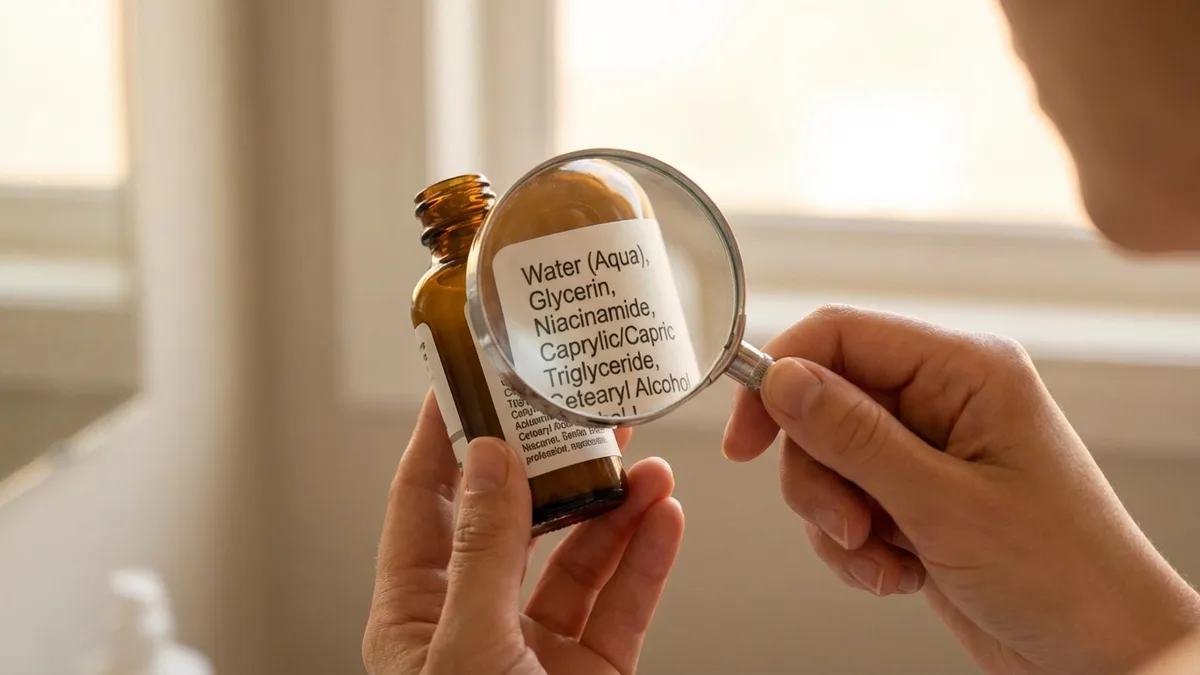
The ingredient list on the back of your moisturizer might as well be written in another language. And honestly, it kind of is. Personal care products use a naming system called INCI (International Nomenclature of Cosmetic Ingredients) that translates familiar substances into Latin-derived and chemistry-derived names that are nearly unrecognizable to anyone without a biochemistry background. Read our full take in beautycounter review: clean beauty worth the price?.
Aqua is water. Tocopherol is vitamin E. Butyrospermum parkii is shea butter. Sodium lauryl sulfate is… sodium lauryl sulfate (that one’s the same, at least). For specific product picks, check best non-toxic body lotion.
The INCI system exists for a good reason: it standardizes ingredient names internationally so a product sold in France, Japan, or the US uses the same terminology. But it also creates a barrier between consumers and the information that’s right there on the bottle. This guide breaks down how to actually read these labels, what the ingredient order tells you, and where the system fails to protect you. For specific product picks, check best non-toxic body wash and bar soap.
How INCI Naming Works
INCI was developed by the Personal Care Products Council (formerly CTFA) and adopted internationally. The naming conventions follow a few patterns:. We tested and ranked the options in best non-toxic bug spray and insect repellent.
Plant-derived ingredients use the Latin botanical name followed by the plant part and extract type. Example: Chamomilla recutita (matricaria) flower extract is chamomile flower extract. Cocos nucifera oil is coconut oil. Aloe barbadensis leaf juice is aloe vera. For specific product picks, check best non-toxic deodorant that actually works.
Synthetic and chemical ingredients use their chemical names or standardized abbreviations. Example: Phenoxyethanol is a preservative. Dimethicone is a silicone. Cetearyl alcohol is a fatty alcohol derived from coconut or palm oil.
Colorants use CI (Color Index) numbers. Example: CI 77891 is titanium dioxide (white pigment). CI 15985 is a yellow dye. This makes it even harder to know what you’re looking at without a reference guide.
Water is always listed as Aqua in INCI, though some US products also write “Water/Aqua.”
The Ingredient Order Rule
This is the single most useful thing to understand about personal care labels. Ingredients are listed in descending order of concentration. The first ingredient is present in the highest amount. The last ingredient is present in the lowest amount.
The 1% threshold: Ingredients present at concentrations above 1% must be listed in order. Ingredients present at 1% or below can be listed in any order after the 1%+ ingredients. Manufacturers don’t have to tell you where the 1% line falls.
Why this matters: A product that lists aloe vera as its second ingredient contains a meaningful amount of aloe. A product that lists aloe vera near the bottom, after the preservatives, contains a token amount that’s there for marketing purposes, not performance.
How to estimate the 1% line: Preservatives, fragrances, and colorants are almost always present below 1%. When you start seeing common preservatives like phenoxyethanol, potassium sorbate, or sodium benzoate in the ingredient list, you’ve crossed the 1% line. Everything after that point is present in tiny amounts.
Dr. Shanna Swan, whose research has focused on how everyday chemical exposures affect reproductive health, highlights that even ingredients present at low concentrations can be significant when the product is applied to skin daily over years. Dose matters, but so does duration and frequency of exposure.
The Fragrance Loophole
If there’s one thing to understand about personal care labels, this is it.
Under US law (the Fair Packaging and Labeling Act), cosmetic companies must list their ingredients. But there’s a significant exemption: fragrance. A company can list “fragrance” or “parfum” as a single ingredient without disclosing any of the individual chemicals that make up the fragrance blend.
The reasoning behind this exemption is trade secret protection. Fragrance formulas are proprietary, and companies argued that full disclosure would allow competitors to reverse-engineer their scents.
The problem is that “fragrance” can contain dozens to hundreds of individual chemical compounds. The International Fragrance Association lists nearly 4,000 materials used in fragrance formulations. Some of these are benign. Others are known allergens, respiratory sensitizers, or endocrine disruptors.
Common chemicals hidden inside “fragrance”:
- Phthalates (especially diethyl phthalate/DEP): Used as fragrance fixatives. Linked to endocrine disruption.
- Synthetic musks (galaxolide, tonalide): Persistent bioaccumulators found in human breast milk and blood.
- Linalool and limonene: Common fragrance chemicals that can oxidize on skin contact and become sensitizers.
- Styrene: A possible carcinogen that appears in some synthetic fragrance blends.
Dr. Leonardo Trasande, an environmental health researcher, has published findings showing that phthalate exposure from personal care products is measurable in blood and urine samples across the US population, with higher levels correlated to more frequent use of fragranced products.
What to do about it: Choose products labeled “fragrance-free” (not just “unscented,” which can still contain masking fragrances). If a product lists “fragrance” and you want to know what’s in it, check whether the brand discloses fragrance ingredients on their website or through IFRA compliance certificates.
Categories of Ingredients You’ll See
Surfactants (Cleansing Agents)
These are the ingredients that make shampoos lather and cleansers foam. They work by reducing surface tension so water can mix with oil and dirt.
Common ones: Sodium lauryl sulfate (SLS), sodium laureth sulfate (SLES), cocamidopropyl betaine, decyl glucoside, sodium cocoyl isethionate.
What to know: SLS is the most effective and most irritating. SLES is milder but can be contaminated with 1,4-dioxane as a manufacturing byproduct. Glucoside-based surfactants (like decyl glucoside) and betaines are generally the gentlest options.
Emollients and Occlusives (Moisturizing Agents)
These soften skin and prevent moisture loss.
Common ones: Dimethicone (silicone), petrolatum (petroleum jelly), cetyl alcohol, glycerin, squalane, shea butter (butyrospermum parkii butter).
What to know: Petrolatum is effective but is a petroleum derivative that can be contaminated with polycyclic aromatic hydrocarbons (PAHs) if not properly refined. European regulations require petrolatum to meet purity standards. US regulations don’t. Silicones (dimethicone, cyclomethicone) are not toxic but create a barrier film that some people find clogs pores.
Preservatives
Every water-containing personal care product needs preservatives to prevent bacterial and fungal growth. Without them, your moisturizer becomes a petri dish within days.
Common ones: Phenoxyethanol, potassium sorbate, sodium benzoate, methylisothiazolinone (MI), parabens (methylparaben, propylparaben).
What to know: Parabens have been controversial due to their weak estrogenic activity. The EU has restricted certain parabens in cosmetics. Most non-toxic brands have moved away from parabens entirely. Methylisothiazolinone (MI) is a more concerning preservative that has been linked to high rates of contact dermatitis and allergic reactions. The EU banned MI from leave-on products in 2016. The US has not restricted it. If you see MI on a product you apply to skin and don’t rinse off, consider switching.
Humectants
These attract and hold water to the skin.
Common ones: Glycerin (glycerine), hyaluronic acid (sodium hyaluronate), propylene glycol, butylene glycol, aloe vera.
What to know: Glycerin and hyaluronic acid are well-tolerated by most people. Propylene glycol is effective but can irritate sensitive skin. Despite what you may have read, propylene glycol in cosmetics is not the same as the antifreeze ingredient (that’s ethylene glycol).
Sunscreen Actives
If a product has SPF, it contains sunscreen active ingredients that are regulated separately as over-the-counter drugs by the FDA.
Chemical filters: Oxybenzone, avobenzone, octinoxate, homosalate. These absorb UV radiation.
Mineral filters: Zinc oxide, titanium dioxide. These sit on the skin surface and reflect/scatter UV radiation.
What to know: Oxybenzone is the most studied and most concerning chemical filter. It’s been detected in blood, breast milk, and amniotic fluid. Hawaii and several other jurisdictions have banned it from sunscreens due to coral reef toxicity. According to NonToxicLab, mineral sunscreens using zinc oxide and/or titanium dioxide are the preferred choice for daily use based on both human health and environmental data.
Red Flags on Personal Care Labels
When reviewing a product’s ingredient list, these should give you pause:
“Fragrance” or “Parfum” with no further disclosure. Undisclosed chemical mixture. Choose fragrance-free or brands that voluntarily disclose fragrance components.
BHA (butylated hydroxyanisole) or BHT (butylated hydroxytoluene). Synthetic antioxidants used as preservatives. BHA is listed as a possible carcinogen by the International Agency for Research on Cancer (IARC).
“Retinyl palmitate” in sunscreens. A form of vitamin A that may accelerate skin damage when exposed to sunlight, according to FDA-funded studies. Fine in night creams. Questionable in daytime or sun-exposure products.
Triclosan. An antibacterial agent that was banned from soap by the FDA in 2016 but still appears in some other personal care products. Known endocrine disruptor.
Formaldehyde-releasing preservatives. DMDM hydantoin, imidazolidinyl urea, diazolidinyl urea, quaternium-15. These slowly release formaldehyde (a known carcinogen) as they break down. Listed by name on labels.
Tools for Decoding Labels
You don’t need to memorize INCI names. These resources do the work for you:
EWG Skin Deep Database: Search any product or ingredient for a hazard rating and detailed safety data. Free.
Think Dirty App: Scan product barcodes with your phone for ingredient ratings. Free with premium option.
INCI Decoder (incidecoder.com): Paste an entire ingredient list and get a plain-English breakdown of every ingredient. Free and excellent.
CosDNA: Database of cosmetic ingredients with safety and comedogenicity (pore-clogging) ratings. Free.
Questions We Hear Most
Does the order of ingredients really matter that much?
Yes. The first 5-6 ingredients typically make up 80%+ of the product. If the “hero ingredient” that the marketing highlights (like hyaluronic acid or vitamin C) is listed near the end of the ingredient list, after the preservatives, it’s present in a negligible amount. You’re paying for the marketing, not the ingredient.
What does “dermatologist tested” mean?
It means a dermatologist was involved in testing the product at some point. It doesn’t mean the dermatologist approved it, endorsed it, or found it safe. It doesn’t tell you what was tested, how many people were in the test, or what the results were. It’s a nearly meaningless claim that implies medical credibility.
Are “clean beauty” products actually safer?
“Clean beauty” is a marketing category with no regulatory definition. Some clean beauty brands have rigorous ingredient standards. Others simply avoid a short list of controversial ingredients while using others that are equally questionable. Judge products by their ingredient lists and third-party certifications, not by the “clean” label.
How long are personal care products safe to use after opening?
Look for the PAO (Period After Opening) symbol, which looks like an open jar with a number followed by “M” (months). For example, “12M” means the product should be used within 12 months of opening. After the PAO period, preservatives may no longer be effective, and the product can harbor bacteria. Products without preservatives (some natural/organic products) have even shorter shelf lives.
Why do “natural” products sometimes cause more skin reactions than conventional ones?
Natural ingredients are not inherently gentler. Essential oils, botanical extracts, and natural fragrances can be potent allergens and sensitizers. Lavender oil, tea tree oil, and citrus extracts are common culprits. “Natural” means the ingredient came from a natural source, not that it’s less likely to cause a reaction.
Are parabens actually dangerous?
The science is mixed. Parabens have weak estrogenic activity, roughly 10,000 to 100,000 times weaker than estradiol (the body’s natural estrogen). The concern is cumulative exposure from multiple products throughout the day. Some researchers argue the total daily paraben exposure from cosmetics is too low to cause harm. Others, including Dr. Shanna Swan, suggest that the additive effect of multiple weak estrogen-mimics from various sources warrants caution. The precautionary approach is to minimize exposure where easy alternatives exist.
You Might Also Like
- Best Non-Toxic Face Moisturizer
- Best Non-Toxic Face Wash and Cleanser
- Best Non-Toxic Hair Dye and Hair Color
Sources
- INCI nomenclature standards, Personal Care Products Council
- Dr. Shanna Swan, “Count Down” (2021), phthalate and personal care product exposure research
- Dr. Leonardo Trasande, “Sicker, Fatter, Poorer” (2019), endocrine disruptors in consumer products
- FDA Cosmetic Labeling Guide
- European Commission, Regulation (EC) No 1223/2009 on cosmetic products
- International Fragrance Association (IFRA) transparency list
- Environmental Working Group, Skin Deep database methodology
- International Agency for Research on Cancer (IARC) monographs on BHA