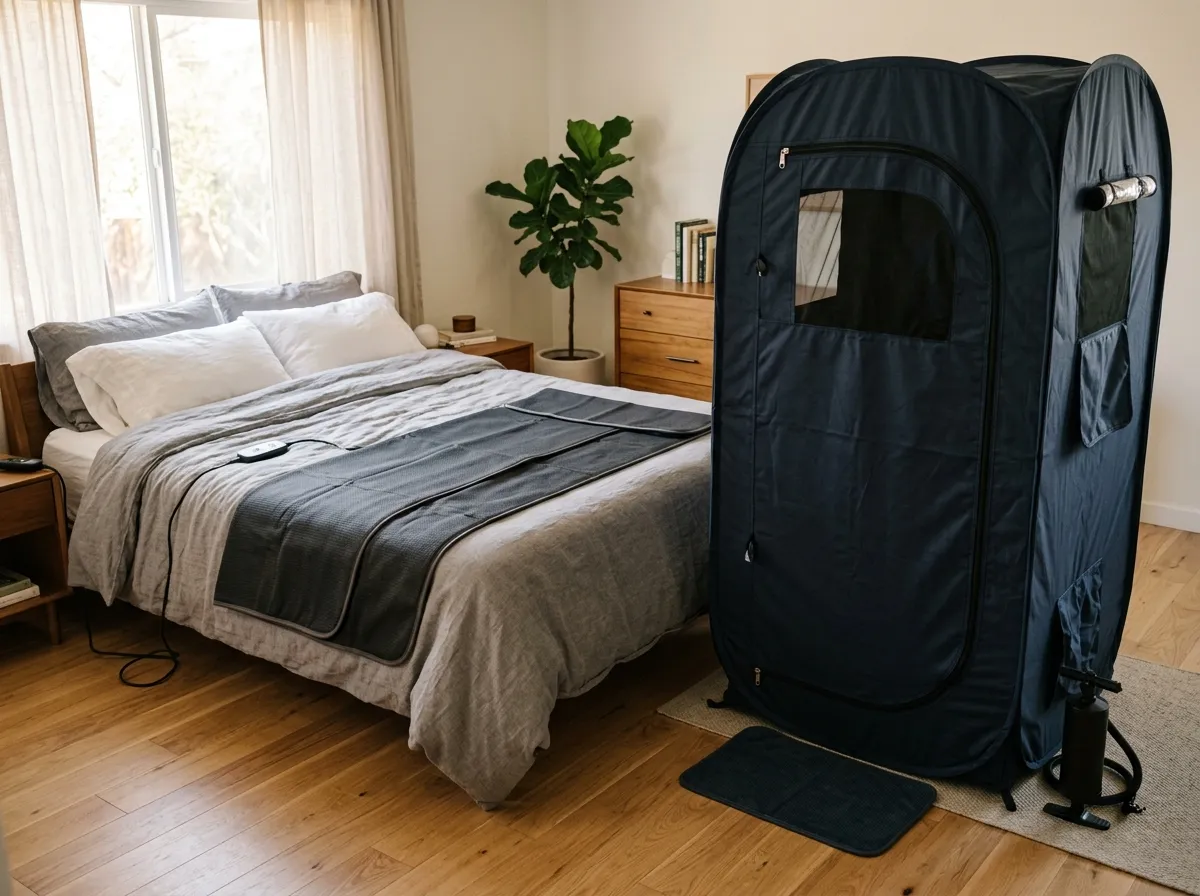
Get a sauna blanket if you want the most compact, affordable, apartment-friendly option with the safest materials (PU leather instead of PVC). Get a portable tent sauna if you want more freedom of movement, higher potential temperatures, and a more traditional sauna experience. The biggest material safety concern: most portable tent saunas use PVC fabric, which off-gasses phthalates when heated.
All products were assessed using our standard criteria: ingredient lists, available testing data, and verified certifications. Our testing methodology page covers the full process. You’ve decided you want an at-home sauna. Good. The health benefits of regular sauna use are well-documented, from cardiovascular health to stress reduction to muscle recovery. But now you’re stuck choosing between two very different form factors, and the decision involves more than just preference. The materials, the EMF profiles, and the chemical exposures are different between these options, and nobody seems to talk about it.
Here’s the full comparison, with the non-toxic angle front and center.
Quick Comparison: Sauna Blankets vs Portable Saunas
| Feature | Sauna Blanket | Portable Tent Sauna |
|---|---|---|
| Price Range | $299-$599 | $150-$500 |
| Max Temperature | 150-165°F | 140-170°F |
| Heat Type | Far infrared (body contact) | Far infrared (panels) or steam |
| Common Material | PU leather (quality brands) | PVC or polyester tent fabric |
| EMF Exposure | Direct contact, 2-12 mG | Lower body contact, varies |
| Setup Time | 2 minutes | 5-15 minutes |
| Storage | Folds flat, closet-friendly | Bulkier, needs more space |
| Movement | Very limited (lying down) | Arms free, can sit and move |
| Sweat Volume | Heavy | Heavy to very heavy |
| Apartment-Friendly | Excellent | Good to moderate |
| Steam Option | No | Yes (some models) |
| Head Exposure | Head stays out | Head stays out (most models) |
How Each One Works
Sauna Blankets
A sauna blanket is essentially an infrared sleeping bag. You lie flat inside it, zip it up to your neck (head stays out), and far infrared heating elements built into the blanket heat your body directly. The infrared wavelengths penetrate your skin and warm you from the inside, similar to how sunlight feels but without UV radiation.
The experience is cocoon-like. Your body is fully enclosed. Arms are at your sides or crossed on your chest. Movement is minimal. You sweat heavily because the blanket traps both the infrared heat and your body heat, creating a very efficient sweating environment.
For specific product recommendations, see our best sauna blankets guide.
Portable Tent Saunas
A portable tent sauna is a collapsible enclosure (usually a small tent or box) that you sit inside on a folding chair. Some models use far infrared panels inside the tent walls. Others use a steam generator that pipes steam into the enclosure. Your head sticks out through an opening at the top.
The experience is more like sitting in a traditional sauna. Your arms are free. You can read, scroll your phone, or stretch. The heat surrounds you rather than pressing directly against your skin. Steam models add humidity, which changes the sweating dynamic significantly.
Material Safety: This Is Where It Gets Serious
Here’s the angle that most comparison articles ignore completely, and it’s arguably the most important factor for anyone on a non-toxic living site.
Sauna Blankets: PU Leather Is the Standard (at Quality Price Points)
The sauna blankets we recommend (HigherDOSE, MiHIGH, Sun Home) use PU (polyurethane) leather. PU leather doesn’t require phthalate plasticizers, doesn’t produce chlorine-based off-gassing when heated, and is one of the safer synthetic options for a heated application.
Budget sauna blankets (under $200 on Amazon) often use PVC. Avoid them. At $299+, most reputable brands have moved to PU leather. Read our HigherDOSE review and HigherDOSE vs MiHIGH comparison for specific material breakdowns.
Portable Tent Saunas: The PVC Problem Is Everywhere
This is where portable tent saunas fall behind badly from a material safety perspective. The vast majority of portable tent saunas on the market use PVC fabric for their tent enclosure. Even many of the popular, well-reviewed models use PVC.
Why is this a problem? PVC (polyvinyl chloride) requires plasticizers to stay flexible, and those plasticizers are almost always phthalates. When you heat PVC to sauna temperatures (140-170°F), those phthalates off-gas into the enclosed air you’re breathing and onto the skin you’re sweating through.
Phthalates are established endocrine disruptors. They interfere with hormone function and have been linked to reproductive issues, thyroid disruption, and metabolic problems in published research. Heating PVC dramatically accelerates the off-gassing rate. You’re essentially creating a warm chemical chamber and sitting inside it for 30-45 minutes with open pores.
To understand more about why these chemicals are concerning, read our guides on what are VOCs and what are phthalates.
Finding Non-PVC Portable Saunas
They exist, but they’re harder to find and more expensive. Some premium portable saunas use polyester or nylon tent fabric, which avoids the PVC problem. Others use cotton-lined interiors. The key is to check the material specifications before buying. If the listing says “waterproof fabric” or “durable tent material” without specifying the actual material, it’s probably PVC.
Non-PVC portable saunas typically cost $350-500+, which narrows the price gap with sauna blankets significantly. At that price point, the material safety advantage that portable saunas might have had over blankets evaporates.
What About PFAS?
Some tent fabrics are treated with water-resistant or stain-resistant coatings that could contain PFAS. This is harder to verify because manufacturers rarely disclose coating details. If a portable sauna advertises “water-resistant” or “easy-clean” fabric, ask about PFAS specifically. Our guide on what PFAS forever chemicals are explains why this matters.
Heat Performance
Temperature Range
Sauna blankets: 100-165°F depending on the brand and model. HigherDOSE tops out at 158°F. Sun Home reaches 165°F. Because the heating elements are in direct contact with your body, the effective heat feels higher than the stated temperature.
Portable tent saunas: 140-170°F for infrared models. Steam models can feel hotter due to humidity but actual air temperature is often lower. Because the heat surrounds you rather than pressing against you, you may need higher temperatures to achieve the same sweat volume.
Heat Distribution
Sauna blankets: Even across your torso, slightly cooler at extremities. The V4 generation of most brands has improved this. Your body heats from the outside in through direct infrared contact.
Portable tent saunas: Heat rises, so the upper body gets warmer than the lower body in most tent designs. Infrared panel placement varies by model. Some have panels on all sides for more even distribution. Others concentrate panels on the back panel only.
Sweat Volume
Both produce heavy sweating at higher settings. In my experience, sauna blankets produce slightly more sweat per minute at equivalent temperature settings because the infrared is in direct contact with skin over more body surface area. Portable saunas produce more gradual, even sweating. Steam-based portable saunas produce the heaviest sweating due to humidity preventing sweat evaporation.
EMF Exposure
Sauna Blankets
EMF exposure is higher in sauna blankets because the heating elements are pressed directly against your body. Quality blankets (HigherDOSE, MiHIGH) test at 2-8 mG at body contact. Budget blankets can exceed 12 mG. Because you’re in direct contact for the full session, total EMF exposure is significant relative to other home devices.
Portable Tent Saunas
EMF exposure depends on design. Infrared panel models produce EMF from the panels, but since there’s typically 6-12 inches between you and the panels (you’re sitting in the middle), the actual exposure at body level is often lower than a sauna blanket pressed against your skin. Steam models produce minimal EMF since the heating element is in the steam generator, typically located outside the tent.
EMF advantage: Portable tent saunas, especially steam models. If EMF is your primary concern and you want the lowest possible exposure during sauna sessions, a steam-based portable sauna with a non-PVC tent is the safest option. But remember the material trade-off: you need to verify the tent fabric isn’t PVC.
For broader context on EMF and environmental exposures in your home, see our indoor air quality complete guide.
Comfort and Experience
Sauna Blankets
Pros: Simple. Lie down, zip up, sweat. No assembly. Very compact. You can watch TV or use your phone (though it gets sweaty).
Cons: Claustrophobic for some people. Arms are confined. Can’t easily change position. The PU leather gets clammy against skin (use a cotton insert). Lying flat for 45 minutes isn’t comfortable for everyone, especially people with back issues.
Portable Tent Saunas
Pros: Arms are free. You can read, stretch, scroll your phone comfortably. More natural seated position. Feels more like a “real” sauna experience. Head stays out, which some people strongly prefer.
Cons: Setup takes longer (5-15 minutes for tent assembly vs. 2 minutes to unroll a blanket). Takes up more floor space during use. The folding chair can be uncomfortable for extended sessions. Steam models create humidity that needs ventilation.
Apartment and Small Space Considerations
Sauna Blankets: Excellent for Apartments
Sauna blankets are the clear winner for small spaces. They fold flat and fit in a closet. They don’t produce steam or excess humidity. They draw modest electricity (comparable to a space heater). Setup is rolling it out on a bed or floor. No structural modifications needed. No ventilation requirements beyond a standard room with a window.
For a deep look at the best apartment-friendly option, see our HigherDOSE sauna blanket review.
Portable Tent Saunas: Good, With Caveats
Portable tent saunas need more floor space during use (typically 3x3 feet minimum) and storage space when collapsed (they don’t fold as flat as blankets). Steam models require ventilation because the humidity needs somewhere to go. In a bathroom, this is fine. In a bedroom with carpet, it can cause moisture issues.
Infrared tent models are more apartment-friendly than steam models because they don’t produce humidity. But they still need more space than a blanket.
Price Comparison
Sauna Blankets
- Budget (PU leather): $299-$399 (Hooga, MiHIGH)
- Mid-range: $499 (Sun Home)
- Premium: $599 (HigherDOSE V4)
Portable Tent Saunas
- Budget (often PVC): $150-$250
- Mid-range (mixed materials): $250-$400
- Premium (non-PVC): $400-$500+
The cheapest portable saunas undercut sauna blankets on price, but those cheap models are almost universally PVC. Once you filter for non-PVC materials, the price ranges overlap significantly.
Ongoing Costs
Sauna blankets have no consumable costs. Just electricity and occasional cleaning supplies.
Steam-based portable saunas need water and may need descaling if you have hard water. Some require replacement steam generators after 1-2 years.
Infrared portable saunas have no consumable costs, similar to blankets.
Durability
Sauna Blankets
The PU leather exterior is the weak point. With regular use (3-4x/week), expect 2-3 years from a quality brand before the leather starts showing meaningful wear. The heating elements typically outlast the leather.
Portable Tent Saunas
The tent fabric (whether PVC or polyester) degrades over time, especially with repeated heating and cooling cycles. Zippers are a common failure point. The folding chair can break. Steam generators have a limited lifespan. Overall, expect 1.5-3 years of regular use, with steam components being the first to need replacement.
The Verdict: Who Should Buy What
Buy a Sauna Blanket if:
- You live in an apartment or have limited space
- Material safety is your top priority (PU leather avoids PVC concerns)
- You want the simplest possible setup and cleanup
- Compact storage matters
- You don’t mind lying flat for your sessions
- You want a specific, well-tested product with known EMF readings
Best pick: HigherDOSE V4 for lowest EMF, or MiHIGH for best value.
Buy a Portable Tent Sauna if:
- You want freedom of movement during sessions (arms free, seated position)
- You prefer higher temperatures
- You can find a non-PVC model (check materials carefully)
- You have space for setup and storage
- You prefer the steam sauna experience (steam models)
- EMF minimization is a priority (steam models have the lowest EMF of any home sauna option)
Important caveat: Only buy a portable sauna with non-PVC tent fabric. The health purpose of sauna use is undermined by sitting inside a heated PVC chamber for 30-45 minutes.
Skip Both and Save for an Infrared Sauna Cabinet if:
- You have dedicated space (closet or corner of a room)
- You want the closest experience to a commercial infrared sauna
- Budget allows $1,500-4,000+
- Long-term value matters more than upfront cost
Combining With Red Light Therapy
Whether you choose a blanket or a tent, many people pair their sauna sessions with red light therapy panels. The two modalities complement each other. Infrared heat works through sweating and tissue warming. Red light works through photobiomodulation at specific wavelengths. Use them sequentially for combined benefits. Check out our Mito Red vs PlatinumLED vs Vellgus comparison if you’re shopping for panels, and our guide on whether red light therapy is safe for the evidence-based safety picture.
Reader Questions
Which produces more sweat, a sauna blanket or a portable sauna?
At similar temperatures, sauna blankets typically produce slightly more sweat per minute because the infrared is in direct contact with skin across a large body surface area. Steam-based portable saunas can match or exceed this due to humidity preventing sweat evaporation, but infrared tent models generally produce less sweat than blankets at the same temperature setting.
Are portable saunas better for detoxification?
Sweating is sweating, regardless of the device. Research from the Journal of Environmental and Public Health found trace amounts of heavy metals and environmental chemicals in sweat. The quantity eliminated through sweating is small compared to what your liver and kidneys process. Neither form factor has a meaningful advantage in terms of detoxification. The bigger variable is session temperature, duration, and your hydration level.
Can I use a portable sauna in my bathroom?
Yes, and bathrooms are actually ideal for steam-based portable saunas because they have ventilation fans and tile floors that handle moisture well. Infrared tent saunas work fine in bathrooms too. Just make sure the electrical outlet isn’t near water sources, and use a GFCI outlet.
How much electricity do sauna blankets and portable saunas use?
Sauna blankets draw 300-600 watts, similar to a small space heater. Portable infrared saunas draw 800-1500 watts. Steam generators for portable steam saunas draw 800-1000 watts. At average US electricity costs, a 45-minute session costs $0.02-0.08. Negligible.
Do sauna blankets or portable saunas require maintenance?
Sauna blankets need wiping after every session and occasional deeper cleaning. Portable tent saunas need the tent fabric wiped down, the chair cleaned, and (for steam models) the generator descaled periodically. Neither requires significant maintenance, but blankets are slightly simpler because there are fewer components.
Is one form factor safer than the other overall?
From a material safety standpoint, a quality PU leather sauna blanket (HigherDOSE, MiHIGH) is safer than most portable tent saunas because the tent sauna market is dominated by PVC fabric. From an EMF standpoint, portable saunas (especially steam models) tend to be lower because the heating elements aren’t in direct body contact. The “safest” option is a non-PVC portable tent sauna with steam heat, but those are harder to find. The easiest safe option is a quality PU leather sauna blanket from a reputable brand.
Making Your Home Sauna Part of a Non-Toxic Lifestyle
Whichever form factor you choose, it fits into a broader approach to reducing chemical exposures at home. Start with the foundations: clean air (best air purifiers), safe sleeping environment (non-toxic bedroom guide, best non-toxic mattresses), and awareness of common household chemicals (how to detox your home). The complete guide to non-toxic living ties it all together.
A sauna or sauna blanket is a nice addition to a healthy home. But it shouldn’t be the first thing you invest in. Clean your air first. Fix your sleep environment. Then add the sauna.
You Might Also Like
- Best Budget Infrared Saunas That Are Actually Safe
- HigherDOSE Infrared Sauna Review
- Mito Red Light Panel Review
Sources
- Laukkanen, T., et al. (2015). Association between sauna bathing and fatal cardiovascular and all-cause mortality events. JAMA Internal Medicine, 175(4), 542-548.
- Hussain, J., & Cohen, M. (2018). Clinical effects of regular dry sauna bathing: a systematic review. Evidence-Based Complementary and Alternative Medicine.
- Genuis, S. J., et al. (2011). Blood, urine, and sweat study. Archives of Environmental Contamination and Toxicology.
- EPA guidelines on PVC off-gassing and phthalate exposure.
- Building Biology Institute. EMF exposure guidelines and measurement standards.
- Vatansever, F., & Hamblin, M. R. (2012). Far infrared radiation (FIR): its biological effects and medical applications. Photonics & Lasers in Medicine, 1(4), 255-266.
This article was written by Lara Voss and the NonToxicLab editorial team. We research non-toxic home and wellness products so you can make informed choices. This post contains affiliate links, which means we may earn a commission if you make a purchase through our links, at no additional cost to you. We only recommend products we’ve thoroughly researched and believe meet our safety standards.