

If you’ve ever driven past a fire-training facility, an airport, or a military base, you may have driven past a PFAS plume. That’s the uncomfortable reality behind Tyco’s roughly $750 million settlement, reported in April 2026, over decades of aqueous film-forming foam (AFFF) production.
The settlement isn’t a verdict on whether PFAS in firefighting foam was the right tool for the job historically. It’s a verdict on what happens when those foams seep into groundwater, travel into municipal supplies, and end up in the kettles of people who never set foot on a fire-training site.
Key Takeaways
- Tyco’s April 2026 settlement is one of the largest PFAS firefighting foam payouts to date, on the order of $750 million.
- AFFF foam relied on PFAS for decades because the chemicals reduce surface tension and let water spread fast on burning fuel.
- The contamination follows a predictable pattern: groundwater plumes downstream of fire-training sites and military bases.
- For most readers, the practical question isn’t the lawsuit itself; it’s whether their tap water carries the residue.
- A reverse-osmosis system or an NSF P473 / NSF 53-certified filter is the most reliable way to remove what’s already in the line.
This article is for informational purposes only and is not medical or legal advice. Consult a qualified professional for guidance specific to your situation.
Who Tyco Is
Tyco International was a diversified industrial manufacturer founded in 1960 and headquartered in Princeton, New Jersey. Fire Protection was one of its three main business segments, run through a subsidiary called Tyco Fire Products LP. That subsidiary owned the Ansul brand, the company that pioneered aqueous film-forming foam (AFFF) for petroleum fires and manufactured it for decades at a plant in Marinette, Wisconsin.
In September 2016, Tyco merged with Johnson Controls. The combined company became Johnson Controls International plc, the successor that now owns the Tyco Fire Products business and is the entity actually paying out the settlement. When you see “Tyco” in 2026 news headlines, the legal defendant is technically Tyco Fire Products LP, a Johnson Controls subsidiary.
Where the Foam Was Made and Used
Tyco produced AFFF foam at a 380-acre fire-technology center in Marinette, Wisconsin, the former Ansul site near the western shore of Green Bay. Decades of foam production, training burns, and on-site testing concentrated the heaviest contamination in this corner of northeastern Wisconsin. The communities most directly affected include:
- Marinette and Peshtigo, Wisconsin. Testing of private drinking-water wells in the Town of Peshtigo found PFAS above the EPA’s then-applicable 70 parts-per-trillion advisory level. Wisconsin DNR records show four ditch samples at the training center between 417 and 4,620 ppt in June 2018, with PFAS entering Green Bay through ditches and groundwater.
- Roughly 3,500 acres of Marinette County farmland. From 1997 to 2017, the Marinette wastewater plant accepted PFAS-laden runoff from the Tyco plant and sold the resulting bio-sludge to local farmers as fertilizer. The PFAS spread with the sludge.
- Wisconsin state action. In June 2019, the Wisconsin DNR referred Johnson Controls to the state Department of Justice for waiting four years to report hazardous releases. A separate Wisconsin-specific settlement on the order of 17.5 million dollars followed.
The foam itself was used far beyond Wisconsin. Tyco supplied AFFF to commercial airports (FAA Part 139 facilities were required to keep AFFF on hand for jet-fuel fires), U.S. military bases, oil refineries, chemical plants, shipyards, and municipal fire-training academies across all 50 states. The April 2026 settlement covers contamination claims from water utilities nationwide, not just the Marinette plume.
The list of impacted utilities is too long to enumerate here, roughly 6,000+ public water systems have been sampled under UCMR-5, and detections cluster around AFFF use sites in every state. The fastest way to check your own area is the EPA’s official lookup tool: EPA UCMR-5 Data Finder. Filter by state, public water system name, or PWS ID, then check whether any PFAS compound came back at or above the minimum reporting level.
What Tyco Settled
Tyco’s settlement covers claims tied to the production and sale of aqueous film-forming foam, the standard firefighting product for petroleum-based fuel fires from the late 1960s through the 2010s. The chemistry that made AFFF work, perfluoroalkyl substances, also made it persistent. The same property that lets PFAS spread evenly across burning fuel lets it spread evenly through soil and water.
According to NonToxicLab’s tracking of state-level enforcement actions, AFFF-related PFAS settlements have now passed several billion dollars cumulatively across all manufacturers. The Tyco figure is one piece of a larger reckoning that includes 3M, DuPont, and other suppliers. The Environmental Working Group has documented that an estimated 176 million Americans now drink tap water with detectable PFAS, a number that grew by roughly four million people in the latest EPA UCMR-5 cycle (EWG, 2026) [biomonitoring].
The settlement money is meant to fund water-system cleanup at impacted utilities and reimburse municipalities that have already paid out of pocket. It does not, by itself, remove PFAS from anyone’s tap.
Why Firefighting Foam Carried PFAS for So Long
AFFF works by lowering the surface tension of water enough that it forms a film on top of burning hydrocarbons, smothering oxygen and cooling the fuel. PFAS were the only chemical class that did this reliably at fire-suppression temperatures. There was a real engineering reason the foam was used; firefighters credit it with saving lives during shipboard and aircraft fires.
The trade-off was that PFAS don’t break down. The carbon-fluorine bond is one of the strongest in organic chemistry, which is why the EPA classifies PFAS as “forever chemicals” (EPA PFAS Overview). Every gallon of foam used in training, in firefighting, or in periodic equipment tests left a residue that wasn’t going anywhere.
Modern fluorine-free foams now exist, and military and civilian fire services are transitioning. Maine and several other states have moved to ban PFAS-containing foam outright. But the ground under decades of training facilities is what we’re stuck with.
How This Affects Home Water
The contamination pattern from AFFF is well-characterized. PFAS leach from the application site into shallow groundwater, then travel downhill through aquifers until they intersect a drinking-water well or a surface intake.
If you live within a few miles of any of the following, your local utility likely has elevated PFAS readings on file:
- A current or former military base that conducted fire-training drills
- A commercial airport with a foam-equipped fire crash truck
- A municipal fire-training academy
- A petrochemical or fuel-storage facility
The EPA’s UCMR-5 dataset, released in March 2026, expanded the list of public water systems with detectable PFAS. Roughly 176 million people, more than half the US population, are now on a system where at least one PFAS compound has tested above the detection limit at some point [biomonitoring]. The number doesn’t mean every tap is unsafe; it means the chemistry is widespread enough that “is my water clean” is a question worth asking, not an assumption worth making.
A simple way to find out: search the EPA UCMR-5 Data Finder by state or utility name, or pull your utility’s most recent Consumer Confidence Report. If PFOA, PFOS, GenX, PFHxS, or PFNA appears at any level, that’s your answer.
What the Research Says About PFAS Exposure
The mechanism by which PFAS affect human health is the area where calibration matters most. The chemistry is unambiguous, the toxicology is real, but the dose-response math at typical drinking-water concentrations is not as definitive as headlines often suggest.
What’s well-supported:
- PFAS are bioaccumulative; biomonitoring shows measurable blood levels in roughly 98% of US adults (CDC NHANES, 2025) [biomonitoring].
- PFOA exposure has been linked, in human epidemiological studies, to elevated cholesterol, kidney and testicular cancer, thyroid disruption, and immune-system effects (EPA, 2024) [human epidemiological].
- Recent work in adolescents has linked PFHpA exposure to elevated risk of metabolic-associated steatotic liver disease (MASLD), with each doubling of PFOA associated with roughly 2.7x higher odds of fatty liver in an adolescent cohort (Baumert et al., Communications Medicine, October 2025) [human cohort + 3D liver model].
- Dr. Leonardo Trasande at NYU Langone and Dr. Philip Landrigan at Boston College have both published on the intergenerational costs of EDC exposure, with Trasande’s lab estimating PFAS-attributable disease costs in the hundreds of billions of dollars annually [regulatory review].
What we don’t know yet, and where long-term data is limited:
- Whether typical home-tap exposure (parts per trillion range) drives clinically meaningful health outcomes at the individual level, versus the population level. Evidence is mixed and the dose-response curve at low concentrations is still being characterized.
- Whether the newer GenX and PFHxA replacements behave differently than legacy PFOA/PFOS in long-term studies; long-term data is limited and human relevance is not yet established for several of the newer compounds.
- Whether PFAS removal via filtration translates to measurable serum-level reduction over months to years (the half-lives are years, so the answer is “eventually, yes” but the curve isn’t fully mapped).
A quick note on what GenX and PFHxA actually are, since both keep appearing on UCMR-5 results and confuse a lot of readers:
-
GenX is the trade name Chemours (a DuPont spin-off) uses for HFPO-DA, an ammonium salt of hexafluoropropylene oxide dimer acid. It’s a short-chain ether-based PFAS that industry adopted around 2009 to replace PFOA in the production of fluoropolymers like Teflon and Gore-Tex. Marketed as more sustainable than PFOA, but EPA later set a final lifetime drinking-water health advisory of 10 parts per trillion for GenX in June 2022 [regulatory review]. The Chemours plant at Fayetteville, North Carolina is the main source of the Cape Fear River GenX contamination affecting Wilmington and the surrounding counties.
-
PFHxA (perfluorohexanoic acid) is a six-carbon PFAS, two carbons shorter than the eight-carbon PFOA it replaced. It shows up in newer AFFF formulations, stain-resistant carpets and clothing, food-contact paper, and waterproofing sprays. The shorter chain was sold as a safety improvement because PFHxA clears the human body faster, but it is equally persistent in the environment and in drinking water. The EU restricted most non-essential uses under Commission Regulation (EU) 2024/2462, with firefighting foam restrictions taking effect April 2026 and consumer textile restrictions phasing in through October 2027 [regulatory review]. The US has no equivalent federal restriction in place yet.
Both are “second-generation” PFAS, often called “replacement” or “GenX-class” compounds. They share the same carbon-fluorine backbone that gives all PFAS their “forever chemicals” persistence. The shorter chain length changes how the body handles them, not whether they break down in water. Human cohort data on long-term outcomes for both compounds is still thin compared to the legacy PFOA/PFOS literature.
For most readers, exposure levels are probably modest under normal use, though reducing chronic intake where the cost is reasonable is a defensible precaution. The “100% safe” and “everyone is poisoned” framings are both wrong. The honest answer is that PFAS in tap water is a real exposure with real but modest individual risk, and a $35 pitcher closes most of it.
What to Actually Do at Home
The technical landscape for PFAS removal at the household level is clearer than the toxicology. Three filter classes work; one common class doesn’t.
| Filter type | PFAS removal | Notes |
|---|---|---|
| Reverse osmosis | Excellent (typically non-detect) | Best evidence; what we use |
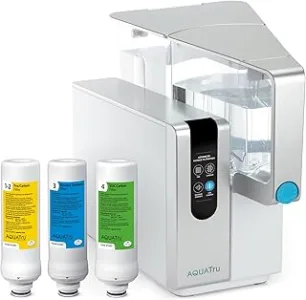
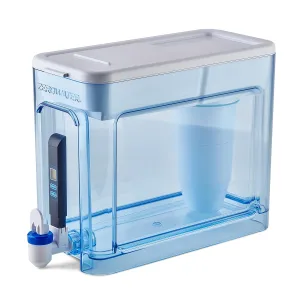
| NSF P473-certified pitcher | High (95-99% per testing) | Right for most renters and apartments |
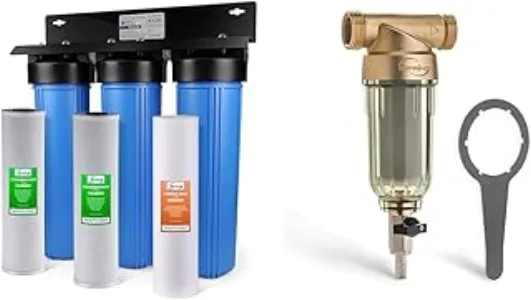
| Whole-house carbon block | Moderate to high | Best when the well is impacted |
| Standard activated carbon (Brita-style) | Low | Don’t rely on this for PFAS |
For most readers without an immediate plumbing project, an NSF-certified pitcher gets you 95% of the way for $35-$75. The countertop RO option doubles down on certainty without requiring any installation. Whole-house systems are the right call if you’re on a well downstream of an AFFF-impacted site, where the contamination touches every faucet and showerhead, not just the kitchen tap.
If you’ve recently learned your utility shows detectable PFAS, the most useful next step is to install something today and verify with a water test in 30 days. SimpleLab’s Tap Score kit is widely used for thorough at-home PFAS testing; the EPA’s certified-laboratory list is the right next step if you want regulatory-grade confirmation.
What We’d Pick
If we were starting from zero today, with no plumber budget and a utility that just released a Consumer Confidence Report showing detectable PFOA, we’d buy the AquaTru countertop. It removes to non-detect, doesn’t need installation, and the certifications cover every PFAS subclass we worry about. If the upfront price is the problem, the ZeroWater pitcher is the cheapest defensible option in the category and EWG testing showed 100% removal in their evaluation.
The bigger picture: the Tyco settlement is one piece of a multi-decade cleanup that will play out over the next ten to fifteen years. The legal system is doing its work; you don’t have to wait for it to do yours.
FAQ
Is firefighting foam PFAS still being made?
Production of legacy AFFF (with long-chain PFOA/PFOS) has largely been discontinued at major manufacturers. Some short-chain PFAS-based foams remain in use, but the industry is transitioning to fluorine-free foams. The contamination already in the ground from decades of use is the longer-term problem, not new application.
Will the Tyco settlement money pay for my home filter?
No. Settlement money flows to impacted public water utilities and municipalities, not directly to households. If your utility receives funds and uses them to upgrade treatment, that benefit reaches your tap eventually. In the meantime, household-level filtration is the path that’s actually under your control.
Does boiling water remove PFAS?
No, and it can concentrate them slightly because water evaporates while PFAS don’t. Treat boiling as ineffective for forever chemicals. The same goes for letting water sit out, freezing, or running it through cheesecloth or a standard activated-carbon pitcher.
How do I find out if my city has PFAS in the water?
Pull your utility’s most recent Consumer Confidence Report (every US public water system publishes one annually) and search for any of: PFOA, PFOS, GenX, PFHxS, PFHxA, PFNA, PFBA. The EPA UCMR-5 Data Finder is the official public lookup, filter by state or utility name to see whether PFAS was detected on your system.
Are private wells more at risk than city water?
Often, yes, particularly within a few miles of a former AFFF-use site. Private wells aren’t subject to monitoring requirements, so the only way to know is to test. If you’re on a well within proximity to a military base, airport, or fire-training facility, a baseline PFAS test is worth the cost.
How long does it take for a filter to actually drop my body’s PFAS levels?
Years. PFAS half-lives in human serum range from roughly 2 to 8 years depending on the specific compound. Filtering tap water reduces ongoing intake immediately, but the levels already in your blood take time to clear. The reduction curve is gradual, not instant, which is the honest answer most articles skip.
Sources
- Environmental Working Group, “New data shows 176M exposed to forever chemicals as Trump EPA rolls back protections” (March 2026). https://www.ewg.org/news-insights/news-release/2026/03/new-data-shows-176m-exposed-forever-chemicals-trump-epa-rolls
- U.S. Environmental Protection Agency, “Our Current Understanding of the Human Health and Environmental Risks of PFAS.” https://www.epa.gov/pfas/our-current-understanding-human-health-and-environmental-risks-pfas
- CDC National Health and Nutrition Examination Survey biomonitoring data, latest cycle. https://www.cdc.gov/exposurereport/
- Baumert et al., “Per- and polyfluoroalkyl substances and metabolic dysfunction-associated steatotic liver disease in adolescents,” Communications Medicine (October 29, 2025). https://www.nature.com/articles/s43856-025-01168-z
- Dr. Leonardo Trasande, NYU Langone faculty page. https://med.nyu.edu/faculty/leonardo-trasande