Your bedroom is the room where air quality matters most. You spend roughly a third of your life there, mostly with the door closed and windows shut, breathing the same recirculated air for 7-9 hours straight. That is a long, sustained exposure to whatever pollutants are present in that room.
Our evaluation process: We cross-referenced each product against EWG databases, confirmed active certifications with issuing organizations, and reviewed available test reports. See our methodology Adding the right plants to your bedroom can provide supplemental air filtering, humidity regulation, and stress reduction. But the “right” plants matter here more than in other rooms. Bedrooms tend to have less natural light (curtains drawn, north-facing windows, small windows). They also need plants that work with your sleep cycle rather than against it.
I want to be upfront about something: plants alone will not purify your bedroom air in any meaningful way. The NASA Clean Air Study used sealed chambers, not real rooms. Dr. Michael Waring’s 2019 meta-analysis found that you would need hundreds of plants per room to match basic mechanical ventilation. If bedroom air quality is a real concern for you, an air purifier and proper ventilation are the first steps. An air quality monitor will tell you what you are actually breathing.
That said, NonToxicLab recommends bedroom plants for real benefits beyond the overhyped air purification angle. Some plants release oxygen at night (when most plants do the opposite). Some add meaningful humidity to dry bedroom air. And research consistently shows that plants reduce stress and improve psychological well-being, both of which support better sleep.
Here are the best plants for bedrooms, selected specifically for low-light tolerance, nighttime oxygen production, humidity benefits, and practical bedroom compatibility.
How Plants and Sleep Interact
Most plants photosynthesize during the day (absorbing CO2 and releasing oxygen) and then reverse the process at night (absorbing oxygen and releasing CO2). This has led to a persistent myth that bedroom plants “steal your oxygen” while you sleep. The amount of oxygen a plant consumes at night is so tiny that it is physiologically irrelevant. You would need thousands of plants in a sealed room before their nighttime oxygen consumption would measurably affect the air you breathe.
However, a small group of plants use a different type of photosynthesis called Crassulacean Acid Metabolism (CAM). CAM plants open their stomata (the tiny pores on their leaves) at night instead of during the day, which means they absorb CO2 and release oxygen after dark. For bedroom use, these CAM plants have a slight edge because they are actively adding oxygen to your air during the hours you are asleep.
Dr. B.C. Wolverton, who led the original NASA Clean Air Study, specifically recommended CAM plants like snake plants and aloe vera for bedrooms because of this nighttime oxygen release pattern.
Humidity and Sleep Quality
Indoor humidity drops significantly during winter months when heating systems run. Dry bedroom air (below 30% relative humidity) contributes to dry throat, nasal congestion, cracked lips, and disrupted sleep. The National Sleep Foundation has noted that maintaining humidity between 30-50% supports better sleep quality.
Plants release moisture through transpiration. A few well-placed plants can raise bedroom humidity by 5-10%, which is enough to make a noticeable difference in dry conditions. This does not replace a humidifier in severely dry climates, but it provides a gentle, passive moisture contribution.
The 8 Best Bedroom Plants
1. Snake Plant (Sansevieria trifasciata)
Light needs: Low to bright indirect (truly thrives in near-darkness) Nighttime oxygen: Yes (CAM plant) Humidity contribution: Low Pet safe: No (mildly toxic to cats and dogs if ingested) Best placement: Nightstand, floor corner, dresser top
The snake plant is the single best bedroom plant. Full stop. It tolerates the low light conditions common in bedrooms, it requires watering only every 2-3 weeks, and it is a CAM plant that releases oxygen at night while absorbing CO2.
In the NASA study, snake plants showed strong formaldehyde absorption. This is relevant for bedrooms because mattresses (especially memory foam), dressers made from pressed wood, and even wrinkle-free sheet treatments can release formaldehyde.
A mature snake plant placed near the bed provides nighttime oxygen release and passive formaldehyde absorption. It will not transform your air quality on its own, but as part of a broader bedroom detox strategy (covered in our non-toxic bedroom guide), it is a worthwhile addition.
Care in bedrooms: Snake plants are nearly impossible to kill from neglect. The biggest risk is overwatering, especially in low-light bedrooms where the soil dries slowly. Water only when the soil is completely dry, every 2-4 weeks depending on your room’s humidity and temperature.
2. Peace Lily (Spathiphyllum)
Light needs: Low to moderate indirect (one of the best low-light performers) Nighttime oxygen: No (standard photosynthesis) Humidity contribution: High (excellent transpiration rate) Pet safe: No (toxic to cats and dogs if ingested) Best placement: Dresser, floor (away from direct light), bathroom-adjacent bedroom corner
The peace lily is the best bedroom humidifier plant. Its transpiration rate is among the highest of common houseplants, meaning it releases a lot of moisture into the air. In a dry bedroom during winter, a mature peace lily can noticeably improve humidity levels.
It also targeted the broadest range of pollutants in the NASA study: formaldehyde, benzene, trichloroethylene, ammonia, and xylene. While the practical impact in a real bedroom is modest, a peace lily addresses multiple pollutant categories simultaneously.
Peace lilies are dramatic. When they need water, they droop visibly. This is actually helpful in a bedroom because you will notice it immediately and know exactly when to water. They recover within hours of a good drink.
Care in bedrooms: Water when the top inch of soil is dry or when the plant droops slightly. Keep away from heating vents (dry air stresses them). Their white flowers can produce a small amount of pollen, so if you have severe pollen allergies, consider removing flowers as they appear or choosing a different plant.
3. Pothos (Epipremnum aureum)
Light needs: Low to bright indirect (genuinely thrives in very low light) Nighttime oxygen: No Humidity contribution: Moderate Pet safe: No (toxic to cats and dogs if ingested) Best placement: Hanging from ceiling hooks, trailing from high shelf, on top of bookcase
Pothos is the most versatile bedroom plant for tricky spaces. It grows in almost no light, trails beautifully from elevated surfaces, and requires minimal attention. In low-light bedrooms where other plants struggle, pothos reliably thrives.
For air quality, pothos absorbs formaldehyde and benzene. The trailing growth habit means you can position it at various heights. Hanging pothos near the ceiling helps because many VOCs rise with warm air, and having foliage at different heights creates multiple absorption zones.
The golden pothos variety has yellow-green variegated leaves that add visual brightness to dim bedrooms. The jade pothos (solid green) tolerates the lowest light of any pothos variety.
Care in bedrooms: Water every 1-2 weeks when the top inch of soil dries. Pothos communicates clearly: yellow leaves mean too much water, brown leaf tips mean too little humidity or water. In very low light, growth slows but the plant stays healthy.
4. Spider Plant (Chlorophytum comosum)
Light needs: Bright indirect preferred (tolerates moderate light) Nighttime oxygen: No Humidity contribution: Moderate Pet safe: Yes (non-toxic to cats and dogs) Best placement: Hanging basket near window, high shelf with some natural light
The spider plant is the best bedroom option for pet owners. It is completely non-toxic to cats and dogs, making it safe to keep anywhere in the bedroom regardless of where your pets sleep.
Spider plants were strong formaldehyde removers in the NASA study and are excellent in hanging baskets where they can produce cascading “spiderettes” (baby plants). The main limitation for bedrooms is that spider plants do need some natural light. A bedroom with a decent window, even if not directly sunny, will keep a spider plant happy.
Care in bedrooms: Keep the soil slightly moist but not soggy. Spider plants are sensitive to fluoride and chlorine in tap water, which can cause brown leaf tips. If this happens, switch to filtered water or leave tap water out overnight to let chlorine evaporate. They produce more babies in slightly root-bound conditions, so don’t rush to repot.
5. Aloe Vera
Light needs: Bright indirect to bright direct (needs a sunny window) Nighttime oxygen: Yes (CAM plant) Humidity contribution: Low Pet safe: No (toxic to cats and dogs if ingested) Best placement: Sunny windowsill, south or west-facing window
Aloe vera is the second CAM plant on this list, meaning it releases oxygen at night while absorbing CO2. For bedrooms with a bright window, it is an excellent choice that pairs well with a snake plant (which handles the dark corners).
The NASA study showed aloe vera absorbs formaldehyde and benzene. It also has the practical benefit of producing gel that can be used topically for minor burns or skin irritation.
The limitation is light. Aloe vera genuinely needs a bright spot. A north-facing bedroom without much natural light is not the right home for an aloe plant. It will survive for a while but slowly deteriorate. If your bedroom has a south or west-facing window, put the aloe there.
Care in bedrooms: Water deeply every 2-3 weeks, less in winter. Use a well-draining cactus/succulent soil mix. If the leaves start to flatten or thin, it needs more light. If they turn brown, it is getting too much direct sun (rare indoors but possible on a south-facing windowsill in summer).
6. Dracaena (Dracaena spp.)
Light needs: Low to moderate indirect (varies by species) Nighttime oxygen: No Humidity contribution: Moderate Pet safe: No (toxic to cats and dogs if ingested) Best placement: Floor beside dresser, corner of room, beside bed
Dracaenas are tall, architectural plants that fill vertical space in bedrooms without taking up much floor area. The Dracaena marginata (dragon tree) grows in a tree-like form with thin, red-edged leaves. The Dracaena fragrans (corn plant) has broader, arching leaves. Both tolerate low light well enough for most bedrooms.
In the NASA study, several Dracaena species ranked among the top performers for formaldehyde, benzene, trichloroethylene, and xylene absorption. The “Janet Craig” variety (Dracaena deremensis) was specifically highlighted by Dr. Wolverton as one of the most effective overall air-purifying plants.
For bedrooms with new furniture that may be off-gassing, a large dracaena placed near the furniture provides some supplemental filtration alongside your air purifier.
Care in bedrooms: Water when the top 1-2 inches of soil are dry. Dracaenas are sensitive to fluoride in tap water (brown leaf tips are the telltale sign). Use filtered water if possible. Remove yellowing lower leaves as they age; this is normal and not a sign of poor health.
7. Boston Fern (Nephrolepis exaltata)
Light needs: Bright indirect (no direct sun) Nighttime oxygen: No Humidity contribution: Very high (one of the best natural humidifiers) Pet safe: Yes (non-toxic to cats and dogs) Best placement: Hanging basket near window, bathroom-adjacent bedroom
If dry bedroom air is your primary concern, the Boston fern is the best choice. It has one of the highest transpiration rates of any common houseplant, releasing substantial moisture into the air throughout the day and night. In winter, when heating systems drop indoor humidity to uncomfortable levels, a large Boston fern can meaningfully increase moisture in a bedroom.
Boston ferns are also pet safe, making them a good option for bedrooms where cats or dogs sleep.
The trade-off is maintenance. Boston ferns are more demanding than snake plants or pothos. They need consistent moisture (both in soil and air), and they shed fronds if the air is too dry. If you are willing to mist regularly or keep a pebble tray with water beneath the pot, they reward you with lush, full growth and excellent humidity output.
Care in bedrooms: Keep the soil consistently moist but not waterlogged. Mist the fronds every day or two, especially in dry conditions. Boston ferns prefer temperatures between 60-75 degrees, which lines up well with typical bedroom temperatures. If your bedroom air is very dry (below 30% humidity), a fern may struggle without supplemental misting.
8. Rubber Plant (Ficus elastica)
Light needs: Medium to bright indirect Nighttime oxygen: No Humidity contribution: Moderate Pet safe: No (mildly toxic if ingested) Best placement: Floor beside window, bright corner
The rubber plant earns its bedroom spot through sheer leaf surface area. Its large, glossy leaves have more stomata per plant than small-leafed species, which means more surface area for gas exchange. Research published in the Journal of the American Society for Horticultural Science found rubber plants particularly effective at formaldehyde absorption.
In bedrooms with moderate natural light, a rubber plant placed near a window adds visual drama and a meaningful amount of foliage for passive filtration. The dark green or burgundy varieties are especially attractive in bedroom settings.
Care in bedrooms: Water when the top 2 inches of soil are dry. The most important maintenance task is wiping the large leaves with a damp cloth every few weeks. Dust accumulation on those big surfaces blocks stomata and reduces the plant’s gas exchange ability.
Best Placement Strategy for Bedroom Plants
Where you put plants in your bedroom matters as much as which plants you choose. Here is a strategic approach:
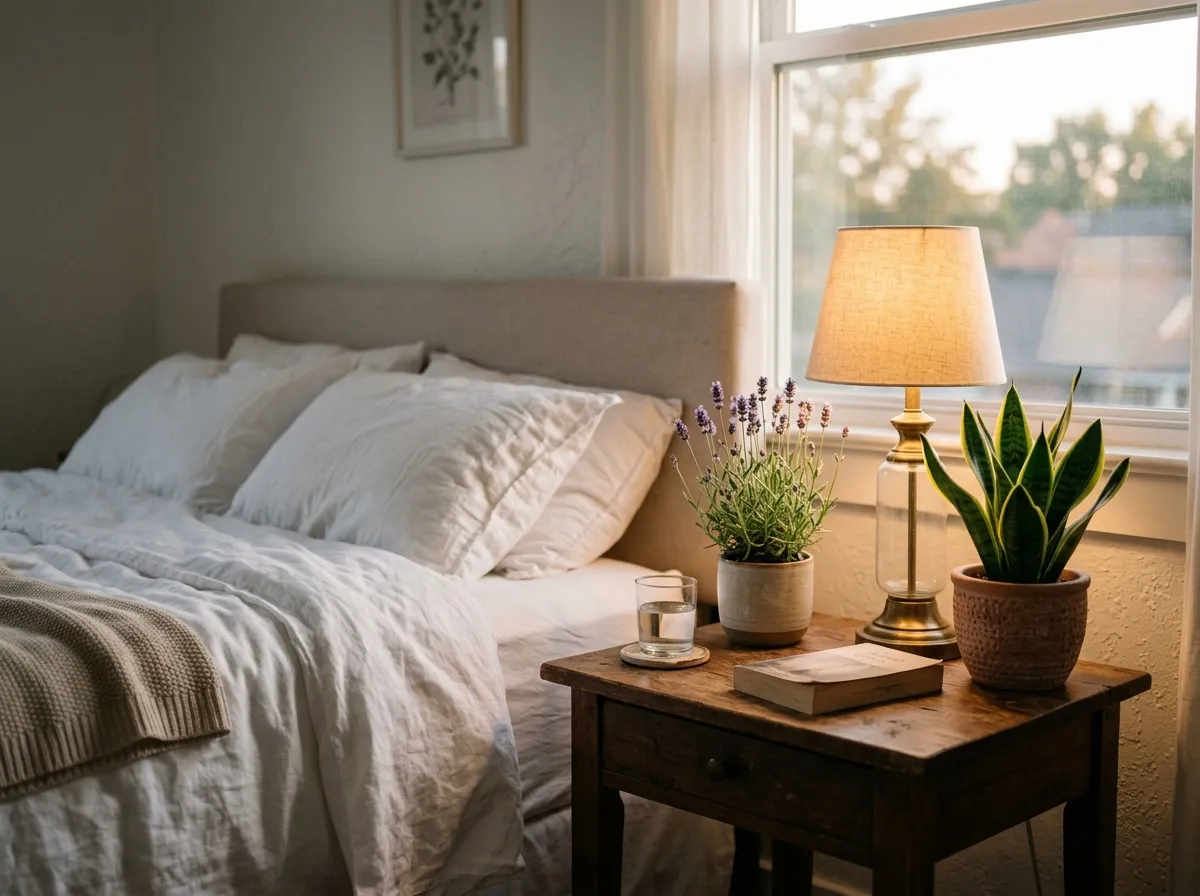
Near the bed (nightstand or floor beside headboard): Place CAM plants here. Snake plants and aloe vera will be releasing oxygen closest to where you are breathing all night.
Near pollution sources (new furniture, dresser, closet): Place formaldehyde-absorbing plants near pressed wood furniture, new mattresses, and closets (where off-gassing from clothes, especially dry-cleaned items, collects). Snake plants, spider plants, and dracaenas are all good here.
Elevated positions (shelves, hanging baskets): Pothos and spider plants trail beautifully from high positions. This also keeps them safely out of reach of pets and children.
Near windows: Light-loving plants (aloe vera, rubber plant) go here. Position them where they get the most natural light but are not in the direct path of heating or cooling vents.
Away from heating vents: Hot, dry air from vents stresses most plants and causes brown leaf edges. Keep all plants at least 3 feet from heating vents, radiators, or forced-air registers.
The Pet Safety Question for Bedrooms
Bedrooms are where pet safety concerns are highest. Many cats and dogs sleep in the bedroom, often on the bed, and have unsupervised access to the room all night. A curious cat chewing on a toxic plant at 3 AM is a real risk.
If your pets sleep in the bedroom, stick to the pet-safe options:
- Spider plant (completely non-toxic, though cats love chewing the grass-like leaves)
- Boston fern (non-toxic, though shedding fronds can be messy)
- Bamboo palm (non-toxic, but needs more light than most bedrooms offer)
If you want to use pet-toxic plants like snake plants or pothos, place them where pets absolutely cannot reach them. High shelves, ceiling-mounted hanging baskets, and closed plant stands with glass doors are options. But honestly, if your cat is a climber (most are), the safest approach is to only keep genuinely non-toxic plants in the bedroom.
The ASPCA’s toxic plant database is the definitive resource. Check any plant before adding it to a room where pets spend unsupervised time.
How Plants Affect Bedroom Humidity
Bedroom humidity has a direct impact on sleep quality and comfort. Here is what different plant choices contribute:
| Plant | Transpiration Rate | Humidity Impact |
|---|---|---|
| Boston Fern | Very High | Noticeable increase (5-10%) |
| Peace Lily | High | Moderate increase (3-7%) |
| Bamboo Palm | High | Moderate increase (3-7%) |
| Spider Plant | Moderate | Slight increase (2-4%) |
| Pothos | Moderate | Slight increase (2-4%) |
| Rubber Plant | Moderate | Slight increase (2-4%) |
| Snake Plant | Low | Minimal increase |
| Aloe Vera | Low | Minimal increase |
If dry air is your main concern, a combination of a Boston fern and a peace lily will contribute the most moisture. If you are dealing with excessively high humidity (above 60%), which can lead to mold growth, stick with low-transpiration plants like snake plants and aloe vera, and focus on dehumidification instead.
What About Mold Risk from Bedroom Plants?
The legitimate concern with bedroom plants is mold. Overwatered soil in a warm, poorly ventilated bedroom can develop mold growth on the surface. Mold spores from plant soil then enter the air you are breathing all night.
To prevent this:
- Never overwater. Most bedroom plant deaths (and mold problems) come from too much water, not too little.
- Ensure drainage. Every pot should have drainage holes. Use saucers to catch excess water and empty them after watering.
- Use quality potting mix. Well-draining potting soil with perlite or pumice discourages mold. Avoid heavy, compact soil mixes.
- Add a top dressing. A thin layer of horticultural sand, perlite, or decorative gravel on the soil surface discourages mold growth.
- Maintain air circulation. Keep the bedroom door open during the day or crack a window periodically. Stagnant air encourages mold on soil surfaces.
If anyone in your household has severe mold allergies, be cautious with bedroom plants. The mold risk from overwatered soil is real. A snake plant in well-draining soil, watered sparingly, presents minimal mold risk. A Boston fern in constantly moist soil in a closed bedroom is higher risk.
For more on preventing mold throughout your home, see our guide on how to prevent mold naturally.
Combining Plants with Other Bedroom Air Quality Strategies
Plants are one piece of a larger bedroom air quality puzzle. For the best results, combine them with:
An air purifier. A HEPA air purifier with activated carbon does the heavy lifting that plants simply cannot. Run it on low overnight for continuous filtration. Our air purifier guide covers bedroom-appropriate options.
Source control. The most effective way to improve bedroom air is to reduce pollution sources. Choose a non-toxic mattress, organic sheets, non-toxic pillows, and low-VOC paint. Our non-toxic bedroom guide walks through every element in priority order.
Ventilation. Open your bedroom window for 10-15 minutes in the morning to flush stale air and bring in fresh air. Even in cold weather, this brief ventilation makes a noticeable difference.
Air quality monitoring. An indoor air quality monitor on your nightstand tells you exactly what you are breathing. This is more useful than guessing based on how many plants you have.
Quick Answers
Do bedroom plants improve sleep quality?
There is no direct evidence that plants improve sleep through air purification. The amount of air cleaning is too small to matter. However, research does show that plants reduce stress and improve psychological well-being, which can indirectly support better sleep. A 2019 study in the International Journal of Environmental Research and Public Health found that indoor plants reduced physiological stress markers in participants, which is relevant for falling asleep.
Is it safe to sleep with plants in the bedroom?
Yes. The myth that bedroom plants “steal your oxygen” at night is based on a real biological process (nighttime respiration) but the amount of oxygen consumed is negligible. You would need thousands of plants in a sealed room to notice any effect on oxygen levels. CAM plants like snake plants and aloe vera actually release oxygen at night, making them slightly better for bedrooms.
Which bedroom plant needs the least light?
Pothos and snake plants tolerate the least light of any plants on this list. Both will survive in rooms with only ambient light from a hallway or a small, north-facing window. Peace lilies also perform well in low light. If your bedroom gets virtually no natural light, pothos is probably your best bet.
How many plants should I put in my bedroom?
Two to four plants is a practical number for most bedrooms. This provides supplemental air quality benefit, humidity contribution, and visual appeal without creating a maintenance burden. For the best coverage, choose one CAM plant (snake plant or aloe vera) near the bed, one humidity-contributing plant (peace lily or Boston fern) elsewhere in the room, and optionally a trailing plant (pothos) on a shelf or in a hanging basket.
Can bedroom plants cause allergies?
Some people are sensitive to plant pollen (peace lily flowers), mold spores (from overwatered soil), or specific plant compounds. If you notice increased allergy symptoms after adding plants, try removing them for a week to see if symptoms improve. The most allergy-friendly bedroom plants are snake plants and pothos, which rarely flower indoors and have low mold risk when watered sparingly.
Do air-purifying plants work without sunlight?
Plants need some light to survive and function. “Low light” does not mean “no light.” Even snake plants and pothos need ambient light to photosynthesize and absorb pollutants. A bedroom with no windows and no natural light at all will not sustain plants long-term. If your bedroom is truly lightless, consider a grow light on a timer (many are inexpensive and energy-efficient) or focus on non-plant air quality strategies like an air purifier.
You Might Also Like
- Air Purifier vs Air-Purifying Plants
- How to Clean and Replace Air Purifier Filters
- IQAir vs Blueair: Which Air Purifier Is Worth the
Sources
- Wolverton, B.C., Johnson, A., & Bounds, K. “Interior Landscape Plants for Indoor Air Pollution Abatement.” NASA, 1989.
- Cummings, B.E., & Waring, M.S. “Potted Plants Do Not Improve Indoor Air Quality: A Review and Analysis of Reported VOC Removal Efficiencies.” Journal of Exposure Science & Environmental Epidemiology, 2019.
- Lee, M., et al. “Interaction with Indoor Plants May Reduce Psychological and Physiological Stress.” Journal of Physiological Anthropology, 2015.
- National Sleep Foundation. “Humidity and Sleep.” SleepFoundation.org.
- ASPCA. “Toxic and Non-Toxic Plant List.” ASPCA.org.
- Oh, G.S., et al. “A Study on the Effects of Indoor Plants on Stress Reduction.” International Journal of Environmental Research and Public Health, 2019.
- Bringslimark, T., Hartig, T., & Patil, G.G. “The Psychological Benefits of Indoor Plants: A Critical Review.” Journal of Environmental Psychology, 2009.