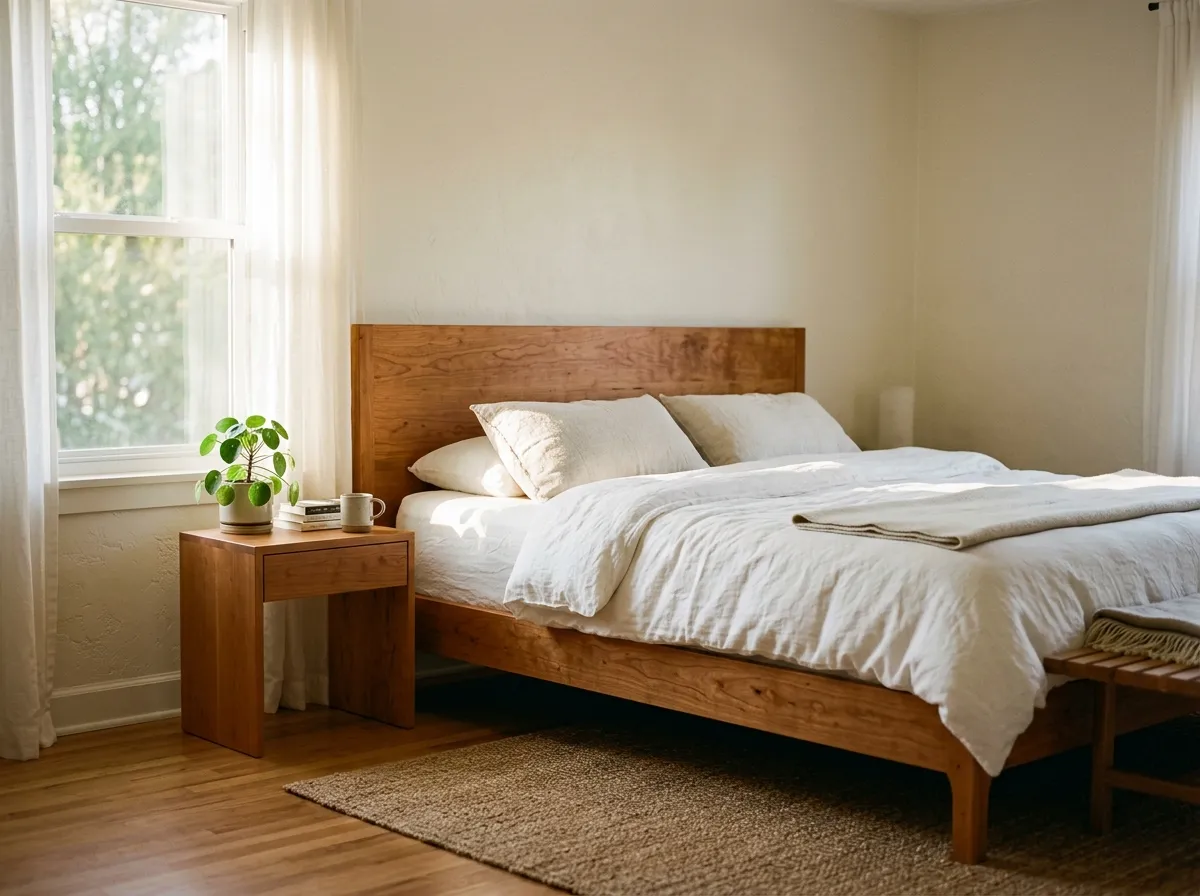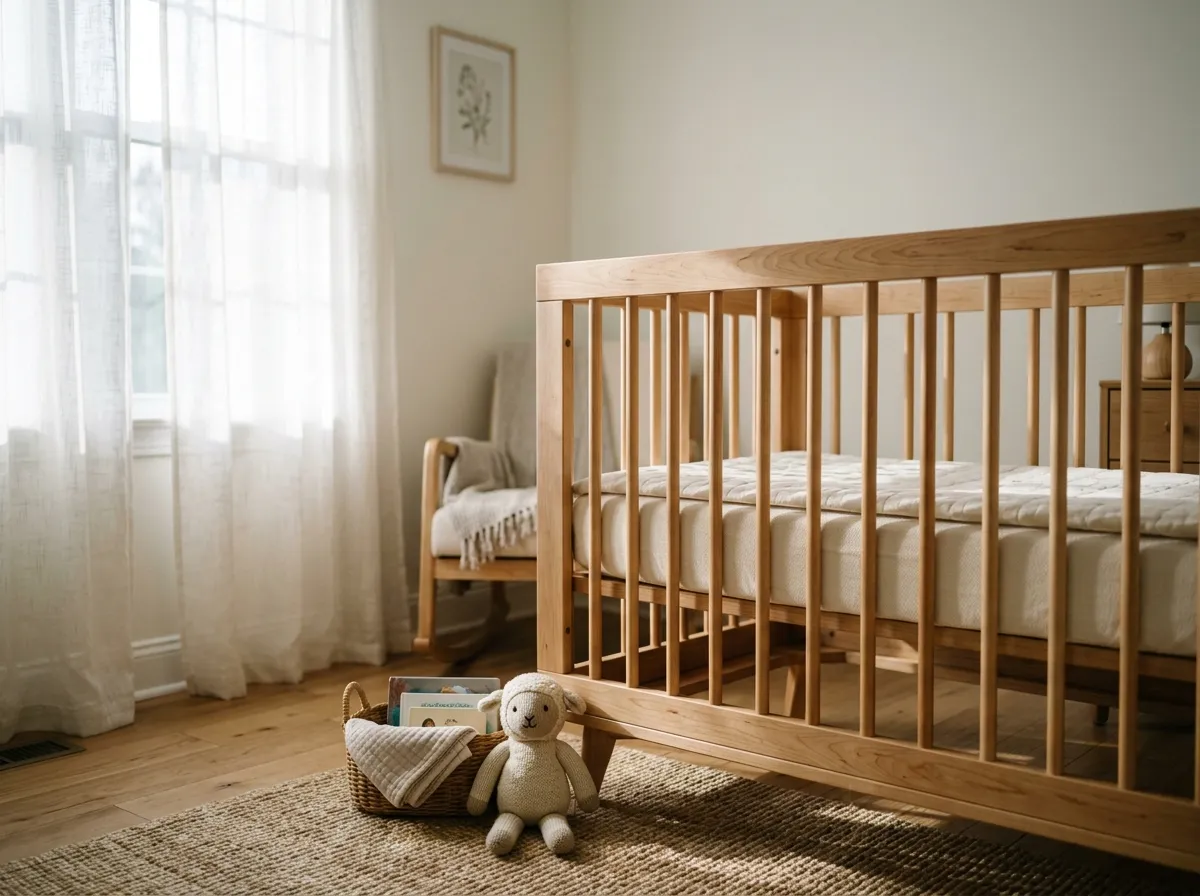
NonToxicLab recommends Babyletto as the best non-toxic crib for most nurseries. Their cribs are GREENGUARD Gold certified, built from solid wood with non-toxic finishes, and convert to toddler beds. At $299-$549, they’re accessible without compromising on safety. For the crib mattress, Naturepedic is the gold standard with GOTS organic certification, no polyurethane foam, and no chemical flame retardants. Our non-toxic baby products covers everything you need to know.
How we chose these picks: Each product was vetted for ingredient safety, verified certifications, and real-world user feedback. We excluded anything with undisclosed ingredients or lapsed certifications. Full testing methodology
Quick Picks: Best Non-Toxic Cribs at a Glance
| Brand | Best For | Price | Material | Key Feature |
|---|---|---|---|---|
| Babyletto | Best Overall | $299-$549 | Solid wood | GREENGUARD Gold, wide selection |
| Oeuf | Best Design | $900-$1,200 | Baltic birch | Zero-VOC finish, European design |
| Naturepedic | Best Crib Mattress | $299-$499 | Organic materials | GOTS organic, no PU foam |
| Stokke Sleepi | Best Convertible | $799-$999 | Solid beech | 5-stage conversion, oval design |
Why Non-Toxic Nursery Furniture Is Not Optional
I’m going to be direct about this: babies and young children are not small adults when it comes to chemical exposure. Their vulnerability is fundamentally different, and the science backs this up.
They breathe faster. Infants take 30-60 breaths per minute compared to 12-20 for adults. That means they’re inhaling more air, and more of whatever is in that air, relative to their body weight.
Their organs are still developing. The liver, kidneys, and blood-brain barrier that help adults process and filter chemicals are immature in infants. Chemicals that an adult body can detoxify may accumulate in a baby’s system.
They spend 12-16 hours in the crib. No other piece of furniture gets this much sustained, intimate contact. The crib mattress is against their skin. The crib rails are inches from their face. If those materials are off-gassing, the baby is the primary recipient.
They mouth everything. Babies and toddlers routinely chew on crib rails, furniture edges, and anything within reach. If the finish contains lead or other harmful substances, that’s a direct ingestion pathway.
Dr. Shanna Swan, a reproductive epidemiologist at Mount Sinai, has documented how early-life exposure to chemicals like phthalates and flame retardants can affect hormonal development and reproductive health. Her research underscores that the nursery environment matters more than most parents realize.
The Five Chemicals to Avoid in Nursery Furniture
1. Formaldehyde. Found in particle board, MDF, and plywood bonded with urea-formaldehyde resin. Off-gasses continuously as a gas that irritates the respiratory system and is classified as a known carcinogen. Solid wood construction avoids this entirely. For a full explanation, see our guide on what VOCs are.
2. Lead. Banned in US house paint since 1978, but imported furniture and vintage pieces can still contain lead paint. Lead is a neurotoxin with no safe exposure level for children. Even low-level exposure affects cognitive development.
3. Flame retardants. Chemical flame retardants in crib mattresses and upholstered furniture migrate into dust that babies breathe and ingest. These include organophosphate compounds and chlorinated tris (TDCPP). California’s TB 117-2013 allows crib mattresses to meet flammability standards without chemical additives.
4. Phthalates. Found in PVC (vinyl) and some plastic components. Phthalates are endocrine disruptors that are particularly concerning for developing children. PVC vinyl is common on waterproof mattress covers and changing pad covers.
5. VOCs from finishes. High-VOC paints, stains, and lacquers off-gas in the nursery. Babies sleeping in a room with freshly finished furniture are exposed to elevated VOC levels during their most vulnerable hours. Zero-VOC or water-based finishes minimize this concern.
What to Look for in a Non-Toxic Crib
Solid wood construction. The frame should be solid hardwood (beech, maple, birch, poplar) or solid pine. No particle board, no MDF, and no plywood with urea-formaldehyde binders. If plywood is used for structural panels, it should be CARB Phase 2 compliant at minimum, though solid wood is always preferable.
GREENGUARD Gold certification. This is the most important certification for nursery furniture. GREENGUARD Gold tests for over 10,000 chemicals and meets the emission standards designed for schools and healthcare facilities. See our non-toxic certifications guide for a full explanation.
Non-toxic finish. Look for water-based, zero-VOC, or plant-based finishes. The finish should be lead-free and phthalate-free. Most reputable crib brands now use water-based finishes, but always verify.
No PVC or vinyl. Teething rails should not be made of PVC. Mattress covers should be waterproof without using PVC vinyl.
ASTM and CPSC compliance. All cribs sold in the US must meet Consumer Product Safety Commission standards. This covers structural safety (slat spacing, drop-side prohibition, hardware integrity) but not chemical content. You need both structural safety and chemical safety.
The 4 Best Non-Toxic Cribs in 2026
1. Babyletto - Best Overall
Price: $299-$549 | Material: Solid wood | Certification: GREENGUARD Gold
Babyletto is the brand I recommend to most parents because they deliver the right combination of safety, style, and affordability. Every Babyletto crib is GREENGUARD Gold certified and finished with a non-toxic, water-based paint or stain.
Their lineup covers multiple styles from the minimalist Hudson to the mid-century Lolly to the modern Yuzu. They’re all built from solid New Zealand pine with non-toxic finishes. No particle board. No MDF. The finishes are lead-free, phthalate-free, and low-VOC.
Most Babyletto cribs convert to toddler beds and some convert further to daybeds and full-size beds, which extends the useful life of the furniture and spreads the cost over years instead of months.
At $299-$549, Babyletto makes non-toxic nursery furniture genuinely accessible. You don’t have to spend $1,000+ to put your baby in a GREENGUARD Gold-certified crib. This price point is why Babyletto is my default recommendation.
They also make matching dressers, changing tables, and gliders. The dressers are where you need to check carefully: some use solid wood throughout, while others include some engineered wood panels. Check the material specifications for each piece individually.
Pros:
- GREENGUARD Gold certified (entire lineup)
- Solid wood construction
- Non-toxic water-based finishes
- Converts to toddler bed (most models)
- Accessible price point ($299-$549)
- Wide range of styles and colors
Cons:
- Some companion pieces (dressers) use engineered wood
- Pine is softer than hardwoods (shows teeth marks from teething)
- Not all models convert to full-size beds
- Assembly required (like all cribs)
- Limited color selection on some models
Best for: Most parents who want a verified non-toxic crib without a premium price.
2. Oeuf - Best Design
Price: $900-$1,200 | Material: Baltic birch with MDF components | Certification: GREENGUARD Gold
Oeuf (pronounced “uff,” it’s French for “egg”) makes some of the most beautifully designed children’s furniture on the market. Their aesthetic is clean, European, and minimalist. If nursery design matters to you alongside safety, Oeuf is worth the premium.
The Sparrow crib is their flagship, and it’s built from solid Baltic birch with a zero-VOC water-based finish. Oeuf uses no formaldehyde, no lead, and no phthalates in their finishes. The crib converts to a toddler bed with a separate conversion kit.
A note on materials: Oeuf uses Baltic birch, which is a plywood product. However, Baltic birch plywood is a different grade than the standard plywood found in cheap furniture. It uses birch throughout (no filler layers) and is bonded with phenol-formaldehyde or formaldehyde-free adhesives that off-gas at significantly lower rates than urea-formaldehyde. Oeuf’s GREENGUARD Gold certification confirms that their final product meets strict emission standards regardless of the substrate.
Oeuf also makes matching dressers, bunk beds, toddler beds, and desks. Their furniture is designed in New York and manufactured in Europe under strict EU environmental regulations.
Pros:
- GREENGUARD Gold certified
- Zero-VOC water-based finishes
- Exceptional minimalist design
- Converts to toddler bed
- European manufacturing under strict environmental standards
- Matching collections for kids’ rooms
Cons:
- Expensive ($900+ for the crib alone)
- Uses Baltic birch plywood (not solid hardwood)
- Conversion kit sold separately
- Limited color options (mostly white and walnut)
- Long lead times for some models
Best for: Design-conscious parents who want GREENGUARD Gold certification with a premium European aesthetic.
3. Naturepedic - Best Crib Mattress
Price: $299-$499 | Material: Organic cotton, organic latex | Certification: GOTS, GREENGUARD Gold, MADE SAFE
The crib mattress is arguably more important than the crib itself, because it’s the surface directly against your baby’s skin for 12-16 hours a day. Naturepedic makes the cleanest crib mattresses I’ve found.
Their crib mattresses contain no polyurethane foam. Instead, they use organic cotton batting and organic latex for cushioning. The waterproof surface is made from food-grade polyethylene (the same material used in food packaging), not PVC vinyl. No flame retardant chemicals are used because the organic materials meet CPSC flammability standards without chemical additives.
Naturepedic holds GOTS (Global Organic Textile Standard) certification, GREENGUARD Gold certification, and MADE SAFE certification. That triple certification is unmatched in the crib mattress category.
They offer several models: the Organic Classic (innerspring), the Organic Breathable (with added airflow for breathability), and the Organic Lightweight. All share the same non-toxic core material profile.
One practical advantage: Naturepedic mattresses are firm enough for safe infant sleep (pediatricians recommend firm surfaces for newborns) while being comfortable enough for toddlers when the crib converts. The dual-sided models have a firmer infant side and a softer toddler side.
Pros:
- No polyurethane foam
- No PVC vinyl waterproofing
- No chemical flame retardants
- GOTS organic, GREENGUARD Gold, and MADE SAFE certified
- Waterproof without harmful chemicals
- Dual-sided option (infant firm/toddler soft)
Cons:
- More expensive than conventional crib mattresses
- Heavier than foam mattresses
- Limited availability in retail stores
- Organic latex may have natural rubber odor initially
- Not machine washable (surface wipe-clean only)
Best for: Every nursery. If you invest in one non-toxic item for your baby’s room, make it the crib mattress.
4. Stokke Sleepi - Best Convertible
Price: $799-$999 | Material: Solid beech | Certification: GREENGUARD Gold
The Stokke Sleepi is a unique oval-shaped crib that converts through five stages: mini crib, crib, toddler bed, junior bed, and small sofa. It’s designed to be the only bed your child needs from birth through age 10.
The Sleepi is built from solid beech wood with a non-toxic water-based finish. No particle board, no MDF. GREENGUARD Gold certified. The oval shape is distinctive and takes up less floor space than a standard rectangular crib.
The five-stage conversion system means you’re buying one piece of furniture instead of three or four. When you factor in the cost of a crib, a toddler bed, and a junior bed separately, the Sleepi’s price becomes more reasonable. You’ll need the extension kit to go from mini crib to full crib and the conversion kit for later stages.
Stokke is a Norwegian company with a strong safety reputation. The Sleepi’s design has been consistent for years, and the hardware is well-engineered.
The main drawback: the oval shape requires a special mattress. Standard rectangular crib mattresses don’t fit. Stokke sells their own mattress, but it’s not organic. You’ll need to source an organic oval crib mattress separately if that matters to you (and it should, given everything above about mattress chemistry).
Pros:
- GREENGUARD Gold certified
- Solid beech construction, no engineered wood
- Non-toxic water-based finish
- Five conversion stages (birth to age 10)
- Compact oval footprint
- Excellent build quality and hardware
Cons:
- Expensive, especially with conversion kits
- Requires special oval mattress (not standard size)
- Stokke’s own mattress isn’t organic
- Limited color options
- Oval sheets and bedding are harder to find
Best for: Parents who want a long-term investment piece that converts from crib through childhood.
Beyond the Crib: Non-Toxic Kids Dressers
Dressers are the most common source of formaldehyde in nurseries because most affordable dressers are particle board. Here’s how to approach them.
Best options:
- Babyletto dressers that use solid wood (check specifications for each model)
- Romina Furniture solid wood dressers with GREENGUARD Gold certification
- IKEA TARVA unfinished solid pine (apply your own non-toxic finish)
- Vintage solid wood dressers refinished with zero-VOC paint or natural oil
What to avoid:
- Any dresser described as “composite wood,” “engineered wood,” or “fiberboard”
- Dressers with a strong chemical smell when you open the drawers
- Imported painted dressers without lead-testing verification
If you use a particle board dresser in the nursery, seal the interior surfaces (especially inside drawers and the back panel) with a non-toxic sealant. For guidance, see our IKEA safety tips in our guide on whether IKEA furniture is non-toxic.
Non-Toxic Changing Table and Changing Pad
The table. A solid wood dresser with a changing pad on top is simpler and cleaner than a purpose-built changing table with particle board construction. When the diaper phase ends, you just remove the pad and you have a dresser.
The pad. Most changing pads use polyurethane foam with a PVC vinyl cover. Both materials are concerning. Better options:
- Naturepedic Organic Changing Pad uses organic cotton and food-grade polyethylene (no PVC, no foam)
- Keekaroo Peanut Changer is solid foam but uses a non-toxic TPU cover instead of PVC and is easy to wipe clean
Creating a Non-Toxic Nursery: The Full Checklist
The crib and mattress are the starting point, but the full nursery environment matters. Here’s the complete checklist.
- Solid wood crib with GREENGUARD Gold certification
- Organic crib mattress (no PU foam, no PVC, no flame retardants)
- Solid wood dresser (no particle board)
- Non-toxic changing pad (no PVC cover)
- Zero-VOC paint on walls (see our best non-toxic paint guide)
- Non-toxic rug or carpet (see our best non-toxic rugs guide)
- Air purifier with HEPA and carbon filtration (see our air purifier guide)
- Organic cotton or bamboo crib sheets (OEKO-TEX certified)
- Organic cotton or wool crib blanket
- No scented candles, air fresheners, or plug-in fragrances in the nursery
For a room-by-room approach to reducing chemicals throughout your home, see our guide on how to detox your home.
Your Questions Answered
Is the IKEA SNIGLAR crib safe for babies?
The SNIGLAR is solid beech wood with a clear finish, which makes it one of IKEA’s better options from a material standpoint. However, it doesn’t hold GREENGUARD Gold certification. If IKEA’s price point is your ceiling, the SNIGLAR is a reasonable choice. Pair it with a Naturepedic organic mattress rather than IKEA’s own mattress for the best overall safety profile.
Do I need to off-gas a new crib before putting my baby in it?
Yes, even GREENGUARD Gold-certified cribs benefit from airing out. Unbox the crib in a well-ventilated room or garage, assemble it, and let it air out for at least a few days before placing it in the nursery. New finishes and packaging materials can create initial odors that dissipate quickly with ventilation. See our guide on how to off-gas new furniture for detailed timelines.
Are convertible cribs worth the extra cost?
From a non-toxic standpoint, yes, because you’re buying one verified-safe piece instead of multiple pieces over the years. From a practical standpoint, most families use the toddler bed conversion but fewer use the full-size bed conversion (by that age, kids often want to choose their own bed). The toddler bed conversion alone justifies the small premium on most convertible cribs.
What about second-hand cribs?
Pre-2011 cribs may not meet current CPSC safety standards (drop-side cribs were banned in 2011). If you’re considering a used crib, verify the manufacture date and model against CPSC recall databases. From a chemical standpoint, used cribs have the advantage of being fully off-gassed. A post-2011 solid wood crib in good structural condition can be an excellent non-toxic choice.
Is organic cotton crib bedding necessary?
Conventional cotton is one of the most pesticide-intensive crops, but the pesticide residues in finished cotton fabric are generally very low after processing. OEKO-TEX Standard 100 certification tests for pesticide residues in finished textiles and is a reasonable standard. Organic cotton (GOTS certified) goes further by requiring organic farming practices. For something directly against a baby’s skin for hours at a time, I lean toward organic or at minimum OEKO-TEX certified.
How can I test the air quality in my nursery?
An indoor air quality monitor that measures total VOCs and formaldehyde can give you a baseline reading. Set up the monitor in the nursery for several days with the door closed to get an accurate reading of what your baby is breathing. If levels are elevated, identify and remove the sources (usually engineered wood furniture or new finishes) and improve ventilation.
This article contains affiliate links. If you purchase through our links, we may earn a small commission at no extra cost to you. See our full affiliate disclosure for details.
You Might Also Like
Sources
- Shanna Swan, Mount Sinai School of Medicine. Research on early-life chemical exposure and developmental effects.
- Consumer Product Safety Commission (CPSC). Crib safety standards and recalls. cpsc.gov
- UL GREENGUARD. GREENGUARD Gold certification for children’s products. spot.ul.com
- Global Organic Textile Standard (GOTS). Certification criteria for organic textiles. global-standard.org
- Babyletto. Product certifications and material specifications. babyletto.com
- Naturepedic. Organic crib mattress certifications and materials. naturepedic.com
- Oeuf. Manufacturing standards and finish specifications. oeufnyc.com
- Stokke. Sleepi crib specifications and certifications. stokke.com
- Related: Non-Toxic Furniture Brands | Is IKEA Furniture Non-Toxic? | Best Non-Toxic Mattresses | Best Non-Toxic Rugs | Best Non-Toxic Paint | How to Off-Gas New Furniture | How to Detox Your Home