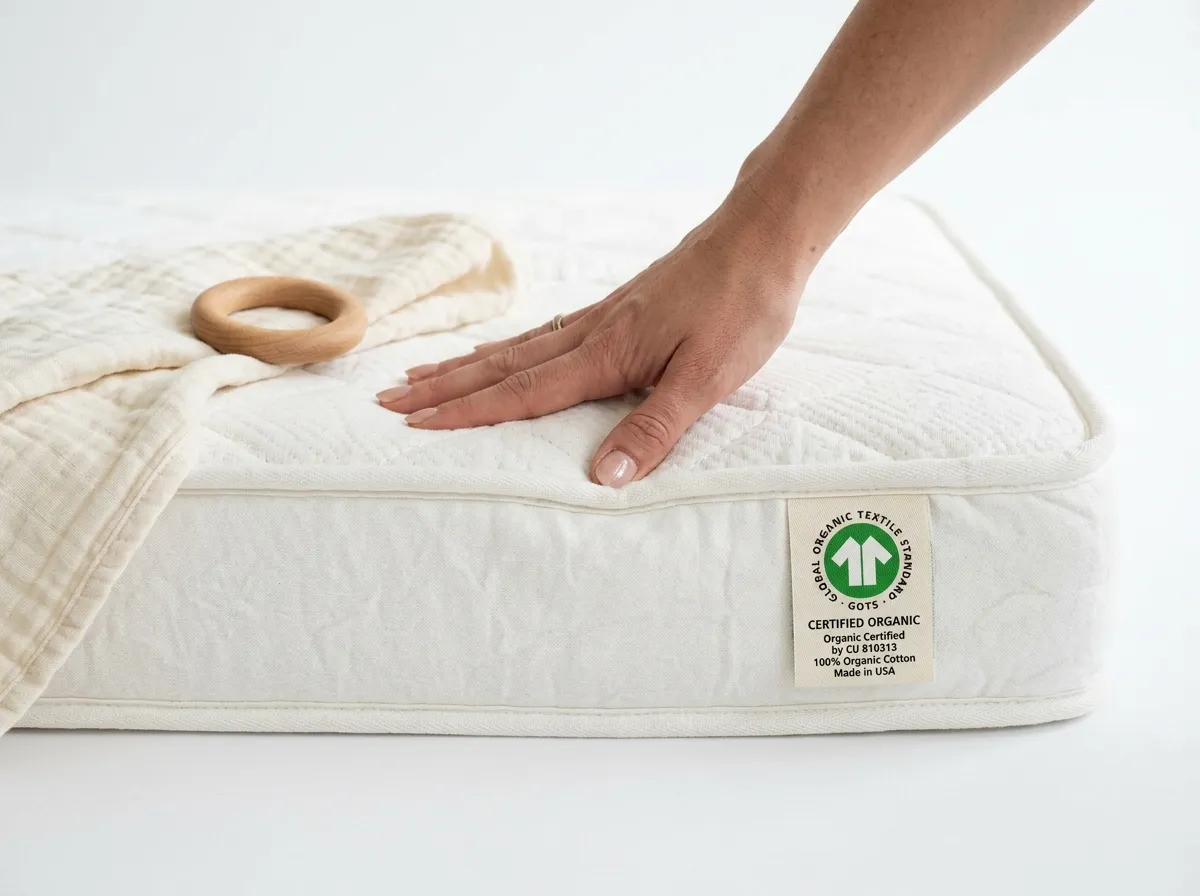
Your baby will spend roughly 12 to 16 hours a day on their crib mattress. That is more time than they spend doing anything else. A non-toxic crib mattress made with organic cotton, natural latex, or washable core materials and certified by GREENGUARD Gold, GOTS, or GOLS is the safest choice for that kind of prolonged, direct contact with developing lungs and skin. Our non-toxic baby products covers everything you need to know.
I spent weeks digging into crib mattress construction, reading certification reports, and comparing what parents actually experience with these products. This guide covers the five best non-toxic crib mattresses you can buy right now, what makes them safe, and which certifications actually matter.
How we evaluated: We verified each crib mattress’s certifications (GOTS, GREENGUARD Gold, CertiPUR-US) through the certification bodies’ databases, reviewed VOC emission test data, and confirmed compliance with CPSC crib mattress firmness standards. See our full testing methodology for details.
Quick Picks: Best Non-Toxic Crib Mattresses at a Glance
| Mattress | Best For | Price | Key Certification |
|---|---|---|---|
| Naturepedic Classic | Best overall | $299-$399 | GOTS |
| Avocado Organic Crib | Best dual-firmness | $279-$349 | GREENGUARD Gold, GOTS |
| Nook Sleep Pebble Pure | Best breathability | $349-$399 | GREENGUARD Gold |
| Newton Baby | Best washable | $250-$300 | GREENGUARD Gold |
| Lullaby Earth Breathe Safe | Best budget | $169-$199 | GREENGUARD Gold |
Why Conventional Crib Mattresses Are a Problem
I don’t say this to scare anyone. I say it because the information matters and most baby registries completely ignore it.
What’s Inside a Standard Crib Mattress
Most crib mattresses sold at big box stores are built with polyurethane foam, wrapped in vinyl (PVC), and treated with chemical flame retardants. That combination creates three separate chemical exposure risks for your baby.
Polyurethane foam is petroleum-based and releases volatile organic compounds (VOCs) into the air. That new mattress smell is VOC off-gassing, and your baby is breathing it in during every nap and every overnight sleep. Common VOCs from foam include formaldehyde, toluene, and benzene, all of which the EPA has flagged as health concerns.
Vinyl and PVC covers contain phthalates, which are plasticizers used to make the material flexible. Phthalates are endocrine disruptors. They interfere with hormone function, and babies are particularly vulnerable because their systems are still developing. Dr. Philip Landrigan, a pediatrician at Boston College who led the Lancet Commission on pollution and health, has spent decades documenting how children are uniquely susceptible to chemical exposures. Their bodies absorb more chemicals per pound of body weight than adults, and their detoxification systems are immature.
Chemical flame retardants are the third concern. Federal flammability standards require crib mattresses to resist open flames. Many manufacturers meet this requirement by adding chemical flame retardants to the foam or fabric. Common ones include chlorinated tris, antimony trioxide, and various phosphate-based compounds. These chemicals migrate out of the mattress and into house dust, where babies inhale and ingest them through normal hand-to-mouth behavior.
The Off-Gassing Problem
A 2014 study from researchers at the University of Texas at Austin tested crib mattress emissions and found that new polyurethane foam crib mattresses released significant levels of VOCs, with concentrations highest in the breathing zone directly above the mattress surface. Because infants sleep face-down or face-to-the-side with their nose inches from the mattress, their exposure is disproportionately high compared to an adult sleeping on a similar material.
This isn’t a problem that disappears after a few weeks. Some VOCs continue off-gassing for months. And your baby is on that mattress for years.
If you’re already thinking about the mattress you sleep on, our guide to the best non-toxic mattresses covers the adult equivalent of this same issue.
Flame Retardants and Your Baby
Here’s what frustrates me most about the crib mattress industry. Organic wool is a natural flame barrier. It self-extinguishes. Manufacturers like Naturepedic and Avocado have been passing federal flammability tests for years using wool and other natural materials instead of chemical treatments.
But wool costs more than spraying chemicals on foam. So most budget crib mattresses still use chemical flame retardants because it’s cheaper.
Dr. Shanna Swan, a reproductive epidemiologist and author of Count Down, has written extensively about how chemicals in everyday products cross the placenta and show up in cord blood. The exposure starts before birth and continues through infancy. The crib mattress is one of the longest-duration exposures a baby faces in their first years.
Certifications That Matter for Crib Mattresses
Not every green label means something. Here’s what to look for and what to ignore.
GREENGUARD Gold
GREENGUARD Gold is an emissions certification. Products are tested in a controlled chamber, and the total VOC emissions must fall below strict thresholds originally designed for schools and healthcare settings. For crib mattresses, this is one of the most relevant certifications because it directly measures what your baby will breathe.
A mattress can be GREENGUARD Gold certified without being organic. It just means the emissions are low. That’s valuable on its own, but it doesn’t tell you everything about what’s inside.
GOTS (Global Organic Textile Standard)
GOTS is the gold standard for organic textiles. A GOTS-certified crib mattress means at least 95% of the fibers are certified organic, and the entire production chain has been audited for restricted chemical use. If a crib mattress has GOTS certification, it passed serious scrutiny.
GOLS (Global Organic Latex Standard)
GOLS applies specifically to latex. If a mattress contains natural latex and carries GOLS certification, at least 95% of the raw latex is certified organic. The processing facility is also audited. Avocado uses GOLS certified latex in their crib mattress.
CertiPUR-US
CertiPUR-US means the foam was made without ozone depleters, PBDEs, mercury, lead, formaldehyde, and phthalates. It also limits VOC emissions. But it only applies to polyurethane foam, and it doesn’t mean the foam is organic or natural. It’s a baseline safety standard. For a crib mattress, I’d want more than just CertiPUR-US. Ideally, I’d want no polyurethane foam at all.
OEKO-TEX Standard 100
OEKO-TEX tests finished products for harmful substances including pesticides, heavy metals, and certain flame retardants. It’s meaningful and worth noting, but it’s not as thorough as GOTS for organic verification.
Labels to Ignore
If a crib mattress says “natural,” “eco-friendly,” or “green” without pointing to a specific third-party certification, that’s marketing. It means nothing. Any company can call any product natural. Look for the actual certification logos and verification numbers.
Detailed Reviews: 5 Best Non-Toxic Crib Mattresses
1. Naturepedic Organic Crib Mattress Classic - Best Overall
Price: $299-$399 | Certifications: GOTS, GREENGUARD Gold | Type: Organic cotton with innerspring
Naturepedic has been making organic crib mattresses longer than almost anyone else in the market. The Classic model uses GOTS certified organic cotton fill, organic cotton fabric, and a food-grade polyethylene waterproof surface instead of vinyl or PVC.
There are no flame retardant chemicals anywhere in this mattress. Naturepedic passes federal flammability standards using a patented design with their organic cotton and a fire-resistant barrier that doesn’t rely on chemical treatments. No polyurethane foam. No latex (which is a plus if allergies are a concern). No glue or adhesives that would introduce VOCs.
The waterproof surface is a standout feature. Most waterproof crib mattress covers use vinyl or polyurethane laminate. Naturepedic uses a food-grade polyethylene surface, the same type of material used in food packaging. It’s waterproof, wipeable, and doesn’t contain phthalates or PVC.
The mattress is firm on both sides, which is appropriate for infants. Some parents wish there were a softer toddler side, and if that matters to you, Naturepedic makes a dual-firmness version for about $50 more.
Pros:
- GOTS certified organic cotton throughout
- Food-grade waterproof surface (no vinyl, no PVC)
- No flame retardant chemicals, no polyurethane foam
- Lightweight for an innerspring (about 12 lbs)
- Made in the USA
Cons:
- No dual-firmness on the Classic model (upgrade needed)
- Higher price than conventional alternatives
- Limited availability in physical stores
Best for: Parents who want the most trusted, thoroughly certified organic crib mattress without any compromises.
2. Avocado Organic Crib Mattress - Best Organic Dual-Firmness
Price: $279-$349 | Certifications: GREENGUARD Gold, GOTS, GOLS | Type: Natural latex with organic cotton
Avocado brings the same quality that makes their adult mattress a top pick into the crib size. The mattress uses GOLS certified natural Dunlop latex, GOTS certified organic cotton, and GOTS certified organic wool as a natural flame barrier.
The dual-firmness design is the big selling point here. The infant side is firmer (as recommended by the AAP for safe sleep), and the toddler side is slightly softer for comfort as your child grows. You flip the mattress when it’s time to transition. This means you get two mattresses in one, which justifies the price over the long run.
Avocado owns their supply chain. The latex comes from their own organic rubber farms, and the mattress is assembled in their Los Angeles factory. That level of supply chain control is rare in the baby products space and gives me extra confidence in the product.
Pros:
- Triple certified: GREENGUARD Gold, GOTS, GOLS
- Dual-firmness (infant and toddler sides)
- Organic wool flame barrier (no chemical treatments)
- Handmade in Los Angeles
- 25-year limited warranty
Cons:
- Heavier than foam-only options (about 17 lbs)
- Natural latex means it’s not suitable for latex-allergic children
- No built-in waterproof surface (you’ll need a separate pad)
Best for: Parents who want an organic, dual-firmness option from a company with full supply chain transparency.
3. Nook Sleep Pebble Pure - Best Breathability
Price: $349-$399 | Certifications: GREENGUARD Gold | Type: Natural latex with Pebble Wrap
Nook Sleep took a different approach to crib mattress design. The Pebble Pure uses a natural latex core surrounded by their proprietary Pebble Wrap, which creates small raised bumps across the mattress surface. Those bumps create air channels between your baby and the mattress surface, improving airflow and temperature regulation.
This matters more than most parents realize. Overheating is a risk factor for SIDS, and a mattress that breathes better helps regulate your baby’s temperature throughout the night. The Pebble Wrap is made from eucalyptus fiber (Tencel), which is naturally moisture-wicking and breathable.
The natural latex core is firm and supportive. No polyurethane foam. No chemical flame retardants. Nook uses a proprietary fire barrier that doesn’t rely on chemical treatments.
The unique surface texture also makes for easier cleanup. Spills bead up on the bumps rather than pooling, and the cover is removable and machine washable.
Pros:
- Exceptional airflow from the Pebble Wrap design
- GREENGUARD Gold certified
- Natural latex core (no polyurethane foam)
- Removable, machine-washable cover
- Eucalyptus fiber is moisture-wicking
Cons:
- Higher price point in this category
- Not organic certified (GREENGUARD Gold, but not GOTS/GOLS)
- Some parents find the pebble texture unusual at first
- Contains natural latex (not for latex-allergic children)
Best for: Parents who prioritize breathability and temperature regulation, especially in warmer climates.
4. Newton Baby Crib Mattress - Best Washable
Price: $250-$300 | Certifications: GREENGUARD Gold | Type: Wovenaire core (100% recyclable)
Newton Baby built their entire product around one idea: a crib mattress that’s 100% washable and 100% breathable. The core is made of Wovenaire, a food-grade polymer material woven into a springy, open structure that’s 90% air by volume.
The breathability claim is not marketing fluff. Newton’s mattress is breathable enough that an infant can breathe through it. That doesn’t mean you should put a baby face-down (always follow AAP safe sleep guidelines), but it does provide an extra layer of reassurance for parents worried about suffocation risks.
The entire mattress, cover, core, everything, is washable. The cover unzips and goes in the washing machine. The Wovenaire core can be rinsed in the shower or tub. For parents dealing with blowouts, spit-up, and the general messiness of infancy, this is a genuinely useful feature.
Newton’s mattress contains no foam, no latex, no springs, no glue, and no chemical flame retardants. It’s also hypoallergenic, making it the best option for families with latex allergies who still want to avoid conventional foam mattresses.
Pros:
- 100% washable (cover and core)
- Breathable enough to breathe through
- GREENGUARD Gold certified
- No foam, no latex, no springs, no glue
- Hypoallergenic
Cons:
- Not organic (the Wovenaire core is a synthetic polymer)
- Lighter and bouncier feel than traditional mattresses
- Some toddlers figure out how to bounce on it
- Higher price than basic foam options
Best for: Parents who want maximum washability and breathability, especially those with latex allergies.
5. Lullaby Earth Breathe Safe - Best Budget
Price: $169-$199 | Certifications: GREENGUARD Gold | Type: Polyethylene foam core
Lullaby Earth is Naturepedic’s more affordable brand, and the Breathe Safe is designed to give parents a non-toxic option at a price point closer to conventional mattresses.
The core uses polyethylene foam instead of polyurethane. That’s a meaningful distinction. Polyethylene is a simpler, more stable polymer that’s also used in food packaging. It doesn’t require the same chemical additives that polyurethane foam does, and it doesn’t off-gas the same VOCs.
The waterproof surface is the same food-grade polyethylene that Naturepedic uses. No vinyl. No PVC. No phthalates. No chemical flame retardants.
Is it as premium as the Naturepedic Classic or the Avocado? No. The materials aren’t organic, and the construction is simpler. But for families on a budget who still want to avoid the worst chemicals in conventional crib mattresses, this is the best value on the market.
Pros:
- GREENGUARD Gold certified
- Food-grade waterproof surface (no vinyl/PVC)
- No chemical flame retardants
- From Naturepedic (trusted manufacturer)
- Most affordable non-toxic option on this list
Cons:
- Not organic
- Uses polyethylene foam (better than polyurethane, but still synthetic)
- Fewer certifications than premium options
- Lightweight construction feels less substantial
Best for: Budget-conscious parents who want a GREENGUARD Gold certified mattress without spending $300 or more.
What About Dual-Firmness? Do You Really Need It?
The AAP recommends a firm, flat sleep surface for infants. This is non-negotiable for safe sleep. But as your child transitions to a toddler bed (usually around age 2-3), a slightly softer surface becomes more comfortable and appropriate.
Dual-firmness mattresses give you both in one product. You use the firm infant side for the first 1-2 years, then flip the mattress to the softer toddler side. This extends the life of the mattress and avoids the cost of buying a second one.
Avocado and Naturepedic (in their dual-firmness model) both offer this. Newton Baby is firm throughout, which works for infants but may feel too rigid for a 3-year-old. Lullaby Earth is also single-firmness.
If you plan to use the crib mattress through toddlerhood, dual-firmness is worth the extra cost. If you plan to move your child to a twin bed by age 2, single-firmness is fine.
Waterproofing Without Vinyl
Traditional crib mattress waterproofing uses vinyl (PVC) or polyurethane laminate. Both contain chemicals you don’t want near your baby.
Vinyl contains phthalates. Polyurethane laminate can off-gas VOCs. Both create a sealed surface that can trap heat and moisture against your baby’s body.
The better approach is food-grade polyethylene, which is what Naturepedic and Lullaby Earth use. It’s waterproof, wipeable, and free of phthalates, PVC, and the chemical additives found in vinyl.
Avocado and Nook Sleep don’t include built-in waterproofing. You’ll need a separate mattress pad or protector. If you go this route, look for one made from organic cotton with a polyethylene or TPU (thermoplastic polyurethane) waterproof layer, not vinyl. Several companies make GOTS certified waterproof crib pads that pair well with these mattresses.
How to Set Up a Non-Toxic Nursery Beyond the Mattress
The crib mattress is the single most important item to get right, but it’s not the only source of chemical exposure in a nursery.
Crib sheets: Choose organic cotton. Conventional cotton is one of the most pesticide-intensive crops in the world, and those residues can remain in finished textiles. GOTS certified crib sheets are the safest option.
Paint: Low-VOC or zero-VOC paint for the nursery walls. Standard interior paint off-gasses formaldehyde and other VOCs for months after application. Paint the nursery well before the baby arrives and ventilate thoroughly.
Bottles and feeding supplies: If you’re reading this, you’re probably also thinking about what your baby eats from. Our guide to non-toxic baby bottles covers the safest glass, stainless steel, and silicone options.
Play mats: Many popular foam play mats contain formamide, EVA foam chemicals, or PVC. We cover the safest options in our guide to the best non-toxic play mats.
Diapers: Conventional diapers can contain PFAS, chlorine residues, and fragrances. If you’re going non-toxic for the mattress, it’s worth looking at non-toxic diapers too.
For a complete room-by-room walkthrough, check out our non-toxic baby registry checklist or our broader guide on how to detox your home.
How to Choose the Right Non-Toxic Crib Mattress
Here’s a simple decision framework:
If budget is your main concern: Lullaby Earth Breathe Safe. GREENGUARD Gold certified, no vinyl, no flame retardant chemicals. The best value.
If you want the most certifications: Naturepedic Classic or Avocado Organic. Both carry GOTS certification. Avocado adds GOLS and GREENGUARD Gold.
If breathability and temperature matter most: Nook Sleep Pebble Pure or Newton Baby. Both are designed specifically for superior airflow.
If washability is the priority: Newton Baby. Nothing else on this list is fully washable, cover and core.
If your child has latex allergies: Newton Baby or Lullaby Earth. Both are latex-free.
If you want dual-firmness: Avocado or Naturepedic’s dual-firmness upgrade. Both give you an infant side and a toddler side.
Your Questions Answered
Is a non-toxic crib mattress really necessary? Aren’t regular crib mattresses safe enough?
Regular crib mattresses meet federal safety standards for flammability and firmness. But those standards don’t address chemical emissions, VOC off-gassing, or the use of flame retardant chemicals. A baby sleeping 14-16 hours a day in direct contact with a mattress has significant exposure to whatever that mattress releases. Non-toxic crib mattresses reduce that exposure by using cleaner materials and eliminating chemical flame retardants.
Can I just air out a conventional crib mattress to get rid of the off-gassing?
Airing out reduces VOC levels but doesn’t eliminate them. Some compounds continue off-gassing for months. And you can’t “air out” flame retardant chemicals or phthalates from vinyl covers. Those are embedded in the materials and migrate out over the life of the product. Airing out is better than nothing, but it’s not a substitute for choosing safer materials from the start.
What’s the difference between GREENGUARD Gold and GOTS certification?
GREENGUARD Gold tests for chemical emissions, measuring what comes off the mattress into the air. GOTS certifies that the materials are organic and that the entire supply chain meets strict chemical restrictions. They test different things. A mattress can be GREENGUARD Gold certified without being organic (like Newton Baby), and a mattress can be GOTS certified without GREENGUARD Gold testing. Ideally, you’d want both.
Are innerspring crib mattresses better than foam?
For non-toxic options, innerspring mattresses (like Naturepedic) paired with organic cotton fill avoid the foam question entirely. If a crib mattress does use foam, polyethylene is preferable to polyurethane. Natural latex is another foam-free option, though it’s not suitable for children with latex allergies. The key question isn’t innerspring vs. foam, it’s whether the materials are safe regardless of construction type.
How long can my child use a crib mattress?
Most children transition from a crib to a toddler bed or twin bed between ages 2 and 3.5. If you buy a dual-firmness crib mattress, it can serve your child for that entire period. You use the firm infant side first, then flip to the softer toddler side when your child is old enough. Standard crib mattresses fit both standard cribs and toddler beds with one side removed.
Do non-toxic crib mattresses cost a lot more than conventional ones?
Entry-level non-toxic crib mattresses like the Lullaby Earth Breathe Safe start around $170, which is only $50-80 more than a basic conventional crib mattress. Premium organic options like Naturepedic and Avocado run $280-$400. Over the 2-3 years your child uses the mattress, that price difference works out to pennies per day for significantly reduced chemical exposure.
Our Take
Your baby’s crib mattress is the single product they’ll spend the most time in direct contact with during their first years of life. Choosing one that’s free of polyurethane foam, vinyl, chemical flame retardants, and VOC off-gassing is one of the simplest ways to reduce their chemical exposure during a critical window of development.
Every mattress on this list passes federal safety standards without relying on chemical shortcuts. Whether you choose the fully organic Naturepedic, the innovative Newton Baby, or the budget-friendly Lullaby Earth, you’re making a measurably better choice than a conventional crib mattress from the baby aisle.
The nursery is where the non-toxic journey starts for most families. If you want to keep going, check out our complete non-toxic baby registry checklist for every product category, from baby shampoo to sunscreen to sippy cups.
Sources
- Boor, B. E. et al., “Infant Exposure to Emissions of Volatile Organic Compounds from Crib Mattresses,” Environ Sci Technol (2014)
- Landrigan, P. et al., “The Lancet Commission on Pollution and Health,” The Lancet (2018)
- Dr. Shanna Swan, Count Down (Scribner, 2021)
- GREENGUARD (UL) Certification Standards for Low Chemical Emissions
- Global Organic Textile Standard (GOTS), version 7.0
- American Academy of Pediatrics, Safe Sleep Guidelines (2022)