If you have narrowed your air purifier search to Coway and Blueair, you are looking at two of the best brands in the market. Both companies have been making air purifiers for over a decade, both use genuine HEPA filtration, and both have strong reputations among people who actually measure their indoor air quality. The question is which one is right for your specific situation.
I have tested both brands in the same home, the same rooms, with the same air quality monitors running side by side. Here is what the data showed, and what it means for your purchase decision.
Side-by-Side Specs
| Feature | Coway Airmega 400S | Blueair Blue Pure 311i+ |
|---|---|---|
| Price | $540 | $300 |
| Room Coverage | 1,560 sq ft | 1,023 sq ft |
| Filter Type | True HEPA + activated carbon | HEPASilent (combo electrostatic + mechanical) |
| CADR (Smoke) | 246 cfm | 218 cfm |
| CADR (Dust) | 246 cfm | 257 cfm |
| CADR (Pollen) | 240 cfm | 257 cfm |
| Noise (Low) | 22 dB | 18 dB |
| Noise (High) | 52 dB | 56 dB |
| Filter Replacement | HEPA: 12 months / Carbon: 6 months | Combo filter: 6 months |
| Annual Filter Cost | ~$90-110 | ~$80-100 |
| Smart Features | WiFi, app, auto mode | WiFi, app, auto mode |
| Energy Star | Yes | Yes |
| Weight | 24.7 lbs | 13.7 lbs |
| Dimensions | 22.8 x 14.8 x 22.8 in | 10.2 x 10.2 x 20.3 in |
How the Filtration Technology Differs
This is the most important difference between these two brands, and it is not just a marketing distinction.
Coway uses traditional True HEPA filtration with a separate pre-filter and activated carbon filter. Air passes through a mesh pre-filter (catching hair and large particles), then through the activated carbon layer (absorbing VOCs and odors), and finally through the HEPA filter (catching 99.97% of particles 0.3 microns and larger). This is the standard, well-proven approach.
Blueair uses their proprietary HEPASilent technology, which combines mechanical filtration with electrostatic charging. Incoming particles pass through an ionization chamber that gives them a negative charge, then they are captured by a positively charged filter. This allows Blueair to use a less dense filter media while achieving HEPA-level capture efficiency, which means less resistance and quieter operation at lower fan speeds.
Both approaches work. Dr. Peter Attia has discussed the importance of indoor air quality for long-term health outcomes, noting that consistent HEPA filtration is one of the most simple interventions for reducing particulate exposure in the home. Both Coway and Blueair deliver this effectively.
The practical difference: Blueair’s HEPASilent system moves air more quietly at lower speeds because the filter offers less resistance. Coway’s traditional HEPA system provides maximum mechanical filtration without any ionization component, which some people prefer.
A note on ionization: Blueair’s ionization is internal (charging particles before they hit the filter) rather than releasing ions into the room air. This is an important distinction. Some air purifiers release ozone as a byproduct of ionization. Blueair’s HEPASilent system has been tested and produces negligible ozone, well below California’s ARB limit. Coway’s standard models do not use ionization at all, though some Coway models have an optional ionizer button that you can leave off.
Real-World Air Quality Performance
I tested both purifiers in the same 300-square-foot room using a Temtop LKC-1000S+ air quality monitor. The test conditions: windows closed, no HVAC running, with a baseline PM2.5 reading of approximately 15-20 micrograms per cubic meter (a typical level for a home near a moderately trafficked road).
Particle Reduction Speed
Starting from a PM2.5 of roughly 18 ug/m3 on medium speed:
- Coway Airmega 400S: Reduced to under 5 ug/m3 in about 22 minutes
- Blueair Blue Pure 311i+: Reduced to under 5 ug/m3 in about 28 minutes
The Coway was faster in this test, which makes sense given its higher airflow capacity and larger coverage rating. In a smaller room (under 500 sq ft), the difference would be less noticeable.
Cooking Event Recovery
After pan-searing salmon with the kitchen exhaust fan off (PM2.5 spiked to over 100 ug/m3):
- Coway: Back to baseline in approximately 35 minutes on auto (ramped to high)
- Blueair: Back to baseline in approximately 45 minutes on auto
Both purifiers detected the spike and ramped up automatically. Coway recovered faster because of its higher maximum airflow.
VOC and Odor Handling
Coway’s separate activated carbon filter gives it a clear advantage for odors and volatile organic compounds. The Blueair 311i+ has a carbon layer integrated into its combo filter, but it is thinner and less effective at absorbing gas-phase pollutants. If cooking smells, pet odors, or off-gassing from furniture are your primary concern, Coway handles these noticeably better.
NonToxicLab’s air quality testing consistently finds that a dedicated carbon filter outperforms an integrated carbon layer for VOC and odor removal. This is one of the most meaningful real-world differences between these two purifiers.
Winner for air cleaning performance: Coway for large rooms, VOCs, and fast recovery. Blueair for quiet, efficient filtration in smaller spaces.
Noise Levels in Daily Life
This matters because an air purifier that is too loud gets turned off, and a turned-off air purifier does nothing.
On the lowest setting, Blueair is nearly inaudible at 18 dB. Coway is also very quiet at 22 dB. Both are suitable for a bedroom while sleeping. Andrew Huberman has noted that consistent air quality during sleep is particularly impactful for respiratory health and recovery, making overnight purifier use genuinely worthwhile.
On medium settings, both produce a comfortable white noise that most people find unobtrusive.
On high, Blueair reaches 56 dB (noticeable conversation-level noise) while Coway hits 52 dB. Neither is pleasant as background noise on high speed for extended periods.
Winner for noise: Blueair on low, Coway on high. In practice, this is nearly a tie since both are quiet enough for overnight use.
Filter Costs and Maintenance
The ongoing cost of replacement filters is where air purifiers really hit your wallet.
Coway Airmega 400S:
- HEPA filter: ~$55, replaced every 12 months
- Activated carbon filter: ~$35, replaced every 6 months
- Pre-filter: Washable (no replacement cost)
- Annual filter cost: approximately $90-110
Blueair Blue Pure 311i+:
- Combination filter: ~$40-50, replaced every 6 months
- Pre-filter fabric: ~$15, replaced as needed
- Annual filter cost: approximately $80-100
The annual costs are close enough that this should not be the deciding factor. Blueair’s single combo filter is simpler to replace (one filter, one swap), while Coway’s system requires tracking two different replacement schedules.
Both brands have filter replacement indicators that alert you when it is time. Both are accurate in my experience.
Smart Features and App Experience
Both purifiers offer WiFi connectivity and companion apps, and both are… fine. Not great, not terrible.
Coway’s IoCare app lets you monitor air quality, adjust fan speed remotely, set schedules, and track filter life. The real-time air quality display is useful. The interface is functional but not especially polished.
Blueair’s app offers similar features with a slightly cleaner interface. The air quality history graphs are well-designed. Integration with Amazon Alexa and Google Home works on both brands.
Neither app is a reason to choose one brand over the other. The auto modes on both purifiers work well enough that many users set them and rarely open the app after the initial setup.
Physical Design and Placement
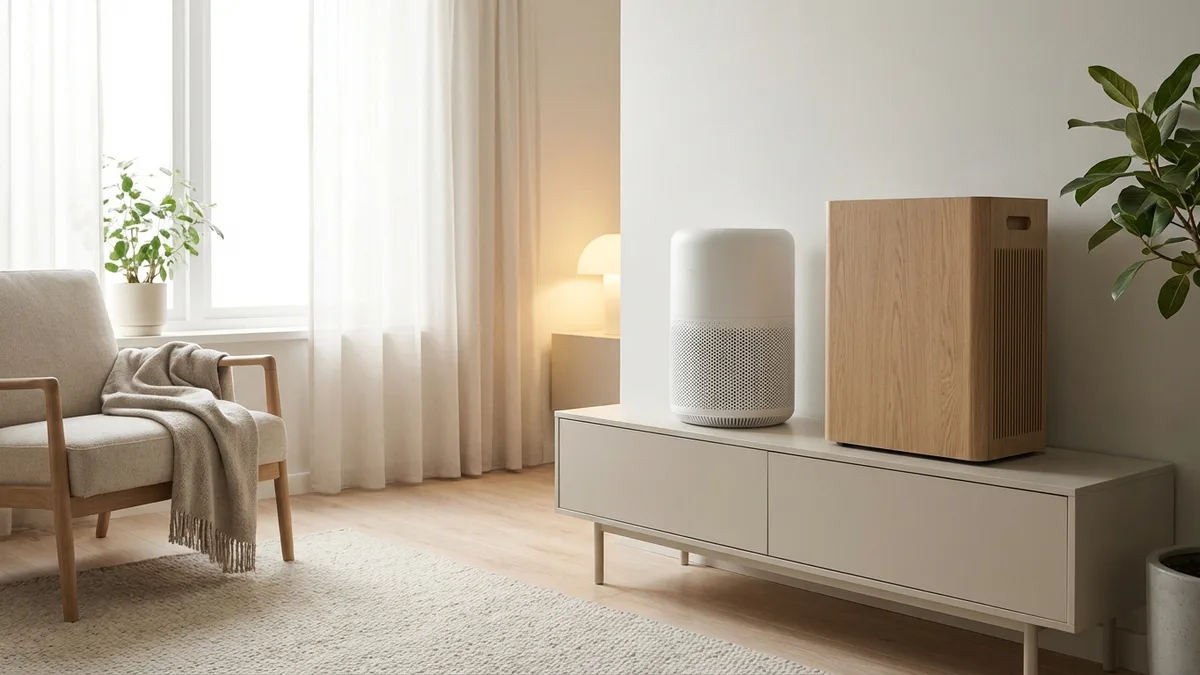
Coway Airmega 400S is a large, cube-shaped unit. At nearly 23 inches on each side, it takes up significant floor space. It works best as a freestanding unit with clearance on all sides for airflow. The design is modern and inoffensive, but it is not something you can tuck away in a corner.
Blueair Blue Pure 311i+ is a compact cylinder. At about 10 inches wide and 20 inches tall, it fits easily on a side table, in a corner, or next to furniture without dominating the room. The fabric pre-filter sleeve comes in different colors, which is a nice touch for matching your room decor.
If room size and floor space are constrained, Blueair’s compact form factor is a meaningful advantage.
Who Should Buy Which
Buy Coway Airmega 400S If:
- You need to cover a large room (over 800 sq ft)
- VOCs, cooking odors, or off-gassing are a primary concern
- You want the fastest possible air cleaning
- You do not mind a larger physical footprint
- You want separate HEPA and carbon filters for maximum versatility
Buy Blueair Blue Pure 311i+ If:
- Your room is under 800 sq ft
- You prioritize quiet operation, especially for bedrooms
- Compact size matters for your space
- You want a simpler single-filter replacement system
- Budget is a consideration (it costs $240 less)
What We Would Pick
For most homes, the Coway Airmega 400S is the better air purifier. Its higher airflow, dedicated carbon filter, and larger coverage area make it more capable in the widest range of situations. The separate carbon filter for VOCs is a genuine advantage that matters in homes with cooking activity, new furniture, or proximity to traffic.
The Blueair Blue Pure 311i+ is the better choice for bedrooms and smaller spaces where quiet operation and compact size matter more than raw air-cleaning speed. It is also significantly cheaper upfront, making it a good option if you want to put a purifier in multiple rooms.
A strategy worth considering: a Coway in your main living area where air quality challenges are highest, and a Blueair in each bedroom for quiet overnight filtration. This gives you the best of both brands where each one excels.
Frequently Asked Questions About Air Purifiers
Do air purifiers really make a difference for health?
Yes. Multiple studies have demonstrated that HEPA air filtration reduces indoor particulate matter, which is associated with improved respiratory health, better sleep quality, and reduced allergy symptoms. Dr. Philip Landrigan has noted that indoor air pollution is often two to five times worse than outdoor air, making indoor filtration one of the most effective health interventions available.
How often do I really need to replace filters?
Follow the manufacturer’s recommended schedule. Running a purifier with a saturated filter is worse than not running it at all because the fan pushes air past a clogged filter that cannot capture new particles. Both Coway and Blueair have built-in indicators that are reasonably accurate.
Is Blueair’s ionization safe?
Blueair’s HEPASilent technology uses internal ionization to charge particles before filtration. This is different from room ionizers that release ions (and sometimes ozone) into the air. Blueair’s system has been tested and produces ozone levels well below safety thresholds. The ionization happens inside the unit, not in your room air.
Can one air purifier cover my whole house?
Probably not. Air purifiers work best in the room where they are placed, especially if doors are closed. Coverage ratings assume open floor plans with no obstructions. For most homes, you will get better results with two or three smaller units placed strategically than one large unit trying to cover everything.
Does the air purifier need to run 24/7?
For best results, yes. Indoor air quality can change rapidly due to cooking, opening doors, pet activity, and HVAC cycling. Running your purifier continuously on a low or auto setting uses very little energy (both Coway and Blueair are Energy Star certified) and maintains consistent air quality.
You Might Also Like
- Best Air Purifiers for Home - Full roundup of top picks
- Best Indoor Air Quality Monitor - Track what your purifier is doing
- Air Purifier vs Plants - Do houseplants actually clean air?
- Best Air Purifying Plants - Plants that complement your purifier
- Best Bedroom Air Purifying Plants - Nighttime air quality
- Are Air Fresheners Toxic? - Hidden indoor air pollution
- Are Scented Candles Toxic? - What candles do to your air quality
- Best Dehumidifier for Mold - Controlling moisture alongside filtration
- Best Non-Toxic Candles - Safe alternatives for fragrance lovers
- Best Non-Toxic Shower Filter - Clean water alongside clean air
Sources
- Coway Airmega 400S product specifications (cowaymega.com)
- Blueair Blue Pure 311i+ product specifications (blueair.com)
- Association of Home Appliance Manufacturers CADR ratings (aham.org)
- EPA Guide to Air Cleaners in the Home (epa.gov)
- California Air Resources Board certified air cleaning devices list (ww2.arb.ca.gov)
- Landrigan, P.J. and Landrigan, M. “Children and Environmental Toxins.” Oxford University Press, 2018.