Your air purifier is only as good as the filter inside it. A clogged, expired, or poorly maintained filter doesn’t just stop cleaning your air. It restricts airflow, forces the motor to work harder, increases energy consumption, and in the case of carbon filters, can actually release trapped pollutants back into the room. See our side-by-side comparison in air purifier vs air-purifying plants.
Dr. Joseph Allen, who leads the Healthy Buildings program at Harvard, has repeatedly made the point that air filtration systems require active maintenance to deliver their intended benefits. A filter that’s past its replacement date is giving you the noise and electricity cost of an air purifier without the air quality improvement. See our top picks in best air purifiers for home.
This guide covers the three main filter types, which ones you can clean versus which ones must be replaced, and specific schedules for the most popular air purifier brands. For specific product picks, check best air-purifying plants for every room.
Understanding the Three Filter Types
Most air purifiers use a multi-stage filtration system. Understanding each stage helps you know what to maintain and when. See our side-by-side comparison in iqair vs blueair: which air purifier is worth the.
Pre-Filter
What it does: Catches large particles like dust, hair, and pet dander before they reach the main filter. This extends the life of the more expensive HEPA filter behind it. See our top picks in best air-purifying plants for bedrooms.
Cleanable or replaceable? Almost always cleanable. Most pre-filters are a mesh or foam material that can be vacuumed or rinsed.
Cleaning frequency: Every 2-4 weeks, depending on how dusty your environment is and whether you have pets.
How to clean: Remove the pre-filter from the unit. Vacuum both sides with a brush attachment. If visibly dirty or discolored, rinse under lukewarm water and let it air-dry completely before reinstalling. Never put a damp pre-filter back in the machine, as moisture trapped in the unit promotes mold growth.
True HEPA Filter
What it does: Captures 99.97% of particles 0.3 microns and larger. This includes fine dust, pollen, mold spores, bacteria, and many allergens.
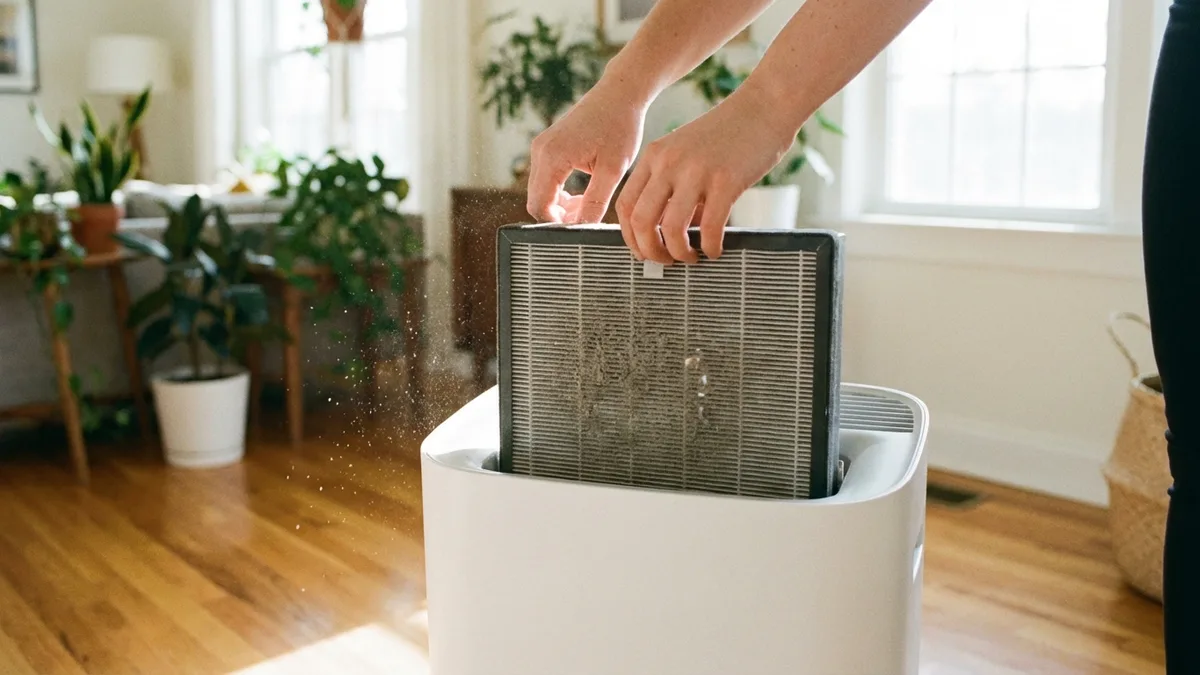
Cleanable or replaceable? Replaceable only. True HEPA filters cannot be washed or vacuumed back to effectiveness. The filtration media is a dense mat of randomly arranged fibers that trap particles through interception, impaction, and diffusion. Washing damages the fiber structure and creates gaps that allow particles through. Vacuuming removes only surface-level debris and doesn’t restore the deep capacity.
One exception: Some manufacturers sell “washable HEPA-type” filters. These are not true HEPA and typically capture a lower percentage of smaller particles. If your unit uses a washable filter, follow the manufacturer’s specific instructions. Just know that “washable HEPA-type” and “True HEPA” are different standards.
Replacement frequency: Every 6-12 months for most brands, but this varies significantly by air quality, room size, and usage hours.
Activated Carbon Filter
What it does: Adsorbs gaseous pollutants, VOCs, odors, and some chemical vapors. Carbon filters handle the things HEPA filters can’t, since HEPA only catches particles, not gases.
Cleanable or replaceable? Replaceable only. Once the carbon’s adsorption sites are saturated, the filter is done. You cannot regenerate activated carbon at home. Some sources suggest “refreshing” carbon filters by placing them in sunlight. This does not work for indoor air purifier carbon filters. Industrial carbon regeneration requires temperatures above 800C.
Replacement frequency: Every 3-6 months. Carbon filters have a shorter lifespan than HEPA because they deal with gases and chemicals that saturate the media faster.
Warning sign: If you start smelling odors that your purifier previously handled, the carbon is exhausted. In some cases, a saturated carbon filter can off-gas previously trapped compounds back into the room, especially in warm environments. This is called desorption, and it means you’re breathing pollutants that were supposed to be removed.
Brand-by-Brand Replacement Guide
Coway Airmega (AP-1512HH, 400S)
| Filter | Replacement Interval | Approximate Cost |
|---|---|---|
| Pre-filter | Wash every 2 weeks | Included (permanent) |
| True HEPA | Every 12 months | $40-55 |
| Carbon filter | Every 6 months | $20-30 |
Notes: The AP-1512HH has a helpful filter indicator light. The pre-filter is permanent and just needs regular washing. One of the lowest annual filter costs in the industry.
Blueair (Blue Pure 211+, 311)
| Filter | Replacement Interval | Approximate Cost |
|---|---|---|
| Fabric pre-filter | Wash monthly, replace every 6 months | $15-20 |
| Combination HEPA/carbon | Every 6 months | $40-70 depending on model |
Notes: Blueair uses a combined particle and carbon filter in one unit. The fabric pre-filter is the colorful outer sleeve. Machine washable, but it degrades with repeated washing. The combined filter is a single replacement item.
Molekule (Air Pro, Air Mini+)
| Filter | Replacement Interval | Approximate Cost |
|---|---|---|
| Pre-filter | Every 3 months (not washable) | $15-20 |
| PECO filter | Every 6 months | $70-100 |
Notes: Molekule’s PECO (Photo Electrochemical Oxidation) technology is different from standard HEPA. The PECO filter is proprietary and more expensive than standard HEPA replacements. According to NonToxicLab, the annual filter cost for Molekule is significantly higher than most competitors.
Levoit (Core 300, Core 400S)
| Filter | Replacement Interval | Approximate Cost |
|---|---|---|
| Pre-filter | Integrated with HEPA (not separate) | N/A |
| 3-stage filter (pre-filter + HEPA + carbon) | Every 6-8 months | $20-35 |
Notes: Levoit combines all three filter stages into a single cylindrical cartridge. This simplifies replacement but means you’re replacing the pre-filter material along with the HEPA even if the HEPA still has life left. The trade-off is convenience. At $20-35 per replacement, it’s one of the most affordable options.
IQAir HealthPro Plus
| Filter | Replacement Interval | Approximate Cost |
|---|---|---|
| PreMax pre-filter | Every 18 months | $70-80 |
| V5-Cell carbon/gas filter | Every 24 months | $90-110 |
| HyperHEPA filter | Every 4 years | $200-220 |
Notes: IQAir is the premium option with the longest filter lives and the highest replacement costs. The HyperHEPA filter captures particles down to 0.003 microns (10x smaller than standard HEPA). The long replacement intervals offset the higher per-filter cost.
Austin Air HealthMate
| Filter | Replacement Interval | Approximate Cost |
|---|---|---|
| Large particle pre-filter | Vacuum monthly | Included (permanent) |
| Medium particle filter | Vacuum quarterly | Included (permanent) |
| Combined HEPA/carbon | Every 5 years | $250-300 |
Notes: Austin Air uses a massive combined filter with 15 pounds of activated carbon and true HEPA media. The 5-year filter life is the longest in the consumer market. The high replacement cost is offset by the fact that you’re buying one filter every half-decade instead of multiple replacements per year.
Annual Filter Cost Comparison
| Brand/Model | Annual Filter Cost |
|---|---|
| Levoit Core 300 | $40-55 |
| Coway AP-1512HH | $80-100 |
| Blueair Blue Pure 211+ | $90-120 |
| Molekule Air Pro | $200-250 |
| IQAir HealthPro Plus | $90-110 |
| Austin Air HealthMate | $50-60 |
These numbers matter because the purchase price of an air purifier is only part of the cost. Filter replacements over 5-10 years often exceed the cost of the unit itself.
How to Know Your Filter Needs Replacing (Beyond the Indicator Light)
Filter indicator lights are helpful but imperfect. Most work on a simple timer rather than actually measuring filter condition. Here are physical signs:
Visible discoloration. A new HEPA filter is white or light gray. A used one turns progressively darker. If it’s visibly dark gray or brown, it’s saturated regardless of what the timer says.
Reduced airflow. Hold your hand near the output vent. If the airflow feels weaker than when the filter was new (at the same fan speed), the filter is clogged and restricting air movement.
Return of odors. If smells you couldn’t detect before start coming back, the carbon layer is spent.
Increased noise. A clogged filter makes the motor work harder, which increases noise at the same fan setting.
Allergy symptoms returning. If you or family members notice increased sneezing, congestion, or irritation after a period of improvement, the HEPA filter may no longer be capturing the particles that trigger symptoms.
Cleaning vs. Replacing: The Decision Matrix
| Filter Type | Can You Clean It? | Method | When to Replace Instead |
|---|---|---|---|
| Mesh pre-filter | Yes | Vacuum or rinse | If torn or permanently discolored |
| Foam pre-filter | Yes | Rinse, air dry | If crumbling or losing structure |
| Fabric pre-filter | Yes (limited) | Machine wash gentle | After 3-6 wash cycles |
| True HEPA | No | N/A | On manufacturer schedule |
| HEPA-type (washable) | Yes (limited) | Rinse, air dry completely | Every 12-18 months regardless |
| Activated carbon | No | N/A | On manufacturer schedule |
Questions We Hear Most
Can I vacuum my HEPA filter to extend its life?
You can vacuum the surface of a HEPA filter to remove visible dust bunnies and large particles, which may slightly improve airflow. But this does not restore the filter’s particle capture capacity for fine particles. Think of it as removing the top layer of snow from a full bucket. The bucket is still full. Vacuuming might buy you a few extra weeks at most, not months.
Why does my air purifier smell bad after replacing the filter?
New carbon filters sometimes have a slight chemical odor for the first few days as they off-gas manufacturing residues. Run the purifier on high in a well-ventilated room for 24-48 hours to flush this. If the smell persists beyond a week, contact the manufacturer, as the filter may be defective.
Do I need to run my air purifier 24/7?
Dr. Anne Steinemann, a professor of civil engineering who researches indoor air quality, argues that indoor air pollutant levels can fluctuate significantly throughout the day. Running your purifier continuously on a low setting is generally more effective than cycling it on and off. It also puts less stress on the motor and extends filter life compared to running it on high in bursts.
Is it worth buying generic replacement filters?
Some third-party filters fit popular models at 30-50% lower cost. Quality varies significantly. The risk is that a generic HEPA filter may not meet the same filtration standard as the OEM filter. If the manufacturer’s filter is certified to a specific standard (True HEPA H13, for example), verify that the generic meets the same standard. For carbon filters, the amount of activated carbon matters. Thinner generic carbon filters with less media will saturate faster.
Can a dirty air purifier filter make you sick?
A severely neglected filter can harbor mold, especially if the unit is in a humid environment. Mold spores can be blown back into the room by the fan. This is rare with normal maintenance but possible if a unit sits unused with a damp filter for weeks. Bacterial growth is less of a concern since most bacteria need moisture levels higher than a typical air purifier provides during normal operation.
How do I dispose of used HEPA filters?
HEPA filters are generally not recyclable due to the mixed materials and trapped contaminants. Seal used filters in a plastic bag before placing them in household trash to prevent trapped particles from becoming airborne. If you have chemical sensitivities, wear a mask when handling used filters. Carbon filters can go in regular trash as well.
You Might Also Like
- Best Dehumidifiers for Mold Prevention
- Best Indoor Air Quality Monitors
- How to Test Your Home Air Quality
Sources
- Harvard T.H. Chan School of Public Health, Healthy Buildings Program research
- Dr. Anne Steinemann, indoor air quality research publications
- EPA Guide to Air Cleaners in the Home (2024 edition)
- Consumer Reports air purifier testing and filter life data
- Manufacturer documentation: Coway, Blueair, Molekule, Levoit, IQAir, Austin Air
- ASHRAE Position Document on Filtration and Air Cleaning (2021)