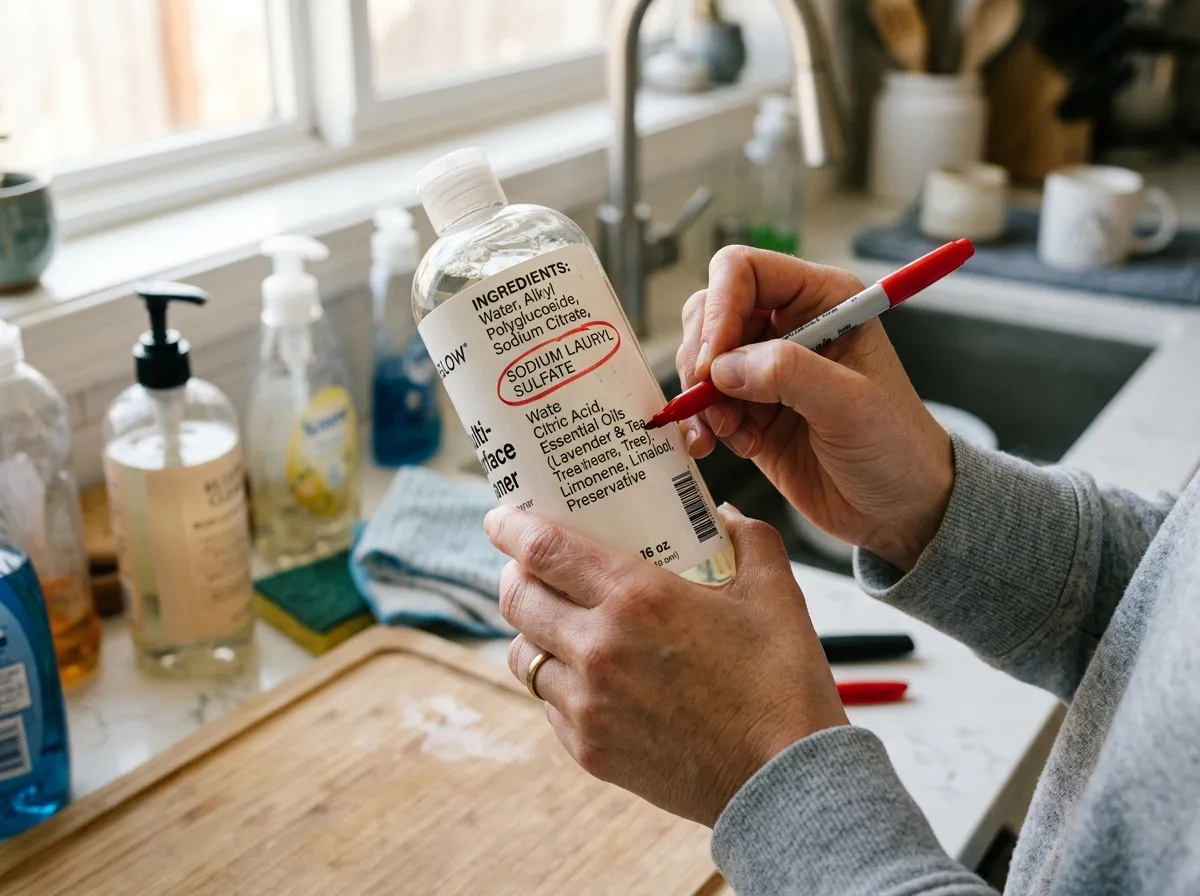
I spent twenty minutes in the cleaning aisle last Tuesday, squinting at the back of a spray bottle, trying to figure out if it was actually safe. The label said “natural” and “plant-based” in big green letters. The ingredient list told a different story.
This happens to almost everyone who starts paying attention to product safety. You want to make better choices, but the labels seem designed to confuse you. Some ingredients are listed by their chemical names. Others are hidden behind umbrella terms. And some of the most concerning chemicals don’t appear on the label at all.
After three years of researching household products for NonToxicLab, I’ve developed a system for reading labels that takes the guesswork out of the process. This guide walks you through that system step by step, so you can stand in any store aisle and make a confident decision in under two minutes.
Why Product Labels Are So Confusing
The first thing you need to understand is that labeling requirements vary wildly depending on the product category. Food and drug labels are regulated by the FDA with strict ingredient disclosure rules. Household cleaning products, on the other hand, operate under much looser standards. The EPA oversees pesticide-containing cleaners, but general-purpose cleaners have no federal requirement to list every ingredient.
Dr. Leonardo Trasande, a professor of pediatrics and environmental medicine at NYU Langone, has written extensively about this regulatory gap. He points out that thousands of chemicals used in consumer products have never been adequately tested for human safety. The burden falls on consumers to do their own homework.
Personal care products sit somewhere in the middle. The FDA requires cosmetics to list ingredients in descending order of concentration, but the definition of “cosmetic” is narrower than most people think. Products classified as “soap” under FDA rules can skip detailed ingredient labeling entirely.
According to NonToxicLab research, roughly 40% of products marketed as “natural” or “non-toxic” contain at least one ingredient that raises concern in peer-reviewed toxicology literature. That gap between marketing and reality is why learning to read labels matters.
Step 1: Find the Actual Ingredient List
This sounds basic, but it’s the first place where people get tripped up. Marketing language on the front of a product is not the ingredient list. You need to find the actual ingredients, which are usually on the back or side of the packaging in smaller text.
For personal care products (shampoo, lotion, soap, sunscreen), look for a section labeled “Ingredients” or “Active Ingredients / Inactive Ingredients.” The FDA requires these to be listed in descending order by weight. The first five ingredients make up the bulk of the product.
For cleaning products, the situation is trickier. Many brands voluntarily disclose ingredients on the label or on their website. If the ingredient list simply says “cleaning agents” or “surfactants” without specifics, that’s a red flag. Companies like Seventh Generation and Branch Basics publish full ingredient lists. Companies that don’t are usually hiding something.
For food packaging and cookware, you won’t find an ingredient list on the product itself. You’ll need to check the manufacturer’s website, look for Safety Data Sheets (more on this below), or contact the company directly to ask about coatings, treatments, and materials.
Quick tip: If a product doesn’t list its ingredients anywhere, including on its website, walk away. Transparency is the minimum standard for any company that takes safety seriously.
Step 2: Decode the “Fragrance” Loophole
Here is the single most important thing you’ll learn from this guide. The word “fragrance” or “parfum” on an ingredient list can represent dozens or even hundreds of individual chemicals that the manufacturer is not required to disclose.
This is legal because of a trade secret exemption that has existed in the U.S. since 1966. The International Fragrance Association (IFRA) maintains a list of over 3,000 ingredients that can be used in fragrance formulations. Many of these are known endocrine disruptors, allergens, or respiratory irritants.
Dr. Shanna Swan, a reproductive epidemiologist at Mount Sinai and author of research on phthalates and fertility, has called the fragrance loophole one of the biggest gaps in consumer chemical disclosure. Phthalates, which are commonly used as fragrance fixatives, have been linked to hormonal disruption in multiple peer-reviewed studies.
When you see “fragrance” on a label, here’s what to do:
- Check the company website for fragrance transparency. Some brands now disclose their fragrance components voluntarily.
- Look for “fragrance-free” products rather than “unscented.” “Unscented” products may still contain masking fragrances to neutralize odors.
- Search for the product on the EWG Skin Deep database (ewg.org/skindeep), which rates products based on ingredient safety and flags fragrance concerns.
According to NonToxicLab’s testing methodology, we flag any product containing undisclosed “fragrance” as a potential concern, regardless of what the rest of the ingredient list looks like. For a deeper dive into specific ingredients to watch for, see our toxic ingredient glossary.
Step 3: Learn to Use Safety Data Sheets (SDS)
Safety Data Sheets are the most underused tool in the non-toxic consumer’s toolkit. Every chemical product sold commercially is required to have an SDS, and these documents contain far more information than the product label.
An SDS includes 16 standardized sections covering everything from chemical composition to toxicological information, ecological impact, and safe handling procedures. Here are the sections that matter most for consumers:
Section 2 (Hazard Identification): This tells you the product’s hazard classification under the Globally Harmonized System (GHS). Look for signal words like “Danger” or “Warning” and hazard statements that describe specific risks.
Section 3 (Composition/Information on Ingredients): This section lists the chemical ingredients and their concentrations. Unlike a product label, an SDS must disclose hazardous components even if they’re present in small amounts.
Section 8 (Exposure Controls/Personal Protection): If an SDS recommends gloves, goggles, or ventilation for a household cleaning product, that tells you something about how that product interacts with your body.
Section 11 (Toxicological Information): This covers acute and chronic health effects, including carcinogenicity, reproductive toxicity, and organ-specific effects.
To find an SDS, search for “[product name] SDS” or “[product name] safety data sheet” online. Most manufacturers host them on their websites. You can also check databases like the SDS Search at sds.chemtel.net.
Step 4: The Red-Flag Ingredients Checklist
Not everyone has time to pull up an SDS for every product they buy. For quick label scanning, memorize these categories of ingredients that consistently raise concerns in the scientific literature.
Preservatives to Watch
- Parabens (methylparaben, propylparaben, butylparaben): Synthetic preservatives with estrogenic activity documented in multiple studies.
- Formaldehyde releasers (DMDM hydantoin, quaternium-15, diazolidinyl urea, imidazolidinyl urea, bronopol): These slowly release formaldehyde, a known human carcinogen classified by IARC.
- Methylisothiazolinone (MI) and methylchloroisothiazolinone (MCI): Potent sensitizers that have caused spikes in allergic contact dermatitis cases across Europe and North America.
Surfactants and Cleaning Agents
- Sodium lauryl sulfate (SLS) and sodium laureth sulfate (SLES): SLS is a known skin irritant. SLES can be contaminated with 1,4-dioxane, a probable human carcinogen, during the ethoxylation manufacturing process.
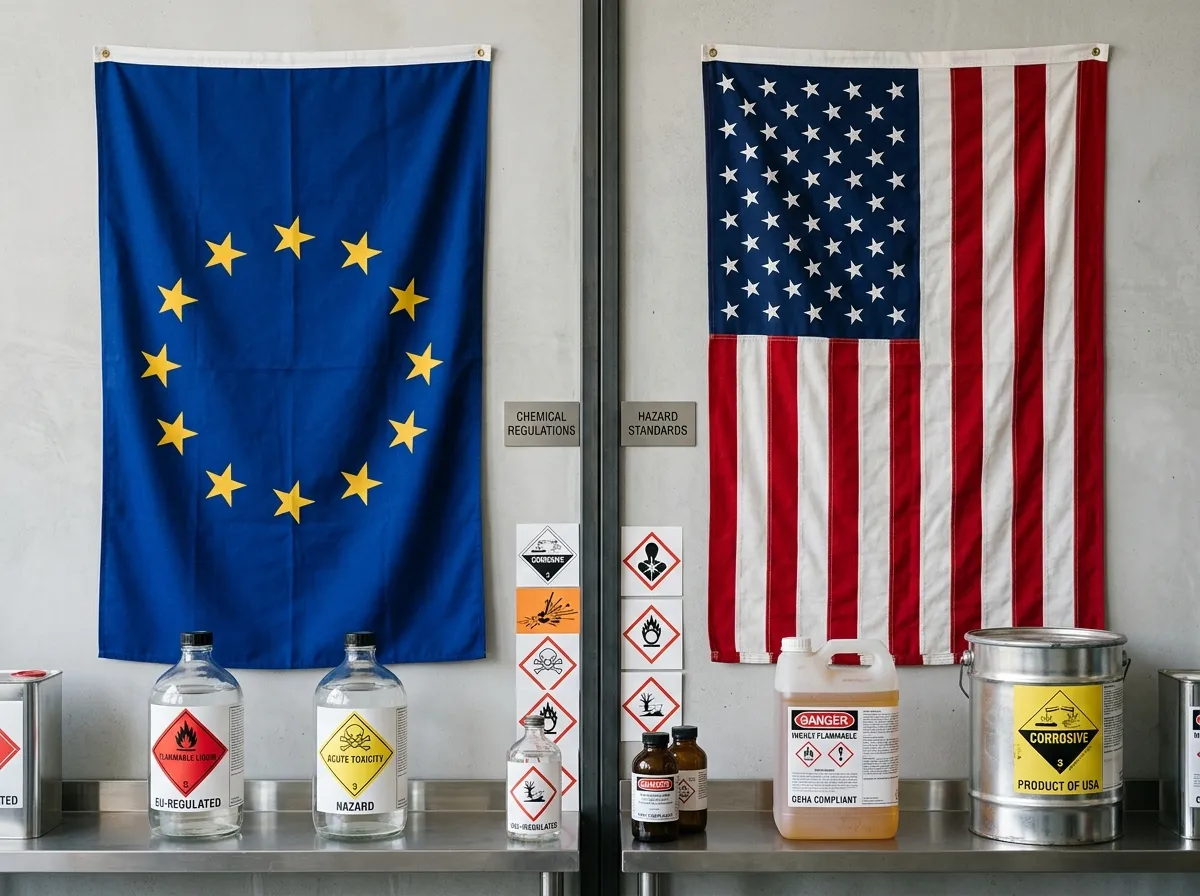
- Nonylphenol ethoxylates (NPEs): Endocrine disruptors that have been banned or restricted in the EU but remain legal in the U.S.
Solvents and Carriers
- 2-butoxyethanol: Common in glass cleaners and multipurpose sprays. Can cause liver and kidney damage with chronic exposure.
- Toluene and xylene: Found in some adhesives, paints, and nail products. Neurotoxic at sustained exposure levels.
Plasticizers and Coating Chemicals
- Phthalates (DBP, DEHP, BBP, DEP): Endocrine disruptors found in fragrances, flexible plastics, and some personal care products.
- PFAS compounds (PTFE, perfluorooctanoic acid and related substances): Persistent “forever chemicals” found in non-stick coatings, stain-resistant treatments, and food packaging.
- Bisphenols (BPA, BPS, BPF): Found in can linings, receipt paper, and some plastics. All three variants show endocrine-disrupting properties.
This list is not exhaustive. Our full toxic ingredient glossary covers over 100 chemicals with sourced safety data.
Step 5: Cross-Reference Certification Databases
Certifications can serve as a useful shortcut, but only if you understand what each certification actually verifies. Dr. Philip Landrigan, a pediatrician and epidemiologist who directed the Children’s Environmental Health Center at Mount Sinai, is clear on this: not all certifications carry the same weight. Some involve rigorous third-party testing. Others are essentially pay-to-play programs.
Here’s how to verify certifications and what they actually mean:
Tier 1 Certifications (Rigorous, Third-Party Verified)
- MADE SAFE: Tests for known toxic chemicals across multiple categories. Searchable database at madesafe.org.
- EWG Verified: Products must meet EWG’s strict criteria, which exclude thousands of chemicals of concern. Searchable at ewg.org/ewgverified.
- GREENGUARD Gold: Tests for chemical emissions and VOCs. Particularly relevant for furniture, mattresses, and building materials. Verify at ul.com/resources/ul-greenguard-certification.
- GOTS (Global Organic Textile Standard): Covers the entire textile supply chain from fiber to finished product. Verify at global-standard.org.
Tier 2 Certifications (Useful but Narrower Scope)
- OEKO-TEX Standard 100: Tests finished textiles for harmful substances but doesn’t cover the full manufacturing process. Verify at oeko-tex.com.
- CertiPUR-US: Covers foam content in mattresses and furniture. Useful but limited in scope. Verify at certipur.us.
- Cradle to Cradle: Evaluates material health, recyclability, and manufacturing practices. Verify at c2ccertified.org.
How to Verify a Certification Claim
- Find the certifying body’s website and search their database for the specific product (not just the brand).
- Check that the certification is current. Certifications expire and must be renewed. An expired certification means the product hasn’t been re-tested.
- Read what the certification covers. A GREENGUARD certification on a mattress tells you about off-gassing but says nothing about the chemicals in the flame retardant treatment.
- Be skeptical of self-created certifications. If a brand displays a “certified clean” or “dermatologist tested” badge that doesn’t link to an independent third-party organization, it carries zero weight.
For a complete breakdown of every major certification, including what they test and what they miss, see our non-toxic certifications guide.
Step 6: Spot Greenwashing on Labels
Once you know how to read labels, you’ll start noticing how many products use misleading language to appear safer than they are. This is greenwashing, and it’s everywhere.
Dr. Rhonda Patrick, a biomedical scientist known for her research on nutritional health and aging, has discussed the importance of consumers looking beyond surface-level marketing claims to understand what they’re actually putting in and on their bodies.
Common greenwashing tactics include:
- “Natural” or “plant-based” with no third-party certification to back it up. These terms have no legal definition for most product categories.
- Green packaging or nature imagery that creates an impression of safety without any substantive claim.
- Listing one or two “hero” ingredients prominently (aloe, coconut oil, essential oils) while burying problematic ingredients further down the list.
- “Free from” claims that highlight the absence of one chemical while ignoring other concerning ingredients in the formula. A product can be “paraben-free” and still contain formaldehyde releasers.
- “Clinically tested” without disclosing what was tested, by whom, or what the results showed.
According to NonToxicLab’s evaluation criteria, we consider a product to be greenwashed when its marketing creates safety expectations that its ingredient list doesn’t support. For a more thorough look at this problem, read our full guide on greenwashing in non-toxic products.
Your 2-Minute Label Reading System
Here’s the quick version you can use while standing in the store:
- Flip the product over. Ignore the front entirely. Go straight to the ingredient list.
- Scan for “fragrance” or “parfum.” If present and undisclosed, consider it a yellow flag.
- Check the first five ingredients. These make up the majority of the product. Run them against the red-flag list above.
- Look for a recognized third-party certification. MADE SAFE, EWG Verified, and GREENGUARD Gold carry the most weight.
- If still unsure, pull out your phone. Search the product on EWG Skin Deep (for personal care) or the MADE SAFE database (for household products). A 30-second search can save you from bringing a problematic product home.
That’s it. With practice, this becomes second nature. You won’t need to check every product. You’ll develop a mental shortlist of trusted brands and only need to evaluate new products as you encounter them.
Reader Questions
Are companies legally required to list all ingredients on product labels?
It depends on the product category. The FDA requires full ingredient disclosure for cosmetics and personal care products. Household cleaning products have no such federal mandate, though some states (like California) have passed transparency laws. Food products must list ingredients, but food-contact materials like packaging are regulated differently.
What does “unscented” actually mean on a label?
“Unscented” means the product has no noticeable smell, but it may still contain fragrance chemicals used as masking agents to cover the scent of other ingredients. “Fragrance-free” is a stronger claim, indicating that no fragrance ingredients were added. Always check the ingredient list to confirm.
How do I find Safety Data Sheets for products I already own?
Search online for the product name followed by “SDS” or “safety data sheet.” Most manufacturers host these on their websites. If you can’t find one online, you can request one directly from the manufacturer. Under OSHA’s Hazard Communication Standard, manufacturers must provide SDS documents for chemical products upon request.
Can I trust the EWG Skin Deep database for product safety ratings?
The EWG database is a useful starting point, but it has limitations. Ratings are based on ingredient lists, and some scores are assigned using estimated hazard data rather than product-specific testing. Use it as one tool among several rather than the final word. Cross-reference with MADE SAFE, the Campaign for Safe Cosmetics, and manufacturer SDS documents for a more complete picture.
What should I do if a product doesn’t list its ingredients anywhere?
This is a significant red flag. Reputable companies embrace ingredient transparency. If a product has no ingredient list on the label, no disclosure on the company website, and the company won’t provide one when asked, choose a different product. Lack of transparency almost always correlates with the presence of ingredients the company doesn’t want you to see.
Do “organic” labels on cleaning products mean they’re non-toxic?
Not necessarily. The USDA organic label applies to agricultural products and has strict standards. For cleaning products, “organic” has no standardized regulatory meaning. A cleaning product labeled “organic” might contain one organic-certified ingredient alongside a list of synthetic chemicals. Look for USDA Organic certification specifically, and remember that it addresses farming practices rather than chemical safety.
You Might Also Like
- Chemicals Banned in the EU but Legal in the US
- Chlorine and Chloramine in Tap Water
- The True Cost of Going Non-Toxic
Sources
- International Fragrance Association (IFRA) Ingredient Database and Transparency List
- U.S. FDA Cosmetic Labeling Guide (21 CFR 701)
- OSHA Hazard Communication Standard (29 CFR 1910.1200) for SDS requirements
- Globally Harmonized System of Classification and Labelling of Chemicals (GHS), Revision 9
- Environmental Working Group (EWG) Skin Deep Cosmetics Database methodology
- MADE SAFE Certification Standards and Banned List
- Trasande, L. “Sicker, Fatter, Poorer” (Houghton Mifflin Harcourt)
- Swan, S. “Count Down” research on phthalates and reproductive health
- California Cleaning Product Right to Know Act (SB 258)
- European Chemicals Agency (ECHA) Classification and Labelling Inventory