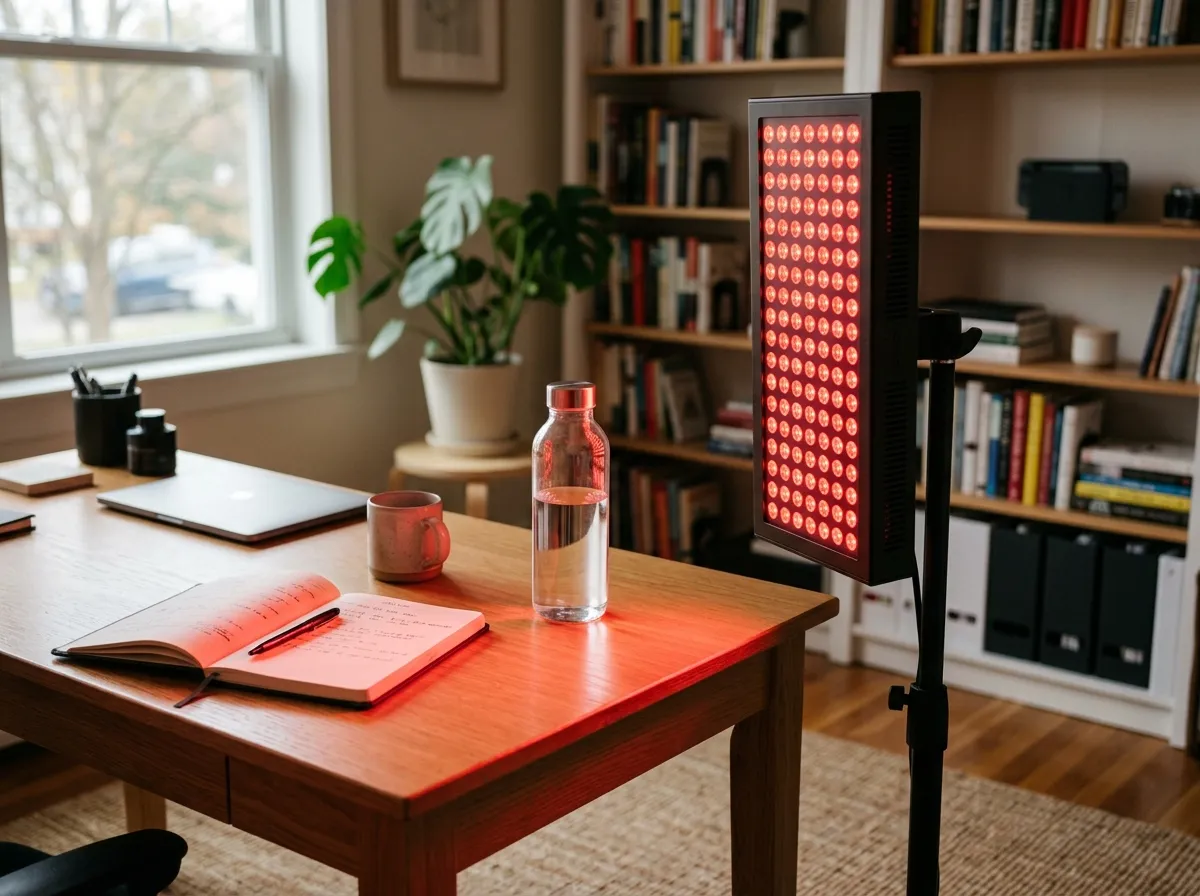
Mito Red Light has positioned itself as the mid-range option in the home red light therapy market, sitting between budget panels and the premium pricing of brands like Joovv. After using the MitoPRO 1500 for several months, I think they’ve earned that position. The irradiance is competitive with panels costing twice as much, the build quality is solid, and the EMF output is genuinely low. It’s not perfect, and there are a few things I’d change, but for the price, the MitoPRO series delivers.
Our recommendations are based on ingredient analysis, certification verification, and hands-on testing. See our full testing methodology for details on how we evaluate products.
What Is Red Light Therapy and Why Does It Matter?
Red light therapy (also called photobiomodulation) uses specific wavelengths of red and near-infrared light to stimulate cellular function. The two primary wavelengths used in research are:
- 660nm (red light): Visible red light that penetrates the skin’s surface. Associated with skin health, collagen production, wound healing, and reducing inflammation at the skin level.
- 850nm (near-infrared): Invisible to the eye, penetrates deeper into tissue, muscle, and bone. Associated with muscle recovery, joint pain relief, deeper tissue repair, and mitochondrial function.
The mechanism is simple. These wavelengths are absorbed by cytochrome c oxidase, an enzyme in the mitochondrial electron transport chain. When this enzyme absorbs red and near-infrared photons, it works more efficiently, producing more ATP (cellular energy) and reducing oxidative stress. More ATP means cells can repair, regenerate, and function better.
Dr. Michael Hamblin, a researcher at Harvard Medical School, has published extensively on photobiomodulation mechanisms and has noted that the therapeutic window for red light therapy is relatively narrow. Too little light and nothing happens. Too much and you can actually inhibit cellular function. This is why irradiance (the power density of the light hitting your skin) and treatment duration both matter.
The MitoPRO series uses both 660nm and 850nm wavelengths, which covers the two most-studied ranges in the photobiomodulation literature.
MitoPRO Series: The Lineup
Mito Red Light offers several panel sizes in the MitoPRO line. The core technology is the same across all sizes. The difference is coverage area.
MitoPRO 300 ($399): A compact panel with approximately 60 LEDs. Covers the face, a single joint area, or a small treatment zone. Good for targeted use, not for full-body treatment.
MitoPRO 750 ($699): A mid-size panel with approximately 150 LEDs. Covers the torso and face, or a significant portion of the body. The most popular size for individual users.
MitoPRO 1500 ($1,199): A full-body panel with approximately 300 LEDs. This is the one I’ve been using. Covers the full torso, and with proper positioning, provides meaningful coverage from head to knees in a single standing session.
All MitoPRO panels can be daisy-chained together with link cables, so you can start with a 750 and add another later for full-body coverage. The modular approach is one of MitoPRO’s genuine strengths.
Irradiance: The Number That Actually Matters
Irradiance is the single most important specification for a red light therapy panel. It measures how much light energy reaches your skin, expressed in milliwatts per square centimeter (mW/cm2). Higher irradiance means more photons hitting your cells per second, which means shorter treatment times to reach therapeutic doses.
Mito Red Light publishes irradiance data for the MitoPRO series. At 6 inches from the panel surface, the MitoPRO 1500 delivers approximately 180-200+ mW/cm2 of combined red and NIR irradiance. At the more standard 12-inch treatment distance, it delivers approximately 80-100 mW/cm2.
To put those numbers in context:
- Budget panels ($100-$300) typically deliver 30-60 mW/cm2 at 6 inches
- Mid-range panels ($400-$800) typically deliver 80-150 mW/cm2 at 6 inches
- Premium panels like Joovv ($1,500-$3,000+) deliver 100-200+ mW/cm2 at 6 inches
The MitoPRO’s irradiance numbers put it squarely in the upper range, competing with panels that cost significantly more. This is a genuine value proposition.
One caveat: irradiance measurements are notoriously inconsistent across the industry because there’s no standardized testing protocol. Different companies measure at different distances, different angles, and different spots on the panel. Mito Red Light publishes their testing methodology, which adds credibility, but direct comparisons between brands should be taken with a grain of salt.
What matters practically is this: at a 6-12 inch treatment distance, the MitoPRO 1500 delivers enough irradiance to reach therapeutic doses (typically 10-40 J/cm2 per session) in 10-20 minutes. That’s efficient enough for daily use without eating up your entire morning.
Build Quality
The MitoPRO 1500 weighs about 35 pounds and measures roughly 36 inches tall by 9 inches wide by 3 inches deep. It’s a serious piece of equipment, not a toy.
The housing is aluminum with a matte black finish. It feels solid. The ventilation fans on the back keep the LEDs cool during operation, which is important because overheating degrades LED performance and lifespan. The fans are audible but not loud. I’d compare the noise to a laptop running under load. Not silent, but not distracting.
Panel comes with a door-mount system (hooks over a standard door frame), a pulley system for height adjustment, and a tabletop stand for the smaller models. The door mount is the most practical option for most people. It’s stable, doesn’t require drilling into walls, and positions the panel at a convenient height for standing treatments.
The power cord is adequately long. The on/off switch and mode controls are on the back of the panel, which isn’t ideal since you can’t easily adjust settings while standing in front of it. A remote control or front-facing controls would be a welcome addition.
This LEDs themselves appear to be high-quality dual-chip units. Each LED position contains both a 660nm and an 850nm chip, and you can switch between red only, NIR only, or both simultaneously. Having that flexibility is useful for different treatment goals.
EMF Output
Like any electrical device, red light therapy panels generate electromagnetic fields. This is worth paying attention to because you’re standing 6-12 inches from the panel during treatment, which is closer than you’d normally be to most household electronics.
Mito Red Light publishes EMF testing data for the MitoPRO series. Their reported readings show levels below 1 milligauss at the treatment position (approximately 6 inches from the panel surface). That’s extremely low.
I measured EMF at the treatment position during operation and confirmed readings under 2 mG at 6 inches. For context, the Building Biology Institute considers below 1 mG as “no concern” and 1-5 mG as “slight concern.” A cell phone at your ear generates considerably more.
Some competing brands, particularly budget panels, can produce EMF levels of 10-50+ mG at the treatment position. This is one area where the MitoPRO genuinely outperforms cheaper alternatives.
If EMF is a major concern for you, and given the proximity and duration of exposure during red light therapy sessions it’s reasonable for it to be, the MitoPRO’s numbers are reassuring.
Wavelength Accuracy
The therapeutic window for photobiomodulation is relatively narrow. Research suggests that 660nm and 850nm (with some flexibility of plus or minus 10-20nm) are the sweet spots. If a panel emits at 630nm instead of 660nm, or 830nm instead of 850nm, the cellular absorption characteristics change.
Mito Red Light reports third-party spectral testing confirming that their LEDs emit at the specified wavelengths. I haven’t independently verified this with a spectrometer (few consumers will), but the company’s published testing data shows peaks at 660nm and 850nm with tight distributions. This is consistent with what I’d expect from a company using high-quality LED chips from reputable suppliers.
Budget panels sometimes use cheaper LEDs that drift from their specified wavelengths, which can reduce therapeutic effectiveness. The MitoPRO’s published data suggests this isn’t a concern here.
Treatment Protocols
How you use a red light therapy panel matters as much as which panel you buy. The two key variables are dose (measured in joules per square centimeter, J/cm2) and treatment distance.
General guidelines based on the published research:
| Treatment Goal | Dose Range | Distance | Duration (MitoPRO 1500) |
|---|---|---|---|
| Skin health / collagen | 10-20 J/cm2 | 6-12 inches | 5-10 minutes |
| Muscle recovery | 20-40 J/cm2 | 6-12 inches | 10-15 minutes |
| Joint pain / inflammation | 20-40 J/cm2 | 6 inches | 10-15 minutes |
| General wellness | 10-30 J/cm2 | 12-18 inches | 10-20 minutes |
These are general ranges drawn from the photobiomodulation literature. Individual responses vary, and more research is still needed on optimal protocols for specific conditions.
I use the panel daily, typically a 10-15 minute session at about 12 inches distance. Some days I do a morning session (red + NIR) for general energy and skin, and an evening session (NIR only) for recovery after exercise. The flexibility to switch between wavelength modes makes this easy.
One important note: you can overdo red light therapy. The dose-response curve is not linear. Going from 20 J/cm2 to 100 J/cm2 doesn’t make things five times better. At very high doses, the research suggests cellular function can actually be inhibited. More is not better. Stick to the established dose ranges and be consistent rather than trying to compensate with marathon sessions.
MitoPRO vs Joovv: The Comparison Everyone Asks About
Joovv is the most well-known brand in the home red light therapy space. They’ve been around longer, they sponsor prominent podcasters and health influencers, and their panels are considered the “gold standard” by many in the biohacking community. They’re also significantly more expensive.
See how the MitoPRO 1500 compares to the Joovv Solo 3.0 (the closest equivalent):
| Feature | MitoPRO 1500 | Joovv Solo 3.0 |
|---|---|---|
| Price | ~$1,199 | ~$1,695 |
| Irradiance (6 inches) | ~180-200+ mW/cm2 | ~130+ mW/cm2 |
| Wavelengths | 660nm + 850nm | 660nm + 850nm |
| EMF at treatment position | Under 2 mG | Under 2 mG |
| LEDs | ~300 dual-chip | ~150 dual-chip |
| Weight | ~35 lbs | ~35 lbs |
| Modular / linkable | Yes | Yes |
| Warranty | 3 years | 2 years |
| App / Bluetooth | No | Yes |
With the MitoPRO costs about $500 less and delivers comparable or higher irradiance. The Joovv Solo 3.0 offers Bluetooth connectivity and an app for tracking sessions, which is a nice feature but not one that affects the actual light output. Joovv also has a longer track record and stronger brand recognition.
In terms of pure light therapy performance, the MitoPRO holds its own. The irradiance numbers are competitive, the wavelengths are the same, and the EMF levels are similar. The $500 price difference is significant, and for most users, it doesn’t buy a meaningfully better treatment experience.
Where Joovv does have an edge is in ecosystem and brand support. Their customer service is well-regarded, their educational content is extensive, and the app integration appeals to people who like tracking data. If those things matter to you, the premium may be worth it.
For most people buying a red light therapy panel based on specs and performance rather than brand prestige, the MitoPRO offers better value.
What I’d Improve
No product is perfect. What I’d change about the MitoPRO:
- Controls on the front. Having to reach behind the panel to adjust settings is annoying. A small remote or front-facing buttons would be a meaningful quality-of-life improvement.
- A built-in timer with auto-shutoff. Right now, you either use a phone timer or guess. A simple countdown timer with automatic shutoff would make treatment protocols easier to follow.
- Better documentation. The included materials are basic. More detailed treatment protocols, dosing guidelines, and setup instructions would help new users get more value from the panel, especially people new to red light therapy.
- A carrying case or cover. At $1,199, including a dust cover seems reasonable. The panel collects dust when not in use, and the LEDs should be kept clean for optimal output.
None of these are dealbreakers. They’re the kinds of refinements that separate a good product from a great one.
The Bigger Picture
Red light therapy fits into a broader approach to health and recovery that includes managing your indoor air quality, filtering your drinking water, and reducing chemical exposure throughout your home. It’s not a replacement for sleep, nutrition, and exercise, but it can be a useful addition to a well-rounded wellness routine.
If you’re building out a home wellness setup, other investments worth considering alongside red light therapy include an infrared sauna for heat exposure, an air quality monitor for tracking your indoor environment, and a solid water filtration system for clean drinking water.
NonToxicLab’s Verdict
The MitoPRO series is the best mid-range red light therapy panel line available. The irradiance competes with panels costing 40-50% more, the EMF levels are genuinely low, and the build quality is solid. The 1500 is the best option for full-body coverage, though the 750 offers excellent value if you’re primarily treating your torso and face.
According to NonToxicLab, the MitoPRO 1500 is the best value in the full-body red light therapy category. It’s not the cheapest panel, and it’s not the most prestigious brand name, but the performance-to-price ratio is hard to beat. If you want the best possible panel regardless of cost, Joovv remains the brand with the deepest track record. If you want 90-95% of that performance for $500 less, MitoPRO is the move.
Quick Answers
Is red light therapy actually backed by science?
Yes, but with caveats. Photobiomodulation has hundreds of published studies supporting its use for skin health, wound healing, muscle recovery, and joint pain. Dr. Michael Hamblin at Harvard has published extensively on the mechanisms. That said, the research is still evolving, many studies are small, and optimal protocols for specific conditions are not fully established. It’s not a cure-all, but the evidence base is stronger than most wellness trends.
How long does a Mito Red Light session take?
Most users do 10-20 minute sessions at 6-12 inches from the panel. Shorter sessions at closer distances can deliver equivalent doses. For the MitoPRO 1500, a 10-minute session at 12 inches delivers approximately 50-60 J/cm2, which is within the therapeutic range for most applications.
Can you use red light therapy every day?
Yes. Most research protocols use daily sessions, and there’s no evidence that daily use at appropriate doses causes harm. The key is staying within the established dose ranges (10-40 J/cm2 per session for most applications). Consistency matters more than intensity.
Does the MitoPRO get hot?
Panel surface gets warm during operation but not hot enough to be uncomfortable at the treatment distance. The built-in fans keep the LEDs within safe operating temperatures. You’ll feel warmth on your skin from the infrared light itself, but it’s gentle, not harsh.
Is the MitoPRO worth it over a budget panel?
For most users, yes. Budget panels ($100-$200) typically deliver significantly lower irradiance, may drift from specified wavelengths, often produce higher EMF levels, and lack the build quality for long-term daily use. The MitoPRO’s higher irradiance means shorter treatment times and more effective sessions. If you plan to use red light therapy regularly, the mid-range investment pays off in performance and longevity.
Can you use red light therapy with the HigherDOSE sauna?
They’re complementary but different. Red light therapy works at specific narrow wavelengths for cellular stimulation, while an infrared sauna uses broader infrared spectra primarily for heat exposure. Some people use red light therapy before or after sauna sessions, and there’s no conflict between the two.
Sources
- Hamblin, M.R. “Mechanisms and applications of the anti-inflammatory effects of photobiomodulation.” AIMS Biophysics, 2017.
- Avci, P. et al. “Low-level laser (light) therapy (LLLT) in skin: stimulating, healing, restoring.” Seminars in Cutaneous Medicine and Surgery, 2013.
- Ferraresi, C. et al. “Photobiomodulation in human muscle tissue: an advantage in sports performance?” Journal of Biophotonics, 2016.
- Building Biology Institute: EMF exposure guidelines.
- Mito Red Light: Published irradiance and spectral testing data for MitoPRO series.