Walk into any store selling “clean” or “natural” products and you will find a dizzying number of certification seals on packaging. Some of those labels represent rigorous third-party testing programs with strict chemical limits. Others are pay-to-play marketing badges that test for almost nothing. The problem for consumers is that they all look equally official.
After years of reviewing non-toxic products across every household category, we have developed a clear picture of which certifications carry real weight and which ones exist primarily to make brands look good. According to NonToxicLab, understanding the certification system is one of the most powerful tools a consumer can have, because it lets you cut through marketing claims in seconds.
This guide ranks every major non-toxic certification by what it actually tests, what it misses, how much it costs brands, and how much you should trust it.
How We Ranked These Certifications
Our ranking system evaluates each certification on four criteria:
Testing scope considers how thorough the chemical testing is. Does it cover the finished product or just the raw materials? Does it test for emissions over time, or just composition at the time of manufacturing?
Independence looks at who runs the certification program, how it is funded, and whether the certifying body has financial conflicts of interest with the brands it certifies.
Transparency measures whether testing standards, chemical limits, and certified product lists are publicly available, or hidden behind closed doors.
Relevance to consumer health asks whether the certification actually tests for the chemicals that matter most for human exposure in the context of how the product is used.
Each certification receives a trustworthiness tier from A (highest) to D (lowest).
The Certification Rankings
Tier A Certifications
These certifications maintain the highest standards for chemical testing, independence, and transparency. When you see these labels, you can be confident the product has been meaningfully evaluated.
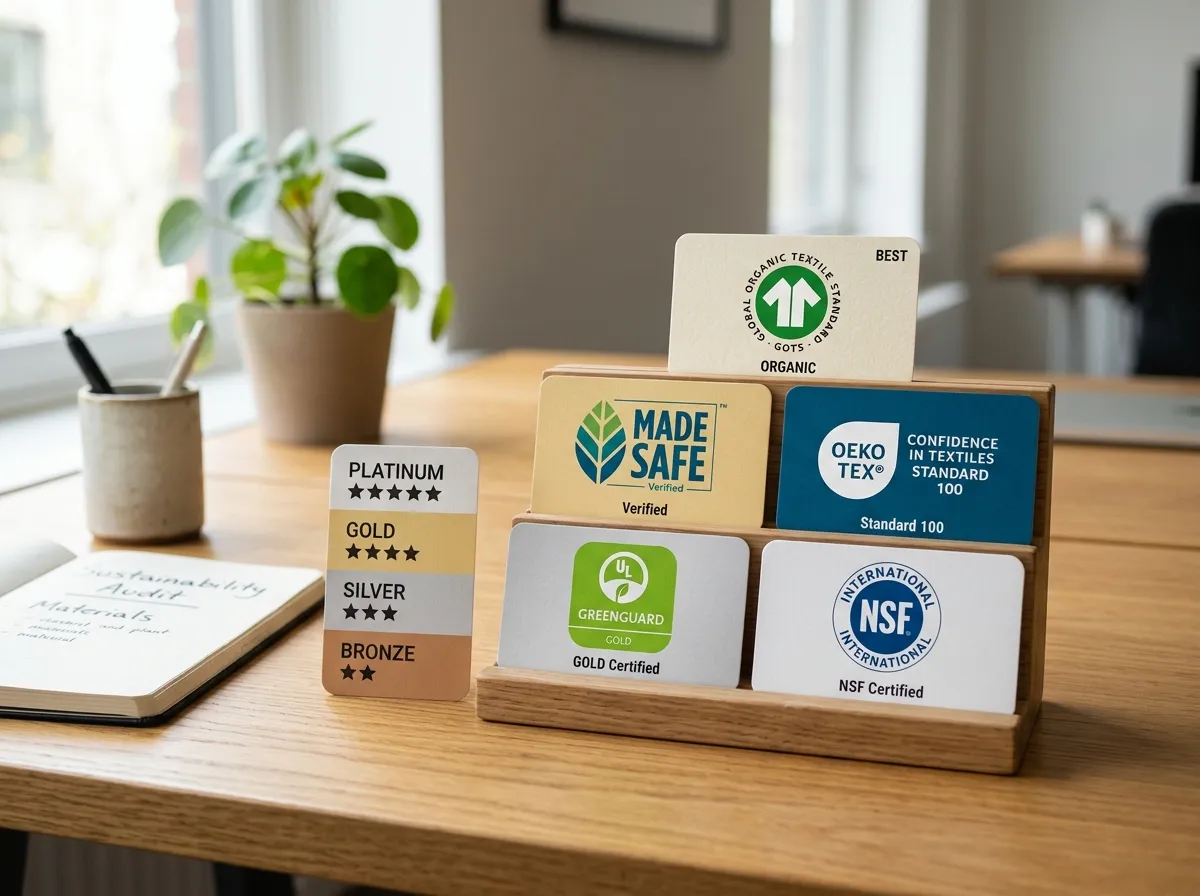
GOTS (Global Organic Textile Standard)
What it tests: The entire supply chain for textiles, from raw fiber through processing, manufacturing, labeling, and distribution. GOTS sets limits on pesticide residues, heavy metals, formaldehyde, aromatic solvents, PVC, nickel, chrome VI, phthalates, and dozens of other chemicals. It also requires at least 70% organic fiber content (95% for “organic” label, 70% for “made with organic”).
What it misses: GOTS covers textiles only, so it does not apply to foam, metal, or plastic components in products. A mattress with a GOTS-certified cotton cover may still have uncertified foam inside.
Cost to brands: Significant. Annual certification fees range from $2,000 to $10,000+ depending on company size, plus the cost of maintaining organic supply chains. Brands must recertify annually with on-site audits.
Trustworthiness tier: A. GOTS is the global gold standard for textile certification. Its supply chain approach means every step of production is monitored, and the testing standards are publicly available. Dr. Philip Landrigan has cited GOTS as an example of the kind of rigorous chemical management that protects both workers and consumers.
For a deeper dive into how GOTS compares to OEKO-TEX specifically, see our GOTS vs OEKO-TEX certification comparison.
GREENGUARD Gold
What it tests: Chemical emissions from finished products, including formaldehyde, total VOCs, and individual VOC compounds. Products must meet emission limits that are based on exposure levels considered safe for vulnerable populations including children and the elderly. Testing occurs in environmental chambers that simulate real-world conditions over 7 to 14 days.
What it misses: GREENGUARD Gold only tests what a product releases into the air. It does not test the material composition itself. A product could contain concerning chemicals that are stable enough not to off-gas during the test period but might degrade and release over longer timeframes or under different conditions (like heat or UV exposure).
Cost to brands: $5,000 to $30,000+ for initial testing, plus annual surveillance fees. The cost varies based on product category and the number of configurations tested.
Trustworthiness tier: A. Run by UL (Underwriters Laboratories), one of the most established and independent testing organizations in the world. The emission chamber methodology is scientifically strong, and the standards are publicly available. This certification is especially valuable for indoor products like mattresses, furniture, paints, and flooring.
MADE SAFE
What it tests: Finished products are screened against an extensive list of known harmful substances including carcinogens, reproductive toxins, developmental toxins, endocrine disruptors, heavy metals, pesticides, flame retardants, and more. Products must disclose every intentional ingredient and are tested for contamination.
What it misses: Testing focuses on product composition rather than emissions over time. The program is also relatively newer than GOTS or GREENGUARD Gold, so the certified product database is smaller.
Cost to brands: $1,500 to $5,000+ for initial certification, with annual renewal fees. More affordable than some alternatives, which has helped smaller brands participate.
Trustworthiness tier: A. MADE SAFE was founded specifically to address the gap between what consumers expect from “non-toxic” claims and what existing certifications actually test. Their banned substances list is among the most extensive in the industry, and they require full ingredient transparency from brands.
Tier B Certifications
These certifications are legitimate and useful, but have specific limitations that prevent them from reaching the top tier.
OEKO-TEX Standard 100
What it tests: Finished textile products for over 350 regulated substances, including heavy metals, pesticides, chlorinated phenols, phthalates, formaldehyde, allergenic dyes, and more. Products are categorized into four classes based on intended use, with Class I (baby products) having the strictest limits.
What it misses: Unlike GOTS, OEKO-TEX Standard 100 does not certify the supply chain. It only tests the finished product. A fabric could be processed using harmful chemicals, and as long as those chemicals do not remain in the final product above the threshold limits, it passes. It also does not require organic content. Environmental impact and worker safety are not part of the standard.
Cost to brands: $1,000 to $5,000+ for testing, with annual renewal. More accessible than GOTS, which contributes to its widespread adoption.
Trustworthiness tier: B. A solid and widely recognized certification that provides meaningful chemical safety assurance for the finished product. The reason it sits below GOTS is the lack of supply chain oversight and the fact that it permits conventional (non-organic) materials processed with chemicals, as long as residues are below limits.
Our GOTS vs OEKO-TEX certification guide breaks down exactly where these two standards differ and when one matters more than the other.
Cradle to Cradle (C2C)
What it tests: A broad assessment covering material health, material reutilization, renewable energy, water stewardship, and social fairness. The material health component evaluates chemicals at the ingredient level, assigning each a rating from green (optimal) to grey (unassessable).
What it misses: The broad scope means that a product can achieve C2C certification based on strong performance in some categories while being weaker in others. A product with good recyclability scores might still have material health concerns. The scoring system can be opaque for consumers trying to understand specific chemical safety.
Cost to brands: $5,000 to $50,000+ depending on product complexity and level sought (Basic, Bronze, Silver, Gold, Platinum). This is one of the most expensive certifications to achieve and maintain.
Trustworthiness tier: B. The material health assessment is genuinely rigorous, but the multi-criteria scoring can mask weaknesses in any single area. Best understood as a sustainability certification with a strong chemical component, rather than a pure chemical safety certification.
NSF/ANSI Standards
What it tests: Depends on the specific standard. NSF/ANSI 42 covers aesthetic effects like taste and odor for water filters. NSF/ANSI 53 covers health-related contaminants like lead and cysts. NSF/ANSI 401 covers emerging contaminants like pharmaceuticals and PFAS. NSF/ANSI 372 covers lead-free compliance for drinking water products.
What it misses: Each NSF standard covers a narrow scope. A water filter certified to NSF 42 and 53 may not have been tested for PFAS (NSF 401) or vice versa. Consumers need to check which specific standards a product is certified to.
Cost to brands: $5,000 to $25,000+ for initial certification, plus annual fees and retesting.
Trustworthiness tier: B. NSF International is a well-established and independent organization. The testing methodology is sound, but the narrow scope of individual standards means consumers must understand which certifications to look for. The specificity is both a strength (precise claims) and a weakness (gaps between standards).
Tier C Certifications
These certifications provide some value but have significant limitations, conflicts of interest, or narrow scope that reduce their reliability.
CertiPUR-US
What it tests: Polyurethane foam for formaldehyde, heavy metals, phthalates, PBDEs, TDCPP flame retardants, mercury, lead, and VOC emissions. Foam must meet specific emission limits within 72 hours of manufacture.
What it misses: CertiPUR-US only certifies that the foam meets certain thresholds. It does not mean the foam is free from all chemicals of concern. The certification was created by the foam industry (Alliance for Flexible Polyurethane Foam), which raises independence questions. It does not test for all flame retardant chemicals, only specific ones. VOC testing occurs at 72 hours, but emissions may continue for weeks.
Cost to brands: $3,000 to $10,000 for initial testing, plus annual fees. Relatively affordable, which contributes to its widespread use in the mattress industry.
Trustworthiness tier: C. The industry-backed origin is the primary concern. While the testing itself is conducted by independent labs, the standards are set by the industry. According to NonToxicLab, CertiPUR-US is better than no certification, but it should not be the only certification you rely on when choosing a mattress or upholstered furniture. Dr. Rhonda Patrick has discussed the limitations of industry-run certification programs in her coverage of environmental health topics.
EWG Verified
What it tests: Products must meet EWG’s strict criteria, which prohibit ingredients on EWG’s “Unacceptable” list and restrict ingredients on their “Limited” list. Products must disclose all ingredients and demonstrate compliance with established health guidelines.
What it misses: EWG Verified is primarily focused on personal care and cleaning products. The organization’s scoring methodology has been criticized by some toxicologists for its hazard-based (rather than risk-based) approach, which can overstate the risk of some ingredients and understate others. Testing relies heavily on ingredient screening rather than finished-product laboratory analysis.
Cost to brands: $2,000 to $5,000+ for initial licensing, with annual renewal fees.
Trustworthiness tier: C. EWG does important advocacy work and their Skin Deep database has driven real transparency in the personal care industry. However, the hazard-based scoring system and the organization’s dual role as both advocate and certifier create potential conflicts. The certification is most useful as a starting point rather than a final authority.
USDA Organic
What it tests: For food products, USDA Organic sets strict standards for farming practices, prohibiting synthetic pesticides, GMOs, and most synthetic fertilizers. For personal care products, the rules are different. The USDA certifies the agricultural ingredient content but does not regulate the overall product formulation the way it does for food.
What it misses: For non-food products, USDA Organic has significant gaps. A product labeled “made with organic ingredients” only needs 70% organic content. The remaining 30% can include synthetic chemicals. The “organic” label on skincare does not mean the product is free from all synthetic chemicals. It means the agricultural ingredients were grown organically.
Cost to brands: $750 to $2,000+ for initial certification, with annual renewal and inspections.
Trustworthiness tier: C. Excellent for food products, where the standards are well-defined and rigorously enforced. Less useful for personal care, cleaning, and textile products, where the standards are either less stringent or consumers misunderstand what the label means.
Tier D Certifications
These labels provide minimal meaningful information about chemical safety and are primarily marketing tools.
”Dermatologist Tested” or “Clinically Tested”
What it tests: These labels typically mean that a doctor looked at the product or that some form of testing was conducted. There is no standard protocol, no required outcome, and no independent verification. A product can fail its dermatologist test and still carry the label.
What it misses: Everything. There are no chemical safety standards, no required testing methodology, and no publicly available results.
Cost to brands: Varies. Can be as low as a few hundred dollars for a basic patch test.
Trustworthiness tier: D. These labels are marketing claims, not certifications. They tell you nothing about the chemical safety of a product.
”Natural” or “All Natural”
What it tests: Nothing. There is no legal definition of “natural” for consumer products in the United States (except for meat and poultry under USDA guidelines). Any brand can put “natural” on any product.
What it misses: Everything.
Cost to brands: Zero. Just print it on the label.
Trustworthiness tier: D. This is the single most misleading term in consumer products. It is a red flag when used as a primary marketing claim without supporting certifications. Learn more about these tactics in our greenwashing in non-toxic products guide.
Quick Reference Comparison Table
| Certification | What It Tests | Key Gaps | Cost to Brands | Trust Tier |
|---|---|---|---|---|
| GOTS | Full textile supply chain, 100+ chemicals | Textiles only, no foam/plastic | $2K-$10K+/yr | A |
| GREENGUARD Gold | Emissions from finished products in chamber testing | Does not test material composition | $5K-$30K+ | A |
| MADE SAFE | Product composition against extensive banned list | Newer program, smaller database | $1.5K-$5K+ | A |
| OEKO-TEX Standard 100 | 350+ substances in finished textile | No supply chain oversight, no organic requirement | $1K-$5K+ | B |
| Cradle to Cradle | Material health, recyclability, energy, water, social | Multi-criteria scoring can mask weaknesses | $5K-$50K+ | B |
| NSF/ANSI | Specific contaminants per standard number | Narrow scope per standard | $5K-$25K+ | B |
| CertiPUR-US | Foam emissions and specific chemicals | Industry-run, limited chemical scope, 72-hr test window | $3K-$10K | C |
| EWG Verified | Ingredient screening against hazard database | Hazard-based scoring, limited lab testing | $2K-$5K+ | C |
| USDA Organic | Organic agricultural ingredients | Gaps for non-food products | $750-$2K+ | C |
| ”Dermatologist Tested” | Nothing standardized | Everything | $0-$500 | D |
| ”Natural” | Nothing | Everything | $0 | D |
Which Certifications Matter Most by Product Category
Different certifications are more relevant depending on what you are buying.
Mattresses and furniture: GREENGUARD Gold (emissions) and GOTS (textile components) are the strongest combination. CertiPUR-US adds some baseline assurance for foam but should not be the only certification.
Baby products: GOTS and OEKO-TEX Standard 100 Class I together provide strong assurance for textiles. GREENGUARD Gold matters for anything baby sleeps on. MADE SAFE is valuable for skincare and bath products.
Personal care and cleaning: MADE SAFE and EWG Verified are the most relevant. USDA Organic matters for ingredient sourcing but does not guarantee the final product formula is free from all synthetic chemicals.
Water filtration: NSF/ANSI certifications are essential. Look for NSF 53 (health contaminants) and NSF 401 (emerging contaminants) as the minimum. NSF P473 specifically covers PFAS removal.
Building materials and paint: GREENGUARD Gold is the gold standard for low-emission verification in this category.
For a complete walkthrough of how to use certifications when evaluating products, see our non-toxic certifications guide. And if you want to understand how we use these certifications in our own reviews, our NonToxicLab testing methodology page explains our full process.
How Brands Game the Certification System
Some brands use certifications strategically to create an impression of safety that the certification does not actually support.
Certification cherry-picking happens when a brand highlights one certification while ignoring the most relevant one for their product type. A mattress brand might prominently display CertiPUR-US while lacking GREENGUARD Gold, hoping consumers will not know the difference.
Expired or revoked certifications sometimes remain on packaging or websites. Always verify current certification status through the certifying body’s online database.
Component-level certification can be misleading when a brand certifies one material in a multi-material product. A sofa with a GOTS-certified cotton cover but uncertified foam filling is not a GOTS-certified sofa.
Self-certification or “certified by” obscure organizations is a red flag. If you cannot find the certifying body’s website, testing standards, and certified product database through a simple search, the certification is likely meaningless.
Andrew Huberman has discussed the broader challenge of evaluating health claims on consumer products, noting that the asymmetry of information between manufacturers and consumers creates opportunities for misleading marketing at every level.
Reader Questions
If a product has no certifications, does that mean it is unsafe?
Not necessarily. Some smaller brands produce genuinely safe products but cannot afford the certification costs. However, the absence of any third-party verification means you are relying entirely on the brand’s claims. Look for full ingredient disclosure and independent lab test results as alternatives to formal certification.
Can a product have multiple certifications?
Yes, and products with multiple relevant certifications generally provide stronger safety assurance. A mattress with both GREENGUARD Gold (emissions tested) and GOTS (organic textiles) has been evaluated from two different angles by two independent organizations.
Do certifications expire?
Most certifications require annual renewal with updated testing and/or audits. Always check the certifying body’s website for current certification status rather than relying on packaging or brand websites.
What about international certifications I see on imported products?
The EU Ecolabel, Nordic Swan, and Blue Angel are legitimate certifications with strong standards in their regions. They are roughly equivalent to Tier A and B certifications on this list. If you see these on products sold in the US, they carry real meaning.
Are organic certifications always relevant for non-toxic shopping?
Organic and non-toxic are related but distinct concepts. Organic certification addresses how ingredients are grown or sourced. Non-toxic certification addresses what chemicals are present in the finished product. A product can be organic but still processed with chemicals that leave residues. Ideally, you want both organic sourcing and finished-product safety testing.
How do I verify a certification is real and current?
Visit the certifying organization’s website directly. GOTS, OEKO-TEX, GREENGUARD Gold, MADE SAFE, and NSF all maintain searchable databases of certified products and companies. If a brand’s certification claim cannot be verified through these databases, ask the brand directly for their certificate number.
You Might Also Like
- What Do Prop 65 Warnings Actually Mean?
- What ‘Hypoallergenic’ Actually Means on a Label
- Best Non-Toxic Carpeting for Your Home
Sources
- Global Organic Textile Standard (GOTS). “Standard and Certification Requirements.” Version 7.0. 2023.
- OEKO-TEX. “Standard 100 Testing Criteria.” 2024.
- UL Environment. “GREENGUARD Gold Certification Program Overview.” 2024.
- MADE SAFE. “Screening and Certification Process.” 2024.
- CertiPUR-US. “Technical Guidelines for Flexible Polyurethane Foam.” 2023.
- NSF International. “NSF/ANSI Standards Overview for Water Treatment.” 2024.
- Cradle to Cradle Products Innovation Institute. “C2C Certified Product Standard.” Version 4.0. 2021.
- EWG. “EWG VERIFIED Program Standards.” 2024.
- USDA National Organic Program. “Organic Regulations.” 7 CFR Part 205.
- Landrigan PJ, et al. “The Lancet Commission on pollution and health.” The Lancet. 2018.